
Jakarta-Soekarno-Hatta International Airport Plunges into Travel Chaos as Batik Air, Garuda Indonesia, Lion Air, Citilink and Super Air Jet Grapple with 13 Flights Scrapped and 167 Delays, Disrupting Routes to Singapore, Malaysia, Saudi Arabia, Vietnam, China and Australia While Leaving Scores of Passengers Stranded—Essential Updates for Flyers

Published
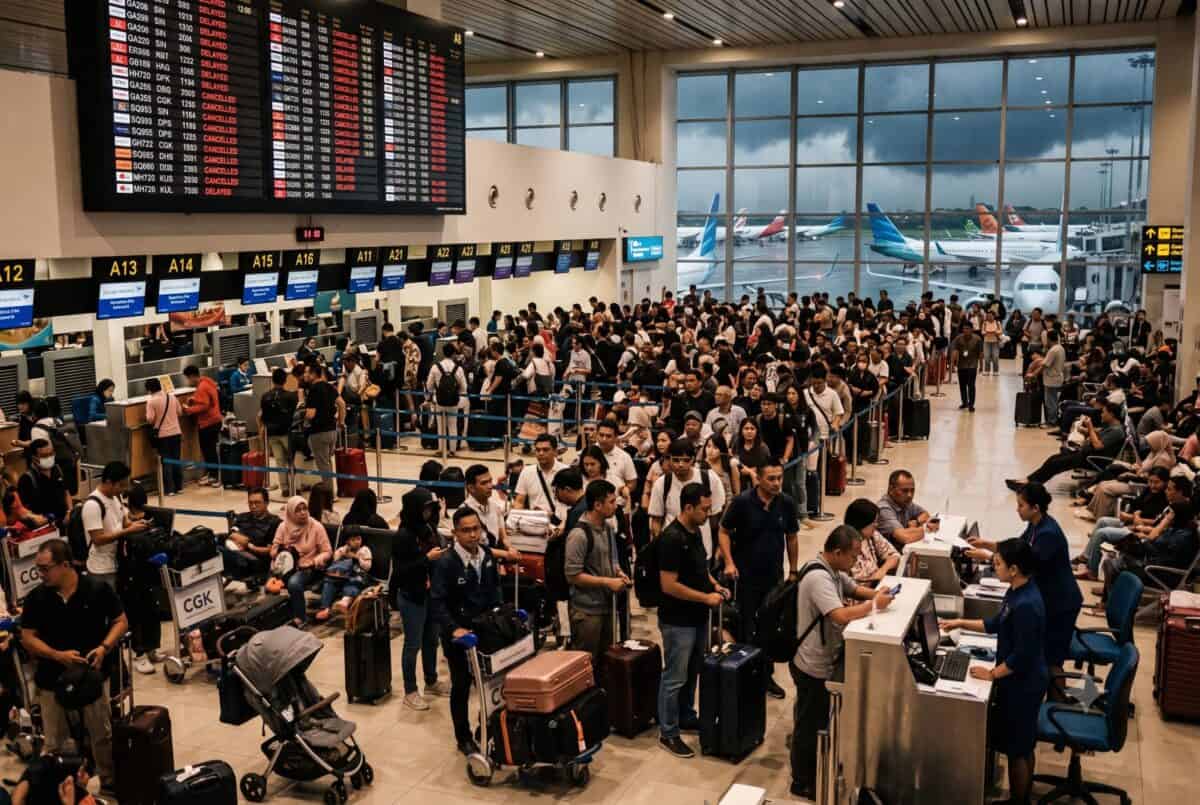
Image generated with Ai
Today, July 8, 2026, one of Southeast Asia’s busiest aviation gateways, Jakarta-Soekarno-Hatta International Airport (CGK), is witnessing significant operational disruption after 107 flights were cancelled while 509 flights were delayed across domestic and international networks. The large-scale disruption is affecting thousands of passengers travelling within Indonesia and to major destinations across Asia, the Middle East and beyond. While airlines continue to adjust schedules throughout the day, the scale of the disruption illustrates the immense operational challenges that can ripple through an airport handling hundreds of departures and arrivals every day.
The combination of widespread flight cancellations, persistent flight delays, and airline schedule adjustments is creating uncertainty for leisure travellers, business passengers, transit guests and international tourists alike. With Jakarta serving as Indonesia’s principal aviation hub, disruptions at Soekarno-Hatta often extend far beyond the capital, influencing connections throughout the country and affecting onward journeys to destinations including Singapore, Malaysia, Saudi Arabia, Vietnam, China, Australia and Europe.
Jakarta’s Primary Aviation Gateway Comes Under Pressure
As Indonesia’s busiest airport, Jakarta-Soekarno-Hatta International Airport plays a critical role in Southeast Asia’s aviation network. Every day, the airport accommodates hundreds of scheduled passenger flights operated by full-service and low-cost carriers, connecting Indonesia with regional and long-haul destinations.
When disruption reaches the magnitude seen today, the effects spread rapidly through airline schedules. Aircraft rotations become more difficult to maintain, flight crews exceed regulated duty hours, connecting passengers miss onward flights, and airport resources—from boarding gates to baggage handling—come under additional pressure.
Advertisement
Advertisement
Today’s operational picture demonstrates precisely how a disruption at a major hub can evolve into a nationwide aviation challenge.
Advertisement
Advertisement
Jakarta-Soekarno-Hatta International Airport Flight Disruption Statistics – Today
| Category | Flights |
|---|---|
| Cancelled Flights | 107 |
| Delayed Flights | 509 |
The numbers reveal a disruption that extends far beyond isolated operational issues. With 509 delayed services compared with 107 cancellations, delayed flights account for nearly five times the number of cancellations, indicating that airlines are attempting to preserve as much of their published schedules as possible rather than grounding aircraft outright.
This operational strategy is commonly adopted at major international hubs. Instead of cancelling every affected service, airlines often delay departures while waiting for aircraft, crew availability, improved weather conditions, air traffic flow clearance or airport capacity to recover. Although this helps retain connectivity, it frequently results in cascading delays that continue throughout the day.
Airline-by-Airline Operational Performance at Jakarta-Soekarno-Hatta International Airport
The following figures are presented exactly as reported.
| Cancelled | % | Delayed | % | Airline |
|---|---|---|---|---|
| 10 | 4% | 28 | 13% | Batik Air |
| 2 | 0% | 27 | 13% | Garuda Indonesia |
| 1 | 0% | 5 | 4% | Lion Air |
| 0 | 0% | 6 | 17% | Indonesia AirAsia |
| 0 | 0% | 4 | 33% | AirAsia |
| 0 | 0% | 1 | 50% | China Airlines |
| 0 | 0% | 2 | 25% | Cathay Pacific |
| 0 | 0% | 2 | 33% | China Southern Airlines |
| 0 | 0% | 21 | 11% | Citilink |
| 0 | 0% | 1 | 10% | XiamenAir |
| 0 | 0% | 1 | 25% | Vietnam Airlines |
| 0 | 0% | 1 | 5% | NAM Air |
| 0 | 0% | 3 | 21% | Malaysia Airlines |
| 0 | 0% | 4 | 40% | Malindo Air |
| 0 | 0% | 8 | 12% | Pelita Air Service P.t. |
| 0 | 0% | 2 | 100% | Royal Brunei |
| 0 | 0% | 5 | 27% | Singapore Airlines |
| 0 | 0% | 22 | 17% | Super Air Jet |
| 0 | 0% | 8 | 30% | Sriwijaya Air |
| 0 | 0% | 2 | 25% | Saudia |
| 0 | 0% | 2 | 20% | Scoot |
| 0 | 0% | 1 | 25% | Thai Airways |
| 0 | 0% | 7 | 18% | TransNusa |
| 0 | 0% | 1 | 100% | Tway Air |
| 0 | 0% | 1 | 25% | Emirates |
| 0 | 0% | 1 | 25% | VietJet Air |
What the Airline Data Reveals About Today’s Disruption
The airline statistics provide valuable insight into how today’s disruption is being distributed across Jakarta’s airline network rather than being concentrated within a single carrier.
Batik Air recorded the largest number of cancellations among the airlines listed, with 10 cancelled flights alongside 28 delayed flights. This combination indicates that the carrier experienced the most significant operational disruption among airlines included in the table. Because Batik Air operates an extensive domestic network across Indonesia, cancellations on its services can have a disproportionate impact on regional connectivity, potentially affecting travellers heading to secondary cities as well as passengers connecting onward through Jakarta.
Advertisement
Advertisement
Garuda Indonesia, Indonesia’s national carrier, reported 2 cancelled flights and 27 delayed services. The relatively low cancellation figure compared with the high number of delays suggests that the airline has prioritised maintaining its published schedule wherever operationally possible. Delays allow aircraft and crews to be repositioned without completely abandoning services, helping preserve connectivity for both domestic and international passengers.
Lion Air, another major domestic operator, experienced 1 cancellation and 5 delayed flights. While the cancellation figure is comparatively modest, even limited disruptions on high-frequency domestic routes can affect thousands of passengers throughout the day because aircraft often operate multiple sectors.
Among airlines reporting no cancellations, delays remain substantial. Super Air Jet recorded 22 delayed flights, making it one of the most affected operators in terms of schedule disruption. Citilink followed closely with 21 delayed services, demonstrating that Indonesia’s domestic low-cost aviation market is experiencing widespread operational pressure despite avoiding outright cancellations.
Several regional and international carriers also experienced notable delays. Pelita Air Service P.t. reported 8 delayed flights, while Sriwijaya Air also recorded 8 delays, reflecting operational strain across Indonesia’s domestic aviation sector.
International operators have likewise been affected. Singapore Airlines recorded 5 delayed flights, Malaysia Airlines reported 3 delays, Saudia experienced 2 delayed services, and Cathay Pacific, China Southern Airlines, Scoot, Royal Brunei, Thai Airways, Emirates, Vietnam Airlines, VietJet Air, China Airlines, and XiamenAir each reported delayed operations without cancellations.
Advertisement
Advertisement
An interesting operational characteristic emerges from the percentage column. Royal Brunei and Tway Air each show 100% delayed operations within the reported sample. Although these involve only two flights and one flight respectively, the figures suggest that every scheduled service represented in today’s dataset experienced a delay. Similarly, AirAsia shows 40% delayed operations, while China Airlines records 50%, indicating comparatively high disruption rates despite relatively small numbers of affected flights.
Overall, the airline data illustrates that today’s disruption is not isolated to one airline or one operational model. Full-service carriers, hybrid airlines and low-cost operators have all experienced delays, reinforcing the conclusion that broader airport-wide or network-wide operational factors are influencing performance.
Why Are So Many Flights Being Cancelled and Delayed?
Large-scale disruption at a major international airport rarely stems from a single cause. Instead, it usually develops through a combination of interconnected operational challenges that gradually reduce airport efficiency before cascading across airline schedules.
Several factors are likely contributing to today’s disruption at Jakarta-Soekarno-Hatta International Airport:
- Weather-related operational challenges. Jakarta frequently experiences periods of heavy tropical rainfall, thunderstorms, reduced visibility and strong winds, particularly during active weather systems. Such conditions may require aircraft to increase separation distances, temporarily suspend ground handling activities or alter arrival sequencing.
- Air traffic congestion. As one of Southeast Asia’s busiest airports, Soekarno-Hatta regularly manages a dense schedule of departures and arrivals. Even relatively minor disruptions can quickly create holding patterns, taxiway congestion and departure queues that extend throughout the day.
- Aircraft rotation delays. Modern airline fleets typically operate several consecutive sectors daily. When an aircraft arrives late from another destination, every subsequent flight assigned to that aircraft may also depart behind schedule unless replacement equipment is available.
- Crew duty time limitations. Aviation regulations strictly govern the maximum number of hours pilots and cabin crew may work. Extended delays can push crews beyond legal duty limits, forcing airlines to locate replacement personnel or cancel services altogether.
- Ground handling and gate availability. When aircraft occupy gates longer than planned due to delays, arriving aircraft may need to wait for parking positions. This creates additional delays that affect baggage handling, catering, refuelling and passenger boarding.
Weather Continues to Be One of Aviation’s Greatest Operational Challenges
Although airlines invest heavily in schedule planning and operational resilience, weather remains one of the few factors that cannot be controlled.
Advertisement
Advertisement
For airports like Jakarta, periods of adverse weather may lead to:
- Reduced runway arrival and departure capacity.
- Longer spacing between aircraft for safety.
- Temporary suspension of ramp operations during lightning activity.
- Diversions to alternate airports.
- Increased airborne holding while awaiting landing clearance.
- Slower baggage loading and aircraft servicing due to safety procedures.
Even after weather improves, recovery can take several hours as airlines work to reposition aircraft, reassign crews and restore normal schedules.
What Guests Get: Immediate Passenger Ramifications
For travellers, today’s disruption extends far beyond a delayed departure board. With 107 cancellations and 509 delays, many passengers will experience knock-on effects that continue long after flights resume. Domestic travellers may face missed appointments and disrupted holidays, while international passengers could encounter complex rebooking processes involving multiple airlines and destinations.
- Missed Connecting Flights Travellers connecting through Jakarta to destinations across Indonesia, Southeast Asia, the Middle East and beyond may miss onward flights. In many cases, a delay on the first leg can trigger a chain reaction, forcing passengers to wait several hours—or even overnight—for alternative services.
- Extended Airport Waiting Times Delayed flights often translate into prolonged stays inside terminals. Passengers may spend additional hours waiting for gate assignments, revised departure slots, baggage updates or boarding announcements, particularly during peak travel periods.
- Accommodation and Additional Expenses Travellers whose journeys extend into the following day may need hotel accommodation, meals and local transport. Whether these costs are reimbursed depends on the airline’s conditions of carriage and the underlying reason for the disruption.
- Business and Leisure Plans Disrupted Business meetings, conferences, weddings, cruise departures, guided tours and family events can all be affected. Even relatively short delays can cause travellers to miss time-sensitive commitments.
- Pressure on Airport Facilities Larger passenger volumes remain inside terminals when departures are delayed. This can result in longer queues at customer service desks, restaurants, security checkpoints and baggage reclaim areas.
Understanding Your Refund, Rebooking and Passenger Rights
Passengers affected by today’s disruptions should remain informed and proactive. Although compensation rules vary depending on the airline, route and reason for the disruption, several practical steps can improve the likelihood of a smoother recovery.
Travellers should first confirm whether their flight has been officially cancelled or merely delayed. A delayed flight may still operate later in the day, whereas a cancellation generally requires rebooking onto another available service.
Advertisement
Advertisement
If your flight has been cancelled:
- Contact the airline immediately through its official website, mobile application or airport service counter.
- Request the earliest available alternative flight if your travel remains essential.
- If you decide not to travel, ask whether your ticket qualifies for a refund or travel credit.
- Retain boarding passes, booking confirmations, receipts and any written communication regarding the disruption.
If your delay becomes extensive:
- Ask the airline whether meal vouchers, refreshments or hotel accommodation are available.
- Keep receipts for reasonable expenses in case reimbursement is permitted.
- Monitor airline notifications frequently, as departure times may continue to change throughout the day.
Travellers using travel insurance should also review their policy carefully. Many comprehensive policies provide coverage for accommodation, meals, transport and missed connections when delays exceed specified thresholds.
Indonesia’s Tourism Momentum Faces Temporary Operational Headwinds
Indonesia has enjoyed strong tourism growth in recent years, welcoming millions of international visitors attracted by destinations such as Bali, Jakarta, Yogyakarta, Lombok, Labuan Bajo and Raja Ampat. Airports serve as the country’s tourism lifeline, making operational reliability essential for sustaining visitor confidence.
Although today’s disruption represents only a single day’s operations, widespread delays and cancellations at the nation’s busiest airport can temporarily affect the overall visitor experience.
Advertisement
Advertisement
International tourists arriving for holidays often begin forming impressions immediately upon landing. Long immigration queues resulting from delayed arrivals, congestion in baggage reclaim areas and uncertainty regarding domestic connections may diminish those first impressions despite the quality of Indonesia’s tourism offerings.
Domestic tourism may also feel the impact. Many Indonesian travellers rely on Jakarta as a connecting hub before continuing to destinations across the archipelago. Missed connections can shorten holidays, increase travel costs and discourage last-minute leisure travel during busy seasons.
Fortunately, such disruptions are typically temporary. Once flight schedules stabilise, tourism demand generally returns quickly, particularly in markets where visitor demand remains fundamentally strong.
The Economic Ripple Effect Extends Beyond Airlines
Large-scale aviation disruptions create financial consequences that reach far beyond the airlines themselves.
Every cancelled flight represents lost revenue opportunities from passenger tickets, baggage fees, onboard sales and cargo operations. Airlines must also absorb costs associated with passenger assistance, aircraft repositioning and crew rescheduling.
Advertisement
Advertisement
Airports face operational challenges as well. Congested terminals require additional staffing, while prolonged aircraft occupancy reduces gate availability and affects airport efficiency.
The broader travel economy also experiences indirect impacts:
Hotels near the airport may benefit from unexpected overnight stays, yet city-centre hotels could receive late arrivals or cancellations. Tour operators may need to rearrange itineraries, while transport providers—from taxis to airport rail services—experience unpredictable demand.
Business productivity can also be affected. Corporate travellers delayed by several hours may postpone meetings, defer investment discussions or incur additional accommodation expenses. For cargo carried in passenger aircraft holds, delays can interrupt supply chains involving high-value or time-sensitive shipments.
Although a single day of disruption is unlikely to alter Indonesia’s broader economic trajectory, repeated operational instability could gradually influence airline scheduling decisions, traveller confidence and business travel planning.
Advertisement
Advertisement
FAQ – Jakarta-Soekarno-Hatta International Airport Flight Cancellations 2026
How many flights have been cancelled today at Jakarta-Soekarno-Hatta International Airport?
A total of 107 flights operating within, into or out of Jakarta-Soekarno-Hatta International Airport have been cancelled today.
How many flights are delayed today?
Today’s operational data shows 509 delayed flights, making delays considerably more widespread than outright cancellations.
Which airline recorded the highest number of cancellations?
Based on the available airline data, Batik Air recorded the highest number of cancellations, with 10 cancelled flights.
Which airlines experienced significant delays?
Among the most affected airlines by delayed services are Batik Air (28 delays), Garuda Indonesia (27), Super Air Jet (22) and Citilink (21). Several international airlines also reported delayed operations.
Should passengers still travel to the airport?
Passengers should check directly with their airline before leaving for the airport. Flight schedules may continue changing throughout the day as airlines recover operations.
Advertisement
Advertisement
Can travellers receive a refund if their flight is cancelled?
Eligibility depends on the airline’s fare rules and applicable regulations. Passengers should contact their airline directly to discuss refunds, alternative flights or travel credits.
Will delayed flights continue operating later today?
Many delayed flights are expected to operate once aircraft, crews and airport capacity become available. However, passengers should continue monitoring official airline updates.
Looking Ahead: Smart Travel Strategies for Passengers Flying Through Jakarta in the Coming Days
Although aviation systems are designed to recover quickly after major operational disruptions, travellers flying through Jakarta over the next several days should remain flexible.
Checking flight status before departing for the airport, arriving with additional time, downloading airline mobile applications and enabling real-time notifications can significantly reduce travel stress. Those with important international connections should also consider allowing longer transfer times whenever possible.
Passengers travelling with flexible tickets may wish to review alternative departure times if disruption continues, while those with travel insurance should familiarise themselves with available benefits before beginning their journey.
Advertisement
Advertisement
For airlines and airport authorities, restoring schedule reliability will remain the immediate priority. Efficient aircraft rotations, clear passenger communication and effective coordination between operational teams will be critical in returning Jakarta-Soekarno-Hatta International Airport to normal performance levels.
Author’s Thoughts
Days like today remind us just how interconnected modern aviation has become. A single disruption at one major hub can ripple across hundreds of flights, affecting families beginning holidays, business professionals heading to important meetings and international visitors eager to explore Indonesia.
What stands out most is not only the 107 cancellations, but the 509 delayed flights. Those figures suggest that airlines have worked hard to preserve as many services as possible despite considerable operational pressure. While delays are frustrating, maintaining flights rather than cancelling them outright often gives passengers a better chance of reaching their destinations on the same day.
For travellers, patience and preparation remain invaluable. Airports and airlines perform best when passengers stay informed through official channels rather than relying on rumours or unofficial social media updates. As aviation demand continues to grow across Southeast Asia, investments in operational resilience, technology and passenger communication will become even more important for handling disruptions like today’s more efficiently in the future.
Source: Different airports and FlightAware
Advertisement
