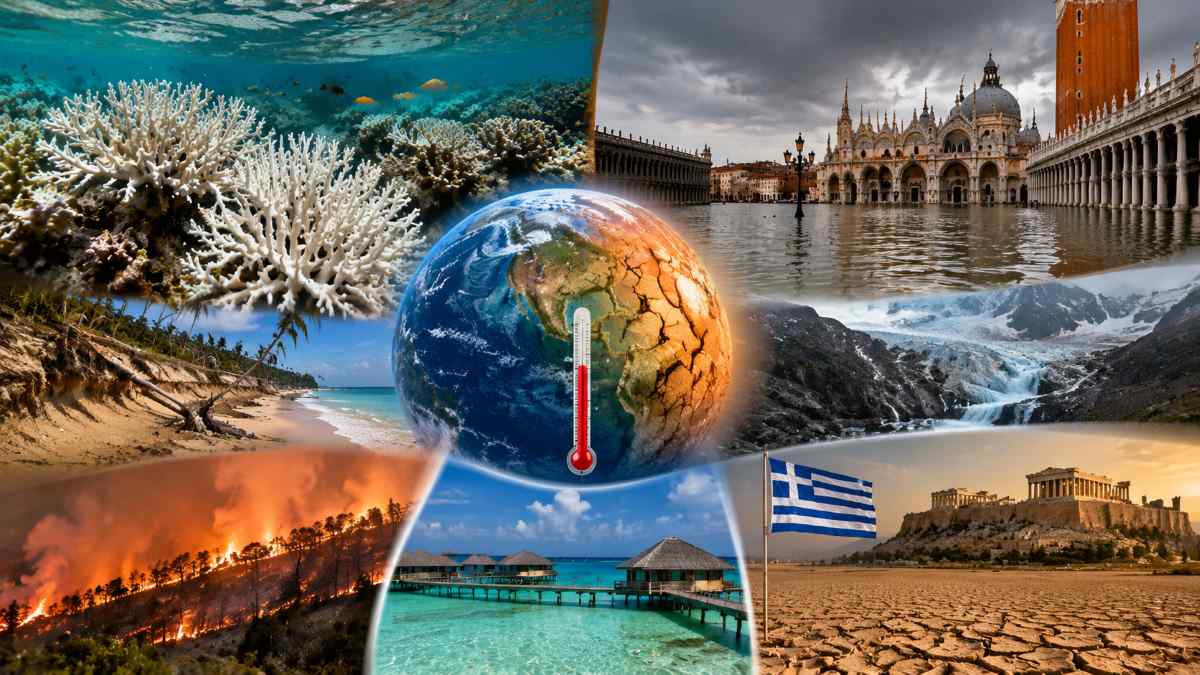
Image generated with Ai
Climate change is redefining global tourism in 2026 as Australia’s Great Barrier Reef, Venice in Italy, Maldives, European Alpine resorts and Greece’s island destinations face increasing challenges from rising sea levels, extreme heat, ocean warming, wildfires and unpredictable weather patterns. Across all continents, destinations that formed major of their economies around beaches, skiing, marine ecosystems and heritage points are adopting a new tourism pattern where seasonal dependency is declining and climate resilience has become a major factor for future travel growth. Global tourism landscape is goinf through one of its most important operational changes as conventional travel patterns become less predictable. Before summer beach holidays, winter ski escapes and tropical island breaks were planned priorly around stable seasonal conditions. As a result extreme heatwaves, stronger storms, changing rainfall patterns, and environmental crisis are forcing destinations, hotels, airlines, and travellers to rethink how holidays are planned and delivered.
The impact is now visible across major tourism regions. Coastal destinations are confronting erosion and flooding. Mountain resorts are dealing with shorter snow seasons. Marine destinations are protecting fragile coral ecosystems. Mediterranean countries are adjusting to extreme heat that is shifting visitor demand away from peak summer months. According to global tourism assessments, extreme weather events including heatwaves, floods, storms and wildfires are increasingly disrupting tourism activity, damaging infrastructure and changing traveller behaviour. The emerging travel environment is no longer based only on location, attractions and affordability. Climate conditions are becoming a major factor influencing destination choices, travel insurance decisions, booking flexibility and tourism investment strategies.
Advertisement
For decades, tourism depended on predictable seasons. Mediterranean countries attracted peak summer crowds, ski resorts relied on winter snowfall, and tropical islands promoted year-round sunshine. Climate change is now challenging these established patterns. Travellers are increasingly monitoring real-time weather forecasts rather than relying only on historical seasonal expectations. A destination that was considered ideal for a specific month can now face unexpected heatwaves, storms or wildfire risks.
This shift is creating several major changes in travel behaviour:
Advertisement
Advertisement
| Changing Travel Pattern | Impact on Tourism |
|---|---|
| Movement from peak summer to shoulder seasons | More visitors choosing spring and autumn to avoid extreme heat |
| Increased demand for flexible bookings | Hotels and airlines reviewing cancellation and rebooking policies |
| Greater use of travel insurance | Travellers protecting against weather-related cancellations and disruptions |
| Longer connection times | Passengers allowing additional buffer time due to possible flight delays |
| Real-time climate monitoring | Weather becoming a major factor in destination selection |
The changing climate is also creating new tourism trends. Southern European destinations are seeing growing interest in cooler months, while northern European countries are becoming increasingly attractive during traditional summer holiday periods. The concept of “coolcations” has gained momentum as travellers search for destinations offering comfortable temperatures instead of extreme summer heat. For tourism businesses, this means moving away from dependence on short peak seasons and developing year-round strategies.
| Destination | Climate Threat | Tourism Impact |
|---|---|---|
| Maldives | Sea-level rise and coastal erosion | Threats to beaches, resorts and freshwater resources |
| Venice, Italy | Rising tides and land subsidence | Flooding risks to heritage attractions and tourism infrastructure |
| Great Barrier Reef, Australia | Ocean warming and coral bleaching | Pressure on diving and marine tourism |
| European Alps | Reduced snowfall and shorter winters | Decline of traditional ski tourism |
| Rhodes and Greek Islands | Heatwaves and wildfires | Summer disruptions and changing travel seasons |
The Maldives remains one of the world’s most vulnerable tourism destinations because of its low-lying geography and dependence on coastal ecosystems. The Indian Ocean archipelago is famous for white-sand beaches, luxury overwater villas and coral reefs. However, more than 80% of the country’s islands are located less than one metre above sea level, making rising seas one of the biggest long-term threats to its tourism economy. Tourism contributes significantly to the Maldivian economy, meaning environmental changes directly affect national economic stability.
| Risk | Tourism Consequence |
|---|---|
| Rising sea levels | Increased coastal flooding risks |
| Beach erosion | Shrinking resort beaches |
| Saltwater intrusion | Threats to freshwater supplies |
| Coral degradation | Reduced marine tourism appeal |
| Stronger storms | Damage to coastal infrastructure |
The Maldives’ tourism model depends heavily on its natural environment. Coral reefs protect islands from waves while supporting diving and snorkelling experiences. However, warmer ocean temperatures are damaging reef ecosystems and increasing coral bleaching risks.
Luxury resorts are investing heavily in adaptation measures, including:
Projects such as Hulhumalé demonstrate attempts to create elevated urban areas capable of improving long-term resilience. However, the challenge remains significant. Climate adaptation requires continuous investment because the tourism assets attracting millions of visitors are directly connected to fragile coastal ecosystems. The Maldives represents the wider challenge facing island tourism worldwide: protecting a tourism economy built around natural beauty while that same environment faces increasing climate pressure.
Venice remains one of the world’s most recognisable cultural tourism destinations, attracting millions of visitors with its canals, historic architecture and unique urban landscape. However, rising sea levels, land subsidence and increasing tidal flooding events are creating major challenges for the city’s tourism future. The phenomenon known as acqua alta has become a growing concern as high tides increasingly affect public spaces, historic buildings and visitor infrastructure.
| Climate Challenge | Effect on Tourism |
|---|---|
| Rising sea levels | Greater frequency of flooding |
| Land subsidence | Increased vulnerability |
| Saltwater exposure | Damage to historic structures |
| Extreme tides | Disruption to visitor movement |
Iconic locations such as St Mark’s Square have experienced repeated flooding events, creating concerns about preservation of heritage assets. The MOSE flood barrier system provides important protection during extreme tidal events, but climate pressures continue increasing the need for long-term adaptation. Venice demonstrates that climate change is not only affecting natural tourism attractions. Historic cities and cultural landmarks are also facing increasing risks. UNESCO assessments have highlighted that climate change threatens numerous World Heritage locations through rising temperatures, sea-level rise, melting glaciers and extreme weather events. For tourism operators, adaptation now includes improved flood preparation, infrastructure protection and stronger resilience planning.
Australia’s Great Barrier Reef remains one of the planet’s most valuable marine tourism destinations. Stretching across thousands of kilometres, it supports diving, snorkelling and nature-based tourism experiences. However, rising ocean temperatures are creating severe challenges for reef ecosystems. Marine heatwaves have contributed to repeated coral bleaching events, where corals lose the algae responsible for their colour and energy supply.
| Climate Threat | Tourism Consequence |
|---|---|
| Ocean warming | Coral bleaching events |
| Ocean acidification | Reduced reef resilience |
| Severe storms | Physical ecosystem damage |
| Biodiversity loss | Declining visitor experiences |
The reef supports a major tourism economy, but climate change is forcing operators to adapt.
Tour companies are increasingly focusing on:
Operators from Queensland’s tourism hubs such as Cairns and Port Douglas have adjusted experiences to maintain visitor satisfaction while supporting reef protection. The challenge is not only ecological but economic. Damage to coral ecosystems affects tourism businesses, local communities and destination reputation. Official environmental assessments warn that climate change impacts are creating significant risks for reef-dependent industries, including tourism and fisheries. The Great Barrier Reef illustrates how climate change can directly affect tourism products that depend on natural ecosystems.
The European Alps have long been the heart of global winter tourism, attracting millions of skiers to Switzerland, France, Austria and Italy. However, warmer winters and declining snowfall are changing the future of ski destinations. Lower-altitude resorts are facing increasing uncertainty as natural snow becomes less reliable.
| Climate Issue | Tourism Effect |
|---|---|
| Reduced snowfall | Shorter ski seasons |
| Rising temperatures | Lower snow reliability |
| Increased snowmaking dependence | Higher operating costs |
| Changing visitor behaviour | Growth of summer mountain tourism |
Many resorts are now investing in four-season tourism models, including:
Artificial snowmaking has become an important adaptation tool, but it requires significant water and energy resources. Some smaller ski destinations have struggled financially as traditional winter operations become increasingly difficult. The Alpine tourism industry is therefore undergoing a major transformation from being winter-focused to becoming a year-round mountain economy.
Greece’s Rhodes, Crete and Aegean islands represent some of Europe’s most popular holiday destinations. However, extreme summer temperatures and wildfire risks are changing the Mediterranean tourism model. Heatwaves regularly push temperatures beyond 40°C, creating challenges for visitors, outdoor attractions and hospitality businesses.
| Climate Challenge | Impact |
|---|---|
| Extreme heat | Reduced outdoor activity comfort |
| Wildfires | Evacuations and hotel disruptions |
| Drought conditions | Increased environmental pressure |
| Rising temperatures | Shift towards shoulder seasons |
Wildfires have affected tourism operations by forcing emergency responses, temporary closures and changes in visitor movement. Major attractions, including archaeological sites, have required heat-related safety measures during extreme conditions. As a result, Greece is seeing greater interest in spring and autumn travel periods. The Mediterranean tourism industry is increasingly extending seasons beyond traditional summer peaks to maintain visitor demand while reducing climate exposure.
Beyond the five major case studies, several other destinations are facing significant climate-related tourism challenges.
Countries including Tuvalu, Fiji and Kiribati are confronting coastal erosion, rising seas and stronger storms. Tourism infrastructure, beaches and transport links face increasing vulnerability.
The destination is experiencing more frequent high-tide flooding and hurricane risks, affecting roads, beaches and hospitality infrastructure.
Nepal, India and Tibet are experiencing glacier retreat, changing trekking conditions, glacial lake outburst flood risks and unpredictable mountain weather.
Destinations including Belize and The Bahamas are facing coral bleaching, stronger hurricanes and seasonal sargassum seaweed accumulation affecting beaches.
Arctic warming is driving “last-chance tourism” as travellers seek disappearing glaciers and wildlife experiences, while melting ice threatens infrastructure.
Climate change is no longer only affecting destinations themselves. It is increasingly disrupting the entire travel ecosystem, including airlines, airports, hotels, transportation networks and visitor services. Extreme weather events are creating operational uncertainty across global tourism supply chains. Heavy rainfall, storms, heatwaves, wildfires and flooding can interrupt airport operations, damage roads, close attractions and force sudden itinerary changes.
Modern aviation networks are particularly vulnerable because international travel depends on interconnected routes. A weather disruption in one region can create delays across multiple destinations through aircraft rotation issues, crew availability challenges and missed passenger connections. Heatwaves are also affecting airport infrastructure. Extremely high temperatures can reduce aircraft performance, increase operational restrictions and place additional pressure on ground-handling systems. Meanwhile, storms and heavy rainfall can cause airport closures, flight cancellations and delays.
For travellers, this has changed the traditional approach to holiday planning. Instead of focusing only on destination attractions and prices, visitors are increasingly considering weather risks, flexibility options and protection measures before booking. The growing importance of travel insurance reflects this changing environment. Policies covering cancellations, weather delays, medical emergencies and unexpected disruptions are becoming a standard consideration for international travellers. Tourism businesses are also adapting by developing stronger contingency plans, flexible booking systems and crisis management strategies.
The tourism industry is entering a period where adaptability has become essential for survival and competitiveness. Historically, tourism businesses operated around predictable seasonal cycles. Ski resorts depended on winter snowfall, Mediterranean hotels relied on summer demand, and island destinations promoted year-round coastal experiences. Climate change is challenging these traditional models. Hotels, airlines, tour operators and destination authorities are now investing in strategies that reduce dependence on vulnerable seasons.
| Tourism Sector | Climate Adaptation Strategy |
|---|---|
| Hotels | Flexible cancellation policies, climate-resistant infrastructure |
| Airlines | Weather monitoring systems and operational adjustments |
| Ski Resorts | Expansion into summer tourism and wellness experiences |
| Coastal Resorts | Beach restoration and flood protection |
| Island Destinations | Marine conservation and resilient infrastructure |
| Heritage Sites | Visitor management during extreme weather |
The shift is particularly visible in destinations where tourism demand was historically concentrated into short periods. Mediterranean destinations are expanding spring and autumn tourism campaigns. Mountain resorts are promoting hiking, cycling and wellness tourism. Island destinations are investing in environmental protection to preserve marine attractions. This transformation represents a broader change in global tourism economics. The future success of destinations will increasingly depend on their ability to manage climate risks while maintaining visitor experiences.
One of the most significant changes caused by climate disruption is the movement of tourism demand away from traditional peak periods. Destinations that once reached maximum capacity during July and August are increasingly seeing visitors choose alternative months. Southern Europe provides one of the clearest examples. Countries including Greece, Spain and Italy continue attracting millions of visitors, but extreme summer temperatures are encouraging travellers to explore these regions during April, May, September and October.
This shift creates both challenges and opportunities. For tourism operators, shoulder seasons can provide longer business periods, improved workforce stability and reduced pressure on local infrastructure. For travellers, cooler temperatures create more comfortable conditions for sightseeing, outdoor activities and cultural experiences. However, destinations must adjust marketing strategies, accommodation operations and transport schedules to support a more evenly distributed tourism calendar. The concept of avoiding climate stress while maintaining travel experiences is becoming a defining feature of future tourism planning.
The modern traveller is increasingly adopting a risk-management approach before taking international trips.
Travel decisions are now influenced by:
This represents a major psychological shift in tourism. Previously, travellers often selected destinations based on expected seasonal conditions. Today, many are checking immediate environmental conditions before finalising plans. A summer holiday in a Mediterranean destination now requires consideration of heat risks and wildfire alerts. A ski holiday requires monitoring snowfall reliability. A coastal escape requires awareness of storms and flooding risks.
This change does not mean travellers are avoiding climate-affected destinations completely. Instead, they are adjusting timing, expectations and preparation. The future of travel is likely to be defined by flexibility rather than fixed schedules.
While many destinations are suffering tourism disruption because of climate change, some polar regions are experiencing increased visitor interest due to a phenomenon known as “last-chance tourism”. Destinations including Greenland’s Ilulissat Icefjord and Norway’s Svalbard are attracting travellers who want to experience glaciers, Arctic landscapes and wildlife before environmental changes accelerate further.
However, the growth of polar tourism presents a complex challenge. The same climate changes attracting visitors are also threatening the destinations themselves. Rapid Arctic warming is reducing sea ice, accelerating glacier retreat and destabilising infrastructure.
Challenges include:
Polar destinations must balance tourism opportunities with conservation responsibilities. The Arctic demonstrates the complicated relationship between climate change and tourism: environmental loss can create demand while simultaneously threatening the very attractions visitors want to experience.
The Great Barrier Reef is one of the most recognised examples of climate pressure affecting marine tourism, but similar challenges are occurring across global ocean destinations. The Caribbean, including areas such as Belize and The Bahamas, is facing rising ocean temperatures, coral bleaching and increasing hurricane intensity. Another growing issue is the spread of sargassum seaweed, which has affected popular beaches across parts of the Caribbean and requires expensive removal operations. Marine tourism destinations depend heavily on healthy ecosystems. Diving, snorkelling, wildlife tourism and coastal recreation all rely on environmental stability.
As oceans warm, tourism operators are increasingly investing in:
The future competitiveness of marine destinations will depend on their ability to protect ecosystems while maintaining tourism value.
The transformation of mountain tourism extends beyond the European Alps. Across the world, mountain destinations are facing changing conditions. The Himalayas, including trekking regions in Nepal, India and Tibet, are experiencing glacier retreat, unpredictable weather and increased risks from glacial lake outburst floods. Popular trekking routes, including areas around Annapurna and Everest Base Camp, face growing challenges from changing mountain environments.
In North America, the Rocky Mountains, Sierra Nevada and destinations such as Banff, Jasper and Yosemite are also experiencing climate-related pressure. Reduced snowpack, earlier snowmelt and increased wildfire risks are affecting outdoor tourism. During severe wildfire seasons, smoke and poor air quality can force temporary closures of national parks and recreation areas. As a result, mountain destinations worldwide are expanding beyond traditional winter tourism.
Future mountain tourism is increasingly focused on:
Climate change is bringing one of the major structural changes in global tourism. Like The Great Barrier Reef shows how environmental damage can affect nature-based travel economies. Venice highlights the risks confronting cultural heritage tourism. The Maldives shows the vulnerability of its island destinations facing rising seas. The Alps showcases how conventional winter tourism models must evolve over time. Greece reveals how extreme heatwave and wildfires are reshaping Mediterranean travel patterns.
However, climate change is not ending tourism. Instead, it is changing how destinations operate, how travellers plan and how businesses invest. The destinations that successfully adapt will be those that combine environmental protection, infrastructure investment and flexible tourism strategies. The future tourism landscape will increasingly reward destinations that can offer safe, sustainable and resilient experiences. From coastal islands to mountain regions, the ability to manage climate risks will become one of the most important competitive advantages in international tourism. As global temperatures continue rising and weather patterns become more unpredictable, climate resilience will no longer be an optional strategy for tourism destinations. It will become a fundamental requirement for survival and long-term growth.
Advertisement
Tags: Alpine tourism, climate change tourism, Climate Resilience, Great Barrier Reef tourism, Greece travel
Advertisement
Advertisement












Wednesday, September 2, 2026

Wednesday, September 2, 2026

Wednesday, September 2, 2026

Wednesday, September 2, 2026

Wednesday, September 2, 2026
Tuesday, September 1, 2026

Wednesday, September 2, 2026

Wednesday, September 2, 2026