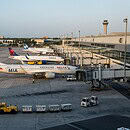

Discover Airlines is due to launch its first Munich–Ivalo service on 23 December 2026, but the aviation story has moved beyond the original route announcement. The airline’s live booking system now shows flights 4Y1328 and 4Y1329 with longer scheduled journey times than an earlier official trade timetable. The change comes as Ivalo’s international passenger traffic expands and Finland’s Lapland airports reach 1.1 million passengers in the first half of 2026, strengthening the commercial context for the new German connection.
The most immediate development for airlines, travel agents and passengers is buried not in another route announcement, but in Discover Airlines’ current booking data.
Advertisement
According to the airline’s live Munich–Ivalo page checked on 7 September 2026, flight 4Y1328 is currently scheduled to leave Munich at 10:15 and reach Ivalo at 14:50, giving a published journey time of three hours and 35 minutes. Return service 4Y1329 is listed to depart Ivalo at 15:40 and reach Munich at 18:10, with a journey time of three hours and 30 minutes. The airline places the distance at approximately 2,411 kilometres.
That timetable is different from an earlier official Discover Airlines B2B destination sheet for the winter 2026–27 programme. That document listed Munich departure at 10:40, Ivalo arrival at 14:50, Ivalo departure at 15:40 and Munich arrival at 17:50.
Advertisement
Advertisement
| Operational element | Earlier Discover B2B timetable | Live airline timetable on 7 September 2026 | Practical change |
|---|---|---|---|
| Munich departure | 10:40 | 10:15 | 25 minutes earlier |
| Ivalo arrival | 14:50 | 14:50 | Unchanged |
| Outbound scheduled duration | 3h 10m | 3h 35m | 25 minutes longer |
| Operating number | Not shown in the earlier sheet | 4Y1328 | Now identifiable |
| Ivalo departure | 15:40 | 15:40 | Unchanged |
| Munich arrival | 17:50 | 18:10 | 20 minutes later |
| Return scheduled duration | 3h 10m | 3h 30m | 20 minutes longer |
| Operating number | Not shown in the earlier sheet | 4Y1329 | Now identifiable |
| Ivalo turnaround | 50 minutes | 50 minutes | Unchanged |
This matters commercially. An earlier Munich departure affects feeder journeys, airport arrival planning and ground transport. A later return arrival may alter onward connections and same-evening travel from Munich. For agents packaging Lapland holidays, the live operating schedule should therefore take precedence over earlier trade material.
Lufthansa’s own current sales pages reinforce the revised timetable and list LH4248 and LH4249 as the Lufthansa-marketed flight numbers, with the services operated by Discover Airlines.
The greater significance becomes clearer when the latest Ivalo aviation statistics are examined.
According to Finavia, 249,056 passengers used Ivalo Airport in 2025. The total was essentially unchanged year on year, but the headline number hides a major change in traffic composition. International passengers increased 11.8 per cent to 79,386, while domestic passengers declined 4.6 per cent to 169,670.
That divergence is important. Ivalo did not need overall passenger expansion in 2025 to become more internationally oriented. Direct foreign traffic was already taking a larger role while domestic volumes softened.
| Indicator | Official 2025 figure | Annual change | Aviation significance |
|---|---|---|---|
| Total passengers | 249,056 | Approximately flat | Overall demand remained stable |
| Domestic passengers | 169,670 | -4.6% | Domestic segment contracted |
| International passengers | 79,386 | +11.8% | Direct foreign traffic expanded strongly |
| Leisure passenger share | 73% | — | Airport has a strongly leisure-led demand profile |
| UK-origin passenger group | 39,000 | — | Largest foreign passenger group |
| France-origin passenger group | 12,000 | — | Second-largest |
| Germany-origin passenger group | 11,000 | — | Third-largest |
According to Finavia’s official northern-airport passenger analysis, Germany was already Ivalo’s third-largest foreign passenger group in 2025, with approximately 11,000 passengers, behind the United Kingdom and France.
That gives the Munich route a stronger evidence base than a simple destination-expansion narrative suggests. Discover Airlines is entering an airport where German demand already exists and where international traffic is growing substantially faster than the total passenger count.
The newest official data significantly strengthens this aviation angle.
According to Finavia’s six-month review published on 2 September 2026, airports in Lapland handled approximately 1.1 million passengers between January and June 2026, compared with about 1.0 million during the equivalent period. Finavia specifically identified international traffic at tourism-driven airports including Ivalo, Rovaniemi, Kittilä and Kuusamo as an important contributor to regional airport growth.
This information was not available when Munich–Ivalo was originally announced in February.
It changes the context. The December launch is approaching during another period of expanding international demand rather than entering an untested northern market.
The longer-term trajectory is equally notable. Finavia recorded approximately two million passengers across Rovaniemi, Kittilä, Ivalo, Kuusamo and Kemi-Tornio in 2025, up 12 per cent from around 1.8 million in 2024. International passenger numbers increased throughout the year, while March and November recorded international growth of roughly 40 per cent.
Munich adds something different to Ivalo’s existing European network.
The route does not create Ivalo’s first Central European gateway. Finavia confirmed when announcing the service that Lufthansa Group airlines already connected Ivalo with Frankfurt, Vienna, Düsseldorf and Zürich during the preceding winter season. Other European connections have also included London and Paris.
The value of Munich is therefore network diversification rather than first access.
Munich Airport itself handled 23,213,055 passengers from January through July 2026. Of those, almost 19.9 million were direct international passengers. The airport recorded 178,511 aircraft movements during those seven months.
| Indicator | Munich | Ivalo or Lapland |
|---|---|---|
| Latest relevant passenger measure | 23.21m Munich passengers Jan–Jul 2026 | 1.1m Lapland airport passengers Jan–Jun 2026 |
| International relevance | 19.91m direct international passengers Jan–Jul | Ivalo international traffic +11.8% in 2025 |
| Operational role | Major Lufthansa Group aviation hub | Finland and EU’s northernmost airport |
| New service | Munich–Ivalo | Starts 23 December 2026 |
| Published frequency | Once weekly | Wednesday operation |
| Seasonal end | 24 March 2027 | Winter 2026–27 |
Munich Airport’s 2026 traffic has been softer than the previous year, with January-to-July passenger volume down 3.6 per cent and direct international traffic down 3.4 per cent. The new Ivalo service should therefore be viewed as part of broader network diversification rather than evidence that every segment at Munich is expanding simultaneously.
Discover Airlines and Finavia have confirmed that the service begins 23 December 2026, operates once weekly on Wednesdays and continues through 24 March 2027.
There are fourteen Wednesdays within that inclusive operating window. Assuming every scheduled operation runs, the published pattern therefore represents up to 14 round trips, or 28 individual flight sectors, during the first season.
That limited frequency deserves attention.
A once-weekly route can work well for seven-night winter products, but it also concentrates operational exposure. A cancellation or major disruption can have greater consequences for packaged travellers than on a route with several alternative departures each week.
For travel sellers, this makes flexible accommodation arrangements, alternative routing options and clear disruption procedures particularly important.
Passenger numbers are only one part of the northern aviation story.
Finavia began another major winter recruitment programme in June 2026. It opened 120 jobs across Ivalo, Rovaniemi, Kittilä and Kuusamo, reflecting the extreme seasonality of northern airport operations. Finavia’s September half-year review subsequently reported preparations involving approximately 460 seasonal employees at northern airports across Finavia and Airpro, almost doubling staffing for the busiest period.
That operational investment matters because Ivalo’s traffic can change dramatically between seasons.
Fintraffic has previously recorded only around 50 to 100 flights per month outside the high season at Ivalo, compared with more than 500 flights during a busy December.
The new Munich flight will therefore enter an airport designed around highly compressed winter demand rather than a uniform year-round operating pattern.
A separate infrastructure development makes this route story more important from a B2B aviation perspective.
Ivalo shifted from procedural air traffic services to radar-based air traffic services in October 2023. Fintraffic introduced the change to accommodate rising seasonal demand and provide greater operational flexibility. The system supports more flexible approaches and departures and can facilitate continuous descent and climb profiles.
The next step is considerably larger.
Fintraffic confirms that Finland’s remote air traffic control implementation project starts in September 2026. Under current plans, Ivalo is one of seven airports scheduled to move eventually into the Multi Remote Operating Tower model, alongside Kittilä, Kuusamo, Oulu, Turku, Vaasa and Mariehamn. Implementation is planned progressively between 2030 and 2032, with the remote control centre located in Vantaa.
That will not affect Discover Airlines passengers this December. It does, however, demonstrate that Ivalo’s infrastructure is being planned around a future in which seasonal international air connectivity plays an increasingly important role.
For the travel trade, the important issue is no longer whether Munich–Ivalo has been announced. It is whether booking, transfer and contingency systems reflect the latest operating information.
The most important development is not another announcement that Discover Airlines will fly to Finnish Lapland. That fact has been public since February.
The stronger aviation story emerging by September is the combination of updated operational timings, now-visible flight numbers, faster international growth at Ivalo, 1.1 million passengers already handled across Lapland airports in the first half of 2026, expanded winter staffing and a major future air traffic control modernisation programme.
Taken together, those factors show that Munich–Ivalo is entering a northern aviation market undergoing structural change.
Ivalo remains a relatively small airport by European standards. Its 2025 passenger total was below 250,000. Yet its international segment is moving in the opposite direction to its domestic segment, Germany is already one of its largest overseas passenger markets, and direct European aviation is becoming more important to the economics of Finland’s northern airport system.
The first winter schedule is deliberately cautious at one weekly rotation. That makes the launch small in capacity terms but strategically useful as a market test.
If demand supports continuation or higher frequencies in later seasons, the significance will be greater than simply adding another line to an airline route map. It would provide further evidence that Finnish Lapland’s aviation model is shifting steadily from heavy reliance on domestic connections towards a broader portfolio of direct international scheduled services.
Advertisement
Advertisement
Advertisement













Monday, September 7, 2026

Monday, September 7, 2026

Monday, September 7, 2026

Monday, September 7, 2026

Sunday, September 6, 2026

Monday, September 7, 2026

Monday, September 7, 2026