
Canada Updates Travel Advisories for Japan, France and Other Popular Destinations Amid Growing Safety Concerns

Published
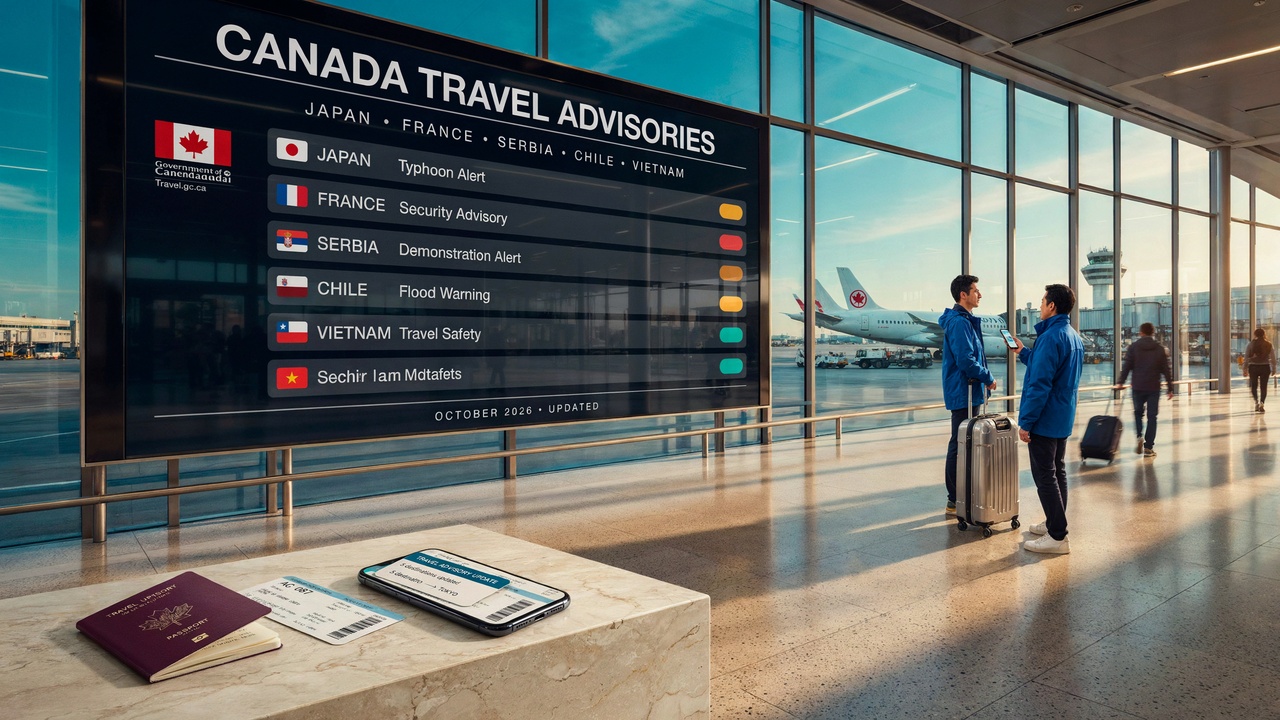
Canada has updated its travel advisories for Japan, France, Serbia, Chile and Vietnam in October 2026, drawing attention to tropical storms, political demonstrations, flooding, crime and road safety risks affecting popular international destinations. The Government of Canada’s latest guidance is particularly relevant to Canadians planning autumn holidays, winter escapes and international business trips. Japan’s Ryukyu Islands face a regional warning linked to Typhoon Champi, while France and Serbia have concerns involving demonstrations. Chile faces flooding and security risks, and Vietnam’s revised guidance highlights road accidents, theft and unsafe alcohol. Travellers are being encouraged to review destination-specific conditions before departure.
Canada Travel Advisories 2026: Five Countries Face Updated Safety Guidance Ahead of International Holidays
The Government of Canada has revised travel safety information for five countries across Asia, Europe and South America, reflecting different local developments that may affect travellers.
Advertisement
Advertisement
The updates were published between 19 and 20 October 2026 through Global Affairs Canada’s official Travel Advice and Advisories service.
The federal platform provides country-specific guidance on security, entry requirements, health considerations, local laws and natural hazards.
Advertisement
Advertisement
Importantly, the latest updates do not mean Canada has imposed a blanket travel ban on all five countries.
The warnings vary considerably according to destination and, in some cases, the precise region travellers intend to visit.
Advertisement
Advertisement
Japan retains a general recommendation to take normal security precautions, but the government advises avoiding non-essential travel to the Ryukyu Islands, including Okinawa Prefecture, because of Typhoon Champi.
France carries a countrywide recommendation to exercise a high degree of caution because of terrorism concerns, alongside information about demonstrations and transport disruption.
Serbia generally remains under normal security precautions, although travellers should exercise greater caution near the Kosovo border and remain alert to potential election-related demonstrations.
Chile carries a higher caution level because of civil unrest, demonstrations and crime, with additional warnings about flooding in central regions.
Vietnam’s latest advisory recommends normal security precautions at the national level, while providing detailed guidance on traffic conditions, petty crime and other safety issues.
These distinctions are essential for travellers deciding whether to continue, postpone or modify their plans.
Advertisement
Advertisement
Latest Canadian Travel Advisory Updates at a Glance
| Country | Latest verified update | Principal concerns | General Canadian advisory |
|---|---|---|---|
| Japan | 20 October 2026 | Typhoon Champi, flooding, landslides | Normal precautions nationally; avoid non-essential travel to Ryukyu Islands |
| France | 19 October 2026 | Demonstrations, transport disruption, terrorism | Exercise a high degree of caution |
| Serbia | 20 October 2026 | Parliamentary elections, demonstrations, Kosovo border tensions | Normal precautions nationally; increased regional caution |
| Chile | 19 October 2026 | Floods, landslides, crime, civil unrest | Exercise a high degree of caution |
| Vietnam | 19 October 2026 | Road safety, petty crime, unregulated alcohol | Take normal security precautions |
The classifications reflect the Canadian government’s published advice checked for 23 October 2026. Risk levels and local conditions may change without advance notice.
Japan Travel Advisory: Canada Warns Against Non-Essential Travel to Okinawa and Ryukyu Islands After Typhoon Champi Threat
Japan is among the most prominent destinations affected by Canada’s latest travel advisory update.
Global Affairs Canada updated its Japan guidance on 20 October 2026, identifying Typhoon Champi as a significant regional weather concern.
The government advised Canadians to avoid non-essential travel to the Ryukyu Islands, including Okinawa Prefecture.
The advisory stated that Typhoon Champi was expected to cross the islands on 22 October, bringing potentially dangerous weather conditions.
Because that date has now passed, travellers should consult the latest observations and local emergency instructions rather than assume the original forecast describes current conditions.
Advertisement
Advertisement
The government’s warning identified excessive rainfall and violent winds as major risks.
Heavy precipitation could cause flash flooding, while saturated ground may increase the possibility of landslides.
Coastal infrastructure and transport services may also be affected.
Which Japanese Destinations Are Covered by the Warning?
The regional warning covers the Ryukyu Islands, including Okinawa Prefecture.
This island chain lies in southern Japan and includes destinations popular for beaches, diving, coastal sightseeing and cultural tourism.
Okinawa attracts visitors interested in subtropical landscapes, marine recreation and island holidays.
Advertisement
Advertisement
Other destinations within the island region, including areas around Ishigaki and Miyakojima, may also experience disruption when severe tropical weather affects the wider island chain.
However, the advisory is not a nationwide instruction to avoid Japan.
Major destinations such as Tokyo, Osaka, Kyoto and Hokkaido are not automatically subject to the same regional warning.
Travellers should assess the specific locations included in their itineraries.
How Typhoon Champi Could Affect Flights, Ferries and Island Tourism
The Canadian government identified several essential services that could be disrupted by the storm.
These include air and maritime transport, electricity distribution, telecommunications, water supplies, food availability and emergency medical services.
Advertisement
Advertisement
Flight cancellations and ferry suspensions are particularly important concerns for island destinations.
Travellers may also encounter closed roads or restricted access to coastal attractions.
Those already in affected areas should monitor Japan Meteorological Agency warnings and follow instructions from local authorities.
A forecast threat does not confirm that every predicted disruption has occurred.
Passengers should therefore obtain current operating information directly from their airlines, accommodation providers and transport operators.
El Niño Adds Longer-Term Climate Considerations for Japan
Canada’s advisory also references the 2026–27 El Niño climate pattern.
Advertisement
Advertisement
The government states that El Niño conditions are present and were expected to strengthen during the second half of 2026 and into 2027.
El Niño can affect rainfall and temperature patterns across different parts of the world.
However, it does not determine the exact path of an individual typhoon or guarantee a specific weather event.
Travellers planning future visits to Japan should continue checking seasonal forecasts, particularly during the country’s usual typhoon period between June and October.
For winter holidays, separate risks may include heavy snowfall and avalanches in mountainous regions.
France Travel Advisory: Demonstrations, Transport Disruption and Terrorism Concerns Prompt Canadian Caution
France remains a major international tourism destination, attracting visitors to Paris, the French Riviera, the Alps and other cultural regions.
Advertisement
Advertisement
However, Canada’s updated advisory highlights concerns about public demonstrations, disruption to essential services and the continuing threat of terrorism.
The Government of Canada updated its France guidance on 19 October 2026.
The latest information describes demonstrations occurring in several cities, with some events involving confrontations between protesters and security forces.
Authorities have reported vandalism, looting, arson and violent clashes associated with certain demonstrations.
In some situations, police have used tear gas to disperse crowds.
The advisory also states that local curfews are in effect in certain municipalities.
Advertisement
Advertisement
Travellers should check with local authorities to determine whether restrictions apply in the places they plan to visit.
Why Demonstrations Matter for Tourists Visiting France
Public demonstrations can affect travel even when visitors do not intend to participate.
Road closures may disrupt taxis, buses and private transfers.
Public transport services may operate reduced schedules or temporarily suspend access to certain stations.
Tourist attractions and surrounding commercial areas may become difficult to reach if police establish security perimeters.
Travellers with flights, railway journeys or other time-sensitive reservations should allow additional time when demonstrations are taking place.
Advertisement
Advertisement
The government advises visitors to avoid protest areas, follow police instructions and remain informed through reliable local media.
Even demonstrations that begin peacefully can become unpredictable.
This does not mean every French city is experiencing unrest simultaneously.
Conditions vary by municipality, neighbourhood and date.
France’s Vigipirate Security System Remains Relevant to Visitors
Canada also highlights France’s Vigipirate counter-terrorism framework.
The system involves different levels of public security measures designed to respond to terrorism threats.
Advertisement
Advertisement
The Canadian advisory lists the current level as the second tier, known as vigilance renforcée, meaning enhanced vigilance.
The country also operates Operation Sentinelle, which involves military personnel supporting police and gendarmerie security operations in selected public areas.
Travellers may therefore encounter increased security around transport hubs, tourist attractions, government buildings and major public events.
Security checks may be particularly noticeable at railway stations, airports and crowded cultural venues.
The government’s recommendation is to remain aware of surroundings and follow security instructions.
France’s advisory does not prohibit tourism or indicate that every major attraction is closed.
Advertisement
Advertisement
Visitors should check conditions in their specific destination rather than assume a nationwide disruption.
Serbia Travel Advisory: Parliamentary Elections Raise Concerns Over Demonstrations and Border Security
Serbia’s travel advisory has been updated ahead of parliamentary elections scheduled for 25 October 2026.
The Canadian government published its revised guidance on 20 October, warning that public demonstrations could occur before, during and after voting.
Political gatherings may affect public spaces, roads and transportation networks.
Travellers visiting Belgrade or other Serbian cities should monitor developments carefully.
The government recommends avoiding demonstrations and large gatherings.
Advertisement
Advertisement
Visitors should also follow instructions from local authorities and check local reporting for information about changing conditions.
The advisory does not establish that violent unrest will occur on election day.
Instead, it identifies the possibility of demonstrations during a politically sensitive period.
Kosovo Border Region Requires Greater Caution
Canada maintains a separate regional warning for areas within 10 kilometres of Serbia’s border with Kosovo.
Travellers are advised to exercise a high degree of caution because of political tensions, possible civil unrest and the presence of landmines.
The southern Serbian district of Pčinja is among the areas where unexploded landmines and other remnants of conflict remain a concern.
Advertisement
Advertisement
The advisory specifically identifies the municipalities of Bujanovac and Preševo.
Visitors should remain on main roads and avoid entering unfamiliar rural terrain.
Political tensions involving northern Kosovo may also produce additional security measures near border crossings.
Travellers planning journeys involving both Serbia and Kosovo must pay close attention to entry procedures.
Serbia does not recognise Kosovo as an independent state, which can create complications for certain border crossings and immigration records.
People planning overland itineraries should check the applicable entry requirements before travelling.
Advertisement
Advertisement
For tourists visiting Serbia’s main cities, the general national advisory remains at the normal security precautions level.
The higher warning applies specifically to the sensitive border region.
Chile Travel Advisory: Severe Flooding Near Santiago and Rising Crime Create Travel Concerns
Chile is another major destination included in Canada’s October travel advisory updates.
The government revised its guidance on 19 October 2026 after severe flash floods affected the Santiago Metropolitan Region.
The advisory confirms that flooding occurred on 8 and 13 October, causing injuries and evacuations.
These incidents are historical events, not projected weather conditions.
Advertisement
Advertisement
The government also warned that further heavy rainfall was expected across Santiago and other central regions extending between Coquimbo and Biobío.
Such rainfall could result in additional flooding, landslides and avalanches.
However, the forecast does not mean all those events have occurred.
Travellers should distinguish between confirmed flooding and possible future weather-related disruption.
Santiago and Central Chile Face Potential Transport Disruption
Flooding can affect urban roads, public transport, highways and access to tourist destinations.
In mountainous areas, heavy rainfall can destabilise slopes and make certain routes dangerous.
Advertisement
Advertisement
Visitors planning journeys through central Chile should monitor official weather warnings and local emergency instructions.
The country’s National Service for Disaster Prevention and Response, known as SENAPRED, provides information about emergency conditions and evacuation requirements.
Travellers should avoid flooded roads and follow instructions issued by local authorities.
Those planning mountain excursions should confirm route conditions before departure.
The Canadian advisory warns that infrastructure may be damaged by severe weather, potentially affecting transport and other essential services.
No nationwide closure of Chile’s tourism industry has been announced through this update.
Advertisement
Advertisement
Santiago and Valparaíso Tourist Areas Face Additional Crime Warnings
Beyond flooding, Canada advises travellers to exercise a high degree of caution in Chile because of crime, demonstrations and civil unrest.
The government reports that armed assaults and robberies have increased in recent years.
Tourists have been targeted, including during daylight hours.
Visitors should be particularly cautious when exploring crowded urban environments or carrying valuable belongings.
The advisory identifies several locations where travellers should avoid walking after dark.
These include Cerro Alegre and other hills in Valparaíso, Cerro San Cristóbal park, and selected areas of Santiago.
Advertisement
Advertisement
Within the capital, the government highlights Bellavista, Barrio Lastarria, Cerro Santa Lucía, Plaza de Armas and Mercado Central.
These are established tourist districts and attractions, but the warning stresses the importance of personal security.
Travellers should avoid displaying expensive jewellery, carrying unnecessary cash or leaving bags unattended.
Rental Cars and Tourist Transport Require Particular Attention
The Canadian guidance also describes theft involving rental vehicles.
In some cases, criminals deliberately puncture a vehicle’s tyre and steal belongings when passengers stop to investigate.
Other incidents involve distractions designed to separate visitors from their possessions.
Advertisement
Advertisement
Motorists should avoid leaving valuables visible inside vehicles.
Drivers should also use secure parking facilities and remain attentive when approached unexpectedly.
The government’s broader message is that visitors should continue planning carefully while recognising that security conditions can vary between neighbourhoods.
Chile’s Weather Risks Extend Beyond Flooding
Chile is geographically diverse, stretching across deserts, mountain ranges, coastal regions and southern landscapes.
Its geography creates exposure to several natural hazards.
The Canadian advisory identifies earthquakes, tsunamis, volcanic activity, floods, landslides and severe coastal swells as relevant risks.
Advertisement
Advertisement
These are broader environmental considerations rather than confirmation that all hazards are active simultaneously.
Travellers visiting national parks, mountain areas or remote destinations should check local conditions before undertaking outdoor excursions.
Weather disruption can also affect cross-border routes and access to isolated communities.
For tourists, the most practical approach is to build flexibility into travel plans and avoid assuming that routes will remain accessible following severe rainfall.
Vietnam Travel Advisory: Road Accidents, Petty Crime and Unsafe Alcohol Highlight Key Safety Concerns
Vietnam is the fifth country included in Canada’s latest travel advisory coverage.
The government completed a comprehensive review of its Vietnam guidance on 19 October 2026.
Advertisement
Advertisement
The current national risk classification is to take normal security precautions.
Nevertheless, the advisory identifies several specific concerns that tourists should understand before visiting.
Road safety is among the most prominent.
Vietnam’s large cities experience heavy traffic involving motorcycles, cars, buses, pedestrians and other vehicles.
Traffic behaviour can differ significantly from what Canadian visitors are accustomed to.
The government warns that drivers do not always respect traffic regulations and that fatal road accidents occur frequently.
Advertisement
Advertisement
Motorcycles and pedestrians are particularly vulnerable.
Vietnam’s Traffic Conditions Create Challenges for Tourists
Visitors travelling through Hanoi, Ho Chi Minh City, Da Nang and other urban centres should remain attentive around roads and intersections.
Motorcycles may travel on pavements, while pedestrian areas can be obstructed by parked vehicles or other obstacles.
Crossing busy roads can be challenging because traffic movement may be continuous and unpredictable.
The Canadian government recommends using pedestrian bridges and elevated walkways where available.
It also advises travellers considering car journeys to think about hiring a driver.
Advertisement
Advertisement
Motorcycle travel creates additional risks, particularly for visitors unfamiliar with local conditions.
Those who intend to drive must ensure they hold the appropriate licence and insurance.
Tourists should also avoid unnecessary road travel during severe weather or after dark.
Petty Theft Remains a Concern in Popular Vietnamese Destinations
Pickpocketing and bag snatching occur in Vietnam, particularly in larger cities and crowded tourist areas.
The Canadian advisory warns that theft may become more prevalent during major public holidays, including Tet, the Lunar New Year.
Criminals may work alone or in groups.
Advertisement
Advertisement
Some use distraction techniques, while others attempt to grab phones or bags from passing motorcycles.
Tourists should be particularly cautious in markets, transport terminals, shopping streets and busy public areas.
The advisory also identifies restaurants, outdoor cafés, beaches and public transport as places where theft may occur.
Travellers are encouraged to secure passports, keep copies of important documents and avoid carrying unnecessary valuables.
Although petty crime is a concern, the Canadian government notes that violent offences specifically targeting foreigners remain comparatively rare.
Methanol Poisoning Warning Highlights Risks from Unregulated Alcohol
Canada’s Vietnam advisory also warns about unregulated and adulterated alcoholic drinks.
Advertisement
Advertisement
The government states that people have died after consuming alcohol containing dangerous levels of methanol.
Methanol is a toxic substance that can cause serious poisoning, including permanent injury and death.
Travellers should be cautious when purchasing alcoholic drinks from informal sellers or unfamiliar sources.
The advisory recommends choosing reputable brands and avoiding alcohol sold by individuals or street vendors.
Anyone who becomes unwell after drinking suspected contaminated alcohol should seek urgent medical assistance.
This warning concerns specific unsafe products and does not mean all alcoholic beverages sold in Vietnam are dangerous.
Advertisement
Advertisement
Seasonal Weather Adds Another Consideration for Vietnam Holidays
Vietnam’s climate varies considerably between regions.
The Canadian advisory notes that the rainy season generally occurs from June to September in northern and southern Vietnam.
In Central Vietnam, the wetter period typically extends from October to December.
Seasonal flooding during October and November can affect transport and access to tourist destinations.
Travellers visiting Da Nang, Hue, Hoi An or other central locations should therefore monitor weather conditions.
Flooding and landslides may make roads temporarily impassable.
Advertisement
Advertisement
Visitors planning outdoor activities should check forecasts before travelling to mountainous or rural areas.
For international tourists, understanding Vietnam’s regional climate is particularly important because conditions in one part of the country may differ substantially from another.
What Do Canada’s Four Travel Advisory Risk Levels Mean?
The Government of Canada uses four principal risk classifications to help travellers understand destination safety conditions.
These classifications are not interchangeable.
Understanding the difference is important when deciding whether to continue with a planned holiday.
Canada’s Official Travel Risk Categories
| Advisory level | Meaning for travellers |
|---|---|
| Take normal security precautions | Exercise the usual care expected during international travel |
| Exercise a high degree of caution | Recognise significant safety concerns and remain particularly vigilant |
| Avoid non-essential travel | Reconsider whether the journey is necessary because safety may be at risk |
| Avoid all travel | Do not travel because personal safety faces serious risks |
A country may carry one national classification while particular regions are subject to a higher warning.
Advertisement
Advertisement
Japan and Serbia demonstrate this distinction.
Most of Japan remains under normal security precautions, but the Ryukyu Islands face an avoid non-essential travel advisory because of Typhoon Champi.
Serbia also retains normal precautions nationally, with increased caution recommended close to Kosovo.
France and Chile have countrywide high-caution classifications, although their main concerns differ.
Vietnam’s updated national classification is normal security precautions, despite the detailed safety risks identified in its advisory.
Travellers should therefore read the full country page instead of relying exclusively on the headline risk level.
Advertisement
Advertisement
Why This Matters
Canada’s updated travel advisories demonstrate how international travel risks can vary significantly between countries and even between different regions within the same destination.
The five updates cover several types of disruption.
Japan faces a weather-related regional warning associated with Typhoon Champi.
France and Serbia have political and public security considerations involving demonstrations.
Chile faces both confirmed flooding and wider crime-related concerns.
Vietnam’s revised guidance focuses on everyday safety issues, including traffic conditions, theft and unregulated alcohol.
Advertisement
Advertisement
For travellers, the distinction between these risks matters.
A tropical storm can disrupt flights and ferries, while demonstrations may affect public transport and city access.
Flooding can damage infrastructure, whereas road safety risks require different precautions during daily sightseeing.
The updates also have implications for airlines, travel agencies, tour operators and accommodation providers.
Businesses serving international travellers may need to communicate changes in local operating conditions and help customers understand their booking options.
However, no official evidence establishes that these five advisory updates have caused a particular reduction in tourism demand or a measurable increase in cancellations.
Advertisement
Advertisement
The principal benefit of the advisories is that they allow travellers to make more informed decisions using destination-specific information.
What Travellers Should Know
Canadian travellers planning overseas holidays should review official destination guidance both before departure and during their trip.
Advisories can change quickly following natural disasters, political developments or security incidents.
The information available when a holiday is booked may differ from the guidance in effect at the time of departure.
Before Booking
- Japan: Check the regional warning for the Ryukyu Islands, particularly Okinawa, and review current typhoon and transport information.
- France: Monitor demonstrations, public transport disruption, security measures and any locally imposed curfews.
- Serbia: Follow election-related developments and exercise additional caution near the Kosovo border.
- Chile: Review flood warnings, road conditions and security guidance for Santiago, Valparaíso and central regions.
- Vietnam: Consider road safety, seasonal flooding, petty theft and the risks associated with unregulated alcohol.
- Travel insurance: Check whether existing or newly issued advisories affect cancellation, interruption or emergency assistance coverage.
- Travel documents: Verify passport validity, visa requirements and destination-specific entry conditions.
- Emergency planning: Keep digital copies of important documents and maintain contact information for airlines, accommodation providers and Canadian consular services.
Travellers should not assume that a travel advisory automatically cancels flights or makes an insurance claim eligible.
Airline policies and insurance contracts contain different conditions.
Advertisement
Advertisement
It is therefore important to obtain information directly from the relevant service provider before changing reservations.
How Canadian Travellers Can Prepare for Sudden Travel Disruption
Travel planning should include more than checking flights and hotel availability.
Visitors travelling during periods of changing weather or political uncertainty should maintain a degree of flexibility.
For Japan, this may involve allowing additional time between domestic flights, ferries and international departures.
Travellers visiting France should account for possible public transport interruptions during demonstrations.
Those travelling through Serbia around the parliamentary elections should monitor local developments and avoid unnecessary exposure to large political gatherings.
Advertisement
Advertisement
In Chile, visitors planning road journeys should check whether flooding has affected highways, mountain passes or access to particular regions.
Vietnam visitors may benefit from using reputable transport companies and avoiding unnecessary motorcycle travel.
Canadian citizens can also register through the Government of Canada’s Registration of Canadians Abroad service.
The service allows the government to send important information during emergencies and helps consular officials contact registered travellers when necessary.
Registration does not guarantee evacuation or immediate assistance, but it can improve communication during a crisis.
Frequently Asked Questions About Canada’s Updated Travel Advisories
Which countries are included in Canada’s latest October 2026 travel advisory updates?
The five countries covered are Japan, France, Serbia, Chile and Vietnam. The updates address typhoon risks, demonstrations, election-related uncertainty, flooding, crime and road safety.
Advertisement
Advertisement
Has Canada advised against all travel to Japan?
No. Canada recommends normal security precautions for Japan generally, but advises avoiding non-essential travel to the Ryukyu Islands, including Okinawa Prefecture, because of Typhoon Champi.
Why has Canada updated its travel advice for France?
The government has highlighted demonstrations, possible transport disruption, local curfews and terrorism-related security concerns. France remains under an advisory to exercise a high degree of caution.
Is Serbia considered unsafe for Canadian tourists?
Canada recommends normal security precautions for Serbia nationally. However, travellers should avoid demonstrations associated with the 25 October parliamentary elections and exercise a high degree of caution within 10 kilometres of the Kosovo border.
What precautions should travellers take in Chile and Vietnam?
In Chile, visitors should monitor flooding, avoid affected areas and remain vigilant against crime. In Vietnam, travellers should take precautions around road traffic, secure their belongings and avoid unregulated alcohol.
Canada Urges Informed Travel Planning as International Safety Conditions Continue to Change
Canada’s October 2026 travel advisory updates underline the importance of checking destination conditions before undertaking international journeys.
Japan, France, Serbia, Chile and Vietnam remain important destinations for leisure and business travellers, but their current safety considerations differ substantially.
Advertisement
Advertisement
The most significant regional warning concerns Japan’s Ryukyu Islands, where Typhoon Champi prompted advice against non-essential travel.
France’s revised guidance highlights demonstrations and terrorism-related security measures, while Serbia’s upcoming parliamentary elections create a need for greater awareness around political gatherings.
Chile faces the consequences of recent flash flooding alongside wider security concerns.
Vietnam’s updated advisory draws attention to road safety, theft and dangerous unregulated alcohol.
None of these updates should be interpreted as a universal travel prohibition covering all five countries.
Instead, they provide targeted advice intended to help Canadians understand local risks and prepare accordingly.
Advertisement
Advertisement
For travellers arranging autumn holidays, international city breaks or longer overseas itineraries, the practical message is to review the latest government guidance, check transport and accommodation arrangements, and remain flexible if circumstances change.
As weather events and security conditions evolve, destination-specific information will remain an essential part of responsible international travel planning.
Advertisement
