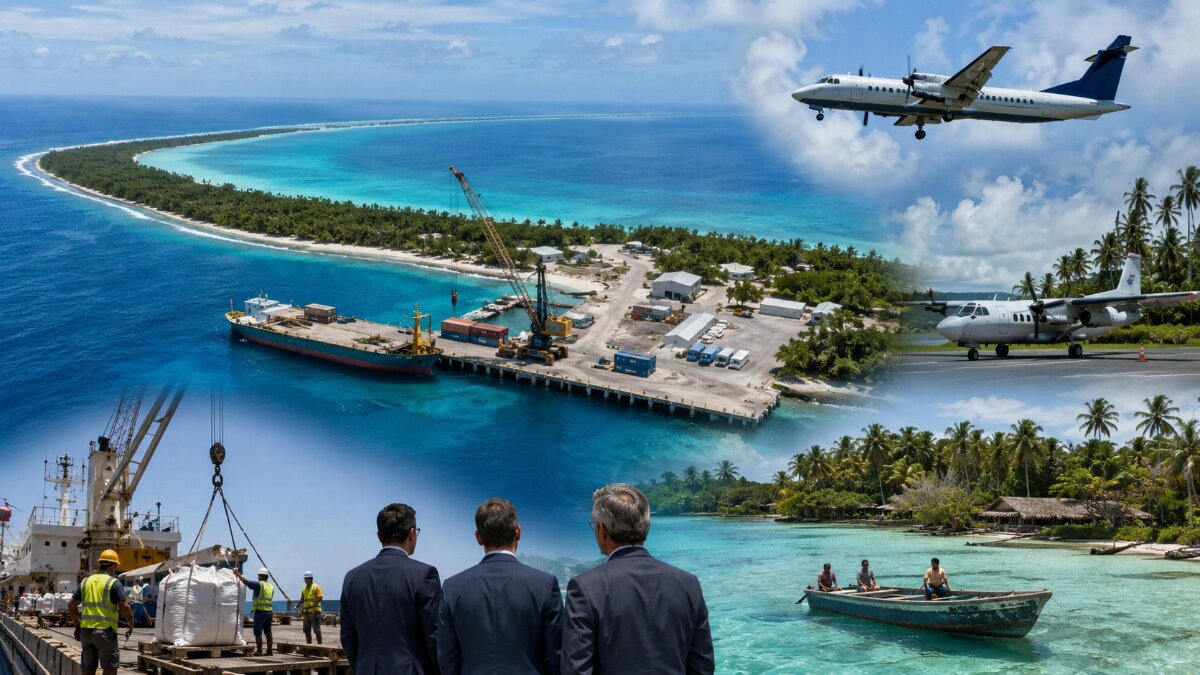
Image generated with Ai
The Cook Islands’ newly announced investment in Omoka Port on Penrhyn could have consequences far beyond safer ship landings. The United States intends to provide US$50 million and New Zealand NZ$17.5 million for the project, while New Zealand is expected to coordinate implementation. The overlooked travel implication is that historical government infrastructure planning directly connected Penrhyn’s harbour and fuel system with northern aviation while the ongoing Manihiki Airport Improvement Project identifies Penrhyn as an alternate aerodrome required for larger-aircraft operations. Together these developments could eventually reshape access to some of the Pacific’s hardest-to-reach islands.
According to the Cook Islands Office of the Prime Minister, the major Penrhyn port upgrade was announced in Koror, Palau, on 31 August 2026 around the Pacific Islands Forum Leaders Meeting. The United States, working through its Department of State and Congress, intends to contribute US$50 million, equivalent to approximately NZ$84 million. New Zealand intends to provide NZ$17.5 million, or approximately US$10 million. The final project scope and implementation plan remain subject to a feasibility study and further technical work among the three governments.
Advertisement
The immediate objectives are straightforward. Omoka needs safer landings, better access to supplies and stronger transport links. Yet older Cook Islands infrastructure documents reveal an additional layer of significance. Penrhyn Harbour has previously been planned as infrastructure capable of supporting aviation fuel movements and wider Northern Group transport operations. That historical connection changes how the new investment can be assessed by airlines, specialist tour operators and destination planners.Penrhyn development factor Verified position as of 2 September 2026 Travel significance US contribution US$50 million intended Creates the financial basis for a major port intervention New Zealand contribution NZ$17.5 million intended Adds funding and implementation capability Project implementation New Zealand to implement in coordination with Cook Islands and US Gives the programme an identified delivery partner Port location Omoka village, Penrhyn Directly serves Penrhyn’s main transport node Final port design Not yet determined Tourism and aviation benefits cannot yet be treated as guaranteed Penrhyn airport renewal Future possibility only No approved airport construction package has been announced Manihiki airport development Current Cook Islands infrastructure priority Could create the second aviation node needed for stronger Northern Group operations
The most significant information gain for the travel industry comes from Cook Islands infrastructure planning that predates this week’s funding announcement.
Advertisement
Advertisement
A government Preventative Infrastructure Master Plan identified Penrhyn Harbour at Omoka as the only outer-island harbour where inter-island ships could berth and unload directly onto the wharf. Crucially, the plan also envisaged the harbour being used to unload aviation fuel in support of expanded Air Rarotonga Saab 340 operations. It additionally recognised potential revenue from yacht traffic, refuelling and maritime activity.
The 2015 National Infrastructure Investment Plan went further. It included Penrhyn coastal protection, Omoka port facilities and relocation of the fuel depot. The planned benefits included a safer northern international port of entry, stronger security for fuel supplies, cargo transit capability for other Northern Group islands and border-control functions involving immigration, customs and quarantine.
This does not mean the newly funded project automatically includes every element of those older plans. Its design remains subject to feasibility work. It does, however, demonstrate that maritime infrastructure and aviation logistics at Penrhyn have historically been treated as connected systems rather than independent assets.
A second official development makes the travel angle considerably stronger.
Advertisement
Advertisement
According to Infrastructure Cook Islands, the Manihiki Airport Improvement Project is intended to provide safer and more affordable access while increasing climate resilience. Government planning has examined larger turboprop operations, including aircraft in the Saab SF340 and ATR 72 categories, as a way to reduce average fares, increase capacity and support sustainable tourism and economic development.
More importantly, official planning identifies a specific operational relationship between Manihiki and Penrhyn. Larger-aircraft services into the Northern Group require at least two suitable aerodromes so an aircraft has an alternate in poor weather or an emergency. The government states that previous airline planning envisaged an upgraded Manihiki airstrip as the primary destination with Penrhyn serving as the alternate.
That detail creates the new travel story. Penrhyn is potentially valuable not simply because travellers might fly there more easily one day, but because its aviation infrastructure could help make larger-aircraft operations elsewhere in the Northern Group more operationally viable.Network element Current official evidence Potential B2B travel effect Manihiki Airport Runway rehabilitation and resilience project Safer access and potential larger-aircraft capability Penrhyn Aerodrome Existing Northern Group aerodrome Potential alternate airport function Omoka Port Major new funding commitment Stronger supply and logistics chain Fuel infrastructure Historically tied to Penrhyn port planning Could become important to sustained aircraft operations Domestic shipping New national policy covers Penrhyn and Manihiki More predictable supply and passenger logistics Rarotonga Main national aviation gateway Principal feeder point for Northern Group journeys
The port announcement also arrives only months after a significant domestic transport policy change.
According to the Cook Islands Ministry of Finance and Economic Management, Cabinet approved a new Domestic Shipping Policy on 4 June 2026. The framework covers government-operated shipping between Rarotonga and the Pa Enua, including Penrhyn, Manihiki, Pukapuka, Nassau, Rakahanga and Palmerston in the Northern Group.
The policy establishes six-month pre-arranged voyage scheduling, allows government support for charter voyages and introduces a subsidy mechanism for routes that are not commercially viable. Government documentation acknowledges that long distances, small populations, variable demand and weather disruption have historically made consistent outer-island shipping difficult.
This is highly relevant to tourism development. A destination cannot build dependable air access in isolation if fuel, food, construction material, accommodation supplies and emergency equipment cannot reach the island predictably. Better shipping therefore has the potential to improve the underlying operating environment in which aviation and tourism must function.
For travellers, however, expectations need to remain realistic.
Cook Islands Tourism describes Penrhyn, also known as Tongareva, as the country’s northernmost island and among its most remote and difficult destinations to access. Its defining natural asset is an enclosed lagoon covering about 233 square kilometres. Its population is distributed principally between Omoka and Tetautua on opposite sides of the lagoon.
The 2021 Cook Islands Census places Penrhyn 737 nautical miles from Rarotonga and 196 nautical miles from Manihiki. The same census counted a total population of 233 on Penrhyn in 2021, illustrating the extremely small local market on which commercial transport economics must partly depend.
Air access is also fundamentally different from high-frequency tourist islands such as Aitutaki. Cook Islands Tourism lists Penrhyn among outer-island destinations where flight availability depends on demand and warns that some services may operate only on a charter basis. Air Rarotonga’s own Penrhyn information describes access through charter operations and specialist Northern Atolls expedition travel.
Any successful tourism strategy for Penrhyn would almost certainly need to differ from the volume model associated with major island resorts.
Penrhyn’s remoteness is itself part of the tourism product. Its large lagoon, Polynesian community, traditional handicrafts, marine environment and isolation give it characteristics more suitable for specialist travel than conventional high-volume package tourism. Improved access could theoretically support expedition itineraries, cultural journeys, fishing programmes, research travel, specialist aviation tours and small-group Northern Cook Islands circuits.
The infrastructure evidence suggests that the first commercial opportunity may therefore be improved reliability rather than dramatically larger visitor numbers.
That distinction matters. Predictable transport can enable operators to sell an itinerary with greater confidence, reduce the risk of travellers being stranded by irregular logistics and make it easier to move food, maintenance materials and other inputs required by small accommodation providers.
But there is currently no official government target for Penrhyn visitor arrivals, hotel development, resort construction or scheduled airline expansion. Those outcomes must not be presented as approved consequences of the port investment.
The potential Northern Group opportunity also sits behind an increasingly connected national gateway.
Cook Islands Tourism currently lists direct international access to Rarotonga from Auckland, Sydney, Brisbane, Honolulu and Papeete, alongside seasonal Christchurch services operating through October 2026. Domestic outer-island connections are then distributed from Rarotonga.
The latest tourism publication available from the Cook Islands Statistics Office as of 2 September covers May 2026. It recorded 17,285 visitors during that month. New Zealand represented 62 per cent of visitor arrivals, Australia 27 per cent, Europe 3.8 per cent and the United States 3.6 per cent.
That national demand does not automatically translate into Penrhyn demand. It does create a sizeable pool of travellers already entering the Cook Islands through Rarotonga, from which specialist Northern Group products could eventually be developed if transport reliability, pricing, accommodation and local capacity improve.
The geography of the announcement is important.
Koror, Palau, is directly associated because the Penrhyn funding commitment was announced there during the Pacific Islands Forum gathering. Omoka is directly associated because it is the Penrhyn village containing the port at the centre of the investment. Omoka is not a city, and describing it as one would be geographically incorrect.
For travel-industry purposes, Omoka is considerably more important than an unrelated Cook Islands city tag. Government infrastructure records place both Penrhyn’s deep-water port and airfield in the Omoka area. The 2021–2031 National Infrastructure Investment Plan also notes the deep-water harbour’s use by fishing vessels seeking refuelling services.
That concentration of maritime, aviation and community infrastructure is precisely why Omoka could become a strategically important transport node if the new investment is completed successfully.
| Issue | Confirmed | Not confirmed |
|---|---|---|
| Major Omoka port upgrade | Yes | Final engineering configuration |
| US financial intention | US$50 million | Final construction expenditure profile |
| New Zealand financial intention | NZ$17.5 million | Detailed procurement timetable |
| New Zealand implementation role | Yes | Completion date |
| Safer maritime access objective | Yes | New passenger shipping frequencies |
| Manihiki airport improvement | Government project | New commercial airline schedule |
| Penrhyn alternate-airport concept | Present in official planning | Immediate operational activation |
| Future Penrhyn airport renewal | Raised by Cook Islands Government | Funding, approval, design or construction |
| Tourism growth | Plausible industry consequence | Government visitor target |
| Lower airfares | Government planning rationale for larger Northern Group aircraft | Any announced fare reduction |
The significance of the Cook Islands’ Penrhyn announcement lies less in the headline funding figure than in how the infrastructure could connect with developments already taking place across the Northern Group.
Omoka Port has historically been associated with cargo, fuel and aviation logistics. Manihiki is pursuing airport improvements that official planning associates with larger aircraft, tourism growth and lower average fares. Penrhyn has previously been identified as the alternate aerodrome needed to support that model. The Cook Islands has also introduced a domestic shipping framework designed to make remote-island transport more predictable.
Taken together, those elements reveal the possibility of an integrated sea-and-air connectivity system rather than an isolated harbour upgrade.
Yet the distinction between opportunity and confirmed development remains critical. There is no approved Penrhyn airport-renewal programme with no announced new scheduled service alongside no confirmed tourism-capacity expansion and no guaranteed reduction in fares.
If the port feasibility process Manihiki runway development with shipping reform and any later Penrhyn aviation investment ultimately converge, the Cook Islands could gain something far more strategically valuable than a reconstructed wharf: a more resilient Northern Group transport network capable of turning extreme remoteness from a barrier into a carefully managed travel asset.
Advertisement
Advertisement
Advertisement












Wednesday, September 2, 2026

Wednesday, September 2, 2026

Wednesday, September 2, 2026

Wednesday, September 2, 2026

Wednesday, September 2, 2026

Tuesday, September 1, 2026

Wednesday, September 2, 2026

Wednesday, September 2, 2026



