
BART Service Cuts Could Add 43 Minutes to California Journeys as Bay Area Traffic Pressure Mounts

Published
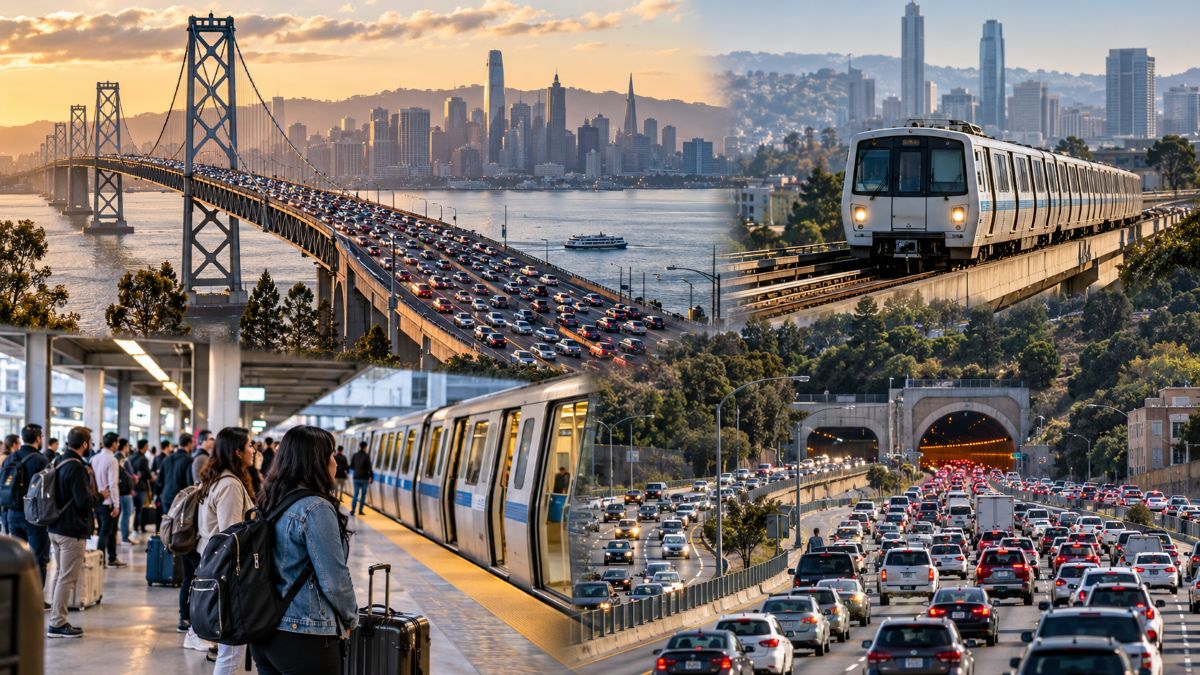
Image generated with Ai
Bay Area transit cuts could turn already difficult journeys across San Francisco and the wider Bay Area into a far more expensive travel challenge. A new SPUR study warns that severe reductions could add 15 to 33 minutes during morning peaks and 20 to 43 minutes in evenings on major regional corridors. The analysis examined the Bay Bridge, Caldecott Tunnel and Interstate 680. It estimates that up to 430,000 people could lose convenient BART access if stations close. That shift could add about 498 million vehicle miles annually. It could also increase individual transport costs by as much as $3,280 a year, according to the study.
The warning arrives as BART and other Bay Area transit operators confront persistent post-pandemic funding pressures. BART has identified a structural deficit of roughly $350 million to $400 million annually. Its FY2027 budget addresses a projected $375 million gap, while a regional funding measure is being considered for November 2026. Meanwhile, California has provided a $590 million state loan to help protect regional services during the 2026–27 financial year.
Traffic Risks Reach Beyond BART
The significance for travellers extends well beyond daily commuters. San Francisco is a major leisure, business and convention destination, while the wider Bay Area connects airports, hotels, attractions, universities and technology centres.
For visitors, public transport often provides an alternative to congested roads. BART links San Francisco with the East Bay and provides a direct rail connection to San Francisco International Airport. Caltrain connects San Francisco with communities across the Peninsula and Silicon Valley.
Advertisement
Advertisement
Therefore, disruption across the regional transport network could affect the entire visitor journey. Airport transfers could take longer, hotel access could become less predictable, and road congestion could complicate trips between destinations.
Advertisement
Advertisement
SPUR’s September 22 research examines this broader regional effect. The organisation worked with engineering and infrastructure consultancy Jacobs to model the consequences of potential service reductions. The analysis considers traffic, affordability, transport access and carbon emissions rather than only the experience of existing transit passengers.
That distinction matters for travel businesses. A visitor who normally takes rail from an airport may switch to a taxi or rideshare service. Thousands of similar decisions could increase road pressure precisely when the transport system is already operating near capacity.
The Bay Bridge illustrates the vulnerability. The Metropolitan Transportation Commission describes its corridor as the Bay Area’s most congested. It also notes severe congestion on approaches to the bridge during morning commuting periods.
Advertisement
Advertisement
| Potential effect from severe transit reductions | Reported or estimated impact |
|---|---|
| Additional morning peak travel time | 15–33 minutes |
| Additional evening peak travel time | 20–43 minutes |
| People potentially losing BART access | Up to 430,000 |
| Additional annual vehicle miles | About 498 million |
| Potential annual fuel, toll and parking burden | Up to $3,280 per commuter |
| Major corridors studied | Bay Bridge, Caldecott Tunnel, I-680 |
| Potential BART station closures | Up to 15 |
| Potential Caltrain station closures | Up to 10 |
| Potential Muni route closures | Up to 20 |
The figures above describe the scenario analysed by SPUR and reported from the study. They are not forecasts that every listed closure will occur. The actual outcome depends on future funding, agency decisions and implementation of service plans.
BART Faces a Structural Funding Problem
BART’s financial challenge did not emerge overnight. Remote and hybrid working patterns have permanently altered commuting behaviour across the Bay Area.
Advertisement
Advertisement
BART says its financial model historically relied heavily on passenger fares. Fewer weekly journeys have therefore created a substantial revenue problem, even as ridership has gradually recovered.
The system has nevertheless recorded meaningful recovery. BART reported that average weekday ridership was projected to exceed 200,000 trips for the first time since the pandemic. FY2026 ridership also grew by more than 12%, according to the agency.
That improvement has not solved the underlying funding gap. BART continues to describe its structural deficit as approximately $350 million to $400 million annually.
Its June 2026 budget contained $1.2 billion in operating expenditure and $828 million in capital spending. The agency also identified $18.2 million in ongoing cuts and relied on $88.5 million in borrowing to bridge part of the FY2027 funding gap.
The contrast is striking. More passengers are returning, but the recovery remains insufficient to restore the previous financial model.
Advertisement
Advertisement
BART’s Potential Service Scenario
If additional operating revenue does not materialise, BART has already outlined an alternative service plan. The proposal shows how dramatically the passenger experience could change.
The January 2027 scenario would represent a 63% reduction in train hours, according to BART. It would reduce operating hours, alter frequencies and introduce substantial fare and parking increases.
| BART service element | Current or planned normal operation | Alternative scenario |
|---|---|---|
| Train hours | Existing service levels | About 63% reduction |
| Closing time | Around midnight | 9pm |
| Main operating lines | Five-line network | Three-line core service |
| Frequency | Roughly 10–20 minutes | About 30 minutes |
| Fares and parking | No FY2027 fare increase in adopted budget | Potential 30% increase initially |
| Station closures | No current blanket closure | Up to 15 under later scenario |
| Employee reductions | Existing staffing adjustments | Up to 600 layoffs in January scenario |
| Further FY2028 reduction | — | Up to 70% service-hour reduction |
BART’s later-stage planning also contemplates up to 15 station closures and a cumulative 70% reduction in service hours if the funding problem persists. The agency says specific station decisions would remain with its board.
For visitors, the implications would be especially significant after major events. Late-night departures from restaurants, entertainment venues and sporting events could become harder to manage.
Airport travellers could also face greater pressure to use road transport outside rail operating hours. That creates another vulnerability because road journeys are sensitive to peak congestion, incidents and bridge bottlenecks.
Advertisement
Advertisement
A $590 Million State Bridge Loan Buys Time
California has already intervened to prevent an immediate regional transport shock.
In January, the state and Metropolitan Transportation Commission agreed on a $590 million loan for Bay Area transit agencies. The arrangement covers BART, Caltrain, San Francisco Muni and AC Transit during FY2026–27.
The loan was designed to avert major service reductions while longer-term funding arrangements are considered. MTC subsequently reported that loan agreements had been executed and funding was scheduled for late June.
However, the measure does not eliminate the structural problem. Instead, it provides additional financial breathing space.
That distinction is important for travellers planning beyond the immediate season. A temporary funding bridge does not guarantee that current service levels will continue indefinitely.
Advertisement
Advertisement
The wider system also faces a combined annual deficit exceeding $800 million, according to MTC’s assessment of BART, Muni, Caltrain and AC Transit.
What Visitors Should Expect From 2027
Travellers heading to the Bay Area should watch transport developments closely, particularly for journeys planned from January 2027 onwards.
A visitor staying in San Francisco may not immediately notice the impact if accommodation and attractions remain within the city centre. The risks become more pronounced for travellers moving between San Francisco, Oakland, Berkeley, the Peninsula, Silicon Valley and surrounding communities.
Airport transfers deserve particular attention. A traveller arriving at San Francisco International Airport may normally rely on BART for onward travel. If frequencies fall or operating hours contract, alternative transport could become necessary.
The same applies to conference delegates. San Francisco hosts major conventions and business events that generate concentrated travel demand. Even modest reductions in transit capacity could place additional pressure on taxis, rideshares and private vehicles.
Advertisement
Advertisement
| Traveller type | Potential exposure | Practical consideration |
|---|---|---|
| Airport passengers | Higher road dependence | Allow additional transfer time |
| Convention visitors | Peak-period congestion | Check event-day transport conditions |
| Leisure tourists | Reduced evening mobility | Verify last-train times |
| Hotel guests outside central San Francisco | Longer road journeys | Compare rail and road options |
| Day-trip visitors | Greater variability | Build flexible return plans |
| Business travellers | Peak commuter congestion | Avoid tight meeting connections |
These considerations do not mean travellers should avoid the Bay Area. Instead, they highlight the importance of checking transport conditions before travelling.
Visitors should also monitor official service information rather than relying solely on historic journey times.
Bay Area Travel Depends on Multiple Networks
The funding problem extends beyond BART. Muni, Caltrain and AC Transit also face financial pressures.
MTC has warned that the four major operators together face more than $800 million in annual deficits from FY2027–28. That creates a regional problem because the systems function as an interconnected network.
A traveller can therefore experience disruption even when one operator continues running normally.
Advertisement
Advertisement
For example, a passenger might use BART for one section of a journey and Muni for the final connection. If frequencies deteriorate across either system, the total journey becomes less reliable.
That interdependence also explains why road congestion matters to tourism. Transport capacity does not simply disappear when a train service is reduced. Some displaced trips move to buses, taxis, rideshares, private cars and other modes.
The Bay Bridge already demonstrates the pressure created by high private-vehicle use. MTC says more than half of the seats in vehicles crossing the bridge are empty, while the corridor experiences persistent congestion.
Consequently, additional vehicle demand could have an outsized effect during peak periods.
Regional Funding Measure Enters The Picture
A separate long-term funding mechanism is also moving towards the November 2026 ballot.
Advertisement
Advertisement
California Senate Bill 63 authorised a regional transportation sales-tax measure covering Alameda, Contra Costa, San Francisco, San Mateo and Santa Clara counties. MTC says the measure could generate approximately $980 million annually over 14 years if approved by voters.
The proposed tax rates vary by county. Alameda, Contra Costa, San Mateo and Santa Clara counties would consider a half-cent sales tax, while San Francisco would consider a one-cent rate.
Approximately 60% of the projected revenue would support transit operations. The allocation would cover BART, Muni, Caltrain, AC Transit, San Francisco Bay Ferry and smaller operators.
The measure also includes funding for rider-focused improvements. MTC says these could include reduced-fare transfers, expanded Clipper START discounts, accessibility improvements and transit-priority projects.
Because this involves a public ballot measure, its future remains dependent on the November 2026 vote and subsequent implementation decisions. The potential effects described by supporters and opponents should therefore be distinguished from confirmed service changes.
Advertisement
Advertisement
SPUR has publicly supported regional funding measures and argues that service reductions would have serious consequences for traffic and affordability. Critics have disputed that interpretation. Marc Joffe, president of the Contra Costa Taxpayers Association, dismissed the SPUR analysis as an effort to build support for higher taxes, according to the report provided for this story.
The disagreement is significant because the underlying numbers come from a scenario analysis rather than an observed future traffic outcome.
What The Data Means For Tourism
The most important travel-industry issue is not simply whether traffic increases. It is whether journey reliability deteriorates across several transport modes simultaneously.
Air travellers value predictable airport transfers. Hotels depend on reliable access from airports and rail stations. Convention organisers require dependable movement between venues and accommodation. Attractions also benefit when visitors can travel without relying entirely on private cars.
A major transit contraction could therefore increase friction across the visitor economy.
Advertisement
Advertisement
It could also influence where travellers choose to stay. Accommodation close to major rail stations could become more attractive if road journeys lengthen. Conversely, properties dependent on easy highway access could face different travel patterns during peak periods.
For travel advisers and corporate travel managers, the issue is particularly relevant to itineraries extending beyond central San Francisco. A journey that appears short geographically may become considerably longer during peak traffic.
The financial implications could also spread beyond commuters. Visitors using taxis or rideshares could encounter longer journeys and potentially higher fares when vehicles spend more time in congestion.
Bay Area Is Still Investing In Roads
The region is not relying solely on public transport to address congestion.
MTC’s Bay Bridge Forward programme includes measures designed to improve traffic flow and move more people and buses across the corridor. One project is evaluating expanded HOV-lane operating hours on Interstate 80, including periods outside the traditional morning and evening peaks.
Advertisement
Advertisement
The current HOV hours generally cover weekday mornings and afternoons. The project is examining expansion into midday and weekends.
Traffic analysis is scheduled for 2026, with final design expected in 2027 and construction targeted for 2028.
These investments underline the scale of the regional challenge. Road capacity, transit capacity and travel demand are closely connected.
If rail service weakens before alternative capacity expands, travellers could experience a difficult transition period.
A Crucial Test For Bay Area Mobility
The September study places an increasingly familiar post-pandemic problem into sharper focus. The Bay Area has recovered substantial transit demand, yet its traditional funding model has not recovered at the same pace.
Advertisement
Advertisement
BART’s own data illustrates that contradiction. Weekday ridership has crossed the 200,000-trip threshold again, while the agency still faces a structural shortfall running into hundreds of millions of dollars.
For travellers, the coming months will therefore matter more than a single traffic study.
The immediate question concerns whether emergency and interim funding can protect existing services. The longer question concerns whether the region can establish a sustainable financial model for a transport network that serves residents, workers and visitors.
The SPUR analysis offers one scenario of what could happen if severe cuts proceed. Its projected traffic increases are not guaranteed outcomes. However, the underlying exposure is clear: rail, road and tourism mobility in the Bay Area are deeply interconnected.
For visitors, the practical response is straightforward. Check official transit information before travel, allow additional time during peak periods, and avoid relying on tight connections when crossing the region.
For the travel industry, the issue deserves sustained attention because transport reliability is part of the destination experience itself. As the Bay Area approaches another crucial funding decision, the consequences will reach far beyond railway platforms and into the roads, airports, hotels and visitor economy of Northern California.
Advertisement
