
Los Cabos Unites With Baja California Sur and Others to Assess the Cost as Hurricane Polo Leaves Localised Tourism Damage Across Mexico

Updated
Published
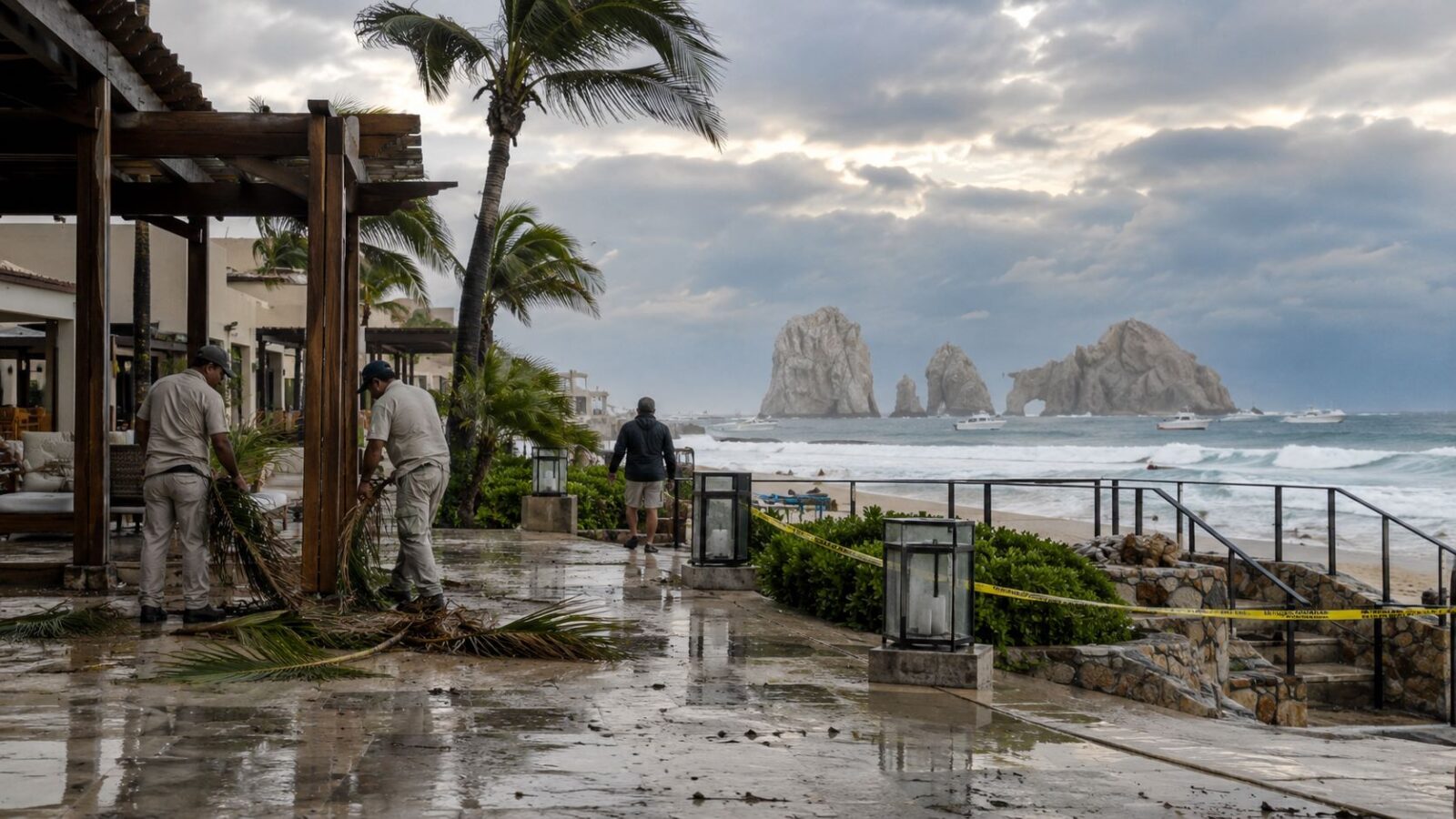
Los Cabos unites with Baja California Sur and others to assess the cost as Hurricane Polo leaves localised tourism damage across Mexico, with the storm disrupting beaches, ports, marine excursions, roads and transport links while sparing the country’s largest resort zones from catastrophic destruction. The uneven impact has left major hotels largely operational, but smaller coastal communities, fishing businesses, tour operators and road-dependent destinations are counting lost revenue, cancelled bookings and repair costs, highlighting how even limited structural damage can create significant economic pressure across Mexico’s Pacific tourism sector.
Los Cabos Avoids Catastrophic Resort Damage but Marine Tourism Takes a Hit
Los Cabos emerged from Hurricane Polo in a far stronger position than initially feared. The destination’s major resorts, hotels and tourism districts avoided widespread structural destruction because the most dangerous part of the storm did not move directly through the heart of the high-density resort corridor.
That did not mean tourism continued normally.
Civil protection measures forced beach closures, while port authorities suspended marine navigation as high winds, dangerous surf and heavy rain approached. For a destination where sport fishing, luxury yacht charters, sailing, diving and boat excursions form a major part of the visitor economy, those closures immediately removed revenue from hundreds of operators.
Advertisement
Advertisement
Los Cabos Tourism Impact
| Area | Impact |
|---|---|
| Major hotel infrastructure | Limited structural damage |
| Beaches | Temporarily closed |
| Marinas and ports | Navigation suspended |
| Yacht excursions | Cancelled or postponed |
| Sport fishing | Temporarily halted |
| Diving and marine tours | Disrupted |
| Restaurants near marine zones | Reduced footfall |
| Overall recovery | Relatively rapid |
Los Cabos therefore illustrates an important difference between physical tourism damage and operational tourism damage. A hotel may remain standing and fully functional, but the wider destination can still lose millions in economic activity if excursions, beaches and transport services stop operating.
For travellers, the recovery can appear rapid because hotels reopen almost immediately. For small businesses, however, lost operating days cannot always be recovered.
Advertisement
Advertisement
Cabo San Lucas Faces Revenue Losses Across Its Excursion Economy
Cabo San Lucas felt the storm primarily through precautionary closures and lost tourism activity rather than large-scale rebuilding requirements. The marina is a key economic engine, connecting tourists with fishing charters, sunset cruises, sailing excursions, water sports and trips around the famous rock formations near Land’s End.
When navigation was suspended, that entire network temporarily stopped.
Advertisement
Advertisement
The impact moves quickly through the local economy. Boat crews lose work, excursion operators issue refunds or reschedule passengers, restaurants receive fewer customers and ground transport providers handle fewer transfers.
The disruption is especially significant because marine tourism is often booked in advance. A visitor whose excursion is cancelled because of a hurricane may not have enough remaining holiday time to reschedule.
This means even a closure lasting only two or three days can permanently remove revenue from that particular travel period.
The broader Los Cabos tourism system has therefore recovered faster than the businesses that depend on daily experiences.
Advertisement
Advertisement
Baja California Sur Takes the Hardest Direct Hit Outside the Main Resort Corridor
Farther north in Baja California Sur, the situation became much more serious. Hurricane Polo made landfall away from the largest tourism centres, affecting communities with smaller hospitality economies and less extensive infrastructure.
Comondú and nearby coastal communities experienced stronger winds, flooding and damage to local buildings and roads. These areas do not have the huge resort inventories of Cabo San Lucas or San José del Cabo, but tourism remains economically important through fishing, surfing, ecotourism, road travel and smaller accommodation businesses.
That creates a different type of vulnerability.
Large hotels often have insurance, backup power systems, emergency teams and access to corporate finance. Smaller guesthouses, restaurants and tour businesses may have far fewer resources available after a storm.
Baja California Sur Impact Profile
| Tourism Sector | Effect |
|---|---|
| Small accommodation businesses | Localised disruption |
| Fishing tourism | Temporary suspension |
| Surf tourism | Unsafe coastal conditions |
| Road tourism | Interrupted by flooding |
| Utilities | Localised outages |
| Community tourism | Significant short-term disruption |
| Major resorts | Largely outside hardest-hit zone |
The economic effect may therefore be smaller nationally but much more severe locally.
Comondú and Puerto San Carlos Face a More Difficult Recovery
Comondú and the surrounding coastal region illustrate why smaller tourism destinations can face longer recovery timelines even when national headlines describe limited damage.
Advertisement
Advertisement
The direct storm impact produced flooding, property damage and disruption to local services. Fishing and nature-based tourism were particularly exposed because both depend on functioning roads, docks and coastal access.
Visitors travelling through this part of Baja California Sur are often attracted by wildlife, remote landscapes, fishing and low-density tourism rather than large resorts.
That gives the area a distinctive tourism identity, but it also creates dependence on infrastructure that can be vulnerable during hurricanes.
A damaged local road can prevent guests from reaching a small hotel. A damaged harbour can stop an operator from running fishing trips. A prolonged electricity interruption can force businesses to remain closed even if their buildings survive.
For Comondú, the recovery challenge is therefore not simply reopening hotels. It is restoring the entire tourism chain.
Loreto Faces the Tourism Cost of Transport Disruption
Loreto’s experience during Hurricane Polo demonstrates how quickly tourism can be weakened when accessibility becomes uncertain.
Advertisement
Advertisement
The historic destination depends heavily on air arrivals, road connections and marine activities. Heavy rain and runoff increased the risk of road closures, while mudslides and flooding complicated regional travel.
Flight schedules also faced disruption as weather conditions worsened.
For travellers, logistical uncertainty can be enough to change behaviour even if the destination itself suffers limited structural damage. Visitors may postpone arrivals, cancel excursions or shorten stays because they are unsure whether roads, airports or attractions will remain accessible.
Loreto Tourism Pressure Points
| Tourism Component | Hurricane Effect |
|---|---|
| Airport operations | Delays and cancellations |
| Road access | Flood and mudslide risk |
| Marine excursions | Temporary disruption |
| Hotels | Operational but affected by cancellations |
| Tour operators | Lost or rescheduled bookings |
| Visitor confidence | Temporarily weakened |
Loreto’s recovery therefore depends heavily on restoring confidence in transport reliability.
Once flights, highways and marine operations return to normal, tourism can rebound quickly because the destination’s main attractions remain intact.
Sonora Becomes the Second Major Impact Zone
After crossing Baja California Sur, Polo moved across the Gulf of California and affected mainland Sonora.
Advertisement
Advertisement
By that stage, the storm had weakened, but heavy rain and flooding still created substantial risks. Authorities suspended non-essential activities in several municipalities, while schools, recreational facilities and public services closed temporarily.
Tourism effects were particularly important in areas reliant on road travel, domestic tourism and adventure experiences.
Hermosillo and surrounding municipalities did not face a classic resort shutdown, but road closures and public safety restrictions limited visitor movement.
The broader economic damage was therefore concentrated in interruptions rather than major tourism infrastructure losses.
For a region dependent on road access, even short-term flooding can disrupt:
- Hotel arrivals
- Domestic road trips
- Adventure tourism
- Nature excursions
- Restaurants
- Local transport
- Regional events
Sonora shows how hurricanes can continue producing tourism losses well after their peak winds have weakened.
Advertisement
Advertisement
Puerto Vallarta and Jalisco Face Flooding From Polo’s Outer Bands
Hurricane Polo also affected Jalisco even though the storm’s centre remained offshore during part of its northward movement.
Heavy rain, dangerous surf and strong coastal currents produced localised flooding and disruption in tourism areas, including Puerto Vallarta.
The city’s tourism sector is heavily dependent on beaches, waterfront hotels, excursions and marine recreation, so dangerous sea conditions had an immediate economic effect even without a direct landfall.
The wider state also suffered severe flooding in inland communities.
For Puerto Vallarta, the main tourism challenge was not widespread resort destruction but a temporary loss of usable tourism space.
Beaches closed. Excursions were cancelled. Some waterfront areas experienced flooding. Outdoor activities were suspended.
Advertisement
Advertisement
This creates a pattern similar to Los Cabos: the destination’s tourism infrastructure may survive, but economic activity is interrupted almost instantly when visitors cannot safely use the coast.
Beach and Port Closures Become One of the Biggest Immediate Tourism Losses
Across Mexico’s Pacific coast, port and beach closures represented one of the clearest and fastest economic consequences of Hurricane Polo.
These closures were essential for safety, but they effectively switched off entire tourism sectors.
Businesses Most Exposed to Temporary Closures
- Sport-fishing operators
- Diving centres
- Yacht charters
- Sailing companies
- Beach clubs
- Water-sports businesses
- Whale and wildlife excursions
- Marina restaurants
- Coastal transport operators
The losses are particularly difficult to measure because many involve small businesses rather than major hotel groups.
A cancelled hotel reservation appears clearly in tourism statistics. A fishing charter losing three days of departures may never appear in a national economic report.
Yet collectively, these small losses can represent a major local economic shock.
Advertisement
Advertisement
For many operators, the storm’s real cost was not rebuilding boats or hotels. It was simply being unable to trade.
Mexico’s $175 Million Catastrophe Bond Draws Attention
Hurricane Polo also became a financial-market event because of Mexico’s sovereign catastrophe insurance structure.
The country maintains catastrophe-bond protection designed to provide emergency financing when storms meet predefined conditions.
One of those instruments carried approximately $175 million in exposure.
The extreme offshore intensity of Polo brought the bond under scrutiny because the hurricane’s central pressure reached levels severe enough to raise questions about potential payout triggers.
However, the storm’s final track proved critical.
Advertisement
Advertisement
Because Polo passed through less densely developed parts of Baja California Sur and weakened before affecting mainland Mexico, initial assessments suggested that a maximum payout was unlikely.
This outcome reflects an important distinction: catastrophe bonds are generally triggered by specific physical storm parameters and geographic criteria rather than by ordinary assessments of visible property damage.
For Mexico, avoiding a major payout event preserves financial capacity for future disasters, but it does not eliminate the need for local recovery funding.
Major Resort Infrastructure Avoids an Otis-Scale Disaster
One of the biggest reliefs for Mexico’s tourism industry is what did not happen.
Hurricane Polo did not reproduce the catastrophic destruction associated with Hurricane Otis in Acapulco in 2023.
Otis caused enormous structural and insured losses after striking a dense tourism centre with exceptional intensity.
Advertisement
Advertisement
Polo behaved very differently.
Its highest winds remained offshore, and the system weakened before reaching Mexico’s most valuable resort infrastructure.
That spared Los Cabos from the kind of hotel destruction that can remove thousands of rooms from the market for months.
Comparison of Tourism Damage Profiles
| Factor | Hurricane Polo | Otis-Type Major Resort Disaster |
|---|---|---|
| Major hotel destruction | Limited | Extensive |
| Long-term room closures | Minimal | Potentially months |
| Marine operations | Temporarily halted | Often severely damaged |
| Road infrastructure | Localised damage | Broad disruption |
| Recovery period | Relatively short in major resorts | Potentially prolonged |
| National tourism effect | Limited | Much larger |
This is why Polo’s economic impact is expected to remain regional rather than nationwide.
Small Tourism Businesses Carry a Disproportionate Burden
Mexico’s national tourism industry avoided catastrophic financial damage, but that does not mean every tourism business escaped easily.
Smaller operators are often more vulnerable than major resorts because their cash flow depends on daily bookings.
Advertisement
Advertisement
A family-owned excursion company may have no revenue if the port closes. A beachfront restaurant may see customer numbers collapse even though the building itself is unharmed. A small hotel in a road-dependent community may lose guests if highways remain inaccessible.
These businesses are essential to the visitor experience but are often less visible in national insurance figures.
The recovery challenge therefore needs to consider:
- Temporary income support
- Fast infrastructure repair
- Port reopening
- Road clearance
- Electricity restoration
- Business insurance access
- Visitor communication
Polo demonstrates that tourism resilience cannot be measured only by whether five-star resorts remain standing.
Cancun, Riviera Maya and Mexico City Remain Outside the Hurricane Zone
Mexico’s greatest protection comes from the geographic diversity of its tourism industry.
Cancún, Riviera Maya and Mexico City remained completely outside Polo’s direct impact zone.
Advertisement
Advertisement
This is important because these destinations represent some of the country’s largest sources of tourism revenue.
A hurricane affecting the Pacific coast therefore does not automatically create a nationwide tourism crisis.
The ability of unaffected destinations to continue operating also helps stabilise:
- Airline capacity
- International visitor arrivals
- National hotel occupancy
- Tourism employment
- Foreign exchange earnings
This geographic diversification is one of Mexico’s strongest tourism resilience advantages.
International travellers also benefit because alternative destinations remain available even when one region faces disruption.
The Economic Damage Is Localised but Real
The financial consequences of Polo can be divided into three distinct categories.
Advertisement
Advertisement
| Economic Area | Expected Impact | Main Cause |
|---|---|---|
| Sovereign catastrophe exposure | Limited | Track and weakened landfall |
| Major resort infrastructure | Low | High-density resort zones avoided worst impact |
| Small tourism operators | Moderate locally | Beach, port and excursion shutdowns |
| Municipal infrastructure | Moderate | Flooding and road repairs |
| Airline and travel services | Short-term | Delays and rebooking |
| National tourism economy | Limited | Major tourism centres remained operational |
This distinction matters because it prevents two misleading conclusions.
The first would be that Mexico suffered a tourism catastrophe. It did not.
The second would be that Polo had almost no economic effect. That is also inaccurate.
The losses were concentrated in specific destinations, specific businesses and specific operating days.
Hurricane Polo Exposes a Bigger Climate-Risk Question for Mexican Tourism
Perhaps the most important long-term issue is the storm’s rapid intensification.
Polo strengthened dramatically over unusually warm Pacific waters before reaching Category 5 intensity offshore.
Advertisement
Advertisement
For tourism authorities, rapid intensification reduces preparation time.
Hotels have less time to secure property. Airlines have less time to adjust schedules. Ports must close quickly. Visitors must make decisions about whether to remain, evacuate or cancel activities.
This creates a growing need for stronger tourism resilience systems.
Tourism Resilience Priorities
- Better storm communication
- Faster visitor alerts
- Hotel backup power
- Emergency transport planning
- Stronger coastal infrastructure
- Rapid port inspection
- Road-drainage improvements
- Flexible airline rebooking
- Insurance for small operators
- Clear reopening protocols
The objective is no longer simply surviving a hurricane.
It is reducing the amount of time a destination remains economically inactive after the storm passes.
Mexico’s Pacific Tourism Sector Moves Quickly Back Toward Normal Operations
The positive development after Polo is the speed with which major destinations have been able to move towards normal operations.
Advertisement
Advertisement
Because large-scale hotel destruction was avoided, tourism businesses in Los Cabos and other established resort markets have been able to reopen far more quickly than would have been possible after a catastrophic direct hit.
Beaches and marine operations can resume once authorities determine that conditions are safe.
Airline schedules can normalise once airports and weather conditions permit.
Hotels can return to regular operations without waiting months for reconstruction.
For travellers, this means the disruption is likely to be temporary across most major tourism areas.
For local businesses in harder-hit communities, however, recovery could take longer.
Advertisement
Advertisement
Los Cabos and Baja California Sur Reveal the Two Faces of Hurricane Recovery
Hurricane Polo leaves Mexico with a divided tourism picture.
Los Cabos demonstrates resilience. Its major resort infrastructure survived, allowing the destination to recover rapidly once safety restrictions were removed.
Smaller areas of Baja California Sur demonstrate vulnerability. Flooding, damaged roads, utility problems and local business interruptions can have a much greater impact in destinations with fewer resources.
Sonora adds another dimension, showing how a weakened hurricane can still damage regional mobility.
Puerto Vallarta and Jalisco demonstrate the reach of a storm whose centre never needed to make a direct local landfall to disrupt tourism.
Together, these areas show why national averages can conceal local hardship.
Advertisement
Advertisement
Mexico Avoids a Tourism Catastrophe but Receives a Major Warning
Hurricane Polo ultimately left Mexico’s tourism industry with a warning rather than a nationwide disaster.
The country avoided mass hotel destruction. Los Cabos remained fundamentally intact. Cancún and Riviera Maya were unaffected. Mexico City continued operating normally. The largest national tourism engines therefore remained functioning.
But the storm still exposed important weaknesses.
Small coastal businesses lost operating days. Regional roads flooded. Marine activities stopped. Airports faced disruption. Communities outside the main resort corridors absorbed more direct physical impacts.
The economic lesson is therefore clear: tourism resilience depends on far more than protecting hotels.
It requires functioning ports, roads, airports, utilities and small businesses.
Advertisement
Advertisement
Hurricane Polo may have spared Mexico from the worst-case scenario in 2026, but its rapid intensification and wide regional disruption show that Pacific tourism destinations must continue preparing for storms capable of moving from distant weather systems to major economic threats in a remarkably short period.
Los Cabos unites with Baja California Sur and others to assess the cost as Hurricane Polo leaves localised tourism damage across Mexico, driven by beach closures, port disruption, flooding, cancelled tours and transport delays.
In conclusion, Los Cabos unites with Baja California Sur and others to assess the cost as Hurricane Polo leaves localised tourism damage across Mexico, with losses driven by beach and port closures, disrupted excursions, flooded roads, transport delays and lost operating days. While major resorts escaped catastrophic destruction, smaller coastal communities and tourism businesses now face the challenge of restoring infrastructure, recovering revenue and rebuilding traveller confidence.
Advertisement
