
France Sugiton Offers a Powerful Lesson in Protecting Popular Nature Sites

Published
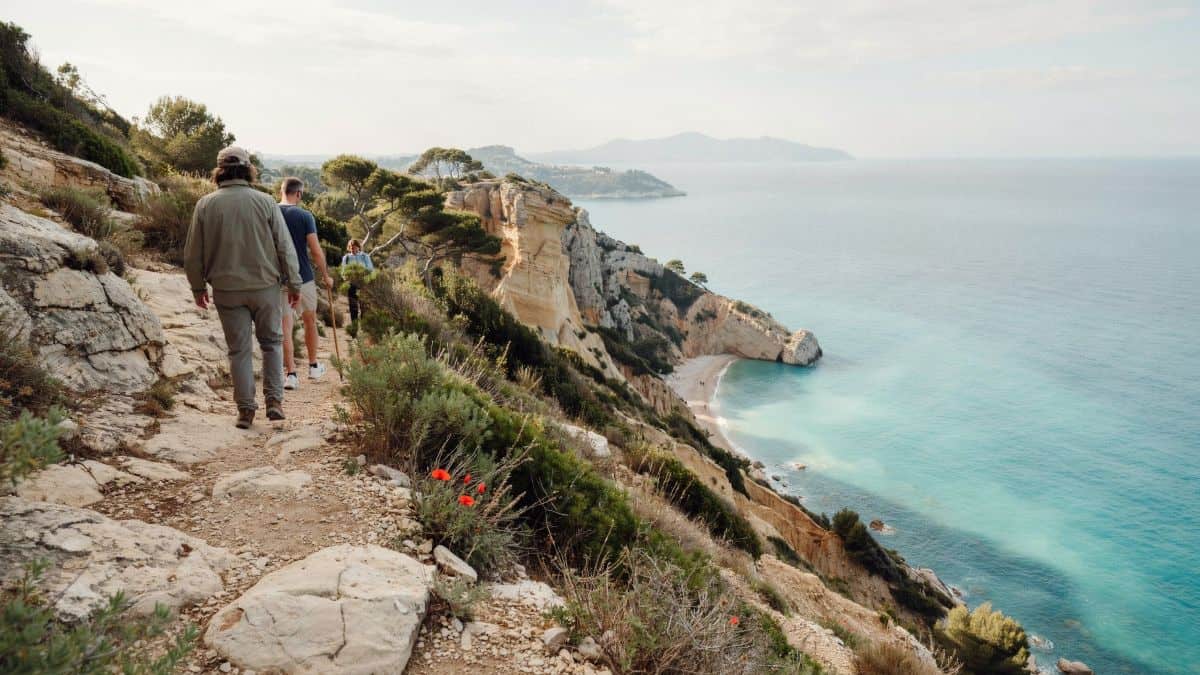
At France’s Sugiton site, we see an excellent example of how limiting the number of visitors could help restore the damaged environment. As reported by the local park officials, erosion rates have decreased and vegetation is starting to come back – small plants and young pines have been identified here. However, these developments are still preliminary and it is impossible to claim that the damage will be undone by now. The assessment of the situation by Calanques National Park will be available in 2027. Other locations in Europe are implementing various solutions to deal with the growing pressure – from the parking reservation system to temporary transport organization and prediction of the number of visitors. Different measures work in different environments because each location has a specific problem that should be solved there. Thus, travelers will be affected by these rules, which makes the story of Sugiton relevant for all of us.
Sugiton’s first signs of recovery put conservation in focus
Sugiton sits within the Calanques National Park, near Marseille. It is a steep, popular coastal site where paths descend towards the water. Heavy footfall had a visible cost. The park says visitors’ repeated steps pushed soil downhill towards the shore. Roots of older pines became exposed. New plants struggled to grow. The risk, it warned, was long-term damage to the cove’s landscape and wildlife.
The park responded with a free reservation system. During the busiest summer dates, visitors had to book before entering the Sugiton and Pierres Tombées area. The system does not charge an entry fee. It does limit the number of people who can use the sensitive coastal zone on covered dates.
In April 2026, France’s ecological ministry reported the early observations shared by the park. Officials had seen erosion slow, humus begin to form again, small plants return and new pines take root. The park says the cove now receives up to 400 people a day under the reservation measure. Its own visitor information describes previous summer peaks of 2,500 a day. A government interview cites a former capacity of up to 3,500 people on the small beaches. These figures come from different official descriptions, so they should not be combined into a single calculation.
Advertisement
Advertisement
The early signs are promising. They are not a final verdict. The park says researchers are monitoring the site, and officials plan a full review in 2027. The strongest story is therefore not that one booking system has solved overtourism. It is that a local authority is testing whether fewer visitors can give a damaged habitat room to recover.
Why the full result matters more than a lower visitor count
A lower daily total is easy to report. It does not, on its own, prove that nature has recovered. A conservation assessment needs to track changes over time. At Sugiton, useful measures include whether soil stays in place, whether vegetation cover expands, whether young trees survive and whether visitors remain on marked paths.
Advertisement
Advertisement
This matters because the park’s stated aim is both to slow erosion and preserve opportunities to visit. The site is not being presented as permanently closed. The reservation requirement applies to selected dates during the high-pressure period. In 2026, those dates included 20 and 21 June, each day from 27 June to 30 August, and two weekends in September. The park has announced the system through 2027 while it gathers evidence.
The system has practical limits. Fire-risk closures cancel bookings, and mobile reception at the cove is weak. The park advises visitors to download or print their confirmation before travelling.
Advertisement
Advertisement
These details give the article a useful travel-service dimension. Readers need to know when a permit applies, how to show it and what can cancel a visit. They also deserve a clear account of what researchers still need to establish. A conservation policy is credible when it reports both its early promise and the work still under way.
Slovenia is managing cars at Vršič, not closing the pass
Slovenia’s Vršič Pass offers a different case. The road crosses the Julian Alps between Kranjska Gora and the Soča Valley. In September 2026, new parking and traffic arrangements took effect at the top of the pass. The Slovenian government said the goal was safer, more orderly visits and better protection of the sensitive mountain environment.
The public parking area has 80 spaces for cars, three accessible spaces, 24 motorcycle spaces, two bus spaces and eight short-stay car spaces. Drivers see occupancy information before reaching barriers on either side. A right-hand lane serves people seeking a space at the summit. A separate lane allows other road users to continue across the pass or towards other destinations. If the summit car park is full, drivers can turn around or continue their journey.
This is a vehicle-management system. It is not a cap on every person entering the wider mountain area, and it does not close the road to through traffic. That distinction matters. Car-park spaces can be counted. The number of people using nearby trails, mountain huts or other parking areas requires separate information.
Advertisement
Advertisement
The 2026 arrangements also changed during the summer. Earlier guidance said summit parking would not yet be allowed during the season, while the later government update announced that the new spaces would open from 1 September. The later notice is the correct source for the September system. Parking was set to remain free through the end of 2026.
Slovenia had also offered free buses across the pass from 1 June to 30 September, with more frequent service during the busiest weeks. That was a seasonal alternative to driving, not evidence of an October bus service. Together, the measures raise a valuable question: do parking information and public transport help reduce queues and pressure on the pass? Officials would need to publish traffic and bus-use figures to answer it.
Italy’s Tre Cime reservations make the journey part of the story
At Tre Cime di Lavaredo in the Dolomites, access management starts before the walk. Visitors who want to drive to the Rifugio Auronzo car park need an online reservation. The booking system requests contact details and the vehicle registration number. Its calendar shows available dates and times.
Auronzo di Cadore’s 2026 municipal tariff lists €40 for a car, €26 for a motorcycle and €60 for a campervan or motorhome. Residents of Auronzo have a listed reduced rate of €5 for their vehicles. The tariff applies to parking and road access under the municipal rules. It should not be described as a general fee for hiking in the Dolomites.
The system makes road capacity easier to manage, but it changes how visitors plan. A traveller needs to check availability, book the right vehicle and understand the time slot. The official portal says a public transport option is available from Auronzo, Dobbiaco and Cortina for people who cannot or do not wish to secure a parking reservation. Travellers should check current local transport details before setting out.
This case lets the article ask who benefits from digital booking and who may face extra friction. Can visitors using a rental car update its registration number? Are accessible spaces available in practice? Do buses run at useful times for walkers? The official system addresses some of these details, but broader claims about fairness or environmental success need evidence from the municipality.
Advertisement
Advertisement
An online reservation can regulate cars, but it cannot show whether trails are quieter or habitats are recovering. Authorities need visitor and conservation monitoring to answer that.
Spain’s Cíes Islands show why quieter months still have rules
The Cíes Islands belong to Galicia’s Atlantic Islands National Park. In high season, visitors travelling by public boat need advance authorisation from the Xunta de Galicia before they buy a ferry ticket. The park describes the high-season period as Easter and 15 May to 15 September. It publishes a daily visitor limit of 1,600 to 1,800 people for Cíes.
The system changes outside peak season. The park says public-boat visits during the rest of the year are available through organised groups with accredited guides. Those guides may take no more than 25 people in a group. Private boats follow another process, with navigation and anchoring permits. The park publishes separate limits for daily anchorages.
This is a strong example for a 2026 article because it shows that seasonal travel is not simply a matter of arriving when fewer tourists are around. The way a visitor can reach the islands may change with the calendar. Travellers need to check the current season, secure the required authorisation and understand whether their visit must be guided.
Galicia has also used guided visits to encourage interest outside the summer peak. In early 2026, the regional government offered 100 places on six guided routes across Cíes, Ons and Cortegada between February and April. The walks were free, but visitors paid for boat travel. This is a specific attempt to introduce people to the islands in a more organised way. It is not proof that tourism demand shifted away from summer. Attendance, visitor origin and local economic data would be needed to measure that result.
Norway’s forecast could help teams prepare before crowds arrive
At Preikestolen in Norway, the new research concerns a different stage of visitor management. SINTEF and Lysefjorden Utvikling combined data that already existed: trail-counter records, weather, road traffic and cruise calls in Stavanger. They trained a machine-learning model to predict visitor numbers 24 hours ahead and tested it against observed figures from 2025 and 2026.
Advertisement
Advertisement
The potential use is practical. If local teams know that a busy period is coming, they could plan staff, manage traffic, arrange extra shuttle buses or tell visitors when a quieter time may be available. The research announcement describes strong potential, but it does not report a measured fall in queues, accidents or environmental damage. It also says the data still had to be retrieved manually and that the model needed more development before full-scale use.
The official Preikestolen visitor website currently displays an hourly forecast for the next 36 hours. It encourages hikers to consider the time of day, weather and daylight. This public visitor tool should be described separately from the SINTEF experiment, which tested a 24-hour prediction. The two sources do not establish that they are the same model or that one replaced the other.
A forecast can support decisions, but it cannot set a trail’s safe capacity or move visitors by itself. The next test is whether local teams can act on it and measure the result.
Europe needs evidence that connects visitor data with nature
Sugiton, a French national park in 2026, demonstrates how Europe could face the challenge of tourism by pointing out early signs of recovery from natural damage due to limiting access of visitors. Still, no solution is applicable to all destinations in the same way. Various measures such as booking systems, restrictions on parking lots, shuttle services in certain seasons and forecasts of the number of visitors are tested in different places in Europe. These tools target various aspects of the issue, and, therefore, should be measured individually. Thus, for instance, forecasts can help the staff to get ready for long periods of high traffic, while visitor limitation would be useful to preserve the vulnerable place. Nevertheless, the reduced number of visitors cannot be considered as the evidence of habitat recovery since the officials should follow up on the condition of trails, queues, transportation use and other factors related to the region around the destination. The data collected by Eurostat in 2025 shows that summer is the most crowded period of accommodation in the whole European Union. However, the statistics does not include visitors at the individual nature locations. This makes progress in Sugiton more important, while the conservation evaluation stays
Advertisement
