
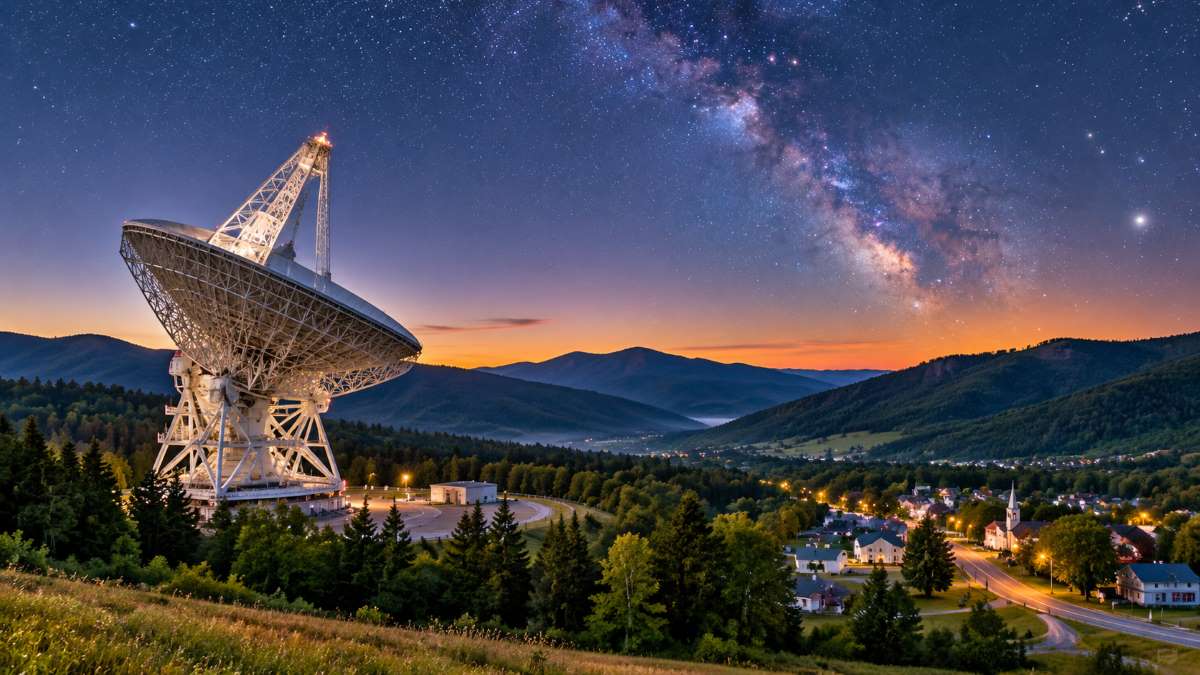
Image generated with Ai
Green Bank, West Virginia is considered one of the best tourist destinations in the United States because it has something that is nearly impossible to find around the world: a place where silence is scientifically important. Green Bank’s location in Pocahontas County is indoors the United States National Radio Quiet Zone (NRQZ), a 13,000-square mile protective area made in 1958 to reduce radio frequency interference and to safeguard scientific observations in Green Bank Observatory and other sensitive sites.
Green Bank is internationally recognized as the “quietest town in America.” A big draw is not lack of technology, but the controls the town has over its tech. Green Bank combines things like the outdoors, the beautiful rural landscapes, and astronomy to make a unique destination. The low-interference environment also has attracted science travelers and star gazers.
Advertisement
Where most tourist places are trying to innovate with more technology, Green Bank is doing just the opposite. Instead of competing with the rest of the world for the most connectivity, they have chosen radio quietness as their main attraction. Due to the community’s excellent tech controls, devices can seriously interfere with scientific research. With the absence of wireless systems, travelers can help scientists hear messages that have traveled over the span of billions of miles. Advanced astrophysics meets rural America at Green Bank.
The story of Green Bank begins with the National Radio Quiet Zone, one of the world’s most important protected areas for radio astronomy. Established by the Federal Communications Commission (FCC) in 1958, the NRQZ was created to minimise harmful interference affecting the National Radio Astronomy Observatory in Green Bank and radio receiving facilities at Sugar Grove, West Virginia. The protected region covers approximately 13,000 square miles across parts of West Virginia, Virginia and Maryland. Within this area, new or modified fixed radio transmitters require coordination to ensure they do not interfere with sensitive scientific operations.
Advertisement
Advertisement
Green Bank’s importance comes from its role as the home of the Green Bank Observatory, which operates the Robert C. Byrd Green Bank Telescope (GBT). The telescope is the world’s largest fully steerable radio telescope and allows researchers to study radio waves produced by distant objects throughout space. Unlike visible-light telescopes, radio telescopes detect invisible signals that are often extremely weak when they reach Earth. Signals from distant galaxies, pulsars and interstellar gas clouds can easily be overwhelmed by human-made radio emissions from everyday technology. For scientists, keeping the surrounding environment quiet is essential. For travellers, that same scientific requirement has transformed Green Bank into a destination built around discovery.
Green Bank does not follow the traditional tourism model. There are no major entertainment districts, dense urban attractions or high-tech visitor experiences. Instead, the destination offers something increasingly rare — an opportunity to experience a place shaped by scientific protection. The Green Bank Observatory has become the centre of astronomy tourism in West Virginia. Visitors can explore exhibits, learn about radio astronomy and understand how scientists use the telescope to investigate some of the biggest questions about space.
The attraction is not only the giant telescope itself. The entire environment tells a story.
Travellers can experience:Experience Tourism Value Green Bank Observatory visits Educational astronomy tourism Robert C. Byrd Green Bank Telescope One of America’s most unique scientific landmarks Appalachian mountain scenery Nature and outdoor tourism Low-radio environment Digital detox and slow travel experience Stargazing opportunities Space and astronomy-focused travel
The combination of science and nature gives Green Bank a distinctive position within America’s growing niche tourism market. As travellers increasingly search for meaningful experiences rather than ordinary sightseeing, destinations connected with science, conservation and cultural uniqueness are gaining attention.
The idea of a town without modern technology is one of Green Bank’s biggest attractions, but the reality is more complex. The area does not completely ban technology. Instead, it carefully manages equipment that can create harmful radio frequency interference. The restrictions are strongest close to the observatory, especially within the immediate protection areas surrounding the telescope.
Some commonly affected technologies include:Technology Management in Green Bank Mobile phone networks Cellular infrastructure is limited near sensitive areas Wi-Fi routers Wireless networks require careful management close to the observatory Smart doorbells Devices using Wi-Fi or Bluetooth can create unwanted signals Cordless phones Restricted because they transmit radio frequencies Microwave ovens Faulty equipment can create interference Drones and wireless devices Controlled near scientific facilities
Residents and businesses have adapted through alternatives such as wired internet connections, traditional telephones and non-wireless equipment. The result is a community where people think differently about everyday technology. A device that is harmless in most cities can become a challenge in a place where scientists are trying to detect extremely weak signals from deep space.
Although Green Bank is famous for silence, maintaining that silence requires some of the most advanced monitoring technology available. The observatory’s interference protection teams use specialised equipment, including spectrum analysers and monitoring vehicles, to identify unwanted signals that may affect observations. When interference occurs, technicians locate the source and work with residents, businesses or visitors to reduce the problem.
Most cases are accidental rather than intentional. Common sources can include malfunctioning electronics, electrical equipment, wireless devices or visitors carrying active technology into sensitive areas. This process highlights an important reality about Green Bank. The community is not against technology. Instead, it protects a unique scientific environment where technology must operate responsibly.
The future of Green Bank is being shaped by a major challenge facing radio astronomy worldwide — the rapid growth of wireless technology. Satellite internet networks, including low-Earth-orbit satellite systems, have created new discussions about how modern communication can coexist with scientific research.
Unlike traditional ground-based transmitters, satellites send signals from above the telescope, creating different technical challenges. Scientists and satellite operators have explored coordination methods to reduce interference risks while maintaining connectivity. These developments show that the National Radio Quiet Zone continues to evolve. The goal is no longer simply protecting a silent environment but creating a balance between scientific discovery and the communication needs of modern communities. Green Bank’s future depends on maintaining this delicate relationship.
Green Bank reflects a wider global tourism trend: travellers are increasingly searching for authentic, educational and meaningful destinations. Science tourism has expanded as visitors look beyond traditional attractions and seek places connected with discovery and innovation. Green Bank fits perfectly into this movement because visitors can experience a real scientific environment rather than simply viewing science through museums or documentaries.
The destination also connects with the growing popularity of digital detox travel. Many travellers now seek locations where they can slow down, reconnect with nature and escape the constant pressure of online life. However, Green Bank’s appeal is not based on rejecting modern society. Its attraction comes from showing that technology can be carefully managed to protect something greater — humanity’s ability to understand the universe.
Green Bank, West Virginia, offers one of the country’s most innovative ways to combine unique travel experiences with its unique approach to addressing a scientific need. The combination of silence as a vital tool for research and nearby science-inspired attractions offers travelers an experience unlike any other. The silence within the National Radio Quiet Zone does not mean the absence of sound. It allows scientists the ability to study and better understand the space beyond the boundaries of the planet and search for new and unknown phenomena.
Green Bank combines its surroundings of beautiful Appalachian nature with astronomy and old-world technology and offers travelers a unique shift in way of life, where each and every electronic signal matters. In an increasingly interconnected world, Green Bank offers travelers the most powerful and unique travel destination by breaking the connection.
Advertisement
Tags: astronomy tourism USA, Green Bank Observatory, Green Bank West Virginia tourism, National Radio Quiet Zone, quietest town in America
Advertisement
Advertisement













Friday, September 4, 2026

Friday, September 4, 2026
Friday, September 4, 2026

Friday, September 4, 2026

Thursday, September 3, 2026

Wednesday, September 2, 2026

Friday, September 4, 2026

Friday, September 4, 2026


