
Dubai Reinvents Last-Mile Travel with New JLT Link Connecting Metro Stations to Business and Residential Clusters with Greater Ease – A Win for Daily Commuters

Published
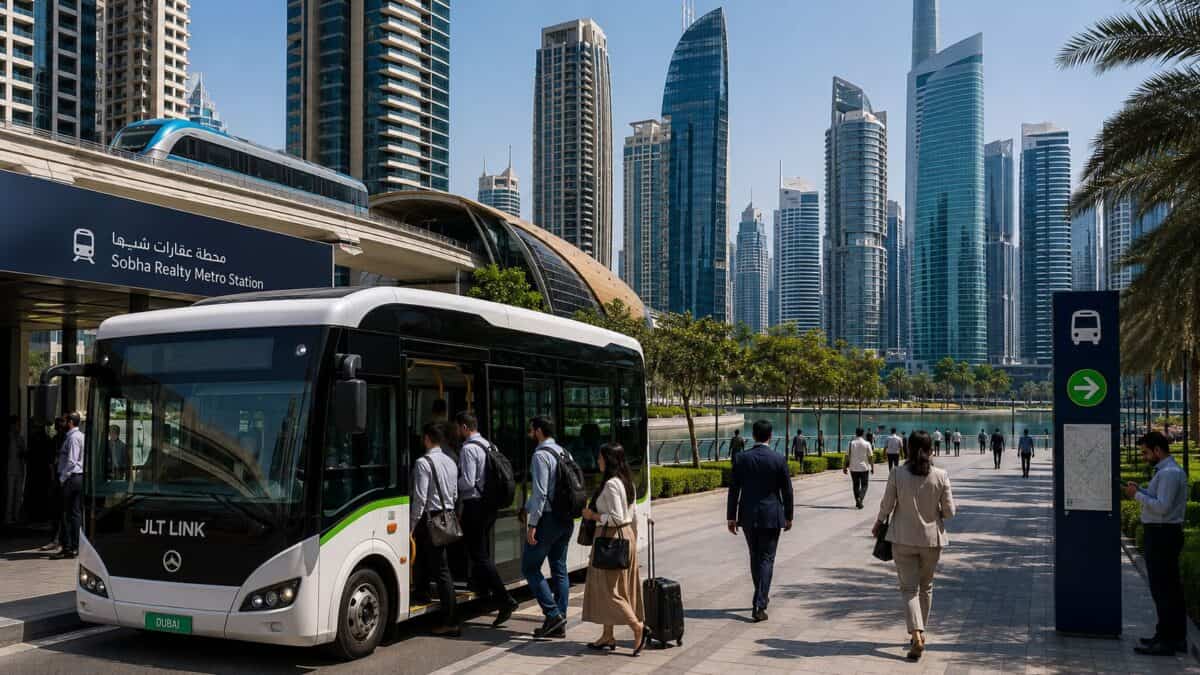
Image generated with Ai
Through the opening of the Dubai JLT Link, a neighbourhood shuttle system, Dubai has made progress in expanding their public transport system. The new system now addresses the mobility gap between Metro stations and the many office and residential towers in the Jumeirah Lakes Towers (JLT). The new service was opened August 1, 2023, offering free rides and then a fare of 3 dirham to provide a faster and easier transport option for commuters, residents, and visitors. The transport system connects the Sobha Realty Metro Station and the DMCC Metro Station and the many clusters in JLT, furthering the goal of an integrated and flexible transport system.
Beyond the routine commute, the new service system connects business travelers to meetings, tourists to JLT hotels, digital nomads to co-working spaces, and professionals traveling throughout Dubai. The new electric bus system replaces long walks between Metro stations and the JLT clusters of buildings. The new transport option also integrates with the Dubai Metro, bus and tram services. The integration of the new transport option reduces the reliance on personal vehicles and promotes shared mobility services, which improve air quality.
Advertisement
Advertisement
Dubai JLT Link Addresses One of Dubai’s Biggest Urban Mobility Challenges
Although Dubai Metro has become one of the world’s most successful automated rail systems, many commuters have continued to face a common obstacle after arriving at their destination station—the final walk to offices, hotels or residential buildings.
In Jumeirah Lakes Towers, this challenge has been particularly noticeable. The community comprises dozens of high-rise commercial and residential towers arranged across numerous alphabetically designated clusters surrounding artificial lakes and landscaped public spaces. While both Sobha Realty Metro Station and DMCC Metro Station provide excellent regional connectivity, many destinations within the district remain a considerable walking distance away.
Advertisement
Advertisement
The newly introduced Dubai JLT Link effectively fills this mobility gap.
Advertisement
Advertisement
Rather than requiring commuters to spend between ten and twenty minutes walking during Dubai’s intense summer temperatures, passengers can now complete the final portion of their journey aboard a neighbourhood electric shuttle specifically designed for local circulation.
For travellers unfamiliar with Dubai, this improvement is equally valuable. Visitors carrying luggage, families with children and business delegates attending meetings in JLT can now reach destinations more comfortably without relying on taxis for relatively short distances.
Electric Shuttle Service Creates Two Dedicated Loops Across JLT
The newly introduced transport service operates using two independent circular routes, ensuring coverage across virtually the entire Jumeirah Lakes Towers community.
Advertisement
Advertisement
The western loop provides connections between DMCC Metro Station and clusters A through N, while the eastern loop links Sobha Realty Metro Station with clusters O through Z.
Instead of creating entirely new stopping points, the buses utilise existing RTA bus stops distributed throughout the community, allowing passengers to board and disembark conveniently without requiring additional infrastructure.
Advertisement
Advertisement
According to operational information released during the service launch, a complete circuit requires approximately 10 to 22 minutes depending on internal traffic conditions and passenger demand.
Services are expected to operate approximately every 20 to 30 minutes throughout the day, enabling commuters to coordinate journeys with Metro arrival times.
Dubai JLT Link at a Glance
| Feature | Details |
|---|---|
| Service Name | Dubai JLT Link |
| Launch Date | 1 August 2026 |
| Launch Fare | Free introductory rides |
| Standard Fare | Dh3 per journey |
| Transport Type | Electric neighbourhood shuttle |
| Western Route | DMCC Metro Station – Clusters A to N |
| Eastern Route | Sobha Realty Metro Station – Clusters O to Z |
| Stops | Existing RTA bus stops |
| Estimated Loop Time | 10–22 minutes |
| Expected Frequency | Every 20–30 minutes |
Why Last-Mile Connectivity Matters for International Travellers
Across major cities worldwide, transport experts increasingly identify “last-mile connectivity” as one of the decisive factors influencing whether travellers choose public transport over private vehicles.
The Metro journey itself often accounts for only part of the overall travel experience. If passengers must walk long distances after leaving the station, especially during extreme weather conditions, the attractiveness of public transport declines considerably.
Dubai experiences prolonged periods of high summer temperatures, frequently exceeding 40°C. Under such conditions, even relatively short outdoor walks can become uncomfortable for visitors unfamiliar with the climate.
Advertisement
Advertisement
The Dubai JLT Link directly addresses this challenge.
For international tourists staying in JLT’s hotels, business travellers attending conferences, expatriate professionals and residents commuting daily, the service reduces physical effort while creating a more seamless journey between Metro stations and final destinations.
The initiative also supports Dubai’s wider tourism objectives by making one of its most important mixed-use districts easier to navigate without depending exclusively on taxis or ride-hailing services.
How the New Service Fits Within Dubai’s Expanding Mobility Strategy
Dubai has invested heavily over the past two decades in creating one of the Middle East’s most integrated public transport systems.
Today, passengers benefit from extensive Metro, tram, bus, marine transport and shared mobility options managed by the emirate’s transport authorities.
Advertisement
Advertisement
However, authorities have increasingly recognised that successful public transport depends not only on major infrastructure but also on efficient neighbourhood-level connections.
Recent mobility initiatives have therefore focused on improving feeder services, digital journey planning, smart ticketing and environmentally sustainable transport solutions. The introduction of neighbourhood shuttle services complements these broader investments by extending the practical reach of existing Metro infrastructure rather than constructing entirely new transport corridors.
Where Dubai JLT Link Fits Within the Journey
| Journey Stage | Existing Transport | Improvement Introduced |
|---|---|---|
| Long-distance travel | Dubai Metro | No change |
| Arrival at Metro station | Sobha Realty / DMCC | Direct neighbourhood connection |
| Final journey to office or residence | Walking or taxi | Electric shuttle bus |
| Payment | Dh3 standard fare | Free introductory launch rides |
| Sustainability | Public transport | Additional electric mobility option |
For Dubai’s rapidly growing business districts, neighbourhood shuttle services such as the Dubai JLT Link demonstrate how relatively modest transport investments can significantly improve the overall passenger experience by removing one of the most common barriers to using public transport. The initiative represents a practical enhancement rather than a major infrastructure project, yet its impact on daily commuting, visitor convenience and sustainable urban mobility could prove substantial as Dubai continues expanding its integrated transport network.
How Dubai JLT Link Strengthens Public Transport Integration Across the Emirate
The introduction of the Dubai JLT Link reflects a broader shift in urban transport planning, where authorities are increasingly focusing on seamless connectivity rather than simply expanding infrastructure. While metro systems provide high-capacity movement across metropolitan areas, neighbourhood mobility often determines whether travellers choose public transport for their entire journey.
Dubai has spent nearly two decades building an interconnected transport network that combines the Metro, public buses, Dubai Tram, marine transport, taxis and shared mobility solutions. The latest shuttle service enhances this ecosystem by improving accessibility within one of the city’s busiest mixed-use communities.
Advertisement
Advertisement
Jumeirah Lakes Towers has evolved into a significant commercial and residential hub, housing multinational companies, co-working spaces, hotels, restaurants and thousands of residents. Every weekday, the district attracts a substantial workforce arriving from different parts of Dubai, making reliable last-mile transport increasingly important.
Rather than requiring passengers to transfer to taxis or complete lengthy walks, the Dubai JLT Link enables smoother transitions between regional and neighbourhood transport.
A Growing Business District Requires Smarter Mobility Solutions
Jumeirah Lakes Towers is no longer simply a residential development. Over the past decade, it has become one of Dubai’s leading business destinations, with hundreds of companies operating from towers spread across multiple clusters.
The district’s street layout, although pedestrian-friendly, means that several office buildings remain a considerable distance from Metro stations. During cooler months, walking may be manageable, but during summer, temperatures and humidity often make outdoor journeys considerably more demanding.
For business travellers arriving directly from Dubai International Airport via Metro, the shuttle provides a more efficient arrival experience. Instead of arranging short taxi journeys or navigating unfamiliar streets, visitors can travel directly to destinations closer to their hotels or offices.
Advertisement
Advertisement
Similarly, conference delegates attending meetings in JLT can now integrate Metro and shuttle services into a single public transport journey.
Who Benefits Most from Dubai JLT Link?
| Traveller Category | Key Benefit |
|---|---|
| Daily office commuters | Reduced walking time between Metro and workplace |
| International business travellers | Easier access to offices and meeting venues |
| Hotel guests | Improved connectivity between accommodation and Metro |
| Residents | Faster access to shopping, parks and public services |
| Families | More comfortable journeys during hot weather |
| Senior travellers | Reduced physical effort for neighbourhood travel |
| Tourists exploring Dubai | Convenient access without relying on taxis |
Supporting Dubai’s Sustainable Mobility Ambitions
The deployment of an electric neighbourhood shuttle also reflects Dubai’s broader sustainability objectives.
The emirate continues investing in lower-emission transport solutions as part of its long-term environmental strategy. Expanding the use of electric vehicles within public transport contributes to reducing urban emissions while supporting national climate goals.
Neighbourhood shuttles can also improve the overall efficiency of Metro systems. When travellers know they can comfortably complete the final stage of their journey, they are generally more willing to choose rail transport over private vehicles.
This shift delivers multiple benefits, including lower traffic congestion, reduced parking demand and improved utilisation of existing public transport infrastructure.
Advertisement
Advertisement
For visitors, sustainability is becoming an increasingly influential factor in destination choice. According to the UN World Tourism Organization (UN Tourism), environmentally responsible urban mobility is playing a growing role in shaping tourism competitiveness, particularly in cities that receive large numbers of international visitors.
Dubai’s continued investment in integrated transport therefore strengthens not only resident mobility but also the city’s appeal as a global tourism and business destination.
Dubai’s Expanding Public Transport Network Continues to Grow
Dubai’s public transport system has experienced remarkable growth since the Metro opened in 2009.
Today, millions of passenger journeys are completed annually across the Metro, buses, tram and marine transport services. According to Dubai’s Roads and Transport Authority (RTA), public transport and shared mobility continue recording steady increases in ridership as population growth, tourism and commercial activity expand across the emirate.
The city’s transport planning increasingly focuses on creating a seamless travel experience rather than viewing each mode independently.
Advertisement
Advertisement
The Dubai JLT Link represents another practical example of this philosophy.
Instead of requiring expensive infrastructure projects, neighbourhood shuttle services maximise the value of existing Metro investments by extending their practical reach into surrounding communities.
Dubai Mobility Ecosystem
| Transport Mode | Primary Purpose | Connection with JLT Link |
|---|---|---|
| Dubai Metro | Citywide rapid transit | Direct interchange |
| Public Bus | Regional connectivity | Integrated bus stops |
| Dubai Tram | Dubai Marina connectivity | Nearby multimodal links |
| Taxi & Ride-hailing | Door-to-door travel | Alternative for longer trips |
| Walking | Local circulation | Reduced need for long walks |
| Dubai JLT Link | Last-mile transport | Bridges Metro and final destination |
What Travellers Should Know Before Using the Service
Although the service simplifies travel considerably, passengers should still plan journeys carefully.
The buses are expected to operate every 20 to 30 minutes, meaning travellers with fixed appointments should allow sufficient time for transfers.
Journey duration can also vary depending on traffic conditions within JLT. While some trips may take as little as ten minutes, peak-hour traffic could extend travel times towards the upper end of the published estimate.
Advertisement
Advertisement
Visitors unfamiliar with Dubai’s public transport system should also verify which Metro station serves their destination.
The western section of JLT connects with DMCC Metro Station, while the eastern clusters are served from Sobha Realty Metro Station.
Using the correct station can significantly shorten overall travel time.
Passengers should also note that the complimentary introductory rides were limited to the launch period. The standard operating fare is Dh3 per journey, making the service one of the city’s most affordable local transport options.
Comparison with Similar Last-Mile Transport Models Worldwide
Dubai joins a growing list of global cities investing in neighbourhood shuttle services that complement high-capacity public transport.
Advertisement
Advertisement
Rather than expanding expensive rail infrastructure into every community, many cities now deploy electric shuttle buses to improve accessibility within business districts and residential developments.
Global Comparison of Last-Mile Mobility
| City | Last-Mile Solution | Key Objective |
|---|---|---|
| Dubai | Electric neighbourhood shuttle | Metro connectivity within JLT |
| Singapore | Feeder bus services | Residential access to MRT |
| Hong Kong | Minibus network | Hillside and neighbourhood access |
| Tokyo | Community buses | Elderly-friendly local transport |
| London | Local bus routes | Rail station neighbourhood access |
While each city uses different operational models, the underlying objective remains consistent: reducing the distance between high-capacity transport and travellers’ final destinations.
Dubai’s latest initiative demonstrates that relatively small operational improvements can produce meaningful enhancements to passenger convenience without requiring major infrastructure expansion.
A Stronger Visitor Experience Beyond the Metro Journey
Convenience of transport can greatly affect a visitor’s first impression of a destination.
Modern air travel, along with efficient metro and tram services, will create a positive first impression. However, convenience of transport in the surrounding neighborhoods will allow visitors easier access to hotels, restaurants, attractions, and business centers.
Advertisement
Advertisement
The Dubai JLT Link helps eliminate one of the few remaining inconveniences experienced by passengers travelling to Jumeirah Lakes Towers.
Whether the visitors are coming for work, travel, or leisure, transport convenience will allow them relief from walking in the intense heat of the day.
Dubai is consistently rated as the most popular destination for international visitors. With the nation developing even further as the central business district of the world, investing in neighborhood mobility is crucial.
As part of the vision to become the most accessible city in the world, Dubai focuses on smaller transport projects. However, these smaller projects are rapidly making Dubai the most sustainable destination for visitation. Improved mobility is a testament to Dubai’s commitment and vision, where seamless movement is core to the city from the arrival terminals to the last mile of the journey.
Frequently Asked Questions (FAQs)
What is the Dubai JLT Link?
The Dubai JLT Link is a neighbourhood electric shuttle bus service connecting Sobha Realty Metro Station and DMCC Metro Station with the various residential and commercial clusters across Jumeirah Lakes Towers (JLT). It is designed to improve last-mile connectivity for commuters, residents and visitors.
Advertisement
Advertisement
When did the Dubai JLT Link begin operating?
The service officially commenced operations on 1 August 2026, with complimentary rides offered during its launch period before regular fares were introduced.
How much does the Dubai JLT Link cost?
The standard fare is Dh3 per journey. During the launch weekend, passengers were offered free rides as part of the introductory service.
Which areas does the Dubai JLT Link serve?
The service operates on two circular routes:
- Loop 1: Connects DMCC Metro Station with JLT Clusters A to N.
- Loop 2: Connects Sobha Realty Metro Station with JLT Clusters O to Z.
How often do Dubai JLT Link buses operate?
The buses are expected to run at 20 to 30-minute intervals, although journey times may vary depending on traffic conditions within JLT.
How long does a complete journey take?
A full loop typically takes between 10 and 22 minutes, depending on passenger demand and traffic inside Jumeirah Lakes Towers.
Advertisement
Advertisement
Where can passengers board the Dubai JLT Link?
Passengers can board the shuttle at existing RTA bus stops located throughout Jumeirah Lakes Towers, including stops near Sobha Realty Metro Station and DMCC Metro Station.
Why is the Dubai JLT Link important for travellers?
The service significantly improves last-mile connectivity, allowing business travellers, tourists and residents to reach offices, hotels and residential towers without lengthy walks, especially during Dubai’s hot summer months.
Is the Dubai JLT Link an electric bus service?
Yes. The Dubai JLT Link operates using electric shuttle buses, supporting Dubai’s wider sustainable mobility and environmental goals.
Who benefits most from the Dubai JLT Link?
The service benefits daily commuters, international business travellers, tourists, hotel guests, residents, senior citizens and families, providing a faster, more convenient connection between Metro stations and destinations across JLT.
Advertisement
