
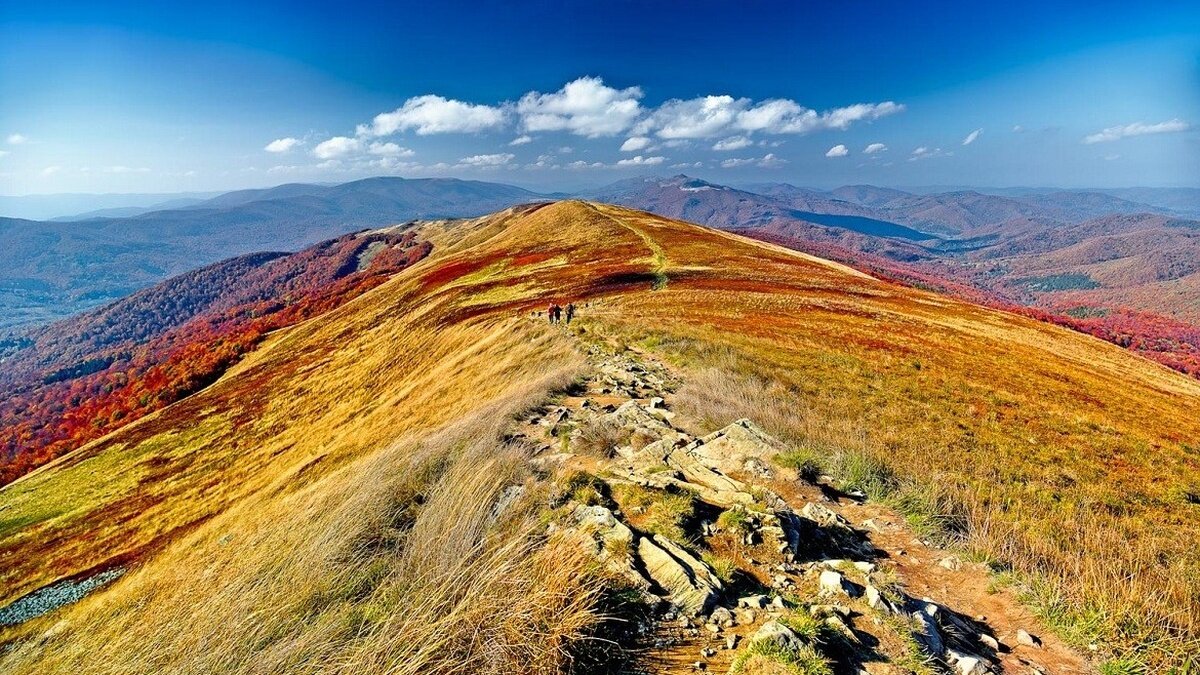
Poland’s Bieszczady tourism season does not close with September. Bieszczady National Park confirms that Tarnawa Niżna camping ends at the close of September, but Górna Wetlinka remains seasonal through the end of October, while the park’s 2026 operating specification also schedules Bereżki camping services until 31 October. That distinction matters commercially because official park monitoring found that October averaged more than 100,000 trail entries between 2021 and 2024, compared with 85,600 in September.
For travel businesses selling Poland’s Bieszczady Mountains, the most important September update is not the end of the camping season but its staggered transition into a second autumn phase.
According to Bieszczady National Park, its Tarnawa Niżna camping field is seasonal from May until the end of September. The location sits in the Upper San Valley enclave close to Poland’s border with Ukraine and serves nature trails, cycling routes, peat bog boardwalks, horse tourism and dark-sky observation. The facility provides parking, toilets, hot showers and a designated campfire area.
That September deadline, however, does not apply across the park.
Advertisement
Advertisement
The park’s current visitor information for Górna Wetlinka states that the camping field operates from mid-April until the end of October. It has 12 connections for campervans and caravans, parking, toilets, hot showers and designated fire areas. It also provides direct access towards Bieszczady National Park hiking routes and sits close to the Połonina Wetlińska tourism zone.
The official 2026 tourism-service specification provides a second October signal. It schedules camping-field service at Bereżki until 31 October 2026. The facility was designed for about 150 people across roughly 1.6 hectares and is connected with the yellow hiking route towards Przysłup Caryński and Połonina Caryńska.
| Bieszczady location | Official published operating position | Tourism function | Important trade detail |
|---|---|---|---|
| Tarnawa Niżna | May to end of September | Upper San Valley nature, cycling, peat bog and heritage access | September really is the final camping month here; hot showers, toilets and parking are provided. |
| Górna Wetlinka | Mid-April to end of October | Base for hiking near Połonina Wetlińska | 12 campervan/caravan connections; no campsite reservations are taken; no shops or restaurants immediately beside the field. |
| Bereżki | 2026 campsite service scheduled through 31 October | Access towards Przysłup Caryński and Połonina Caryńska | About 150-person design capacity across approximately 1.6 hectares. |
This makes a simple September season-ending message unsuitable for tour programmes, camper itineraries and destination content. The operating calendar instead creates two distinct autumn products: September access centred on the broader portfolio, followed by an October camping and hiking window concentrated around facilities that remain available later.
The strongest evidence for treating October seriously comes from Bieszczady National Park’s own visitor-monitoring programme.
Advertisement
Advertisement
According to the park’s research covering 2021 to 2024, average October attendance exceeded 100,000 person-entries, while September averaged 85,600. Autumn traffic is strongly influenced by weather and is particularly concentrated on weekends.
In 2024 specifically, the park recorded about 96,300 trail entries in October, compared with 85,200 in September. October had also reached 112,000 in 2021 and 115,800 in 2022. Those figures show why defining September as the final meaningful tourism window would misrepresent actual visitor behaviour.
The wider seasonality pattern is equally significant. July and August represented 44.6 per cent of trail entries in 2021. That share declined to 41.9 per cent in 2022, 41.3 per cent in 2023 and 39.7 per cent in 2024. Summer remains dominant, but the proportion concentrated in the two main holiday months has progressively reduced across the period studied.
| Tourism indicator | Official figure | Significance for the travel trade |
|---|---|---|
| 2024 total park trail entries | 694,400 | Highest annual result in the park monitoring series, although methodological changes mean older periods are not directly comparable. |
| 2024 summer-season entries | 663,100 | Confirms the scale of the principal operating season. |
| Average September entries, 2021–2024 | 85,600 | September remains a substantial shoulder month. |
| Average October entries, 2021–2024 | More than 100,000 | October averaged higher than September across the four-year study. |
| October 2024 entries | 96,300 | Autumn traffic remained close to six figures. |
| 19 October 2024 daily attendance | 11,763 | Demonstrates that a favourable October weekend can produce peak-like pressure. |
| Peak Tarnica-area count on 19 October 2024 | 3,164 | Shows October concentration can be intense on flagship mountain routes. |
| Entries between 09:00 and 11:00 | 43 per cent | Provides a clear operational signal for itinerary timing. |
| Entries between 11:00 and 13:00 | 28 per cent | Together with the earlier period, most arrivals cluster before early afternoon. |
The information is especially relevant for group operators. October should not automatically be sold as an empty or crowd-free alternative to summer. Sunny weekends can produce substantial trail pressure, meaning weekday departures, earlier scheduling and flexible mountain programmes can offer a more reliable premium experience.
Ustrzyki Dolne and Sanok are relevant to this story as regional tourism and itinerary-planning centres rather than as the physical locations of the park campsites.
According to the Municipality of Ustrzyki Dolne, the Bieszczady Tourism and Promotion Centre carries responsibility for promoting the town, municipality and wider Bieszczady region while providing tourism information. Its official municipal information was updated in March 2026.
Sanok has a different but complementary role. The official City of Sanok tourism portal presents Bieszczady excursions within its suggested visitor programmes, including a three-day itinerary built around Sanok and onward exploration of the mountains.
The Podkarpackie Regional Tourism Board also identifies an official Sanok–Bieszczady itinerary beginning in Sanok and continuing through locations including Zagórz, Lesko and Ustrzyki Dolne. This makes the two places rational geographic anchors for tour operators constructing regional circuits, although neither should be presented as the location of Tarnawa Niżna, Bereżki or Górna Wetlinka.
A longer sellable season does not mean operators can treat autumn Bieszczady programmes as static.
As of 7 September 2026, the current Bieszczady National Park tourist bulletin reports that the bridge across the Roztoka stream on the Tarnawa Niżna–Dźwiniacz Górny nature and history path is closed until further notice. Visitors must use the designated ford at the road bend.
The same bulletin reports technical problems at Chatka Puchatka II on Połonina Wetlińska following recent severe weather. The park warns of possible limitations in water availability and directs visitors to portable toilets around the facility.
Connectivity also requires advance planning. The park says mobile internet coverage can be poor, particularly at Brzegi Górne, Tarnawa Niżna and the Upper San Valley. Visitors are therefore advised to obtain admission tickets in advance rather than depending on an online purchase after reaching a trailhead. Parking is permitted only in designated park or municipal parking areas.
At Górna Wetlinka, the operational profile is similarly important for independent travellers. The official campsite page states that there are no shops or catering outlets immediately beside the camping field, with supplies available in Ustrzyki Górne or Wetlina. A bus stop is beside the main road, while the camping field is not illuminated at night.
These are small details individually, but together they determine whether an autumn itinerary works in practice.
The shoulder-season opportunity sits against a mixed regional tourism backdrop.
According to the Statistical Office in Rzeszów, 1.2 million people used registered tourist accommodation in Podkarpackie Voivodeship during 2025, an increase of 1.7 per cent from 2024. However, the number of overnight stays declined by 1.6 per cent.
More recent official indicators underline why additional sellable months matter. Statistics Poland reported fewer accommodation users and fewer overnight stays in Podkarpackie in June 2026 than in June 2025. In August, the region’s business-climate indicator for accommodation and food services weakened by 33.8 points compared with July, although that sentiment measure should not be confused with a direct visitor-count statistic.
An October outdoor-tourism market therefore has commercial relevance beyond campsite receipts. It can support accommodation, restaurants, guiding, transport, visitor information and cultural stops across the wider Bieszczady circuit.
Poland’s national tourism portal already positions autumn as an important Bieszczady experience, highlighting October foliage across the mountain meadows and beech forests. The official destination-marketing narrative therefore aligns with the visitor data showing that autumn is a meaningful travel period rather than simply the tail end of summer.
For the travel industry, the information gain lies in combining infrastructure dates with behavioural data.
A campsite calendar on its own is an operational notice. Visitor numbers on their own are historical statistics. Put together, they identify a commercially usable two-stage Bieszczady autumn season.
September retains the widest mix of camping options, including Tarnawa Niżna. October then shifts the viable product towards locations such as Górna Wetlinka and Bereżki, while visitor demand remains substantial and can surge sharply on favourable weekends.
That creates opportunities for walking holidays, campervan itineraries, photography trips, nature programmes and regional circuits through Ustrzyki Dolne and Sanok. It also argues against marketing October simply as a cheap low-season substitute. Historical demand suggests that product differentiation should instead be based on autumn scenery, itinerary flexibility and controlled access to popular trails.
There is a sustainability dimension as well. The declining share of annual trail entries concentrated in July and August suggests visitor activity is becoming less tightly compressed into the traditional holiday peak. Spreading economic activity across additional months can support tourism businesses, but popular October weekends can still generate concentrated pressure. Destination managers therefore face a dual task: encouraging shoulder-season travel while managing trail capacity, parking, waste, wildlife interaction and fragile mountain environments.
The original Bieszczady narrative also requires an important correction.
Bieszczady National Park prepared a conservation procurement covering high-mountain grazing across 22.78 hectares during the 2026 and 2027 grazing seasons as part of its 2024–2029 active conservation programme.
However, the park formally cancelled that procurement on 4 March 2026 because no bid had been submitted. The official record reviewed for this report therefore does not support presenting the grazing programme as a guaranteed tourism experience already operating in 2026.
For destination sellers, that distinction is critical. Traditional pastoral heritage can remain part of the cultural interpretation of Bieszczady, but a tour description should not promise travellers that they will encounter an active 2026–27 high-mountain grazing programme unless Bieszczady National Park subsequently confirms implementation.
The more important Bieszczady tourism story in September 2026 is therefore not an approaching shutdown. It is the existence of a measurable October tourism economy supported by later-running camping infrastructure and a visitor pattern that has already pushed October attendance above September averages across the most recent four-year park study.
For Poland’s tourism industry, that creates a credible path towards stronger shoulder-season packaging in the south-east without artificially manufacturing demand. The visitors are already coming. The commercial challenge is to meet the demand by providing accommodation calendars. The commercial challenge also requires visitor information, responsible trail management and products that fit shorter daylight changing weather and concentrated weekend peaks.
If the commercial challenge elements are managed carefully Bieszczady can strengthen its position. The position is not, as a summer mountain escape. The position also becomes an autumn nature destination. The tourism cycle remains commercially relevant after September ends.
Advertisement
Advertisement
Advertisement












Monday, September 7, 2026

Monday, September 7, 2026

Monday, September 7, 2026

Monday, September 7, 2026

Monday, September 7, 2026

Monday, September 7, 2026

Monday, September 7, 2026