
How Uzbekistan Is Revolutionizing Global Tourism With A Massive Boom To Power Its Growth In Central Asia

Published
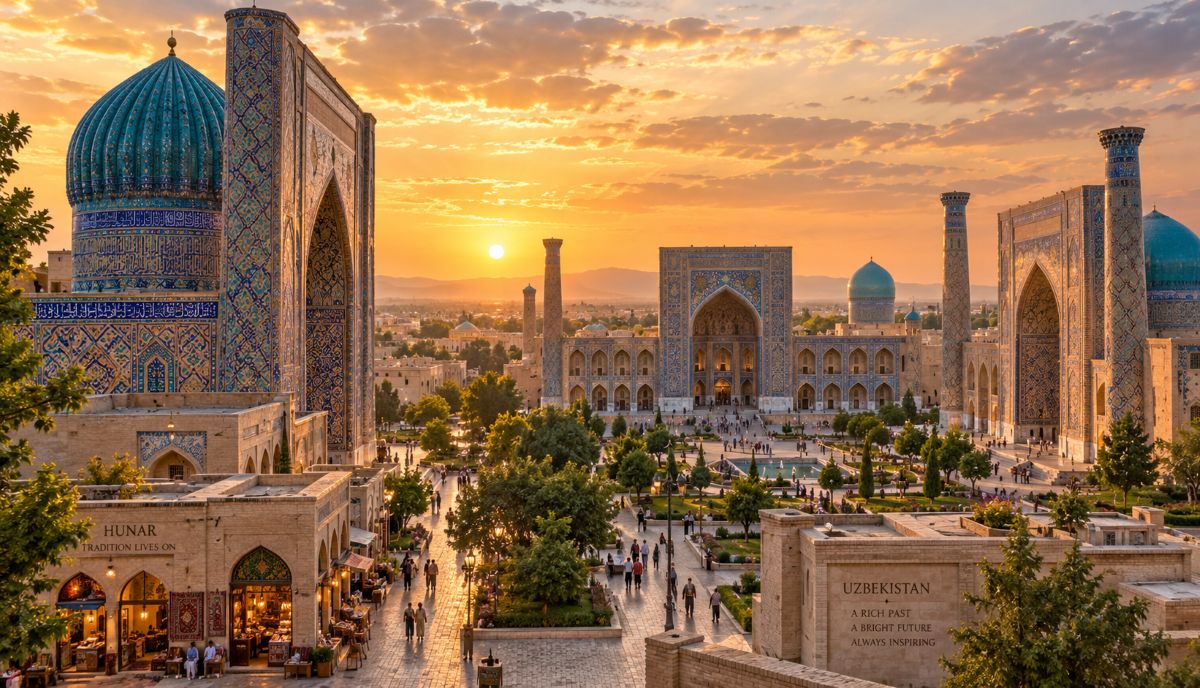
Image generated with Ai
Riding the train to Central Asia means witnessing the rebirth of the Silk Road at sunset. The Silk Road is modernizing trade routes and providing a substantial physical economic revitalization. You will be speechless with new trade fair figures from Uzbekistan. This new trade service has been the leading export service and has made a huge difference in the business of the affected countries. In 2026, from January to July, Uzbekistan recorded an outgoing service expenditure of $7.3 billion, which is a staggering 35.3% increase from the same period in 2025. International trade services account for approximately 36.8% of total exports from the country. Along with these statistics, aids, and visitors in the billions, have made international trade fairs and the warm hosts from countries where the heritage of Samarkand and Bukhara, and Khiva of Kiva catered to a discerning clientele traveling for leisure, the country’s greatest asset is its history.
Strategic Infrastructure Expansion and Heritage Enhancement Across Ancient Silk Road Cities
Advertisement
Advertisement
The rapid financial acceleration observed throughout Uzbekistan highlights the success of targeted public infrastructure investments across key municipal centers. Historical urban hubs such as Samarkand, Bukhara, and Khiva have undergone extensive restoration efforts designed to protect cultural heritage while accommodating modern global travelers. Upgraded international aviation gateways, modernized road corridors, and high-speed rail expansions now seamlessly connect these ancient cities. Consequently, international wanderers can explore iconic monuments with greater comfort, safety, and efficiency than ever before. These localized urban enhancements reduce travel friction for long-haul visitors, encouraging longer stays and deeper cultural immersion.
Beyond physical building upgrades, national authorities have implemented progressive visa reforms and streamlined administrative entry requirements to invite higher foreign visitor volumes. Expanded regional transport links ensure that incoming journeys remain smooth and cost-effective across the entire country. Furthermore, the sustained surge in hospitality revenues directly strengthens long-term economic resilience across urban and rural communities alike. Local artisans, boutique hotel operators, and independent tour specialists in cities like Bukhara and Khiva are experiencing consistent financial growth. Ultimately, this comprehensive development approach creates a reliable, high-quality standard for incoming leisure and business travelers.
Advertisement
Advertisement
Comprehensive Financial Breakdown of Service Export Categories and Regional Economic Growth
A detailed analysis of service export data recorded between January and July 2026 confirms that the travel segment holds an overwhelming majority share of tertiary trade earnings. Accounting for 53.8% of total service exports, visitor spending generated more than half of the US $7.3 billion brought in by international service transactions. Transport services represented the second-largest contribution at 31.7%, driven by expanded transit networks, regional aviation growth, and cargo logistics. Meanwhile, telecommunications, computer, and information offerings generated 8.5% of outgoing service trade, while additional business services comprised the remaining 2.9%.
Advertisement
Advertisement
The dominance of visitor expenditure highlights how international tourism actively fuels economic development across Tashkent and peripheral regions. Direct financial inflows from incoming foreign travelers fund municipal improvement initiatives, heritage preservation projects, and modern public transit expansion. Simultaneously, the robust 31.7% share held by transportation services demonstrates a well-integrated travel ecosystem, where upgraded airports and rail networks directly support increased passenger mobility. This high level of cross-sector synergy ensures that capital earned from incoming travel flows back into national infrastructure, creating an enduring cycle of commercial expansion.
Global Effects on Travelers and Operational Benefits Across Eurasian Transit Hubs
For the global travel community, the strong economic metrics reported in Uzbekistan deliver immediate, tangible operational advantages. Continued financial allocations toward transportation infrastructure mean that international travelers enjoy faster airport processing times, enhanced safety protocols, and modern public transit connections. Major urban entry points like Tashkent offer reliable urban transport links, connecting long-haul visitors smoothly to high-speed rail services bound for Samarkand and Bukhara. Furthermore, increased commercial competition among local hospitality providers has elevated customer service benchmarks across both luxury and budget accommodation tiers.
Additionally, the 8.5% contribution from telecommunications and digital infrastructure ensures that modern travelers enjoy uninterrupted high-speed mobile connectivity throughout their journeys. International visitors can effortlessly navigate digital booking systems, secure digital tickets, and access mapping tools even in remote regions. This reliable digital environment significantly enhances safety and convenience for independent tourists, families, and solo travelers alike. As a result, Uzbekistan is rapidly solidifying its reputation as one of the most welcoming, modern, and accessible destinations in Central Asia.
Government Policy Reforms and Long-Term Strategic Planning for Sustainable Regional Development
The continuous expansion of the national hospitality sector reflects the positive impact of strategic public policy reforms designed to modernize regional economic frameworks. Government agencies have systematically prioritized destination marketing, cultural preservation, and cross-border commercial partnerships to raise the country’s international profile. By actively diversifying visitor experiences to include eco-tourism trails, culinary festivals, and specialized historical corridors, planners have successfully distributed tourist traffic beyond capital cities. This strategic geographic distribution ensures that small towns and rural communities share directly in national service export revenues.
Advertisement
Advertisement
To accommodate anticipated future demand, aviation authorities are continuing to expand passenger terminal capacities at key regional hubs, including Samarkand and Bukhara. These expanded flight options allow international carriers to introduce new direct routes, connecting Central Asia directly to major markets across Europe, Asia, and the Middle East. Moreover, strict regulatory guidelines governing environmental sustainability and historical conservation ensure that rapid commercial growth does not compromise delicate heritage sites. Ultimately, this balanced developmental model provides a reliable template for long-term cultural tourism management across the region.
Future Industry Implications for Eurasian Connectivity and International Tourism Standards
Looking forward, the sustained growth of service exports in Uzbekistan establishes a positive baseline for the broader Eurasian travel market. As incoming travel earnings continue to account for 53.8% of total non-tangible export revenues, national authorities remain fully committed to supporting the visitor economy through continuous structural improvements. The combination of modern transportation links, robust digital networks, and protected historic architecture ensures that the region remains highly attractive to global travel organizers and individual explorers alike.
As a direct result of these ongoing initiatives, global travel providers can confidently design diverse, multi-city itineraries spanning historic locations like Tashkent, Samarkand, Bukhara, and Khiva. The alignment of progressive administrative policies with large-scale facility enhancements guarantees that incoming visitors will encounter world-class hospitality standards. By consistently reinvesting service trade earnings back into public infrastructure, Uzbekistan is successfully preserving its ancient Silk Road heritage while building a resilient, modern tourism economy for future generations.
Exponential Growth in Foreign Visitor Arrivals and Demographic Inflows across Central Asian Gateway Hubs
The incoming volume of foreign travelers scaled rapidly between January and July 2026, reaching 7.75 million visitors. This figures represents a 22.6% increase year-over-year when compared to the matching timeframe in 2025. Specifically, tourism service exports generated US $3.94 billion during these seven months. This marks a dramatic 55% surge from the US $2.5 billion recorded in the corresponding period of the previous year.
Advertisement
Advertisement
This rapid expansion highlights a fundamental evolution in regional visitor demographics. Inbound traveler flows are shifting away from short-range cross-border visits toward long-haul international markets. As a result, incoming tourists are spending more time within historical Silk Road hubs like Tashkent, Samarkand, and Bukhara. The resulting financial inflows provide vital foreign-currency reserves, directly fortifying the broader national economy while injecting capital straight into local commercial ecosystems.
Rapid Aerial Infrastructure Expansion and Decentralized Regional Aviation Networks
During the first half of 2026, national airports processed a total of 8.15 million transit passengers, marking a 16% growth compared to the prior year. Aviation authorities successfully executed 47,371 international flight operations over this timeframe. Regional entry points experienced massive spikes in traffic, with Termez passenger volumes soaring 52%, Urgench rising 24%, and Nukus climbing 23%.
These statistics illustrate the strategic decentralization of transit networks away from capital monopolies toward regional aviation hubs. By expanding terminal capacity and direct international access in regional centers, civic planners have significantly reduced travel friction for international visitors. Travelers bound for iconic architectural monuments in Khiva, Samarkand, and Bukhara now enjoy streamlined domestic transfers, shorter transit times, and enhanced flight availability across the entire country.
Targeted Direct Foreign Investment Inflows Strengthening Regional Hospitality Real Estate
Commercial confidence in the hospitality sector reached new heights during the first six months of 2026. Government authorities launched 97 specialized hospitality projects valued at a combined US $200.2 million. This substantial financial influx directly generated over 2,100 employment opportunities across construction, property management, and hotel operations.
Advertisement
Advertisement
This influx of foreign capital demonstrates growing international trust in the country’s long-term tourism trajectory. Institutional property developers and private investors are actively funding modern hotel developments, boutique heritage accommodations, eco-friendly wilderness resorts, and corporate business centers. These strategic property investments elevate overall regional lodging standards, ensuring that diverse international travelers encounter modern amenities, high security, and exceptional service across every province.
Massive Scaling of Domestic Accommodation Facilities and Commercial Bed Inventory
Between January and July 2026, developers opened 705 new lodging facilities across the nation, adding over 22,000 new guest beds to the national housing matrix. Consequently, the country’s operational total expanded to 7,440 registered accommodation venues, boasting a collective capacity of 202,600 guest beds.
This rapid expansion of lodging supply plays a crucial role in maintaining price stability across the hospitality sector. By dramatically increasing guest bed availability, municipal destinations effectively prevent severe hotel room rate inflation during peak spring and autumn travel seasons. As a result, independent leisure tourists, family groups, and international tour operators can secure high-quality, affordable accommodation options throughout the year.
Widespread Surge in Licensed Travel Agencies and Local Small Business Entrepreneurship
The commercial ecosystem supporting the travel sector expanded significantly by July 2026, with registered travel agencies, tour operators, and destination service firms swelling to 3,455 active enterprises. This represents a 24.3% jump compared to 2025 figures, building on a sustained upward trend from fewer than 2,000 registered firms in 2022.
Advertisement
Advertisement
This growth underscores the positive economic ripple effects created by incoming foreign visitor spending. As thousands of new travel enterprises open, foreign capital flows directly into local supply chains. Independent tour guides, private transportation providers, artisanal craft workshops, and regional farm-to-table dining establishments are gaining direct access to international tourist expenditures, fostering widespread community-level economic empowerment.
National Economic Diversification Shifting Foreign Trade Dynamics Toward Service Trade Reliance
Overall foreign trade turnover reached US $49.5 billion during the initial seven months of 2026, growing 8.1% overall. Simultaneously, non-monetary gold exports plummeted 63.1%, falling from $7.59 billion down to $2.8 billion. This drop caused gold’s relative share of national exports to collapse from 36.7% to 14.1%. In sharp contrast, tertiary services surged from 26.2% to 36.8% of total outgoing trade.
These macroeconomic metrics highlight a successful transition away from volatile commodity dependence toward a resilient service-driven economy. Tourism is no longer merely a secondary leisure sector; it now serves as a primary macroeconomic stabilizing agent. By generating consistent tertiary export revenue, the visitor economy buffers the national balance sheet against global commodity price shocks while establishing a sustainable, long-term foundation for commercial growth.
Strategic Intercontinental Flight Connectivity and Middle Eastern Corridor Integrations
Air connectivity expanded substantially in 2026 through the introduction of several major long-haul routes. Key additions include direct flights linking Tashkent to Shanghai via China Eastern, Seoul via Asiana Airlines, and Yerevan via Shirak Avia. Furthermore, a high-capacity international route connecting Tashkent to Abu Dhabi was officially launched by Etihad Airways on August 10, 2026.
Advertisement
Advertisement
These new air bridges eliminate tedious multi-stop layovers for travelers originating in East Asia, the Gulf Cooperation Council (GCC) member states, and Transcaucasia. By strengthening direct aviation ties with major global transit hubs, international visitors benefit from seamless baggage transfers, reduced transit times, and competitive flight pricing. This improved accessibility positions the nation as a central transit and destination hub within Eurasia.
Multi-Year Trajectory and Historical Milestones Driving the 2026 Performance Expansion
The dramatic performance recorded in 2026 represents the culmination of a multi-year structural transformation. Inbound foreign tourist volumes have grown steadily over the past decade, rising from 5.3 million visitors in 2018 to 6.6 million in 2023, before climbing to 10 million in 2024. By 2025, annual inbound arrivals reached a record 11.7 million travelers, generating US $4.8 billion in service exports, a 42.2% increase over prior figures.
Contextualizing current numbers against this historic timeline proves that the 2026 commercial surge is the result of deliberate long-term planning. Comprehensive regulatory overhauls, progressive visa relaxation policies, and continuous municipal infrastructure investments have successfully modernized the local travel sector. Together, these coordinated national initiatives have permanently transformed Uzbekistan into a premier cultural destination on the global tourism map.
The Final Verdict
This economic boom exceeds managing spreadsheets and breaking attendance records. It reflects Uzbekistan’s ability to welcome everyone once again. Tourist expenditure accounts for 53.8 percent of service trade. Uzbekistan welcomes everyone that visits the country, as each traveler brings another part of Uzbekistan’s history. Travelers are able to stand under the blue Samarkand domes, or travel Bukhara to imagine the scholars, or travel to Khiva to roof their own history and stroll the guesthouses. They are not witnessing economic growth or commercial growth. They are witnessing cultural growth. With plans to introduce bullet trains and modernize the historic family-run guesthouses, Uzbekistan is maintaining history and modernizing historic preservation. The spirit of the Silk Road is still waiting for travelers and the spirit of Uzbekistan is bringing that spirit back.
Advertisement
