
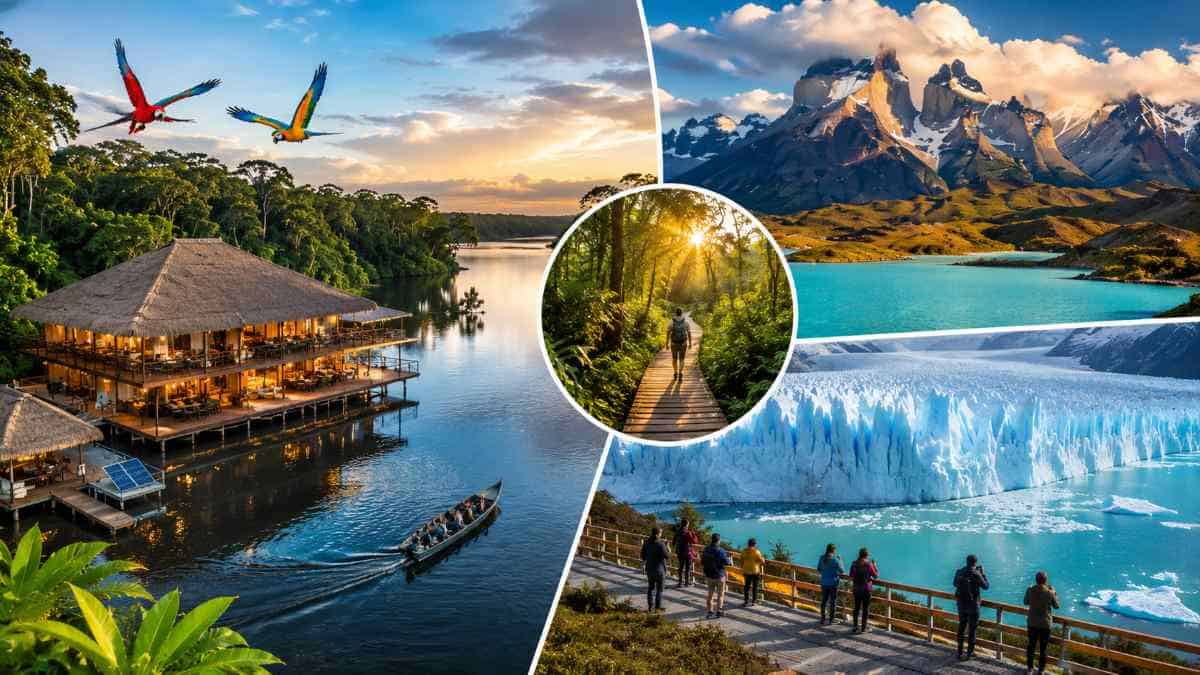
Image generated with Ai
Brazil Joins Chile, Argentina, Peru, Colombia, Ecuador, Uruguay, Bolivia, Paraguay, Costa Rica and Others as Patagonia, Torres del Paine, the Amazon, Rio de Janeiro, Manaus, Santiago, Puerto Natales and More Witness an Eco-Tourism Boom. Patagonia, the Amazon Rainforest, Torres del Paine, the Chilean Fjords and South America’s vast wilderness regions are becoming the centre of a major tourism transformation as travellers increasingly prioritise sustainability alongside adventure. Across the continent, tourism authorities, hospitality providers and conservation organisations are investing heavily in eco-friendly experiences designed to attract visitors seeking meaningful connections with nature while minimising environmental impact.
At the forefront of this shift are Chile and Brazil, two countries leveraging some of the world’s most spectacular natural landscapes to position themselves as leaders in sustainable tourism. Their latest initiatives are helping redefine how travellers experience South America, creating new opportunities for eco-tourism, conservation-focused holidays and low-impact exploration.
The movement comes at a time when global tourism continues evolving, with increasing numbers of visitors actively choosing destinations that combine environmental responsibility with authentic travel experiences.
Chile has placed sustainability at the heart of its tourism strategy by officially designating 2026 as its “Year of Sustainable Adventure.”
Advertisement
Advertisement
The initiative focuses on expanding eco-friendly tourism infrastructure across some of the country’s most iconic destinations, particularly within Patagonia and the country’s extensive network of national parks.
Tourism authorities are promoting experiences that allow visitors to explore Chile’s landscapes while supporting conservation goals and local communities.
The programme is designed to strengthen Chile’s reputation as a global destination for responsible adventure travel while encouraging longer stays and higher-value tourism experiences.
The country’s tourism strategy reflects growing international demand for environmentally conscious holidays that balance exploration with sustainability.
Advertisement
Advertisement
Patagonia remains one of the strongest attractions within Chile’s sustainable tourism campaign.
Known for its dramatic mountains, glaciers, lakes and wilderness landscapes, the region has become synonymous with adventure travel.
New investments in solar-powered accommodation and environmentally responsible visitor infrastructure are helping reduce the environmental footprint associated with tourism growth.
Visitors are increasingly choosing experiences that emphasise conservation, wildlife protection and low-impact exploration.
Trekking routes, guided expeditions and eco-certified accommodation providers are benefiting from growing demand among travellers seeking nature-focused holidays.
The region’s combination of scenery and sustainability is attracting attention from international tourism markets across North America, Europe and Asia.
One of the most notable developments within Chile’s tourism strategy is the introduction of carbon-neutral trekking routes.
These experiences are designed to reduce emissions associated with outdoor tourism while supporting conservation initiatives within protected areas.
Travellers are increasingly looking for opportunities to participate in environmentally responsible activities, and carbon-neutral trekking has become a key part of Chile’s tourism offering.
Routes throughout Patagonia and other adventure destinations are being promoted as examples of how tourism can coexist with environmental stewardship.
The initiative aligns with broader global travel trends that prioritise sustainability and climate-conscious tourism choices.
Brazil is pursuing a parallel strategy through its “Verde” tourism campaign.
The programme focuses on highlighting the country’s extraordinary biodiversity while promoting sustainable visitor experiences across key destinations.
The Amazon Rainforest serves as the campaign’s centrepiece, attracting travellers interested in wildlife, conservation and immersive nature experiences.
Brazil’s tourism authorities are positioning eco-tourism as a major growth sector capable of attracting international visitors while supporting environmental protection.
The campaign reflects increasing demand for tourism experiences connected to nature and sustainability.
Among the most distinctive developments within Brazil’s eco-tourism sector is the growing popularity of floating eco-lodges.
Located within the Amazon basin, these accommodation concepts provide visitors with direct access to one of the world’s most biodiverse ecosystems while minimising environmental impact.
The lodges are designed to blend with the surrounding environment and often incorporate renewable energy systems, local materials and conservation-focused operations.
For travellers, the experience offers opportunities to observe wildlife, explore waterways and engage with local communities.
The growth of floating eco-lodges highlights how hospitality innovation is supporting the expansion of sustainable tourism throughout the Amazon region.
The eco-tourism boom is contributing to wider tourism growth across South America.
Countries throughout the region are increasingly investing in nature-based experiences as visitor demand shifts towards outdoor activities, wellness travel and conservation-focused holidays.
Adventure tourism, wildlife observation, hiking and eco-lodging are becoming key components of destination marketing strategies.
The trend is helping diversify tourism economies while encouraging the protection of natural resources.
Destinations that successfully combine environmental stewardship with memorable visitor experiences are attracting increasing international attention.
A defining characteristic of the sustainable tourism movement is the growing emphasis on meaningful travel experiences.
Visitors are increasingly looking beyond traditional sightseeing and seeking opportunities to engage with local environments, cultures and conservation initiatives.
Eco-tourism products often encourage slower travel, deeper engagement and longer stays.
This shift is benefiting rural destinations and protected areas that may previously have received less tourism attention than major urban centres.
For many destinations, sustainable tourism represents both an economic opportunity and a conservation tool.
Community involvement is becoming increasingly important within South America’s sustainable tourism sector.
Many eco-tourism initiatives are designed to generate economic benefits for residents while encouraging environmental protection.
Community-led tourism experiences, conservation projects and locally operated accommodation providers are helping distribute tourism revenue more broadly.
The approach strengthens destination resilience while creating more authentic experiences for visitors.
It also supports efforts to ensure tourism growth contributes positively to regional development.
Early 2026
Chile officially launches its “Year of Sustainable Adventure” tourism initiative.
2026
New solar-powered tourism facilities and carbon-neutral trekking experiences expand across Patagonia.
2026
Brazil intensifies its Verde campaign promoting sustainable tourism in the Amazon region.
2026
Floating eco-lodges attract increasing visitor demand across Amazon tourism corridors.
Brazil Joins Chile, Argentina, Peru, Colombia, Ecuador, Uruguay, Bolivia, Paraguay, Costa Rica and Others as Patagonia, Torres del Paine, the Amazon, Rio de Janeiro, Manaus, Santiago, Puerto Natales and More Witness an Eco-Tourism Boom. Patagonia, the Amazon Rainforest, Torres del Paine and South America’s diverse natural landscapes are helping drive a new era of sustainable tourism across the continent. Through initiatives such as Chile’s Year of Sustainable Adventure and Brazil’s Verde campaign, destinations are responding to growing demand for environmentally responsible travel experiences. As eco-tourism continues gaining momentum, South America is strengthening its position as one of the world’s leading destinations for travellers seeking adventure, conservation and meaningful connections with nature.
Advertisement
Advertisement
Advertisement













Sunday, September 6, 2026

Sunday, September 6, 2026

Sunday, September 6, 2026

Saturday, September 5, 2026

Saturday, September 5, 2026

Sunday, September 6, 2026

Sunday, September 6, 2026