
Samoa October Ferry Update Leaves Mulifanua–Salelologa Travel Plans Dependent on Direct Timetable Verification

Published
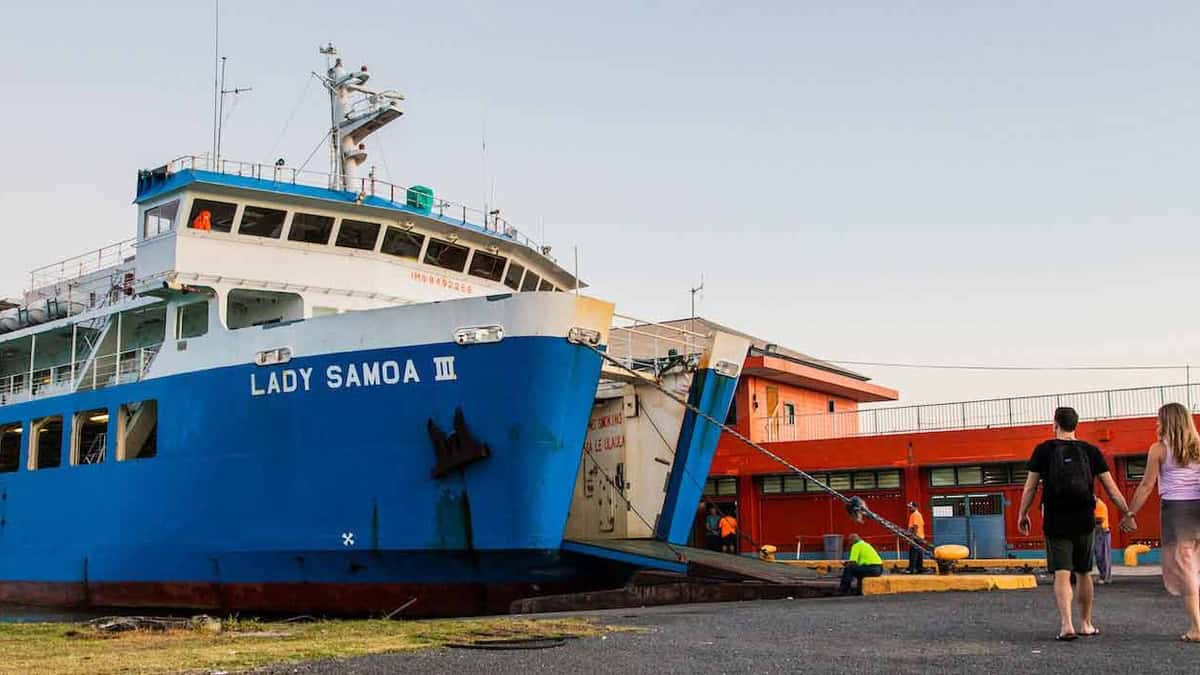
Travellers planning an October journey to Savai‘i should confirm their sailing directly with Samoa Shipping Corporation before fixing airport transfers, accommodation or rental-car movements. As of 6 October 2026, SSC’s official domestic page is headed October 2026, yet the three timetable links beneath it resolve to files named for February 2026. The Mulifanua–Salelologa route itself remains operational, current fares are published and MV Samoa Express II is listed for 250 passengers, but the downloadable material does not presently provide a clean independent verification of every October departure.
Samoa’s October Ferry Information Creates A Verification Gap Travellers Should Not Ignore
The latest travel issue is not whether ferries connect Samoa’s two main islands. They do. The important October development concerns the reliability of the timetable information currently presented to travellers online.
Advertisement
Advertisement
According to the Samoa Shipping Corporation, its domestic timetable and fares page is presently labelled Sailing Schedule for the Month of October 2026. The same page confirms the domestic Mulifanua–Salelologa service and lists passenger, vehicle and bicycle charges.
However, following the three timetable links embedded directly below the October heading produces official SSC file paths carrying February 2026 filenames: PS_FEB_2026.pdf, PS_FEB_2026-1.pdf and DS-FEB-2026-UPDATED-2.pdf. (Invalid URL)
Advertisement
Advertisement
That distinction matters.
It would be unsafe for a travel publication, tour operator or traveller to extract February departure times and present them as the confirmed October schedule simply because the webpage heading now refers to October.
Advertisement
Advertisement
The responsible interpretation as of 6 October 2026 is therefore that SSC has identified October as the current schedule period, but the downloadable timetable documents visible through the live page require direct confirmation before individual October sailing times are treated as definitive.
Mulifanua And Salelologa Remain The Critical Savai‘i Travel Corridor
According to the Samoa Tourism Authority, two vehicle and passenger ferries serve the connection between Upolu and Savai‘i. Sailings operate between Mulifanua Wharf on Upolu and Salelologa Wharf on Savai‘i, with the crossing generally taking around 60 to 90 minutes.
Mulifanua is particularly important for international travellers because Samoa Tourism places the terminal about a six-minute drive from Faleolo International Airport. Apia is approximately one hour away by road. Salelologa is Savai‘i’s principal south-eastern township and the island’s main ferry arrival point.
This creates a closely linked transport chain:
| Journey component | Officially verified position | Travel implication |
|---|---|---|
| Upolu departure | Mulifanua Wharf | Main domestic gateway towards Savai‘i |
| Savai‘i arrival | Salelologa Wharf | Primary ferry gateway onto Samoa’s largest island |
| Typical crossing | 60–90 minutes | Marine conditions and vessel allocation remain relevant |
| Faleolo Airport connection | Around six minutes by road to Mulifanua | Same-day air-to-ferry transfers may be possible but require timetable confirmation |
| Apia connection | Around one hour by road to Mulifanua | Travellers starting in the capital require additional transfer time |
| October schedule webpage | October 2026 heading displayed | Current scheduling period is officially identified |
| Downloadable timetable links | February-labelled files | Individual October departure times require verification |
For international tour operators, this is more consequential than a minor website fault. A wrongly assumed departure can affect rental-car movements, airport transfers, resort check-in times and onward road touring across Savai‘i.
Current Samoa Ferry Fares Remain Clearly Published
While the timetable documents create uncertainty, the fare structure itself is clearly displayed by Samoa Shipping Corporation.
Advertisement
Advertisement
SSC currently publishes an adult domestic fare of SAT10 one way and SAT20 return. Children aged two to 12 are charged SAT5 one way and SAT10 return, while infants from newborn to one year are carried free.
Vehicle prices depend on size. Category A vehicles are listed at SAT80 one way, Category B at SAT95, and Category C at SAT100. Bicycles carry a SAT10 fee, while motorcycles or scooters are listed at SAT30.
| Traveller or vehicle | Published one-way charge |
|---|---|
| Adult passenger | SAT10 |
| Child aged 2–12 | SAT5 |
| Infant aged newborn–1 | Free |
| Category A vehicle | SAT80 |
| Category B vehicle | SAT95 |
| Category C vehicle | SAT100 |
| Bicycle | SAT10 |
| Motorcycle or scooter | SAT30 |
These figures come from SSC’s current domestic fare page rather than older tourism marketing material and should therefore be treated as the primary pricing reference at publication time.
Capacity Is More Complicated Than The October Page Suggests
Capacity is where the story becomes particularly important for travel planning.
According to Samoa Tourism, two vehicle and passenger ferries operate between Upolu and Savai‘i. SSC’s fleet information identifies MV Samoa Express II as serving Mulifanua–Salelologa and gives the vessel a capacity of 250 passengers, plus ten crew and the captain.
SSC also identifies MV Lady Samoa III as an Upolu–Savai‘i passenger and vehicular ferry. Its technical specifications record a length of 46.7 metres, gross tonnage of 1,045 GT and full-load speed of 12 knots. However, SSC’s current public vessel profile does not provide a numeric passenger-capacity figure for Lady Samoa III.
Advertisement
Advertisement
That means a precise combined passenger capacity for an October operating day cannot responsibly be calculated from the current public information alone.
It would therefore be misleading to advertise a specific total October capacity unless SSC confirms both the vessel allocation and the passenger limit for each sailing.
Samoa’s 500-Passenger Fast-Ferry Plan Is Not Capacity Travellers Can Assume
A further official record makes the capacity issue considerably more significant.
A March 2026 Government of Samoa publication recorded that a proposed fast ferry for the domestic Upolu–Savai‘i route had been designed for 500 passengers and 50 vehicle spaces, with an intended service speed capable of making the crossing in roughly 35 to 40 minutes. The vessel was associated with approximately SAT23 million in Samoa Ports Authority investment.
The same government publication reported that the vessel had been assessed as unsuitable for the Mulifanua–Salelologa conditions and had not entered the intended regular domestic service.
That is crucial context for October travellers.
Advertisement
Advertisement
The 500-passenger figure must not be added to current route capacity. Nor should travellers expect the 35-to-40-minute fast-ferry crossing envisioned under that project.
For current travel planning, Samoa Tourism’s published 60-to-90-minute crossing range remains the safer reference.
Why This Matters For Samoa’s Growing Visitor Economy
The timetable issue arrives while Samoa continues to handle substantial international visitor flows.
According to the Samoa Bureau of Statistics, the country recorded 23,161 total international arrivals in August 2026, including 17,660 visitors. Visitor numbers were 0.9 per cent higher than in August 2025.
New Zealand accounted for 8,143 visitors, representing 46.1 per cent of the August visitor total. Australia contributed 3,837, while the United States accounted for 1,528. Some 8,597 visitors travelled for holiday or vacation purposes, and 7,453 visitors reported staying in hotels or motels.
| August 2026 Samoa indicator | Official figure |
|---|---|
| Total international arrivals | 23,161 |
| Total visitors | 17,660 |
| Year-on-year visitor change | +0.9% |
| Holiday and vacation visitors | 8,597 |
| New Zealand visitors | 8,143 |
| Australian visitors | 3,837 |
| US visitors | 1,528 |
| Hotel or motel users | 7,453 |
These are national figures. They do not show how many visitors continued onward to Savai‘i, so they should not be presented as Savai‘i ferry passenger totals. They do, however, demonstrate the scale of the visitor market depending on reliable domestic transport information after arriving in Samoa.
Advertisement
Advertisement
Port Investment Has Improved The Physical Journey
The online timetable weakness contrasts with substantial investment in the physical ferry gateways.
According to Samoa’s Ministry of the Prime Minister and Cabinet, responsibility for the domestic ports at Mulifanua and Salelologa was handed from Samoa Shipping Corporation to Samoa Ports Authority in October 2022. Mulifanua upgrade works were completed in July 2023, followed by works at Salelologa.
The programme covered refurbished departure lounges, improved facilities for pensioners, business-class suites, new commercial spaces, fencing and reconstructed parking areas.
Digital Reliability Is Already An Identified Operational Issue
There is another layer to the story.
In April 2026, Samoa Shipping Corporation issued a formal procurement document seeking upgraded internet and wide-area network connectivity across facilities including Mulifanua Wharf and Salelologa Wharf.
The document stated that SSC had experienced recurring connectivity outages affecting ticketing systems at Mulifanua, Salelologa and Matautu during the preceding two years, alongside performance degradation during peak periods. The proposed system called for redundant connections, automatic failover, monitoring and a minimum 99.9 per cent service-level uptime requirement.
Advertisement
Advertisement
The procurement timetable targeted a July 2026 go-live date. The RFP establishes SSC’s planned technology requirements, although the document alone does not prove that every element was subsequently deployed exactly on schedule.
Analysis: The Real Travel Story Is Information Reliability
For Samoa’s tourism sector, the significance extends beyond three outdated PDF links.
Savai‘i access depends on a sequence of transport decisions. An international visitor may land at Faleolo, collect a rental vehicle, reach Mulifanua, satisfy the required ferry check-in period, cross to Salelologa and continue towards accommodation elsewhere on Savai‘i.
Every element depends on knowing when the ferry actually leaves.
That makes timetable accuracy part of the destination’s tourism infrastructure, alongside wharves, vessels, roads and airports.
The risk is greater for vehicles because space is finite, vehicle reservations require advance handling, rental-car operators may impose their own ferry conditions, and SSC applies changing fees to certain altered or missed confirmed bookings.
Advertisement
Advertisement
The broader lesson for travel sellers is important. Remote-island accessibility is not determined simply by whether a ferry exists. It depends on verified departure data, usable vessel capacity, transfer buffers and clear booking procedures.
Samoa has invested in its terminals and has also pursued stronger digital connectivity. The October timetable-link problem therefore represents a relatively small but commercially important final-mile information gap.
What Travellers Should Know Before Booking Savai‘i
SSC advises vehicle passengers to check in at least one hour before departure, while foot passengers should arrive at least 30 minutes beforehand. Vehicle reservations are available through advance booking at SSC’s main office at Matautu-tai in Apia.
Samoa Tourism also advises rental-car users to confirm that their rental company permits the vehicle to travel aboard the ferry. Some companies may impose vessel-specific requirements.
SSC says card and EFTPOS payments are available at its main Apia office, while Samoa Tourism’s passenger guidance advises walk-on travellers to be prepared for cash payment at the ferry terminals. Travellers should therefore not assume every payment method will be available at every sales point.
Operational Takeaways For Travel Agents And Tour Operators
- Verify October departure times directly with SSC before issuing final client itineraries because the live October page currently points towards February-labelled timetable files.
- Do not advertise 500-passenger fast-ferry capacity. The vessel associated with that figure was not placed into the intended service according to the March government record.
- Use 60–90 minutes as the official tourism crossing reference rather than promising a shorter journey.
- Protect air-to-ferry connections with sufficient buffer time, particularly when clients are collecting luggage or rental vehicles at Faleolo.
- Allow at least one hour for vehicle check-in and 30 minutes for foot passengers, following SSC guidance.
- Confirm rental-car ferry permission before including Savai‘i in self-drive packages.
- Do not calculate aggregate route capacity from incomplete public vessel data, because SSC presently publishes a 250-passenger figure for Samoa Express II but no numeric capacity on its Lady Samoa III profile.
Samoa’s Ferry Corridor Will Remain Central To Savai‘i Tourism
The Mulifanua–Salelologa connection is more than a domestic ferry route. It is the principal surface-transport bridge between Upolu’s international gateway and Samoa’s largest island.
Advertisement
Advertisement
Port improvements have strengthened the physical infrastructure. SSC has also identified digital resilience as an operational priority. Meanwhile, national visitor numbers continue to create demand for dependable onward transport.
The immediate October issue is therefore straightforward: travellers should not infer exact sailing times from outdated downloadable files simply because the surrounding webpage has been updated to October 2026.
Correcting that information gap would give airlines, hotels, rental companies, tour operators and independent visitors greater certainty when building journeys between Faleolo, Mulifanua, Salelologa and the wider Savai‘i tourism economy.
For now, direct confirmation with Samoa Shipping Corporation remains the safest approach.
Advertisement
