

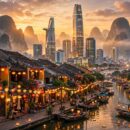
Image generated with Ai
Travelling through a city is usually treated as a practical part of a holiday. Visitors think about reaching a museum on time, getting from a hotel to a restaurant or deciding whether a daily travel pass offers enough value. Yet in some destinations, public transportation does much more than connect two points. The journey itself can become one of the most memorable experiences of the trip, offering views, history and an authentic glimpse into everyday urban life. Ferries cross famous waterways, cable cars climb steep neighbourhoods, suspended trains glide above rivers and historic trams weave through streets that have shaped a city for generations.
What makes these journeys particularly appealing is that they remain part of the transport systems residents actually use. Travellers are not necessarily stepping aboard a vehicle created solely for sightseeing. Instead, they are sharing a route with commuters, students, workers and families while seeing the destination from a perspective that walking or driving cannot always provide. From Istanbul and Hong Kong to Medellín, Wuppertal, Lisbon, San Francisco and London, these seven cities demonstrate how geography, engineering and daily mobility can combine to create public transportation that is also an attraction.
Advertisement
Istanbul is one of the clearest examples of transportation becoming part of the travel experience. The Bosphorus separates the European and Asian sides of the city, but ferries make that division feel remarkably fluid. Services connecting places such as Kadıköy, Üsküdar, Karaköy, Eminönü, Beşiktaş and Kabataş allow travellers to cross the water while remaining within the everyday rhythm of Istanbul.
For visitors, the attraction is the constantly changing panorama. Historic domes and minarets rise behind waterfront buildings, ferries move across the strait and the skyline shifts as the boat approaches another shore. The experience is especially rewarding around sunset, when the water and historic peninsula create a dramatic backdrop.
Advertisement
The key advantage is that the ferry can be both transportation and sightseeing. Instead of purchasing a separate cruise, travellers can use an ordinary scheduled service to reach dinner, a market or another neighbourhood while experiencing one of Istanbul’s defining landscapes.
Medellín’s Metrocable demonstrates how transportation can respond directly to geography. The city stretches through the Aburrá Valley, with densely settled neighbourhoods climbing the surrounding hills. Line K connects Santo Domingo and Acevedo and forms part of the integrated Metro system.
The approximately two-kilometre Line K journey takes around nine minutes and includes four stations. For visitors, those minutes provide a striking view of residential areas, streets and the wider valley. The cable cars also reveal something that a conventional sightseeing tour can miss: how the city’s terrain influences where people live and how they move.
Because Line K operates as public transport rather than as a purely tourist attraction, the experience carries an additional sense of authenticity. Travellers are observing Medellín while using infrastructure designed around the needs of its communities.
Few urban journeys are as recognisable as crossing Victoria Harbour by Star Ferry. The service links Hong Kong Island and Kowloon, providing passengers with a short but visually rich trip between two of the city’s most important urban areas.
The Central to Tsim Sha Tsui service operates throughout much of the day, with frequent departures continuing into the evening. As the boat moves across the harbour, Hong Kong’s towers, waterfront promenades and mountains form a constantly changing cityscape.
The experience works precisely because the crossing is useful. A traveller can take the ferry after visiting Central, use it to reach Kowloon for dinner or simply incorporate the journey into a day of exploring. The transport network therefore becomes part of the destination rather than an interruption between attractions.
Wuppertal offers perhaps the most unusual railway experience on this list. Its Schwebebahn is a suspended railway that has become inseparable from the identity of the city. The system began operating in 1901 and in 2026 is celebrating its 125th anniversary.
Rather than travelling on conventional tracks at street level, passengers ride above the River Wupper and surrounding urban landscape. The elevated position creates views that reveal roads, buildings, bridges and the valley from an unusual angle.
Its significance goes beyond engineering heritage. The Schwebebahn continues to function as urban transport, which means visitors can experience an important piece of Wuppertal’s history while travelling through the city as residents do. That combination of practicality and heritage gives the journey a distinctive character.
Lisbon’s hills and compact historic neighbourhoods have made its trams an enduring part of the city’s visual identity. The famous 28E route is particularly attractive because it passes through historic areas including Graça, the cathedral area, Chiado and Estrela before reaching Campo de Ourique.
The small tram moves through narrow streets and steep sections where the surrounding architecture becomes part of the journey. Travellers can see tiled façades, viewpoints, churches and traditional residential streets from the windows while moving between neighbourhoods.
There is an important distinction between a dedicated sightseeing tour and using a regular tram. The latter places visitors directly within Lisbon’s everyday transport environment. Travellers should also check the latest route information before departure because services can change. The current operator information lists service alterations on the 28E route.
San Francisco’s cable cars occupy a rare position where public transportation and cultural heritage are almost impossible to separate. The steep streets make the system visually distinctive, while the historic vehicles provide an elevated perspective over parts of the city.
The San Francisco Municipal Transportation Agency operates cable-car routes including Powell-Hyde and Powell-Mason. Visitors can purchase fares through official transport channels, while an all-day visitor Passport can make sense for travellers planning repeated rides.
A cable-car journey offers more than a nostalgic photograph. The movement up and down the city’s hills provides an immediate understanding of San Francisco’s dramatic topography. Travellers can connect neighbourhoods while experiencing the physical challenge that helped shape the city’s transportation history.
London’s River Thames provides another example of public transportation doubling as sightseeing. Uber Boat by Thames Clippers connects more than 20 piers, with services running at frequent intervals across central and eastern sections of the river.
For travellers, the advantage is the ability to combine movement with views of landmarks including Tower Bridge, the London Eye, Westminster and Greenwich. A journey between piers can therefore replace part of a conventional sightseeing itinerary while still functioning as transportation.
The river bus is particularly useful for visitors who want to understand London’s geography. Seeing the capital from the Thames shows how districts on both banks relate to one another and how the river continues to influence movement, architecture and tourism.
| City | Public Transport Experience | What Travellers See | Best Travel Value |
|---|---|---|---|
| Istanbul | Bosphorus ferry | Two continents, mosques and waterfronts | Scenic cross-city travel |
| Medellín | Metrocable Line K | Hills, neighbourhoods and valley | Geography and local life |
| Hong Kong | Star Ferry | Victoria Harbour and skylines | Short iconic crossing |
| Wuppertal | Schwebebahn | River, valley and city streets | Engineering heritage |
| Lisbon | 28E tram | Historic quarters and hills | Old-city exploration |
| San Francisco | Cable cars | Hills, streets and city views | Heritage and mobility |
| London | River bus | Thames landmarks and waterfront | Sightseeing while travelling |
The appeal of these experiences comes from the relationship between movement and place. A conventional tour often asks visitors to stop and look at a landmark. Public transportation can reverse that relationship, allowing the city itself to unfold during the journey.
These systems also offer valuable context. A ferry explains a city’s relationship with water. A cable car reveals how topography influences communities. A suspended railway demonstrates how engineering can respond to a narrow valley, while a historic tram shows how older neighbourhoods remain connected to modern urban life.
For responsible travellers, using existing public transportation can also encourage deeper engagement with local communities. The journey becomes less about passing through a destination and more about understanding how residents experience it.
Travellers should consider the purpose of the journey before buying a dedicated sightseeing ticket. If the same route connects two places already included in an itinerary, regular public transport may offer the best combination of practicality and scenery.
Timing also matters. Morning journeys can reveal the city as it wakes, while late-afternoon and evening trips often provide stronger light and changing skylines. Weather, service disruptions and seasonal timetables should always be checked through the relevant transport operator before departure.
Ultimately, the most rewarding public transport experiences are those where the traveller has somewhere to go. Boarding a ferry to reach dinner, taking a cable car towards a neighbourhood or using a river bus to reach a museum can turn an ordinary transfer into a defining memory.
1. Which city has the best public transportation attraction?
There is no single winner. Istanbul, Hong Kong and London are particularly strong for scenic water journeys, while Medellín and Wuppertal offer distinctive elevated experiences.
2. Is Istanbul’s Bosphorus ferry public transportation?
Yes. Regular ferries connect numerous neighbourhoods on both sides of the Bosphorus and serve everyday passengers as well as visitors.
3. Is Medellín Metrocable suitable for tourists?
Yes. Line K is part of Medellín’s integrated public transport system and provides travellers with an excellent perspective over the city’s hills and valley.
4. Can tourists use the Star Ferry in Hong Kong?
Yes. The Star Ferry is an ordinary cross-harbour transport service and also one of Hong Kong’s most memorable urban travel experiences.
5. Why is Wuppertal’s Schwebebahn famous?
It is a historic suspended railway dating from the early twentieth century and remains an important part of Wuppertal’s public transport system.
6. Is Lisbon’s Tram 28 still useful for travellers?
Yes, although visitors should check the current route and service conditions before travelling because alterations can occur.
7. Are San Francisco cable cars public transportation?
Yes. They are operated as part of the city’s public transport network, although their historic character also makes them a major visitor attraction.
8. Can travellers use London’s river bus for sightseeing?
Yes. The river bus connects numerous piers and passes major landmarks, making it possible to combine transportation with sightseeing.
9. Should travellers buy a public transport day pass?
It depends on the number of journeys planned. A day pass is most useful when several rides are expected, particularly when scenic routes form part of a wider itinerary.
10. Why is public transportation valuable for understanding a city?
It shows how residents actually move through their city while revealing the influence of geography, architecture, history and infrastructure on everyday urban life.
Advertisement
Tags: best public transport cities, Hong Kong Star Ferry, Istanbul ferry, Lisbon tram, London river bus
Advertisement
Advertisement













Friday, September 4, 2026

Friday, September 4, 2026

Friday, September 4, 2026

Friday, September 4, 2026

Thursday, September 3, 2026

Wednesday, September 2, 2026
Friday, September 4, 2026

Friday, September 4, 2026


