
Germany and Others Face Schengen Travel Chaos as EES Queues and Border Checks Double Delay Time for Travellers

Published
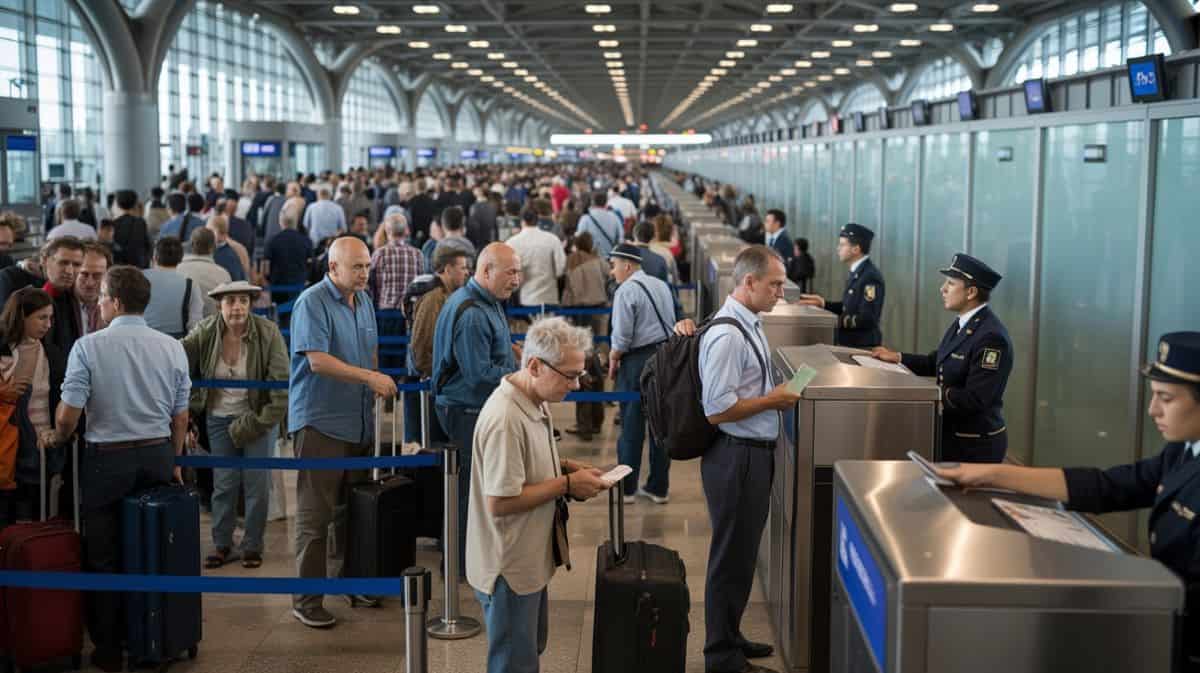
Image generated with Ai
Europe’s summer travel system is entering one of its most difficult border-control periods in years. Passport-control lines at Frankfurt Airport stretched to two hours in July 2026—double what they were the year before. Amsterdam Schiphol hit the same mark, and Munich’s wait times jumped from about half an hour to a full hour. On top of all that, Germany, France, Spain, Italy, the Netherlands, and a handful of other Schengen countries have reinstated border checks on certain routes inside EU borders.
Now, these aren’t exactly the same rules, but if you’re traveling, it doesn’t really matter—you feel them all at once. You show up, go through biometric EES scans to enter Schengen, and just when you think you’re done, you hit another ID check traveling within Europe. That’s where things really bog down. Just as summer crowds hit their peak, Europe’s border system is at its least predictable.
Advertisement
Advertisement
Europe Travel Delays Intensify as EES and Schengen Checks Hit Travellers Together
The biggest travel risk in Europe is no longer one long queue. It is the possibility of several delays appearing across one journey.
The EU Entry/Exit System, or EES, became fully operational across external Schengen border crossing points on 10 April 2026. It digitally records eligible non-EU short-stay visitors and replaces traditional passport stamping.
Advertisement
Advertisement
At the same time, temporary border controls have returned across major internal European routes.
Advertisement
Advertisement
Travellers now need to prepare for:
- longer external border processing;
- possible internal identity checks;
- tighter airport transfer margins;
- less predictable cross-border rail journeys;
- possible road and coach delays;
- greater uncertainty on multi-country holidays.
The key shift is simple. Schengen travel still functions, but the margin for error has narrowed.
Frankfurt Airport’s 120-Minute Queue Shows How Fast EES Pressure Can Build
Frankfurt has become one of the clearest examples of Europe’s border-processing strain.
Peak passport-control waiting time reached 120 minutes in July 2026. A year earlier, the maximum was 60 minutes.
That doubling matters because Frankfurt is one of Europe’s most important international transfer hubs.
Advertisement
Advertisement
A passenger delayed at immigration may also have to:
- change terminals;
- clear another security point;
- collect or recheck baggage;
- reach a distant departure gate;
- board a connecting flight within a narrow window.
This is where a border delay becomes a wider travel problem.
A long passport-control queue can quickly trigger missed connections, rebooking pressure and disrupted onward journeys.
Amsterdam and Munich Confirm the Problem Extends Beyond Frankfurt
Frankfurt is not an isolated case.
Amsterdam Schiphol recorded a maximum wait of 120 minutes, up from 80 minutes. Munich rose from 31 minutes to around 60 minutes.
Advertisement
Advertisement
| Airport | Earlier maximum | July 2026 maximum | Increase |
|---|---|---|---|
| Frankfurt | 60 minutes | 120 minutes | 60 minutes |
| Amsterdam Schiphol | 80 minutes | 120 minutes | 40 minutes |
| Munich | 31 minutes | 60 minutes | 29 minutes |
These are peak queue figures, not average processing times for every traveller.
That difference is critical.
The problem develops when several long-haul flights arrive within a short period and send large numbers of passengers towards the same control zone.
Border technology may be efficient at individual level. Airport congestion is not.
EES Changes How Non-EU Travellers Enter Europe
EES creates a new digital border process for eligible non-EU visitors.
Advertisement
Advertisement
The system records:
- passport and travel-document data;
- entry and exit details;
- facial images;
- fingerprints where required;
- refusals of entry.
The European Commission says the system improves border security, detects overstays and helps authorities combat identity and document fraud.
That gives EES a clear security purpose.
But from a passenger perspective, it also adds another processing layer.
This is an important operational lesson. Better technology does not automatically mean faster passenger movement.
Advertisement
Advertisement
A border system can become more secure and more data-rich while still creating delays when traveller volumes exceed processing capacity.
Amsterdam and Munich Invest Heavily in EES Infrastructure
Europe’s largest airports are not waiting for the pressure to disappear.
Amsterdam Schiphol has installed 161 EES self-service kiosks.
Munich has installed 119.
Airports have also expanded processing areas, improved passenger flow, redesigned waiting zones and added assistance staff.
Advertisement
Advertisement
These investments reveal the real challenge.
The pressure is not simply about how long one biometric registration takes. It is about throughput.
Hundreds of passengers can arrive together.
Thousands can arrive over a short peak window.
If final border verification cannot match that volume, queues form quickly even when self-service technology is available.
Advertisement
Advertisement
That is why capacity planning now matters as much as technology.
Germany Adds Border Controls Across Nine Neighbouring Countries
Germany is dealing with another layer of travel pressure at the same time.
Temporary internal controls remain in place along land borders with:
- France;
- Luxembourg;
- Belgium;
- the Netherlands;
- Denmark;
- Austria;
- Switzerland;
- Czechia;
- Poland.
The current German notification runs until 15 September 2026.
Germany cites irregular migration, migrant smuggling, pressure on its asylum system and wider security concerns.
Advertisement
Advertisement
For travellers, this creates a new route pattern.
A visitor may first enter Schengen through Frankfurt under EES and later cross a German internal border by road, rail or coach where temporary checks are active.
That second check is not guaranteed.
But the possibility means a traveller can no longer assume every onward European border will remain invisible.
Ten Schengen Countries Currently Maintain Internal Border Controls
Germany is part of a wider European trend.
Advertisement
Advertisement
Ten Schengen countries currently have notified temporary internal border controls.
| Country | Current control scope |
|---|---|
| Germany | Nine neighbouring land borders |
| France | Land, air and sea borders with six neighbours |
| Netherlands | Belgium, Germany and intra-Schengen air borders |
| Austria | Czechia, Slovakia, Hungary and Slovenia |
| Poland | Germany and Lithuania |
| Denmark | German land and sea borders |
| Sweden | All internal land, air and sea borders |
| Norway | Ports linked by Schengen ferry routes |
| Italy | Spain air and sea routes plus Slovenia land border |
| Spain | Air and sea borders with Italy |
This does not mean Schengen has ended.
It means governments are using temporary powers allowed under the Schengen Borders Code.
That distinction matters.
The system still allows free movement, but several routes now include the possibility of checks that travellers previously did not expect.
Advertisement
Advertisement
France Creates One of Europe’s Broadest Internal Border-Control Zones
France currently applies temporary controls across land, air and sea borders with:
- Belgium;
- Germany;
- Luxembourg;
- Switzerland;
- Spain;
- Italy.
The measures currently run until 31 October 2026.
France’s position makes this particularly important.
Paris sits at the heart of Europe’s long-haul aviation network.
France also connects directly into high-speed rail, road and short-haul air networks across Western Europe.
Advertisement
Advertisement
A delay at one point can therefore affect the entire itinerary.
This is where the issue becomes bigger than border control.
Europe’s transport system depends on precise connections. Any extra checkpoint can weaken that precision.
Spain and Italy Bring Border Controls Into Peak Summer Aviation
Spain and Italy add another major travel risk.
Italy introduced temporary controls at its internal air and sea borders with Spain from 1 August to 1 September 2026.
Advertisement
Advertisement
Spain followed with corresponding controls from 8 August to 7 September.
This is especially important because both countries are among Europe’s biggest summer tourism markets.
These controls directly touch busy air and ferry routes.
A traveller flying:
London → Madrid → Rome
Advertisement
Advertisement
may complete EES when first entering Schengen in Madrid.
The onward Madrid–Rome sector then sits inside a corridor where temporary internal controls are active.
That does not mean every passenger will face a second inspection.
It does mean the traveller now carries two separate border-control risks inside one itinerary.
Netherlands and Sweden Extend the Problem Into Intra-Schengen Air Travel
The Netherlands currently includes intra-Schengen air borders within its temporary control framework.
Advertisement
Advertisement
Sweden goes further by covering all internal borders across air, land and sea.
That changes one of the most familiar assumptions in European travel.
Travellers often treat a flight between two Schengen countries as effectively border-free.
That assumption is no longer universal.
The right to travel remains, but the possibility of checks has returned on selected routes.
Advertisement
Advertisement
For passengers, this means more uncertainty.
For airports and airlines, it means more operational complexity.
Road, Rail and Ferry Travellers Face a Different Type of Delay
Temporary internal controls also affect journeys beyond airports.
They can influence:
- international trains;
- cross-border coaches;
- rental cars;
- private vehicles;
- tour buses;
- ferries;
- commercial road traffic.
Austria maintains controls involving Czechia, Slovakia, Hungary and Slovenia.
Advertisement
Advertisement
Poland covers Germany and Lithuania.
Denmark controls its land and sea border with Germany.
Norway checks selected ferry-linked ports.
Italy also maintains controls with Slovenia.
Unlike airport EES queues, there is no single verified EU-wide figure showing how many minutes these checks add to every journey.
Advertisement
Advertisement
That means claims of universal two-hour internal border delays would be inaccurate.
The real risk is unpredictability.
A journey may run normally, or one targeted inspection may remove enough time to break a connection.
Why European Countries Are Restoring Border Controls
The reasons vary across Europe.
Official notifications cite combinations of:
Advertisement
Advertisement
- irregular migration;
- secondary migrant movements;
- migrant smuggling;
- terrorism threats;
- organised crime;
- sabotage concerns;
- foreign-state activity;
- pressure on asylum systems;
- wider geopolitical instability.
These measures are separate from EES.
That distinction is essential for accurate reporting.
EES is a permanent external-border digital system.
Temporary internal controls are national security measures permitted under Schengen law.
The two can affect the same traveller, but they do not share the same cause.
Advertisement
Advertisement
The Real Travel Risk Is a Multi-Stage Border Journey
The strongest way to understand Europe’s current border pressure is through one itinerary.
A multi-country journey can now look like this:
Non-EU departure
↓
Arrival at a Schengen airport
Advertisement
Advertisement
↓
EES biometric registration
↓
External passport control
↓
Advertisement
Advertisement
Entry into Schengen
↓
Onward flight, train, coach, road or ferry
↓
Country operating temporary internal controls
Advertisement
Advertisement
↓
Possible second identity check
↓
Final destination
This is where the current situation becomes more serious.
Advertisement
Advertisement
One delay may be manageable.
Two separate points of uncertainty can remove the time needed to make a connection.
That is why the present travel problem is fundamentally about reliability.
British, American, Canadian, Indian and Australian Travellers Need More Buffer Time
Visitors arriving from outside Europe and planning multi-country trips face the greatest planning challenge.
That includes travellers from:
Advertisement
Advertisement
- the United Kingdom;
- United States;
- Canada;
- India;
- Australia.
Major entry airports such as Frankfurt, Amsterdam, Munich, Paris, Madrid and Rome can all become part of these journeys.
The smartest approach is to build more time into:
- international-to-Schengen transfers;
- cross-border rail connections;
- coach journeys;
- ferry departures;
- rental-car itineraries;
- same-day multi-country travel.
The issue is not that every border will be slow.
It is that travellers can no longer assume every border will be invisible.
Europe’s Border Problem Is Now About Reliability, Not Just Delay
The most important insight from summer 2026 is that Europe’s travel system has become harder to predict.
Advertisement
Advertisement
EES has increased processing demands at external borders.
Temporary Schengen controls have brought checks back to selected internal routes.
Peak traffic can then magnify both pressures.
This creates a new planning reality.
A journey may still operate smoothly.
Advertisement
Advertisement
But a schedule built around narrow margins carries more risk than before.
For airlines, airports and governments, the challenge is now bigger than moving passengers through checkpoints.
They must protect the reliability of the entire European travel network.
Germany and Europe Enter a More Complex Schengen Travel Era
Germany and other European countries are not abandoning Schengen, but summer 2026 shows how quickly border friction can return when different security systems operate at once.
Frankfurt and Amsterdam have recorded peak passport-control waits of 120 minutes. Munich has reached around 60 minutes. At the same time, ten Schengen countries maintain temporary internal controls across major air, land and sea corridors.
Advertisement
Advertisement
The result is not a universal doubling of every journey.
It is a sharp reduction in certainty.
A traveller can now face biometric processing at Europe’s external frontier and a possible second check later inside Schengen.
That makes one question more important than ever.
Not simply whether the border is open.
Advertisement
Advertisement
But whether the journey has enough time to absorb the border.
In conclusion, travelers in Germany and other Schengen countries are running into serious headaches this summer. EES queues and border checks are causing two big problems at once. Take Frankfurt, for example—passport control lines peaked at 120 minutes, which is twice the old max of 60 minutes. Amsterdam and Munich aren’t doing much better; they’re seeing similar spikes. On top of that, temporary internal border checks all over Germany and the Schengen zone are making cross-border trips a lot more unpredictable. It doesn’t mean every journey will take twice as long, but when you combine slow EES processing with these extra checks, it’s easy to miss tight connections or spend way more time traveling than you expected. All of this adds up to a summer in Europe where Schengen travel feels a whole lot more stressful.
Advertisement
