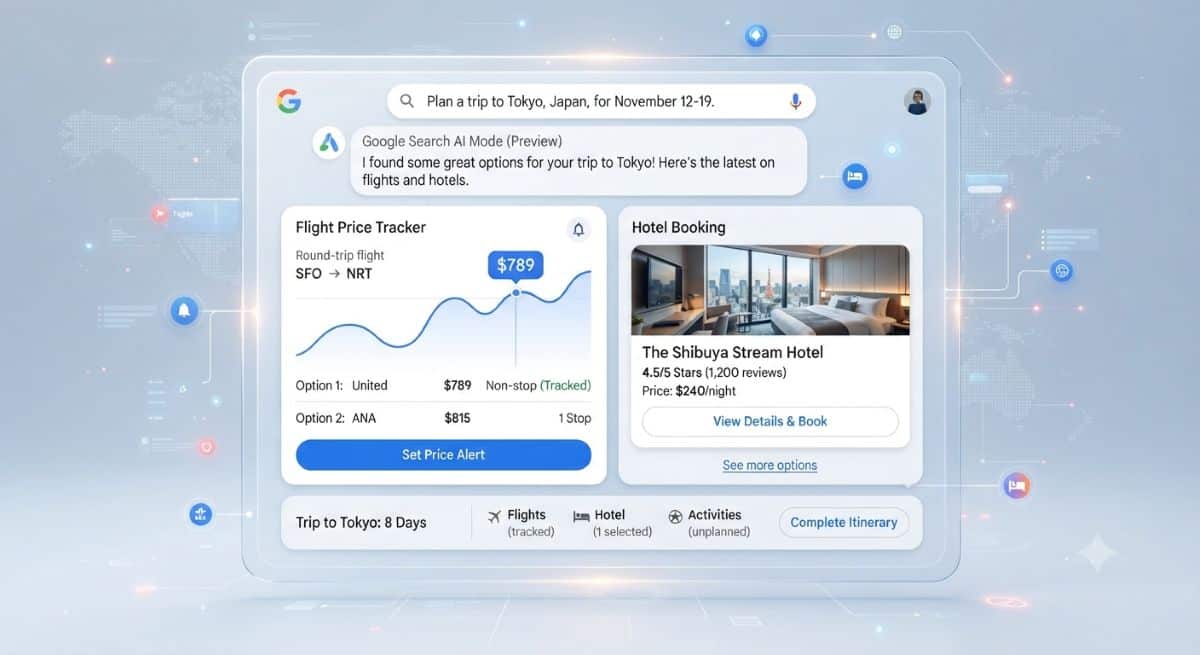
Image generated with Ai
The modern landscape of digital information retrieval has experienced a profound shift with the continuous integration of artificial intelligence into everyday applications. Recently, a significant technological enhancement was introduced by Google, extending the capabilities of its Google Search AI Mode. This development integrates advanced utility tools directly into conversational search interfaces, allowing users to handle complex logistical tasks without navigating away from the main search window.
Historically, specialized travel platforms required distinct applications or separate browser tabs to compare fares, set price alerts, and execute reservations. By merging these functionalities into an intelligent search assistant, a unified environment is established where travel planning is streamlined through conversational prompts, reflecting a broader industry trend toward consolidated digital ecosystems.
For global travelers, the integration of these features introduces a new level of convenience and efficiency. Users are now empowered to monitor fare fluctuations effortlessly through conversational dialogue, setting automated price alerts directly within the chat interface. Instead of manually checking multiple external portals, individuals can describe their travel destinations and timelines to the Google Search AI Mode, which then aggregates optimal options sourced from over 300 partner airlines and travel websites.
Furthermore, the capability to build comprehensive itineraries and search for flights using accumulated miles and points enhances financial flexibility. Travelers can also transition seamlessly from flight discovery to accommodation arrangements, where photos, guest reviews, and dynamic pricing metrics are presented in an accessible format before completing transactions through integrated payment systems.
Advertisement
Advertisement
The deployment of these travel-centric tools highlights the strategic evolution of search engine platforms into comprehensive service hubs. By embedding booking and tracking infrastructure directly into conversational interfaces, technology providers capture a larger share of the user journey, minimizing user churn to third-party aggregator sites.
Competitors within the digital commerce and search sectors are anticipated to face heightened pressure to replicate similar end-to-end capabilities. The incorporation of miles and points processing alongside direct vendor partnerships indicates a maturing digital marketplace where convenience and personalization dictate user adoption rates. Consequently, digital travel agencies and airline distributors are required to adapt their distribution strategies to align with conversational AI discovery paradigms.
Access to these newly deployed features varies depending on the specific service category and geographic region. Flight tracking capabilities have been made available across more than 180 countries and territories globally, while the functionality to view points and miles rates has achieved universal availability.
Conversely, the direct hotel booking feature is initially being rolled out within the United States in the English language, with broader geographical deployment scheduled over the upcoming weeks. Transactions for accommodations are facilitated through direct integration with hotel chains and online travel platforms, allowing room types to be selected, details reviewed, and payments processed securely utilizing Google Pay.
Advertisement
Advertisement
When evaluated against previous iterations of digital travel planning tools, this update represents a departure from fragmented service delivery. Traditional methods relied on isolated utilities such as Google Flights or standalone hotel aggregators, which required users to manually transition between discovery, comparison, and booking phases across disconnected web pages.
Earlier developments primarily focused on informational retrieval or localized recommendations rather than executing end-to-end transactional workflows within an AI-driven chat environment. By consolidating flight alerts, itinerary construction, miles redemption, and hotel checkout into a single interface, the updated infrastructure overcomes previous procedural barriers, offering a more cohesive and continuous user experience than past digital policies permitted.
Advertisement
Advertisement
Advertisement












Wednesday, September 2, 2026

Tuesday, September 1, 2026

Wednesday, September 2, 2026

Wednesday, September 2, 2026

Tuesday, September 1, 2026

Tuesday, September 1, 2026

Wednesday, September 2, 2026

Tuesday, September 1, 2026