

Kazakhstan Teams Up With Uzbekistan And More As Transport Links Expand, Connecting Europe And Asia Tourism

Published
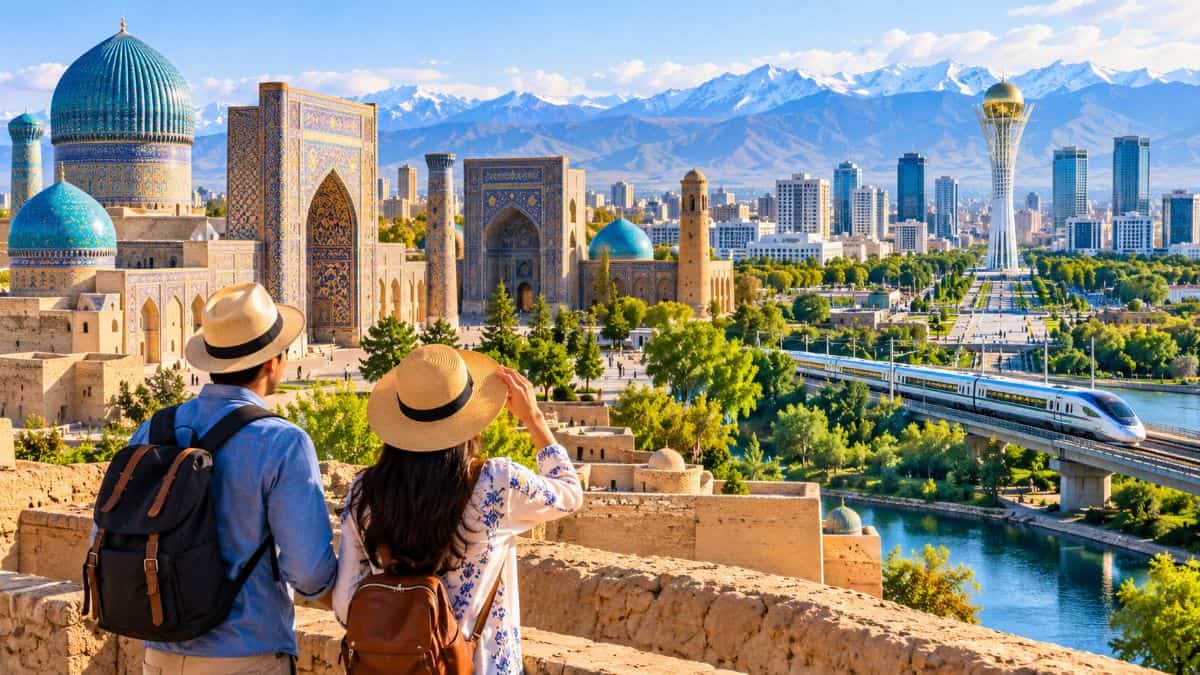
Central Asian overland routes are undergoing a profound structural evolution as international financiers, transport operators, and corporate travellers recalibrate their engagement with the historic crossroads of Eurasia. Long viewed by external observers through the singular prism of primary resource extraction, the sovereign territories stretching across the steppe and desert basins are establishing interconnected transport infrastructure that directly bridges European commerce with Asian consumer powerhouses. Kazakhstan, which retains its established status as the regional economic anchor, alongside an increasingly dynamic Uzbekistan, is drawing sustained focus from major institutions based across London and New York. This mounting commercial gaze reflects not merely opportunistic curiosity, but an intentional strategic drive to diversify transcontinental transit links, secure vital global commodity pipelines, and expand regional financial networks.
Yet this unprecedented wave of international enthusiasm is accompanied by an acute analytical shift. Sovereign stakeholders and regional logistics authorities now encounter international delegations whose priority has transitioned from speculative discovery to meticulous, forensic deliberation. Corporate treasurers and institutional decision-makers no longer query whether Central Asia possesses strategic geographic value; rather, they evaluate the precise legal architectures, administrative transit frameworks, and physical transport reliability underpinning cross-border movements. As trade volumes along the Trans-Caspian corridor surge, the regional imperative requires converting headline interest into durable administrative systems, seamless passenger and freight logistics, and robust, cross-border corporate governance capable of withstanding shifting geopolitical climates.
Advertisement
Advertisement
Shifting Focus from Raw Resources to Connected Transport
The traditional paradigm of Central Asian foreign direct investment, dominated historically by heavy extraction concessions, is diversifying into modern transit arteries, urban infrastructure, and cross-border connectivity. Western capital allocations, historically focused upon remote subsoil extraction in the Caspian basin, increasingly flow towards transport corridors designed to expedite the flow of both people and intermodal freight. Kazakhstan alone absorbed four hundred and forty billion dollars in total foreign direct investment between 2005 and 2025, capturing roughly seventy per cent of capital allocated across the wider regional geography. However, the qualitative composition of modern expenditure has fundamentally broadened, marked by a twenty-point-four per cent expansion in national transport operations and a fifteen-point-nine per cent surge in construction activity over recent cycles.
This infrastructure surge forms the core of Kazakhstan’s comprehensive National Infrastructure Plan, which marshals eighty-one billion dollars across more than two hundred individual projects scheduled through 2029. These capital investments prioritise high-speed passenger rail tracks, automated inland dry ports, modernized airport terminals, and expanded roadway connections that reduce journey times across extensive Eurasian distances. Corporate travellers navigating routes between Astana, Almaty, and regional industrial hubs encounter an operational environment increasingly synchronised with international logistical benchmarks, facilitating cross-border business travel while offering private capital an expanded spectrum of bankable infrastructure debt and equity instruments.
Advertisement
Advertisement
| Jurisdiction | Share of Central Asian Foreign Investment | Key Infrastructure and Economic Growth Sectors | Primary Strategic Asset Classes |
| Kazakhstan | Approximately 70 per cent | Transport, logistics construction, cross-border rail corridors | Global uranium production, copper reserves, sovereign bond issues |
| Uzbekistan | Rapidly expanding regional share | International financial centres, consumer manufacturing, hospitality | Rare-earth extraction, public equity listings, urban transport |
| Regional Partners | Remaining regional allocations | Hydropower networks, inter-state transit highways, civil aviation | Cross-border trade hubs, mineral deposits, agricultural logistics |
Capital Market Expansion Across the Ancient Silk Road
Concurrently with physical route construction, sovereign financial centres across Central Asia are transforming the regional fiscal topography by establishing deep, accessible capital markets. Historically, international institutions seeking commercial exposure to Central Asian expansion were restricted to direct enterprise ownership or state joint ventures. Today, financial hubs in Astana and Tashkent provide institutional investors with sophisticated debt and equity facilities, ranging from sovereign green bonds to international currency placements. The burgeoning issuance of offshore debt instruments demonstrates a regional commitment to investor diversification, establishing a credible sovereign yield curve that permits international travel conglomerates, hospitality developers, and infrastructure syndicates to fund operations locally with minimal currency friction.
This financial maturation reached a milestone with Uzbekistan executing the inaugural international equity listing of its National Investment Fund, an issue that achieved an oversubscription rate exceeding four hundred per cent. Such transactions demonstrate that private international capital welcomes transparent corporate conduits into the regional economy. Uzbekistan is deploying these resources to construct the Tashkent International Financial Center, an initiative explicitly structured to mirror English common law commercial venues and reassure institutional visitors. By creating modern regulatory enclaves, the region provides international corporate visitors with familiar dispute resolution frameworks, transparent transaction settlement procedures, and frictionless corporate establishment facilities, thereby reducing the institutional friction traditionally associated with frontier market engagement.
Advertisement
Advertisement
Navigating Critical Minerals and Sovereign Corridor Logistics
The geopolitical necessity of diversifying international supply chains has cast Central Asia into global prominence regarding critical raw materials, clean energy technologies, and transcontinental transit security. Kazakhstan produces forty per cent of global uranium output and has expanded mineral exploration expenditures to decade highs, targeting major copper, rare earth, and battery-metal deposits. Across the border, Uzbekistan has identified fourteen distinct rare-earth exploration zones alongside commercial-grade deposits of tungsten, lithium, and germanium. These reserves are not merely industrial assets; they serve as catalysts for high-level bilateral diplomatic engagement, driving multi-billion-dollar international framework compacts that pair mineral concessions directly with regional transit modernization and domestic processing facilities.
This economic reality directly reshapes regional transit corridors. International executives, mining engineers, and commercial delegations travelling to Central Asia encounter transport networks explicitly aligned to bypass congested maritime chokepoints and northern rail passages. Supported by substantial multilateral financial commitments, the Trans-Caspian international transport route provides a viable multi-modal conduit linking Central Asian logistics hubs with European ports via Azerbaijan and Georgia. Consequently, regional authorities are allocating substantial capital toward enhancing Caspian Sea port capacities, expanding containerised freight handling systems, and establishing seamless customs inspection systems. These physical upgrades facilitate expedited transit for high-value mineral exports, commercial merchandise, and mobile corporate specialists operating across the Eurasian interior.
Overcoming Information Deficits in the Regional Marketplace
Despite dramatic progress across physical infrastructure and legal mechanisms, the primary impediment constraining Western participation remains a persistent information deficit. While international investor awareness has achieved an elevated baseline, profound disparities endure between headline perception and operational realities on the ground. Western institutions routinely evaluate Central Asian commercial prospects through the lens of external geopolitical disruptions, frequently applying unwarranted risk premiums to stable jurisdictions that possess strong fiscal balance sheets, low debt-to-GDP ratios, and expanding real output. The central challenge confronting local trade ministries is demonstrating that regulatory frameworks, investor protections, and logistical efficiency operate reliably across daily commercial routines.
Resolving this perceptual divide requires sustained, transparent communication combined with direct, on-the-ground commercial discovery. Corporate site inspections, regional trade summits, and professional travel exchanges allow institutional analysts to witness the physical execution of infrastructure master plans rather than relying on generalised macro commentary. As direct flight connectivity expands between European capitals, the Gulf, and Central Asian administrative hubs, the operational distance between Western capital centres and Eurasian markets diminishes rapidly. When international professionals experience first-hand the modernised transit corridors, operational special economic zones, and responsive administrative offices across Kazakhstan and Uzbekistan, abstract interest converts into committed financial partnership, firmly anchoring Central Asia within the global economic mainstream.
Frequently Asked Questions
What is driving increased Western corporate interest in Central Asia?
Western institutions are attracted by the region’s vast critical mineral reserves, expanding transcontinental transport corridors, major state infrastructure investment programmes, and newly accessible capital markets across both Kazakhstan and Uzbekistan.
Advertisement
Advertisement
How does Kazakhstan maintain its economic leadership within the region?
Kazakhstan retains its leadership by attracting roughly seventy per cent of historical foreign investment entering Central Asia, backed by extensive oil, copper, and uranium assets, dynamic infrastructure projects, and robust transport links.
What major transport initiatives are improving regional connectivity?
The development of the Middle Corridor, alongside Kazakhstan’s eighty-one billion dollar National Infrastructure Plan, is modernising cross-border rail, expanding Caspian Sea port terminals, and developing highway networks between major commercial centres.
Why are capital markets becoming significant for institutional visitors?
The emergence of sophisticated financial platforms in Astana and Tashkent allows institutional investors to deploy capital into corporate bonds, sovereign debt, and equity listings with transparent regulatory safeguards and international settlement standards.
Advertisement
Advertisement
What role does Uzbekistan play in the region’s investment transition?
Uzbekistan provides an expanding consumer base, extensive manufacturing growth, large deposits of rare-earth minerals, and substantial financial reforms highlighted by the establishment of the Tashkent International Financial Center.
How are critical minerals influencing international trade routes across Eurasia?
Global demand for uranium, lithium, and rare-earth materials has prompted international alliances that fund direct infrastructure improvements, connecting Central Asian mining and refining operations directly to international manufacturing markets.
What operational challenges do foreign companies face when entering the region?
Foreign operators must navigate persistent information deficits, evolving domestic regulatory frameworks, logistics coordination across national borders, and external geopolitical developments that influence global risk perceptions.
Advertisement
Advertisement
How is business travel adapting to the growth of Central Asian commercial hubs?
Business travel is supported by expanding international air routes, streamlined visa procedures, upgraded municipal transit, and modern hospitality infrastructure in key administrative centres like Astana, Almaty, and Tashkent.
What is the Middle Corridor and why is it commercially significant?
The Middle Corridor is a multi-modal trade route crossing Central Asia and the Caspian Sea to connect Asia and Europe, bypassing conventional northern routes and significantly accelerating containerised transport times.
How are regional governments addressing investor perceptions of political risk?
Governments are institutionalising English common law dispute systems in special economic zones, digitising customs procedures, issuing sovereign debt internationally, and enacting transparent statutory protections for foreign-held physical and financial assets.
Advertisement
