
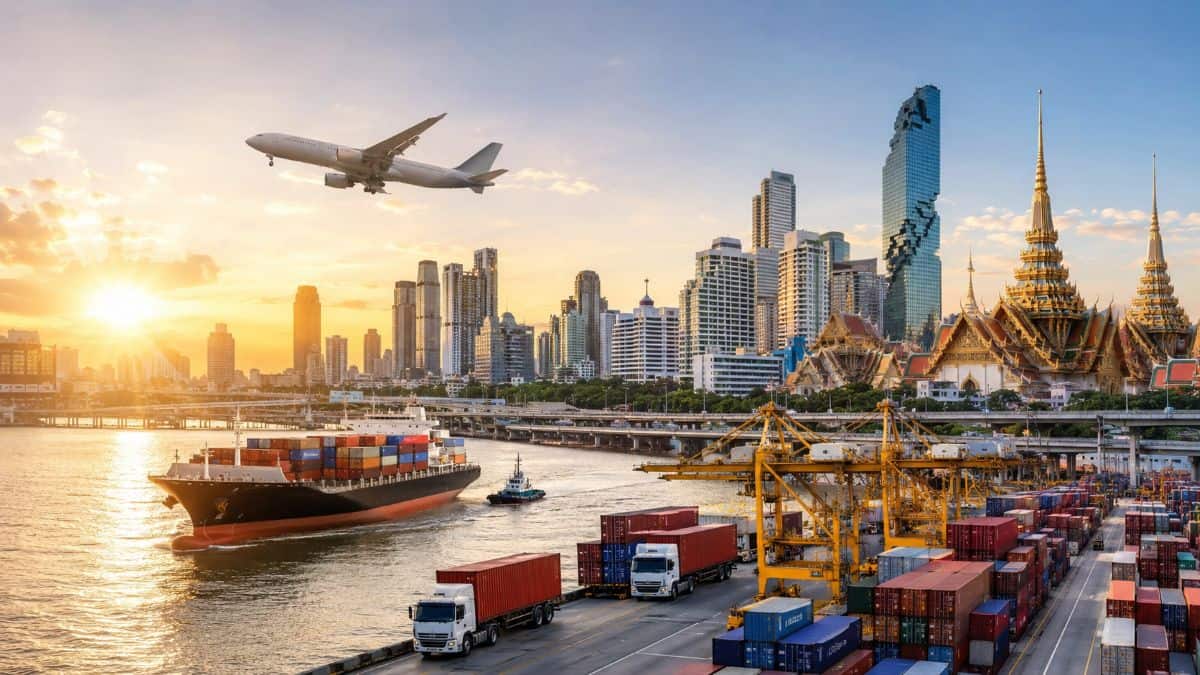
Image generated with Ai
Malaysia and Thailand are moving closer to a US$30 billion trade milestone next year, while stronger commercial ties create fresh opportunities for cross-border business travel and regional connectivity.The two neighbouring Southeast Asian economies are recording encouraging trade momentum during the first eight months of 2026, putting their bilateral trade target within reach. Malaysian Ambassador to Thailand Datuk Wan Zaidi Wan Abdullah said continued cooperation between authorities, manufacturers and technical groups will be important to sustain this progress. His comments came during Vitafoods Asia 2026 in Bangkok, where Malaysian companies showcased health and wellness products alongside more than 800 exhibitors from 40 countries.
The development also carries significance beyond merchandise exchange. Malaysia and Thailand share one of Southeast Asia’s most active cross-border relationships, supported by extensive road, rail and air connections, established commercial networks and frequent movement of business travellers. As companies explore new markets, suppliers and partnerships, easier trade procedures could support more efficient journeys between the two countries. However, documentation and product verification remain challenges for Malaysian businesses entering Thailand, highlighting the importance of regulatory cooperation as bilateral economic activity expands.
Advertisement
Malaysia and Thailand are on course to achieve their US$30 billion bilateral trade target in 2027, according to Malaysia’s ambassador to Thailand. The progress reflects sustained commercial activity between two countries that have long maintained close economic and geographical links.
Wan Zaidi said meetings with relevant stakeholders have been taking place to facilitate exports and imports between Malaysia and Thailand. The discussions are particularly important as businesses seek to expand product distribution, establish partnerships and respond to demand in neighbouring markets.
Advertisement
Advertisement
For travellers, stronger economic integration can have a wider impact than trade statistics alone suggest. Business travel frequently follows commercial expansion, with manufacturers, distributors, investors and industry representatives travelling between major economic centres. As bilateral activity increases, demand for reliable transport, accommodation, meetings and related services can also become more significant.
Thailand remains an important destination for Malaysian business activity, while Malaysia provides Thai companies with access to a developed manufacturing and services ecosystem. Their proximity gives companies an advantage when compared with longer-distance international markets, particularly when frequent face-to-face engagement is required.
Despite the positive outlook, regulatory requirements continue to create obstacles for exporters. Wan Zaidi highlighted product documentation as a major barrier for Malaysian products seeking entry into the Thai market.
He called for relevant Malaysian authorities to assist manufacturers in preparing documentation covering product verification and other requirements needed for approval, marketing or market entry.
Such procedures are particularly relevant to health, wellness and functional food businesses, where product standards and verification can influence how quickly goods reach consumers. Regulatory compliance is therefore not simply an administrative issue; it can affect commercial planning, distribution schedules and the cost of entering a foreign market.
Malaysia and Thailand are continuing discussions through technical groups to identify measures that could facilitate bilateral trade. The objective is to ensure that imported and exported products meet the standards of both countries without creating unnecessary complications for businesses.Key Development Current Position Potential Significance Bilateral trade target US$30 billion Signals expanding Malaysia-Thailand commercial ties 2026 performance Strong progress in the first eight months Supports the 2027 target Main trade challenge Product documentation Businesses need clearer and efficient compliance processes Technical cooperation Ongoing discussions Could improve cross-border trade procedures Health and wellness sector Growing participation Creates opportunities for suppliers and partnerships Business travel Supported by expanding commercial activity May increase movement between Malaysia and Thailand
Vitafoods Asia 2026 provided a useful backdrop for the latest trade discussions. Held from 2 to 4 September at the Queen Sirikit National Convention Centre in Bangkok, the event brought together more than 800 companies from 40 countries across the nutraceutical and functional food industries.
Malaysian exhibitors used the event to demonstrate their manufacturing capabilities, particularly in health and wellness products. According to Wan Zaidi, Malaysian companies can supply international businesses because they are capable of meeting local market requirements.
The presence of Malaysian businesses at a major Bangkok industry event also illustrates how exhibitions can support cross-border commercial relationships. Trade shows provide opportunities for companies to meet prospective buyers, distributors, manufacturers and research partners without requiring them to establish an immediate physical presence in another market.
For business travellers, these events can therefore become important points of connection between the two countries. Bangkok’s role as a regional commercial centre makes it a natural meeting location for companies seeking partnerships across Southeast Asia.
Another area highlighted by the Malaysian ambassador is the ability of local manufacturers to provide original equipment manufacturer and original design manufacturer services.
This flexibility could help Malaysian companies work with Thai businesses that are looking for products adapted to specific market requirements. Rather than simply exporting finished goods, manufacturers can participate in product development, joint research and customised production.
Such arrangements can deepen commercial relationships because businesses become partners in developing products rather than remaining conventional buyer-and-seller counterparts.
For Malaysia, this provides an opportunity to use established manufacturing expertise to reach consumers in Thailand and potentially other regional markets. For Thai companies, collaboration with Malaysian manufacturers could provide additional sourcing and product-development options.
The expansion of these relationships could also encourage more professional travel, including factory visits, research meetings, trade exhibitions and negotiations.
Malaysia and Thailand benefit from their shared border and relatively close geographic proximity. Major cities and commercial centres are connected through air services, highways, rail links and established border crossings.
This connectivity gives businesses practical advantages when managing regional operations. Executives can travel for meetings, suppliers can coordinate production and companies can participate in exhibitions without the logistical challenges associated with distant international markets.
As trade grows, efficient connectivity becomes increasingly important. A company may have strong demand for its products, but delays in documentation, transport or border procedures can affect the commercial value of that opportunity.
The same principle applies to business travel. Efficient movement between markets can make it easier for companies to maintain partnerships, inspect facilities and respond quickly to changing requirements.
The US$30 billion trade ambition is primarily an economic objective, but stronger business relationships can contribute to wider movement between Malaysia and Thailand.
Business travellers form an important segment of regional travel, particularly when companies attend conferences, exhibitions, supplier meetings and industry events. Greater commercial cooperation can increase the frequency of such journeys.
There can also be indirect benefits for hospitality and destination services. Business visitors require hotels, restaurants, transport and meeting facilities, while major exhibitions can generate additional visitor demand in host cities.
The development therefore connects trade, aviation, hospitality and business events within a broader regional ecosystem. However, the scale of any travel impact will depend on the pace of trade growth, business investment and connectivity improvements.
The biggest opportunity now lies in converting trade momentum into smoother commercial processes. Malaysia and Thailand are already using technical discussions to examine ways of facilitating bilateral trade.
Reducing unnecessary administrative difficulties while maintaining product standards could make it easier for companies to enter each other’s markets. Clearer requirements can also give businesses greater certainty when preparing products for approval and distribution.
For smaller manufacturers, this can be especially important because compliance costs and administrative complexity can represent a greater proportion of their international expansion expenses.
The health and wellness sector demonstrates why such cooperation matters. Products must satisfy regulatory expectations before they can be marketed, meaning manufacturers need reliable information about verification, documentation and approval procedures.
Malaysia and Thailand’s progress towards the US$30 billion trade target reflects more than a single economic milestone. It demonstrates the potential of neighbouring ASEAN economies to deepen commercial relationships through manufacturing, product development and technical cooperation.
The next stage will depend on whether businesses can convert opportunities into sustained trade while authorities address documentation and regulatory challenges. Continued engagement between technical groups, manufacturers and government agencies will therefore remain important.
For travellers, the development offers another indication of how economic integration shapes movement across Southeast Asia. Growing trade encourages meetings, exhibitions, investment visits and professional exchanges, while established transport links make such journeys increasingly practical.
As Malaysia and Thailand work towards their 2027 objective, stronger commercial ties could reinforce their positions as important partners within the wider ASEAN economy, with business travel and cross-border connectivity forming a supporting part of that relationship.
1. What is Malaysia and Thailand’s bilateral trade target?
Malaysia and Thailand are aiming to reach US$30 billion in bilateral trade next year.
2. When is the US$30 billion trade target expected to be reached?
The target is expected to be reached in 2027 if current trade momentum continues.
3. What is driving Malaysia-Thailand trade growth?
Strong commercial performance, manufacturing capabilities, health and wellness products, and closer business cooperation are supporting bilateral trade.
4. What is the main challenge for Malaysian exporters entering Thailand?
Product documentation and verification requirements remain a significant challenge for Malaysian exporters.
5. How are Malaysia and Thailand addressing trade barriers?
Technical groups from both countries are continuing discussions on measures designed to facilitate bilateral trade while maintaining required standards.
6. What industries are highlighted in the latest trade discussions?
Health, wellness, nutraceutical and functional food industries received particular attention during Vitafoods Asia 2026.
7. What is Vitafoods Asia 2026?
Vitafoods Asia 2026 is an international exhibition focused on nutraceutical and functional food industries, bringing together companies from around the world.
8. How can stronger trade affect travel between Malaysia and Thailand?
Growing commercial relationships can support more business travel for meetings, exhibitions, research, investment and supplier visits.
9. Why is connectivity important for Malaysia-Thailand trade?
Efficient air, road and rail connections help businesses move people and goods between the two neighbouring countries.
10. Could stronger trade benefit tourism and hospitality?
Yes. Increased business activity and industry events can create additional demand for accommodation, transport, restaurants and other visitor services, although the scale will depend on future commercial growth.
Advertisement
Tags: ASEAN Trade, business tourism, cross-border travel, health and wellness trade, Malaysia Thailand bilateral trade
Advertisement
Advertisement













Thursday, September 3, 2026

Thursday, September 3, 2026

Thursday, September 3, 2026

Thursday, September 3, 2026

Thursday, September 3, 2026

Wednesday, September 2, 2026
Thursday, September 3, 2026

Thursday, September 3, 2026


