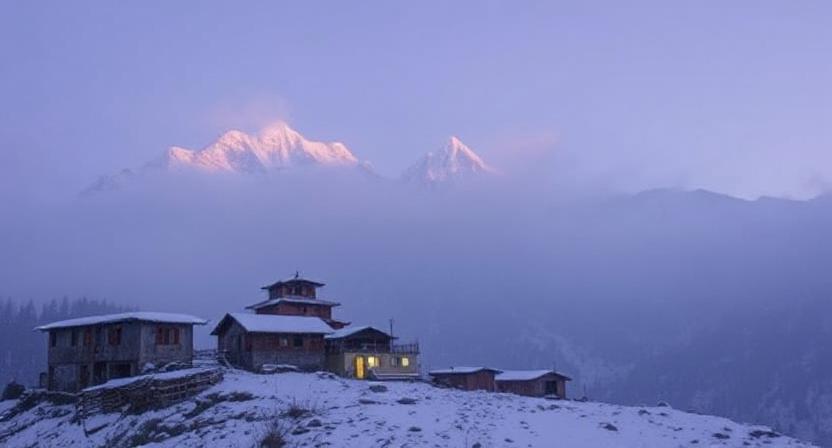
Image generated with Ai
Nepal’s Gorkha District, specifically the northern part of Chumnumbri Rural Municipality, has witnessed intense snowfall from the evening of October 29 disrupting normal life of local inhabitants and travelers in the area. The ongoing snowfall has impacted villages at elevations above 3,000 meters, such as Nile, Chhule, Pangdun, Lar, Phurpe, Lamagaun, Burji, Jong, and Chhekam. These areas, already remote and often hard to access, have seen intensified isolation due to the snowstorm. Apart from disturbing local living, the Gorkha and Manaslu area, which is among Nepal’s most sought-after trekking spots, has also been affected, with travelers and tourists being marooned, particularly at Larke Pass, a key trekking trail. The snow has caused serious difficulties for both locals and tourists who want to experience the stunning Himalayan scenery.
According to Pasang Funjo Lama, a resident of Chumnumbri Rural Municipality-7, the snowfall began on October 29, accompanied by light rainfall. “The area received light rainfall and snowfall last night. Snowfall is still taking place. The people are inside their houses. The yaks are also kept in the sheds,” Lama shared.
As snow accumulates across the villages, many residents have been forced to stay indoors, and livestock, particularly yaks, have been sheltered in protective sheds to avoid exposure to the severe weather. The disruption of daily life in this rural municipality, located in the northern part of Gorkha District, reflects the vulnerability of these mountain communities to extreme weather events, which can hamper access to essential services and affect food security in such remote regions.
The Manaslu region, a renowned trekking area in Nepal, is also facing difficulties due to the snowstorm. Trekkers traveling through the region, particularly those heading toward Larke Pass, have been stranded halfway by the unexpected snowfall, unable to continue their journey to higher altitudes. This disruption has had a considerable impact on tourism in one of Nepal’s most visited trekking areas.
Advertisement
The Manaslu Circuit Trek, which takes travelers through some of the most stunning landscapes in the Himalayas, including remote villages, cultural heritage sites, and high-altitude vistas, has been temporarily halted for some tourists due to the weather conditions. Trekking agencies and guides have advised trekkers to stay in designated shelters until the weather clears and the trail becomes passable again.
While snowfall is typical for the Himalayas, this early-season storm has presented unexpected challenges for tourists and trekking operators alike. The disruption at Larke Pass emphasizes the need for proper weather forecasting and safety measures to ensure that trekkers can continue to enjoy Nepal’s world-class trekking experiences while staying safe in challenging mountain conditions.
The Manaslu region and other remote areas of Nepal have been increasingly attracting tourists from around the world, drawn by the natural beauty, rich cultural heritage, and adventure tourism options. Nepal’s wildlife tourism sector has been growing, with more than 6.5 million domestic and international tourists visiting national parks and wildlife sanctuaries annually. As trekking routes like the Manaslu Circuit gain popularity, the country is becoming a central hub for adventure tourism in Asia.
However, as Nepal’s tourism sector continues to grow, the government and tourism operators must implement better strategies for weather-related disruptions and emergency preparedness to ensure the safety of travelers, particularly in high-altitude areas prone to extreme weather conditions like snowfall, avalanches, or heavy rainfall.
Advertisement
Advertisement
As Nepal’s trekking and adventure tourism market expands, it will be essential for the country to improve its infrastructure in remote regions to handle unexpected weather events. This includes enhancing road systems, weather monitoring technologies, and rescue operations to ensure the safety of both locals and tourists. Moreover, improving shelter facilities for trekkers and local communities in remote areas will play a crucial role in protecting lives during extreme weather.
Nepal’s mountain tourism offers unmatched opportunities for eco-tourism and cultural tourism, but these sectors must be developed in a sustainable and resilient manner. With the growing popularity of trekking and wildlife safaris, there will be a greater need to incorporate climate-conscious tourism practices that prioritize both the safety of tourists and the preservation of Nepal’s fragile mountain ecosystems.
The recent snowfall in Gorkha and Manaslu region highlights the susceptibility of high-altitude tourism to extreme climate events. While Nepal continues to be among the globe’s leading destinations for trekking and wildlife tourism, the nation needs to continue investing in infrastructural development, safety regimes, and emergency preparedness to protect the welfare and security of its tourists.
By concentrating on sustainable tourism and enhancing its resiliency against climate issues, Nepal is able to further establish itself as a world-class destination for adventure, culture, and nature. For the meantime, the Larke Pass and other trekking trails in the Manaslu area will be closed, but weather will clear out someday, and Nepal’s tourists will keep coming to the country’s unexplored natural scenery, making Nepal’s tourism industry one of Asia’s quickest-growing.
Advertisement
Tags: impact of snowfall on trekkers Nepal 2025, local life disruption Nepal snowfall Gorkha, Nepal snowfall Gorkha Manaslu region tourism disruption, Nepal tourism growth Manaslu region, trekking tourism Nepal 2025 snowfall
Advertisement
Advertisement












Wednesday, September 2, 2026

Wednesday, September 2, 2026
Wednesday, September 2, 2026

Wednesday, September 2, 2026
Wednesday, September 2, 2026
Tuesday, September 1, 2026
Wednesday, September 2, 2026

Wednesday, September 2, 2026



