
Croatia Is Now On Track To See Better Tourism Recovery As More Foreign Visitors Return To The Adriatic Coast

Updated
Published
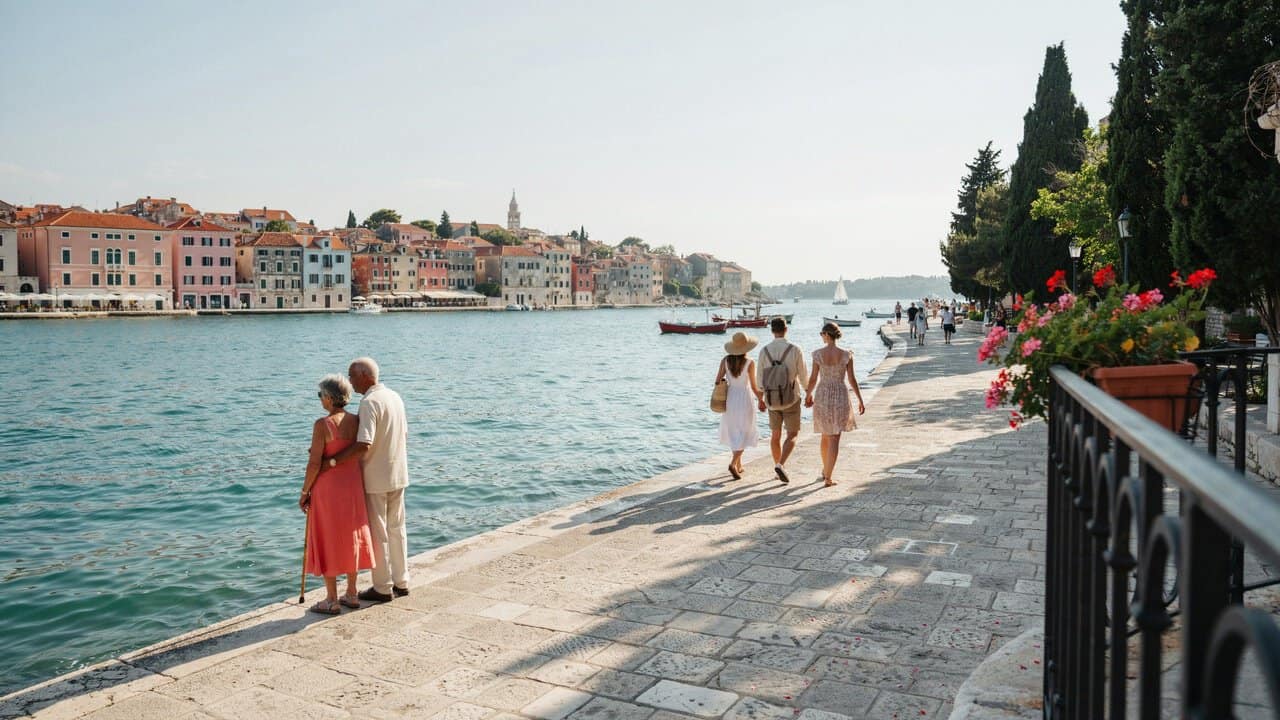
Croatia recorded 4.5 million arrivals and 25.3 million overnight stays in commercial accommodation during July 2026. Official data show arrivals increased by 2.7%, while nights rose by 1.2% from July 2025. Foreign travellers generated 92.7% of all nights. The improvement followed a weaker June, when international arrivals fell by 8.9%. Croatia Tourism Recovery 2026 therefore represents a return to annual growth during the peak summer period. Travellers face no new visa, passport or border rules because of the results, but stronger coastal demand makes early accommodation and transport planning more important.
Evidence Behind Croatia Tourism Recovery 2026
The central development is a statistically confirmed rise in tourist activity. Commercial accommodation recorded exactly 4,476,012 arrivals and 25,264,201 nights during July. The figures cover registered hotels, holiday properties, campsites and similar establishments across Croatia. They do not cover every form of travel or establish how much money visitors spent. They also do not prove that demand increased because of any single policy, campaign or transport change. The strongest confirmed finding is that both arrivals and nights moved above their July 2025 levels after annual declines during June.
Advertisement
Advertisement
The following ratio is an editorial assessment of the story’s verified components. It is not an official statistical measure. Tourism performance receives the largest share because the evidence concerns arrivals, overnight stays, accommodation categories, regions and source markets. Accommodation capacity and regional distribution form the next major parts. Entry policy receives only a small share because no new visa or passport measure was announced. The available evidence establishes a measurable July improvement, but it does not establish higher visitor spending, stronger business profits or a permanent change in travel behaviour.
| News component | Share of story | Officially verified finding | Relevance to travellers | Official source |
|---|---|---|---|---|
| Tourism performance | 45% | Arrivals rose 2.7% and nights increased 1.2% | Confirms stronger peak-season activity | National statistical office |
| International demand | 20% | Foreign travellers generated 92.7% of all nights | Shows reliance on overseas visitors | National statistical office |
| Accommodation | 15% | Holiday properties led nights, followed by campsites and hotels | Identifies where demand was concentrated | National statistical office |
| Regional demand | 15% | Istria, Split-Dalmatia and Primorje-Gorski Kotar led overnight stays | Highlights the busiest coastal areas | National statistical office |
| Entry policy | 5% | No new visa or passport rule was included | Travellers continue under existing requirements | Official Schengen framework |
| Total | 100% | Editorial assessment | Reflects the evidence available | Official data |
June Decline Gives Important Context To The July Rebound
June 2026 delivered three million arrivals and 13.5 million overnight stays in commercial accommodation. Total arrivals were 6.6% lower than in June 2025, while nights declined by 6.1%. The international segment experienced the largest reduction. Foreign travellers generated 2.6 million arrivals, down 8.9%, and 12.3 million nights, down 7.5%. Domestic tourism moved differently. Croatian residents produced 387,000 arrivals and 1.2 million nights, representing increases of 11.8% and 11.7%. However, that growth could not offset the reduction in the much larger international market.
Advertisement
Advertisement
July changed the direction of the annual comparison. Foreign arrivals increased by 2.2% to 4,065,279, while international nights rose by 0.9% to 23,411,809. Domestic travellers generated 410,733 arrivals and 1,852,392 nights. These totals represented growth of 7.4% and 5.6%. Croatia Tourism Recovery 2026 should still be interpreted carefully because June and July represent different stages of the summer season. July usually produces higher volumes. The clearest evidence of improvement is not the month-to-month increase, but the movement from negative annual growth in June to positive annual growth in July.
Why Tourism Recovery Matters To Travellers And Businesses
International visitors remained responsible for most commercial accommodation activity. They delivered 92.7% of July nights, while domestic travellers contributed 7.3%. Foreign guests stayed for an average of 5.8 nights per arrival. Domestic visitors averaged 4.5 nights, while the overall average reached 5.6 nights. Because arrivals grew faster than overnight stays, the improvement came mainly from more trips rather than significantly longer visits. This distinction matters to accommodation providers and destinations because additional arrivals can increase guest turnover without producing the same rate of growth in occupied nights.
Advertisement
Advertisement
Germany remained the largest foreign market, generating 4.4 million nights. This represented 18.8% of international nights and an increase of 1.2%. Slovenia followed with 2.7 million nights and an 11.5% share. Together, these two countries delivered 30.3% of foreign nights. Poland accounted for 9.5%, Czechia 7.5% and Austria 6.9%. Nights from Czechia and Hungary each rose by 8.3%, while Ukraine increased by 16.7%. However, Austria declined by 3.8%, the Netherlands by 3.4%, Slovakia by 2.7% and Italy by 1.2%. Croatia Tourism Recovery 2026 was therefore positive but uneven across its major European markets.
Coastal Regions And Accommodation Carry The Strongest Demand
Istria generated 7,460,208 nights during July, representing 29.5% of Croatia’s total. Its overnight stays increased by 1.3% compared with July 2025. Domestic nights in the county rose by 6.2%, while international nights grew by 1.2%. Split-Dalmatia ranked second with 5,272,484 nights, equal to 20.9% of the national total. Its nights increased by 1.6%. Primorje-Gorski Kotar followed with 4,240,678 nights and a 16.8% share, recording growth of 1.9%. Together, the three counties accounted for more than two-thirds of all recorded nights.
Holiday and similar short-stay properties remained the largest accommodation group. They registered 2.5 million arrivals and 14.3 million nights, representing 56.4% of the national total. Their arrivals increased by 2.3%, while nights rose by 1%. Campsites recorded 849,000 arrivals and six million nights, with respective growth of 2.6% and 1.2%. Hotels and similar establishments generated 1.2 million arrivals and five million nights. Hotel arrivals increased by 3.7%, while nights rose by 1.7%. This was the strongest overnight growth among the three principal accommodation categories and added measurable support to Tourism Recovery.
Croatia had 424,000 available rooms, apartments and camping places during July, supplying approximately 1.1 million permanent beds. Holiday properties provided 59.9% of available units and 60.9% of permanent beds. Hotels offered 83,000 rooms and apartments with 174,000 permanent beds. Average hotel room occupancy reached 79.8%, compared with 78.4% in July 2025. Permanent hotel bed occupancy increased from 92.6% to 93.9%. These ratios show that accommodation use strengthened, particularly during a period when coastal capacity was already operating at high levels.
Rovinj recorded 989,000 nights from foreign visitors, making it the leading international destination. Poreč followed with 778,000, while Medulin generated 777,000. Dubrovnik recorded 735,000 foreign nights, Split 646,000 and Umag 640,000. Domestic travellers most frequently stayed in Crikvenica, which registered 74,000 resident nights. Children aged under 14 generated 5.9 million nights nationally, representing 23.3% of the total. Travellers aged between 35 and 44 recorded another 4.8 million nights, accounting for 18.8%.
What Travellers Need To Know Before Visiting Croatia
The July statistics do not introduce any visa, passport, health or border-policy change. Croatia continues to operate within the Schengen area. Entry requirements depend on a traveller’s nationality, residence status, documents and itinerary. Visitors who require a Schengen visa must obtain the correct authorisation before travelling. Eligible short visits are generally limited to 90 days within a 180-day period. Travellers should confirm their individual requirements through official government or diplomatic channels because tourism statistics do not replace entry guidance.
Advertisement
Advertisement
The main practical consequence is stronger pressure on busy coastal destinations during peak periods. Official data do not show that travellers must cancel or alter existing plans. However, visitors heading to Istria, Split-Dalmatia or Primorje-Gorski Kotar may benefit from confirming accommodation, ferries and local transport early. Those visiting Rovinj, Poreč, Medulin, Dubrovnik, Split or Umag should consider the high concentration of international stays when planning their journeys.
Travellers should:
- Confirm accommodation before travelling during the peak summer period.
- Check road, ferry and local transport information before departure.
- Verify passport validity under the rules applying to their nationality.
- Confirm whether they require a Schengen visa.
- Retain booking confirmations and transport documents.
- Allow additional travel time in heavily visited coastal destinations.
- Follow official entry and transport information.
- Avoid treating the statistical rebound as a change in border rules.
These are planning measures rather than emergency instructions. The official evidence does not identify a safety event, border disruption or regulatory change requiring travellers to abandon or rearrange confirmed trips.
What Comes Next For Croatia Tourism Recovery 2026
The January-to-July totals provide a more balanced measure of the year. Croatia recorded 11.7 million arrivals and 51.2 million nights in commercial accommodation during the first seven months. Arrivals increased by 1.4%, while nights rose by 0.8% from the corresponding 2025 period. Domestic travellers generated 1.9 million arrivals and 5.3 million nights, representing growth of 8.1% and 7%. Foreign visitors contributed 9.8 million arrivals and 45.9 million nights. Both international indicators were only 0.2% higher, confirming that the wider annual improvement remained limited.
Future monthly releases will show whether July’s positive result continued during August and the autumn period. No specific policy review, visa reform or official demand forecast was announced with the July data. August will offer another important measure because it falls within the main summer season. Later results will indicate whether demand continued outside the busiest coastal weeks. Croatia Tourism Recovery 2026 currently reflects stronger July activity, high international dependence and concentrated Adriatic demand. It does not yet establish faster growth across the entire year or every visitor market.
Croatia Tourism Recovery Strengthens but Long Term Growth Remains Measured
Croatia’s July results confirm that Tourism Recovery returned to positive annual growth during the country’s busiest summer period. Higher arrivals supported accommodation demand across the Adriatic, while foreign visitors continued to generate most overnight stays. Yet the small increase in international nights and near-flat seven-month foreign growth require a measured interpretation. No new visa, passport or border policy caused the improvement, and no immediate travel-plan changes are required. August and later monthly statistics will show whether stronger demand continued beyond July. Travellers and tourism businesses should therefore follow official statistical, accommodation, transport and entry updates as Croatia’s 2026 season develops further.
Advertisement
