

China’s Tibetan Plateau Discovery Stuns Experts as Shigatse Emerges as Asia’s Next Heritage Travel Hotspot

Published
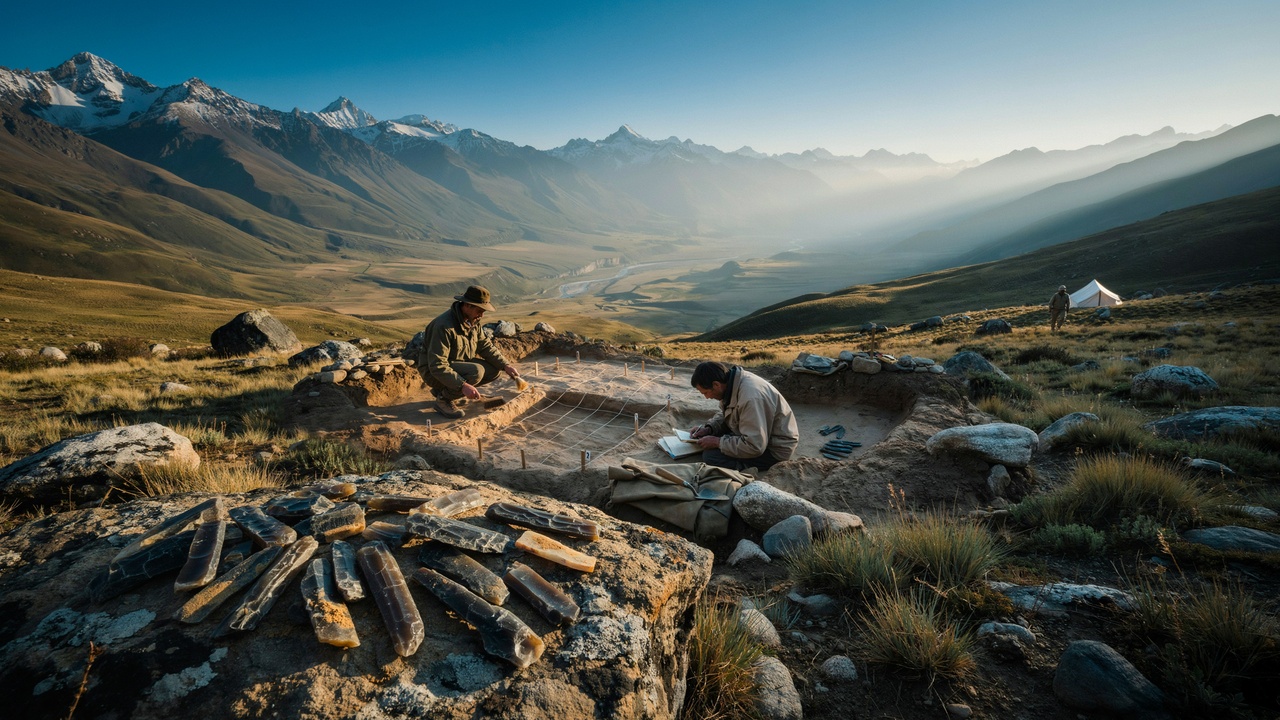
China’s Tibetan Plateau is gaining fresh attention after a major archaeological discovery revealed how early communities survived, travelled and adapted across one of the world’s toughest high-altitude landscapes. The findings from the Luga site in Shigatse add a powerful new dimension to the region’s tourism story. As heritage research expands across Xizang, Shigatse is increasingly emerging as a destination where archaeology, ancient landscapes, cultural history and responsible travel can come together for curious global visitors.
China’s 11,000-Year-Old Tibetan Plateau Discovery Opens Powerful New Chapter for Archaeology and Heritage Travel
A newly published archaeological study is doing more than filling a gap in the prehistory of the Tibetan Plateau. Evidence from the Luga site in Saga County, Shigatse, is revealing how highly mobile hunter-gatherers organised technology, raw materials and movement across the Yarlung Tsangpo Valley roughly 11,000 years ago. At the same time, the discovery arrives as Xizang is recording strong tourism growth and conducting one of its most extensive inventories of archaeological, cultural and tourism resources.
For travel, however, an important distinction is necessary. Luga has not been confirmed as a developed or publicly accessible tourist attraction. Its immediate significance is scientific. Its longer-term tourism value lies in how discoveries of this kind can strengthen interpretation, museums, research tourism and heritage-led itineraries across Shigatse and the wider plateau.
Tibetan Plateau Archaeology Rewrites the Story of High-Altitude Human Mobility
The strongest primary evidence comes from the research article Environmental adaptations of Early Holocene microblade hunter-gatherers in the Yarlung Tsangpo Valley, Southern Tibetan Plateau, published online on 29 September 2026 in Palaeogeography, Palaeoclimatology, Palaeoecology.
Advertisement
Advertisement
Researchers Xuke Shen, Yuanxin Li, Yan Tong, Yongcuo, Jishuai Yang and Dongju Zhang investigated the Luga site in Saga County. Their work combined techno-typological analysis of stone tools, raw-material studies, geological source investigation and non-destructive geochemical analysis.
The researchers examined 158 lithic artefacts. Of these, 141 came from surface survey, six from stratified test excavation and 11 from flotation samples associated with LG-H1. The authors therefore exercise appropriate chronological caution: Luga is most likely dated to around 11,000 years before present, rather than every recovered object being independently dated to precisely 11,000 years ago.
Advertisement
Advertisement
That distinction matters for an authoritative archaeology report.
The assemblage is dominated by very small artefacts. Among the surface collection, 79.43% were classified as micro-sized and another 19.15% as small-sized. Chert was the dominant raw material identified in the surface assemblage.
Yarlung Tsangpo Valley Reveals an Ancient Travel Network Rather Than an Isolated Camp
Perhaps the most compelling finding concerns mobility.
The researchers interpret Luga as a temporary camp used by small task groups, rather than a large permanent settlement. People obtained locally available materials including chert and rock crystal, manufactured tools and adapted their lithic technology to conditions on the plateau.
Yet they were not operating solely within the immediate surroundings.
Geochemical investigation indicated exploitation of obsidian sources approximately 200 kilometres away. That evidence changes how the landscape can be understood. Early Holocene communities were interacting with territories extending well beyond a single campsite.
Advertisement
Advertisement
Microblade technology was particularly suitable for mobile hunter-gatherers because small, standardised cutting components could form part of portable toolkits.
The wider research question is therefore about movement: how prehistoric communities negotiated a high-altitude landscape where useful stone, food, water and other resources were distributed unevenly.
The study identifies the Yarlung Tsangpo Valley as an important east-west corridor for interaction across the southern Tibetan Plateau. Before Luga, reliable early microblade chronologies were notably scarce in this valley, even though later Holocene microblade sites were already known.
That makes Luga important because it helps close a geographic and chronological gap between better-documented archaeological areas elsewhere on the plateau.
Climate Change May Have Helped People Expand Across the Tibetan Plateau
The archaeological evidence cannot be separated from palaeoclimate.
The researchers explore a relationship between early microblade dispersal and environmental changes during the Early Holocene. Improving climatic conditions created opportunities for human populations to exploit areas that remain physically demanding even today.
Advertisement
Advertisement
This adds an environmental dimension to the discovery.
Luga is not simply evidence that humans could survive at high altitude. It contributes evidence about how mobility, technology, resource procurement and changing environmental conditions worked together.
That is precisely what can make prehistoric archaeology valuable to future heritage interpretation. Visitors can understand a landscape not simply as scenery, but as terrain through which people made calculated decisions about distance, resources and survival thousands of years ago.
Tibet Heritage Tourism Is Expanding Alongside Archaeological Discovery
The timing is significant for Tibet heritage tourism.
Official figures reported by the Xizang Autonomous Region show that it received 70.7337 million domestic and international tourist visits during 2025, up 10.71% year on year. Total tourism expenditure reached 81.681 billion yuan, increasing 9.51%.
Inbound tourism grew faster: the region received approximately 437,400 inbound visits, a rise of 36.5%.
Advertisement
Advertisement
The scale of its resource inventory is equally important.
A tourism-resource survey launched in 2023 eventually covered all seven prefecture-level areas and 74 counties and districts. It identified more than 58,000 tourism resources, including more than 31,000 newly discovered or newly recognised resources.
Assessors classified 944 as fifth-grade tourism resources, 2,372 as fourth-grade and 10,202 as third-grade. The Ministry of Culture and Tourism says the survey is feeding research into border tourism, plateau ecology, wellness tourism and cultural-heritage routes.
This is where the Luga discovery becomes relevant to tourism policy without overstating its current visitor status.
Archaeological discoveries can feed future museums, digital interpretation, research trails and broader heritage narratives even when fragile excavation sites themselves remain protected.
Shigatse Travel Gains a Deeper Archaeological Dimension
The implications are particularly interesting for Shigatse travel.
Advertisement
Advertisement
Official archaeological survey results show that Shigatse has become one of the richest areas for newly documented cultural heritage in the region. During the fourth national cultural-relics census, 909 newly discovered heritage sites were recorded in Shigatse, compared with a regional total of 3,346 newly identified sites reported in the census results.
Saga County itself produced another remarkable finding: the Pengyongzhu rock-art site, situated at 5,303.8 metres, was reported as the highest-altitude newly discovered cultural-relic site identified during the national census.
This provides a substantially wider context for Luga.
Saga and the surrounding Shigatse landscape increasingly represent an archaeological geography encompassing prehistoric technology, rock art, mobility corridors and later cultural history.
That could eventually support a different tourism proposition: not simply travelling through western Xizang to reach headline attractions, but understanding the plateau itself as a cultural landscape occupied, traversed and interpreted by humans over millennia.
Archaeological Tourism Could Complement Xizang’s Changing Visitor Economy
Authorities are already trying to move tourism beyond conventional sightseeing.
Advertisement
Advertisement
At an official State Council Information Office briefing, regional officials described plans to shift from straightforward scenic sightseeing towards cultural tourism and immersive leisure experiences. Xizang has also been developing digital heritage interpretation.
Digitalisation could be especially relevant for archaeologically sensitive places.
The region has collected digital data on more than 114,000 cultural objects and has developed projects including digital interpretation associated with the Potala Palace.
For Luga, this suggests a responsible future model: archaeological information could potentially reach travellers through museums, digital reconstructions, interpretive centres and curated routes without requiring uncontrolled visitation to the excavation locality.
Such an approach would reconcile two competing objectives—making archaeological research understandable to travellers while preserving fragile archaeological contexts.
How Travellers Could Benefit From the New Discovery
The Luga research does not mean tourists should attempt to locate or enter the archaeological site. Instead, the discovery can improve the wider visitor experience in several ways:
Advertisement
Advertisement
- Deeper cultural context: Travellers can understand the Tibetan Plateau archaeology story as extending thousands of years beyond its better-known monasteries, palaces and religious heritage.
- More meaningful Shigatse travel: The finding adds prehistoric human mobility to Shigatse’s already substantial cultural and natural heritage narrative.
- Better interpretation of landscapes: The Yarlung Tsangpo Valley can be understood as an ancient movement corridor rather than merely spectacular scenery.
- Potential museum and educational content: Artefacts and research findings could eventually support exhibitions, digital interpretation and educational tourism, subject to decisions by heritage authorities.
- More diversified itineraries: Archaeology could eventually complement established cultural, ecological and high-altitude experiences rather than competing with them.
- Greater emphasis on conservation: Sensitive sites can demonstrate why responsible tourism sometimes means experiencing archaeology through museums and interpretation rather than physically entering excavation areas.
Travellers Need to Check Current Shigatse Access Rules
There is also an immediate practical issue that travel coverage must not overlook.
On 28 August 2026, China’s National Immigration Administration suspended issuance of electronic Border Administration Area Permits for Shigatse following a major mudslide on the Nepalese side that disrupted road and communications links around Gyirong Port. The authority also advised people already holding relevant permits not to travel into the affected border administration area temporarily.
That notice is especially relevant because Saga County lies within Shigatse.
Travellers therefore should not interpret archaeological publicity about Luga as confirmation that the locality is presently accessible. Current border-area rules, road conditions and authorised tourism arrangements must be checked before planning western Shigatse travel.
Earlier in 2026, Xizang introduced electronic border-area permits and improved regional aviation connectivity, including the resumption of Chengdu Tianfu–Dingri flights.
But the August suspension supersedes the earlier convenience measures for affected Shigatse border travel until authorities announce otherwise.
Advertisement
Advertisement
Foreign travellers face additional arrangements. Chinese officials have confirmed that independent foreign travel within Xizang remains subject to management measures rather than unrestricted free travel.
Why Luga Matters to the Future of Yarlung Tsangpo Valley Tourism
Luga’s greatest tourism importance is therefore not a new ticketed attraction.
It is a new layer of meaning.
An apparently sparse high-altitude landscape can now be interpreted through technological innovation, long-distance raw-material movement, temporary camps and calculated human mobility around 11,000 years ago.
At the same time, regional authorities are cataloguing tens of thousands of tourism resources and thousands of newly identified heritage locations. In 2025 alone, Shigatse accounted for 909 newly discovered heritage sites in the fourth national census results.
The opportunity is considerable, but so is the responsibility.
Advertisement
Advertisement
Archaeological tourism works best when research integrity comes first. Luga should not be marketed prematurely as an attraction. Instead, the findings can strengthen museums, educational travel, archaeological interpretation and conservation-led storytelling across the Yarlung Tsangpo Valley and Shigatse.
That is ultimately what makes this 11,000-year-old camp relevant to twenty-first-century tourism: it transforms an extraordinary plateau landscape into evidence of an ancient human journey.
China’s Tibetan Plateau Discovery Stuns Experts as Shigatse Emerges as Asia’s Next Heritage Travel Hotspot.The discovery strengthens Shigatse’s position as more than a gateway to dramatic mountain scenery. It shows how the region can also attract travellers interested in archaeology, human history and heritage interpretation. While the Luga site itself should not be treated as a confirmed tourist attraction, its research value can support museums, educational travel and cultural storytelling. With growing tourism, expanding heritage surveys and deeper archaeological knowledge, Shigatse could become an increasingly important destination for responsible heritage-focused travel in Asia.
Advertisement
