
Thailand Tourism Set to Rebound in 2027 After 2026 Decline as High-Value Travel Drives Recovery Across Major and Rural Provinces

Published
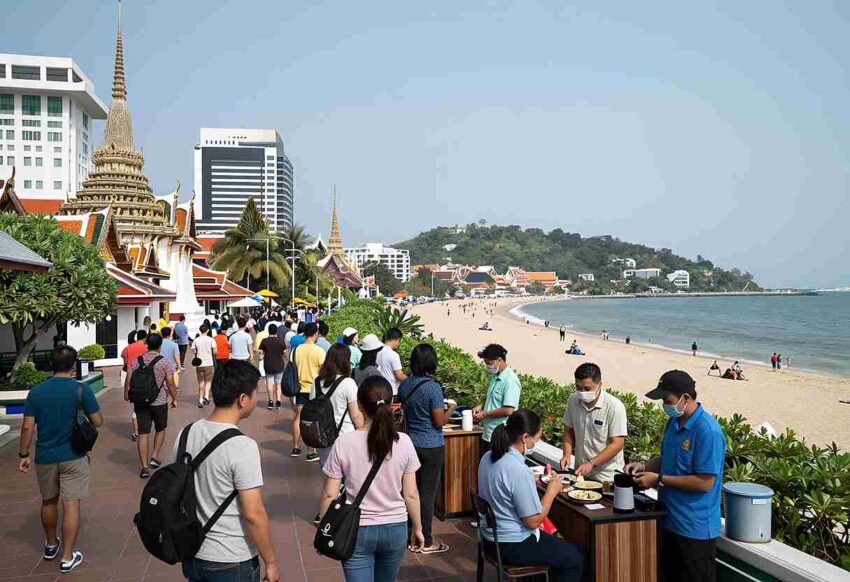
Image generated with Ai
Thailand experienced a noticeable decline in tourism during the first quarter of 2026. Official records show that over 9.31 million foreign tourists visited between January and March, marking a 2.43 percent reduction compared with the same period in 2025. This official data, released through Xinhua and the Ministry of Tourism and Sports, reflects an early softness in the sector. From the beginning of January to April 26, 2026, the total number of international arrivals reached 11.36 million, registering a 3.40 percent year-on-year decrease, even as tourism receipts remained substantial at THB555.6 billion. This indicates that while the visitor numbers declined, overall revenue demonstrated resilience.
Monthly Trends and Revenue Patterns
Detailed monthly data from independent economic sources confirmed the downward trend, with arrivals falling from 3.26 million in February to 2.78 million in March, showing a clear month-on-month contraction. April receipts increased by 2.94 percent from the previous year, yet foreign arrivals dropped approximately 7.0 percent to 2.37 million. This pattern suggests that Thailand’s tourism sector became increasingly reliant on higher-spending travelers even as total visitor volume declined, revealing an important shift in the economic dynamics of tourism.
Macroeconomic Impact of Early 2026 Tourism Decline
The decline in tourism had broader economic implications. Analysts from Reuters indicated that the country’s GDP growth in the first quarter likely slowed due to the reduction in foreign visitors. The weak performance constrained consumption and reduced overall economic momentum, highlighting tourism as a key driver of national economic activity. The effects of declining arrivals were therefore felt not only in hospitality and services but also across broader economic sectors.
Contributing Factors to 2026 Decline
Several factors contributed to the 2026 decline. Geopolitical tension in the Middle East disrupted travel demand from Gulf markets, affecting the flow of international visitors. Rising travel costs, including higher fuel prices and flight fares, made Thailand less competitive relative to neighboring destinations such as Vietnam and the Philippines. Additionally, increased regional competition drew cost-conscious travelers to alternative destinations, reducing short-haul demand to Thailand. In response, the Tourism Authority of Thailand introduced the Thailand Tourism Next strategy, focusing on attracting high-value, quality tourism rather than volume alone, aligning with the revenue trends despite reduced visitor numbers.
Advertisement
Advertisement
Provincial Tourism Distribution and Low-Volume Areas
Comprehensive city-level or provincial-level 2026 data has not been released publicly, making precise comparisons of lowest traffic cities unavailable. Historical patterns and revenue distribution indicate that only eight provinces recorded higher foreign tourism receipts than domestic contributions, including Phuket, Phangnga (Khao Lak), Surat Thani (including Koh Samui), Bangkok, Krabi, Chonburi (including Pattaya), Narathiwat, and Songkhla. Consequently, the majority of provinces, particularly in the north and northeast, exhibited lower foreign visitor activity. Provinces such as Nan and Sukhothai remained low-traffic regions, highlighting an uneven recovery across the country. Independent analysis shows that over seventy percent of tourism income is concentrated in just a few provinces, suggesting that most regions experienced significantly lower activity in 2026.
2027 Tourism Recovery Forecasts
Although official government figures for 2027 have not been released, credible forecasts suggest a recovery in arrivals. Trading Economics data models project monthly foreign arrivals to reach approximately 3.3 million per month in 2027, reflecting a modest upward trend. Industry projections by Krungsri indicate international arrivals could rise from roughly 35.5 million in 2026 to 37.5 million in 2027 and approach 39 million by 2028, implying a 5.6 percent increase over 2026. InnovestX models anticipate a 7 percent increase in 2027 arrivals compared with a flat 2026 baseline, signaling positive growth after early 2026 stagnation.
Advertisement
Advertisement
Policy Support and Long-Term Indicators
The anticipated recovery in 2027 is supported by strategic policy interventions. The Tourism Authority of Thailand has shifted focus towards high-value tourism, promoting wellness, MICE, and cultural experiences. Government initiatives spanning 2023 to 2027 emphasize resilience, sustainability, and diversification, providing a stable foundation for medium-term growth despite potential external risks. Longer-term market projections suggest that Thailand’s tourism industry will expand at an approximate 3.2 percent compound annual growth rate through 2034, indicating a structural increase in international demand and the capacity for sustained recovery.
Comparative Analysis: 2026 vs 2027
| Indicator | 2026 | 2027 (Expected/Forecast) |
|---|---|---|
| Q1 Arrivals | 9.31M | — |
| Jan–Apr Arrivals | 11.36M | — |
| National Arrivals (Annual) | ~30–35M expected (flat/weak) | ~37–37.5M potential rise |
| Growth Trend | Negative / Weak recovery | Positive growth relative to 2026 baseline |
| Tourism Revenue Trend | Pressure on volumes but higher per tourist spending | Likely higher revenue per visitor with improved quality tourism focus |
Key Insights and Takeaways
The first quarter of 2026 highlighted a measurable decline in foreign arrivals and uneven recovery across provinces, particularly in low-volume areas such as Nan and Sukhothai. In contrast, forecasts for 2027 suggest a clear recovery, with arrivals projected to increase by 5 to 7 percent compared with 2026. The recovery is expected to be supported by the continued focus on high-value tourism, policy interventions, and the diversification of tourism offerings. Revenue per visitor is likely to rise further, reflecting a strategic shift towards quality tourism. The overall outlook positions Thailand for a rebound in tourism performance, potentially surpassing 2026 baseline figures.
Advertisement
Advertisement
Critical Considerations
Official 2027 data is pending release, and external risks such as geopolitical tensions, rising travel costs, and regional competition could influence recovery. The focus on high-value tourism ensures that growth is measured not only in volume but also in the economic contribution per visitor, aligning with the strategic objectives of the TAT and government policy.
Meta description: Thailand tourism saw a decline in 2026 but is expected to recover in 2027, with high-value tourism and strategic policies driving arrivals.
Tags: Thailand tourism, 2026 tourism decline, 2027 tourism forecast, Thai provinces tourism, Bangkok tourism, Phuket tourism, Nan province tourism, Sukhothai tourism, Thailand travel recovery, high-value tourism Thailand
Advertisement
