
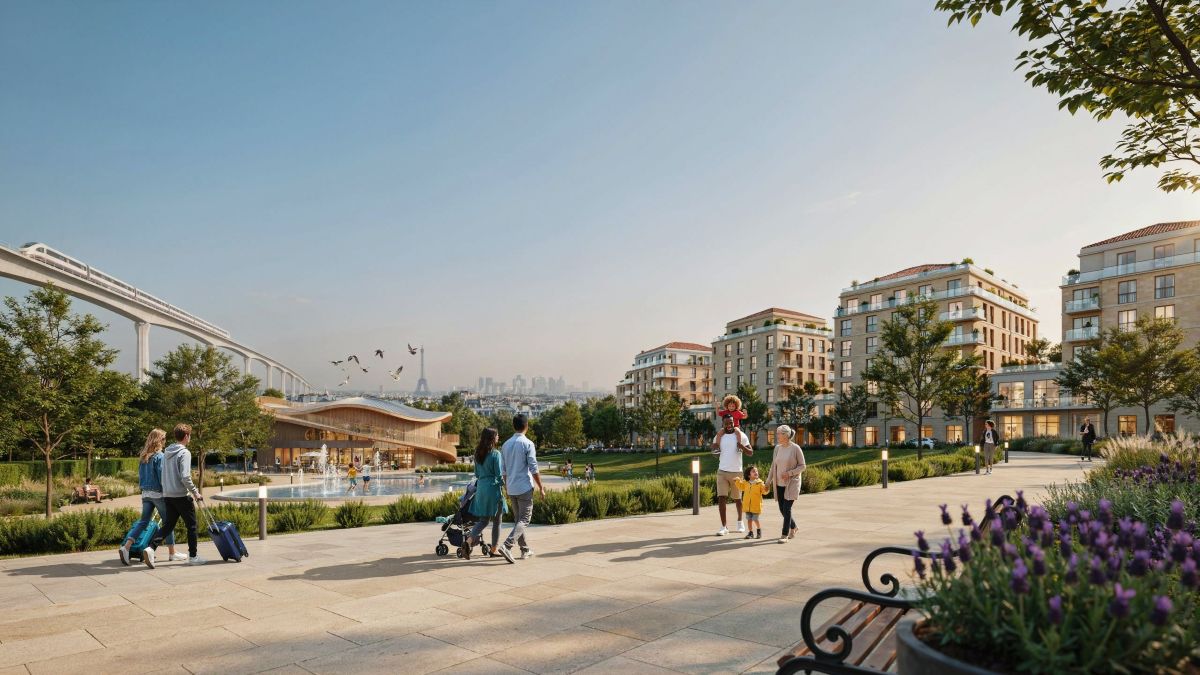
Image generated with Ai
France Sets its Sights on a New Tourist Attraction as Cergy Pontoise Approaches a Future Worth $6 billion for Its Entertainment Sector. Such an exciting undertaking may have far-reaching effects on the country’s travel industry, not just within Paris but in Val-d’Oise as well, with new tourist expenditures entering this region. In addition, the resort may contain major attractions, hotels, recreation venues, as well as cultural and sports facilities. Cergy Pontoise has good transportation links as well as easy access to the Paris tourist market. Thus, the development can entice people and tourists from abroad to spend more time there. But certain permissions must be received first.
The Cergy-Pontoise proposal carries a much bigger message than the size of the investment alone. Qiddiya has said the French project could build on the expertise, experience and partnerships that it is developing in Saudi Arabia. The company has also described its international ambition as part of an expansion of its global presence. That makes France an important test for a development model that Saudi Arabia has so far been building mainly at home.
Advertisement
Qiddiya City is one of the strongest examples of this strategy. Its model does not focus on one ride or one attraction. Instead, it combines entertainment, hotels, restaurants, retail, sport and visitor experiences within one destination. The aim is to make people stay longer and spend more. If this approach reaches France, Cergy-Pontoise could become much more than a theme park location. It could develop into a complete tourism district with a wider economic impact.
Location may become one of the project’s strongest advantages. Cergy-Pontoise sits about 25 kilometres from Paris. It includes 13 communes and has more than 220,000 residents. More importantly for tourism, the area is well connected to central Paris and other major parts of the wider metropolitan region.
Advertisement
The RER A links Cergy-Préfecture with La Défense in roughly 28 minutes. Travellers can reach Châtelet-Les Halles in around 38 minutes and Gare de Lyon in about 45 minutes depending on the service. Other rail lines also connect the area with Paris Saint-Lazare and surrounding parts of Île-de-France. These links could allow a future entertainment resort to attract several types of visitors at the same time.
Paris residents could make day trips. French families could visit for weekends. International tourists staying in central Paris could add one or two days in Cergy. Visitors exploring western Île-de-France could also combine Cergy with Versailles, La Défense and other nearby destinations. This creates a strong tourism opportunity because the project would not need to build a Paris visitor market from nothing. It would instead try to capture part of an already enormous market.
The timing could also favour Cergy-Pontoise because tourism in the Paris region is already becoming more geographically spread. Paris Île-de-France welcomed about 13.3 million tourists between June and August 2026. Tourism spending reached around €7 billion during the period. Tourist nights increased across every department in the region.
Val-d’Oise, where Cergy is located, recorded the strongest summer growth at 12%. That increase did not come from the proposed Qiddiya project because the agreement arrived only in late August. However, the number still shows that visitors are already staying outside the traditional centre of Paris. This matters because a large resort in Cergy could build on a tourism movement that has already started.
Advertisement
Advertisement
During the first half of 2026, Paris Île-de-France welcomed 24.7 million tourists, including about 11.5 million international visitors. Hotels recorded 34.1 million nights, while regional hotel occupancy reached 89% in June. The international pipeline also remained strong, with forward bookings from parts of Asia, South-East Asia and the Middle East showing notable growth. A major new entertainment destination could give those travellers another reason to stay longer in the region.
The biggest tourism impact may not come from the rides. It could come from overnight stays. Cergy itself currently has a relatively small hotel market. Official 2026 statistics for the commune record 10 hotels with about 870 rooms. That small base could become important if the proposed development grows into a large multi-day resort.
France and Saudi Arabia have already included hotels within the broader development ambition. A major entertainment district could therefore create new accommodation demand. Some visitors may stay inside the eventual resort, while others could use independent hotels, serviced apartments or nearby properties. Restaurants, shops, transport services, tour operators and other visitor businesses could also benefit.
There is no official forecast showing how much extra accommodation demand the project could generate. Even so, the economic logic is clear. A visitor who stays for two or three days can spend much more locally than a visitor who arrives in the morning and leaves at night. This is why the hotel component could become one of the most important parts of the Cergy tourism story.
The wider accommodation data reveals another interesting opportunity. Val-d’Oise recorded about 4.45 million nights in collective tourism accommodation in 2025. International visitors represented around one-third of those nights. Yet business travel continues to play a large role in the department.
Around 36% of hotel and other collective accommodation nights in Val-d’Oise came from business travel in 2025. That creates a striking contrast with Seine-et-Marne, which contains Disneyland Paris and has a much lower share of business-driven accommodation demand. The comparison does not prove that Cergy will follow the same path, but it shows how a large leisure attraction can change the tourism profile of an outer Paris department.
If Cergy develops into a powerful entertainment resort, Val-d’Oise could attract more families, holidaymakers and international leisure visitors. Over time, this could create a more balanced mix between business and holiday demand and help support tourism activity throughout the year.
Europe’s entertainment market is already becoming much more competitive. Disneyland Paris launched Disney Adventure World on 29 March 2026 as part of a major transformation of its second park. World of Frozen forms part of that expansion, and more development is also planned.
Across the English Channel, Universal’s planned Bedfordshire resort is also emerging as a major competitor. The British Government has outlined more than £5 billion of investment during construction, along with major employment and infrastructure ambitions. The resort is planned to open in 2031. Established European attractions such as Efteling are also investing more heavily in hotels and longer stays.
These developments show where the industry is moving. The battle is no longer only about rides. It is about full holidays. Resorts now compete through accommodation, food, entertainment districts, transport links and famous intellectual property as much as through individual attractions.
Modern theme park competition increasingly depends on everything surrounding the main attraction. Hotels keep visitors overnight. Restaurants increase visitor spending. Entertainment districts keep people active after rides close. Rail connections make resorts easier to reach, while airport access helps bring international travellers into the market.
Strong characters and intellectual property also make global marketing easier. Family services can encourage repeat visits and make the experience smoother for parents. This is why the Cergy-Pontoise proposal could become disruptive if all three entertainment anchors are eventually developed.
The site could compete not merely as another amusement park, but as a complete resort destination. That would place new pressure on operators across Europe. They may need more hotel rooms, better transport partnerships, stronger family facilities and more exclusive entertainment concepts. The European theme park business is increasingly becoming a contest for overnight stays rather than simple ticket sales.
The geography makes the proposal especially interesting. Disneyland Paris sits east of the French capital in Seine-et-Marne, while Cergy-Pontoise lies on the opposite side of the wider metropolitan area. If the Qiddiya-backed project moves forward, Paris could eventually have two major entertainment poles.
Disney would continue to dominate the east, while a new Cergy destination could strengthen the west and north-west. This is not an official tourism plan, but it is a possible outcome based on the proposed development. For travellers, the effect could be substantial.
A family holiday in Paris might no longer centre only on the Eiffel Tower, the Louvre, Versailles and Disneyland. Future visitors could build longer holidays that mix history, art, urban sightseeing and several days of entertainment. That could help Paris sell longer stays while also spreading tourism spending across a much wider part of Île-de-France.
Qiddiya already offers one important example of its development strategy. In Saudi Arabia, it is developing an officially announced Dragon Ball theme park at Qiddiya City. The project covers more than 500,000 square metres and includes plans for seven themed zones, more than 30 rides and five major attractions. A huge Shenron landmark is also planned.
The project comes through a partnership with Japan’s Toei Animation. It shows that Qiddiya sees famous entertainment properties as tools for destination tourism rather than simply as branding for individual rides. Themed accommodation, restaurants and immersive environments can turn a fictional world into an entire holiday experience.
That strategy could become important in Europe. However, no official evidence says Dragon Ball will come to Cergy-Pontoise. No entertainment franchise has been confirmed for France. Any claim that a Dragon Ball theme park is already planned near Paris would therefore go beyond the official evidence.
The international tourism opportunity is also significant. Paris already attracts travellers from around the world. During summer 2026, the United States supplied roughly one million visitors to the region, while the UK and Spain each contributed close to half a million.
Some of the fastest forward-booking growth, however, came from farther away. Air bookings for September to December 2026 were reported as being up 12% from Asia, 11% from the Middle East and 19% from South-East Asia. These markets could become important for a future entertainment resort in Cergy.
Globally recognised entertainment content can cross language barriers. Anime can attract younger Asian and European audiences. Major sport concepts can bring international fans, while family attractions can appeal to Gulf visitors taking longer European holidays. The eventual choice of intellectual property could therefore help decide whether Cergy becomes mainly a regional attraction or develops into a true international tourism destination.
A mega resort also needs to work well for parents. Families with babies and young children need very different tourism infrastructure. They require step-free transport, pushchair access, changing areas, feeding spaces, bottle-heating facilities, family hotel rooms, quiet areas and simple movement between hotels and attractions.
European destinations already show how important these details can be. Helsinki has been recognised by UNICEF as a Child Friendly City, while parents travelling with a child in a pram or pushchair can benefit from family-friendly public transport arrangements. Copenhagen and Vienna also provide useful family-oriented transport benefits.
Disneyland Paris already operates dedicated Baby Care Centres inside its parks, with changing facilities, microwaves, sinks and private breastfeeding spaces. If Cergy wants to compete at the highest level, services like these cannot be treated as extras. They would need to become part of the core tourism product.
Employment could eventually become one of the largest economic stories around the project, but caution is essential. France and Qiddiya have not announced how many jobs the Cergy-Pontoise project could create. There is no confirmed construction workforce, no confirmed operating workforce and no official skills forecast.
Comparisons with Britain’s Universal project show why the issue will matter. The UK Government expects the Bedfordshire development to support nearly 20,000 construction jobs and around 8,000 jobs once the resort opens. Those figures cannot be applied directly to Cergy because the sites, operators and planning systems are different.
However, the British project shows that a destination of this scale can affect much more than tourism. Transport, housing, utilities, training and infrastructure can all become part of the wider economic story. If Cergy progresses, these issues could become central to the French planning debate.
Cergy already benefits from frequent connections with Paris, but normal commuter demand is very different from theme park demand. A resort attracting very large visitor volumes could create heavy weekend traffic, school-holiday peaks and pressure during major events.
Families carrying luggage and pushchairs also have different needs from commuters. International visitors require simple navigation, clear signage and convenient connections between stations, hotels and attractions. This means transport planning could eventually become a critical part of the project.
However, no official visitor forecast exists today. No new railway station has been confirmed. No airport shuttle has been announced. No major road expansion has been formally linked to the development. These questions remain for the future planning process.
This remains the most important fact in the story. The project is still being explored. The €6 billion figure describes the scale of the ambition across the development lifecycle. It does not mean construction has already begun.
The memorandum of understanding starts a joint process. France and Qiddiya still need to examine the development model, scope and contractual framework. French procedures and approvals will matter before anything can move forward.
The final site boundaries are unknown. The attraction names are unknown. The hotel count is unknown. The visitor forecast is unknown. The job count is unknown. The construction timetable is unknown. The opening date is also unknown.
That uncertainty does not make the project unimportant. It makes the next stages crucial.
The biggest change may ultimately be Saudi Arabia’s role. For years, the Kingdom has brought global tourism, sport and entertainment expertise into Saudi Arabia as part of its wider transformation. Qiddiya has become one of the strongest symbols of that strategy.
Cergy-Pontoise suggests something new. Saudi expertise may now begin moving in the opposite direction. Instead of only importing global entertainment concepts, a Saudi development platform could start exporting its own model into major overseas markets.
France would be a powerful place to test that ambition. Paris already has one of the world’s strongest tourism brands, a huge hotel market, extensive transport links and a deep international visitor base. It also has Disneyland Paris, which means competition is already intense.
That is precisely why Cergy-Pontoise matters. If Qiddiya can build a successful destination beside one of the world’s strongest tourism cities, its wider global ambitions could become much more credible.
Saudi Arabia Rolls Out Ambitious €6 Billion France Tourism Plan as Cergy Pontoise Could Be Paris’s Next Mega Entertainment Destination. Nevertheless, the plan is in its initial exploration phase and is yet to be constructed. If accepted, Qiddiya might contribute some big attractions, hotels, recreation zones, and more revenues for Paris. Furthermore, good rail connection and increasing tourism in Val-d’Oise could help Cergy Pontoise attract families and tourists from abroad. The plan could even enhance France’s tourism offerings and help the country become a long-term destination. Consequently, this exciting plan might change the tourism map outside of Paris and expand Saudi entertainment experience to Europe’s growing holiday market.
Advertisement
Advertisement
Advertisement












Friday, September 4, 2026

Friday, September 4, 2026
Friday, September 4, 2026

Friday, September 4, 2026

Thursday, September 3, 2026

Wednesday, September 2, 2026

Friday, September 4, 2026
Friday, September 4, 2026


