
USA Aligns With Mexico as Marfa and Bisbee Unleash Strangest Legends, Dark History: Mysterious Travel Secrets

Updated
Published
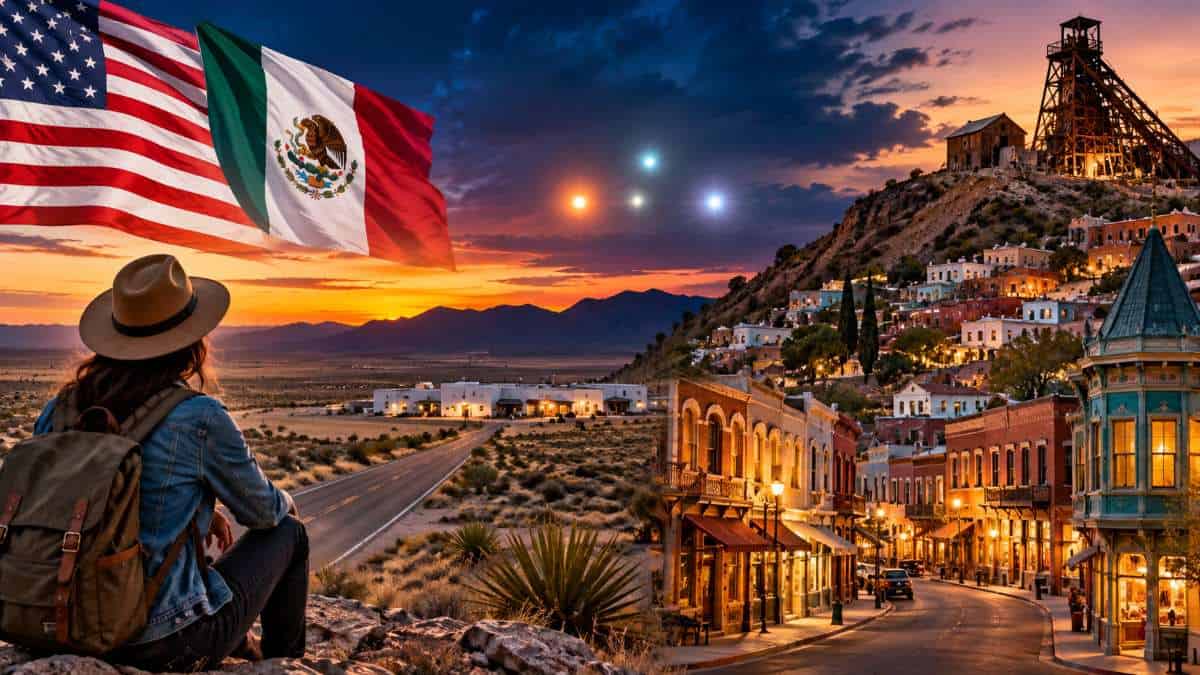
Image generated with Ai
The USA is about to enter a new era in tourism, and Mexico is right at the edge of the story, with intrigued tourists looking for something else. Across the USA, cities like Marfa and Bisbee are being highlighted for their mysterious landscapes and their stories, which remain intriguing enough. They are not dependent upon the glitzy tourism features of the country. These cities have many travel secrets that are made up of mining, deserts, mysteries of unexplained lights, and many years of human experience. Marfa gives travelers mysterious lights over the Texas desert, while Bisbee gives the old mining town experience and all the stories associated with it. This is how America’s most mysterious travel secrets are created outside its popular tourist spots. Travel And Tour World invites readers to find out more about these amazing destinations. What took place here? How have these stories been preserved? What makes the travelers return? Find out in the full story!
US International Visitor Forecast by Leading Source Market, 2026
| Rank* | Source market | 2025 actual visitors | 2026 forecast visitors | 2026 change |
|---|---|---|---|---|
| 1 | Mexico | 17.980 million | 19.026 million | +5.8% |
| 2 | Canada | 16.019 million | 16.622 million | +3.8% |
| 3 | United Kingdom | 4.058 million | 4.202 million | +3.5% |
| 4 | India | 2.061 million | 1.977 million | -4.1% |
| 5 | Japan | 1.967 million | 2.055 million | +4.5% |
| 6 | China | 1.562 million | 1.617 million | +3.5% |
| 7 | Brazil | 1.917 million | 2.027 million | +5.8% |
| 8 | Germany | 1.770 million | 1.807 million | +2.1% |
| 9 | South Korea | 1.647 million | 1.673 million | +1.6% |
| 10 | France | 1.590 million | 1.573 million | -1.0% |
| 11 | Italy | 1.183 million | 1.187 million | +0.3% |
| 12 | Australia | 0.959 million | 0.973 million | +1.5% |
| — | Total international | 68.288 million | 70.474 million | +3.2% |
America’s Most Underrated Mysterious Cities: Where Dark History, Strange Legends and Unexplained Stories Meet
America has no shortage of famous destinations associated with mystery. New Orleans has its ghost stories. Salem is forever linked with the 1692 witch trials. St. Augustine is known for centuries of history and tales of the supernatural. But the country’s most intriguing stories are not always found in its biggest cities. Across the United States, smaller communities hide unusual histories, abandoned mines, unexplained lights, forgotten disasters, and legends that have survived for generations. Some are former mining towns that nearly disappeared. Others have become destinations because visitors continue to report strange experiences. A few are shaped by mysteries that remain unresolved.
Advertisement
Advertisement
These places offer a different kind of travel experience. Their appeal is not simply about ghosts. It comes from the collision of history, landscape, folklore, and the unknown. Here are ten American destinations where the past still seems unusually close.
“America’s lesser-known cities reveal a fascinating side of travel, where history, folklore and mystery create experiences beyond conventional sightseeing. As international arrivals continue to grow in 2026, these destinations have an opportunity to attract curious travellers while preserving their character, heritage and stories for future generations,” said Anup Kumar Keshan, Founder and Editor-in-Chief, Travel And Tour World.
Advertisement
Advertisement
Marfa, Texas, turns an empty desert horizon into a mystery
Marfa may be one of the most fascinating small destinations in America because its mystery is built into the landscape. The West Texas community sits in the Chihuahuan Desert and has a history that stretches from its establishment as a railway water stop in 1883 to its later reputation as an international centre for contemporary art. Today, its identity combines art, culture, history, desert landscapes and mystery. The biggest attraction for curious travellers is the Marfa Lights. Reports of strange lights appearing on the horizon southeast of town date back to the 19th century. According to local tourism authorities, witnesses have described lights in different colours appearing seemingly without an obvious source. They can appear at different times and in different weather conditions.
Advertisement
Advertisement
There is no universally accepted explanation for what every reported sighting represents. Proposed explanations include distant vehicle lights and atmospheric effects, while others interpret the phenomenon in paranormal terms. That uncertainty is precisely what gives Marfa its character. Visitors can go to the official Marfa Lights Viewing Area, around nine miles east of town on US 90. The experience is less about expecting a supernatural event and more about standing beneath a vast West Texas sky and waiting to see what appears. Marfa also demonstrates why mystery tourism does not have to be built around abandoned buildings or ghost stories. Sometimes, an empty landscape is enough.
Bisbee, Arizona, keeps the shadows of a mining boom alive
Bisbee looks almost theatrical. Its streets climb through the Mule Mountains, with old buildings, stairways and narrow passages reflecting the town’s mining past. Copper, silver, gold and turquoise helped turn Bisbee into an important mining centre, and visitors can still explore the Copper Queen Mine today. The mining industry also left behind a long trail of difficult human stories. Mining accidents, boomtown disorder, and the characters who passed through Bisbee have become part of the community’s modern folklore. Ghost tours now use historic streets and buildings to tell stories about alleged paranormal encounters. Arizona tourism even highlights reports of unexplained footsteps and whispers at historic properties.
It is important to separate the historical record from the supernatural claims. The mines, buildings, and mining history are tangible. Ghost stories are part of local folklore and tourism. That distinction does not make the experience less interesting. In fact, it makes Bisbee more compelling. A traveller can walk through an old mining district, learn about the people who worked underground, and then hear the stories that later grew around those same places. The mystery becomes an additional layer over a very real past.
Jerome, Arizona, survived its own disappearance
Jerome has one of the strangest transformations on this list. Copper mining made the hillside community prosperous. By the early 20th century, Jerome had become a major copper-producing centre in Arizona Territory. When mining operations ended in 1953, however, the town declined dramatically and became what Arizona tourism describes as the nation’s largest ghost town. Then Jerome changed again. Artists moved in, attracted by the inexpensive properties and dramatic landscape. Former commercial buildings gained new lives as galleries, restaurants, and creative spaces. Today, Jerome is a functioning destination rather than an abandoned settlement.
Yet the town’s earlier history remains visible. The Jerome State Historic Park preserves the story of the copper boom, while the old buildings and mining landscape provide a physical connection to the town’s past. Ghost tours now explore the darker stories associated with historic properties and past tragedies. That combination makes Jerome unusual. It is neither a conventional ghost town nor a conventional tourist resort. It is a living community built around the remains of a place that once appeared destined to disappear.
Advertisement
Advertisement
Vicksburg, Mississippi, carries the weight of war and loss
Some mysteries emerge from places where history has left an especially heavy mark. Vicksburg is one of them. The city is closely associated with the American Civil War, and Vicksburg National Military Park covers more than 1,800 acres. Its historic landscape preserves the memory of the 47-day siege that made the city a crucial part of the conflict. The city’s darker reputation also extends into its historic homes.
McRaven House, a property dating from 1797, is promoted locally as one of Mississippi’s most haunted houses. Stories connected with the building involve people who lived and died there across different periods of its history. Vicksburg now combines conventional heritage tourism with organised ghost tours. Visitors can walk through historic neighbourhoods while hearing stories involving war, epidemics, violence and local legends. The interesting part is that the mystery does not stand apart from history. It grows from it. The city demonstrates how places affected by war, disease, and tragedy can develop folklore over time. Whether a visitor believes in ghosts is almost secondary. The stories reveal how communities remember difficult periods and turn those memories into narratives for later generations.
Eureka Springs, Arkansas, built its identity around miraculous waters
Eureka Springs is mysterious for a completely different reason. The town’s earliest reputation was connected to water. Local historical accounts say that Native American traditions associated the area’s springs with healing, while Victorian-era visitors were drawn by claims about the curative qualities of the waters. Eureka Springs was officially founded in 1879 and grew rapidly as thousands of visitors arrived seeking health and healing. The result was an unusual Victorian mountain town. Today, Eureka Springs is known for its architecture, winding streets, arts scene, and natural setting in the Ozarks. But its history has also produced a substantial ghost-tour culture.
The Crescent Hotel is particularly associated with paranormal stories. Local tourism promotes tours that recount alleged encounters with spirits and stories connected with the building’s past. Again, the distinction between history and legend matters. The hotel’s history is documented. Reports of spirits belong to the realm of paranormal folklore. For travellers, however, the two worlds are intertwined. A daytime visit reveals a striking Victorian town shaped by 19th-century health tourism. After dark, the same buildings acquire an entirely different atmosphere. That contrast is part of Eureka Springs’ appeal.
Point Pleasant, West Virginia, turned a cryptid legend into a destination
Point Pleasant offers a different version of American mystery. Instead of historic mansions or mining accidents, its identity is linked to a creature known as the Mothman. Reports of Mothman sightings emerged in the area in 1966. The legend later became part of American popular culture, particularly through books, films, and continuing interest in the reported encounters. Today, the town has a dedicated Mothman Museum.
Advertisement
Advertisement
West Virginia tourism describes the museum as the world’s only museum and research centre devoted to the Mothman legend. Its collection includes historical documents, press clippings, photographs and memorabilia connected with the sightings and the wider story. The museum also addresses the Silver Bridge disaster, an important historical event that became closely associated with the Mothman narrative. The attraction here is not proof of a mysterious creature. It is the story itself: how eyewitness accounts, journalism, tragedy, popular culture and local tourism combined to create one of America’s best-known cryptid legends. For travellers interested in folklore, Point Pleasant shows how a small community can build a distinctive cultural identity around an unexplained story.
Natchez, Mississippi, hides mystery behind elegant historic homes
Natchez is often celebrated for its grand historic architecture and Mississippi River views. Its history reaches back to 1716, and the destination has more than 1,000 structures listed on the National Register of Historic Places, according to its tourism organisation. But the city’s historic beauty has another side. Many of its homes survived the Civil War, leaving a remarkably intact architectural landscape. That preservation has also allowed generations of stories about former residents, tragedies, and unusual occurrences to remain connected with individual properties.
Longwood is perhaps the most visually striking example. The enormous octagonal mansion was left unfinished in 1861. Today, it is part of Natchez’s historic-home tourism, while special evening experiences explore its ghostly reputation. Natchez also offers dedicated ghost tours through its historic centre. But the city’s deeper story goes beyond the supernatural. Its cultural history includes Native American communities, European settlers, enslaved Africans, and later generations whose lives shaped the region. That makes Natchez particularly valuable for travellers who want mystery with historical context.
Deadwood, South Dakota, keeps the Wild West alive
Deadwood’s mystery is rooted less in unexplained phenomena and more in the legends created during America’s Wild West era. The town was established in 1876 after prospectors arrived in the Black Hills. Figures such as Wild Bill Hickok and Calamity Jane became part of the mythology surrounding the community. But Deadwood’s survival was not guaranteed.
The town endured major fires and economic difficulties and came close to becoming another abandoned Old West settlement. The legalisation of limited-wage gambling in 1989 helped revive its economy. Today, visitors encounter a town that deliberately preserves its historical identity. Living-history performances recreate events such as Wild Bill Hickok’s assassination and the trial of Jack McCall. This is a different kind of mystery. Deadwood demonstrates how historical events can become legends, and how legends can eventually become tourism. The line between history and storytelling is part of the attraction.
Advertisement
Advertisement
Centralia, Pennsylvania, is a warning rather than a conventional attraction
Centralia may be the most unsettling place on this list because its mystery is based on a documented environmental disaster. A coal mine fire began in May 1962 in abandoned mine workings beneath the community. Pennsylvania’s Department of Environmental Protection says the fire reportedly began after an intentional burning of rubbish in an abandoned strip pit and subsequently spread into underground coal workings. The fire did not simply disappear. Government efforts to control it continued for years, but the underground fire persisted. Dangerous gases and ground instability eventually forced large-scale relocation. Between 1985 and 1991, 545 residences and businesses were acquired, and residents moved. The state’s chronology records that the fire continues to spread. Centralia therefore became something very different from an ordinary American town. It became a place where the consequences of an underground fire reshaped an entire community.
Its empty streets and damaged landscape have attracted enormous curiosity over the years, partly because the town has been portrayed in popular culture as an eerie abandoned settlement. But there is an important warning for travellers. Pennsylvania’s Department of Environmental Protection says the affected area is extremely dangerous because of hazardous gases and the risk of sudden ground collapse. It specifically discourages people from walking or driving in the immediate area. Centralia is therefore better understood through its history than treated as an adventure playground. Its real story is stranger than fiction.
The mystery is often more interesting than the myth
What connects these destinations is not evidence of the supernatural. It is uncertainty. Marfa has unexplained lights whose causes remain disputed. Bisbee and Jerome have genuine mining histories surrounded by paranormal folklore. Vicksburg and Natchez preserve buildings where historical events have inspired ghost stories. Point Pleasant transformed reports of an unusual creature into a cultural phenomenon. Centralia demonstrates how a real underground disaster can turn an ordinary community into one of America’s strangest landscapes.
That distinction matters. Travel journalism should not turn local legends into facts. A ghost story can be reported as a ghost story. An eyewitness account can be described as an eyewitness account. A documented historical event can be treated as history. Keeping those categories separate actually makes the destinations more fascinating. These places do not need exaggerated claims to be compelling. Their real histories are already full of ambition, tragedy, reinvention and unanswered questions. For travellers willing to look beyond America’s most famous destinations, that may be the greatest attraction of all. The country’s quieter towns often reveal stories that cannot be reduced to a postcard or a conventional sightseeing checklist. Sometimes the strangest journey begins when there is no clear explanation waiting at the end.
Advertisement
