
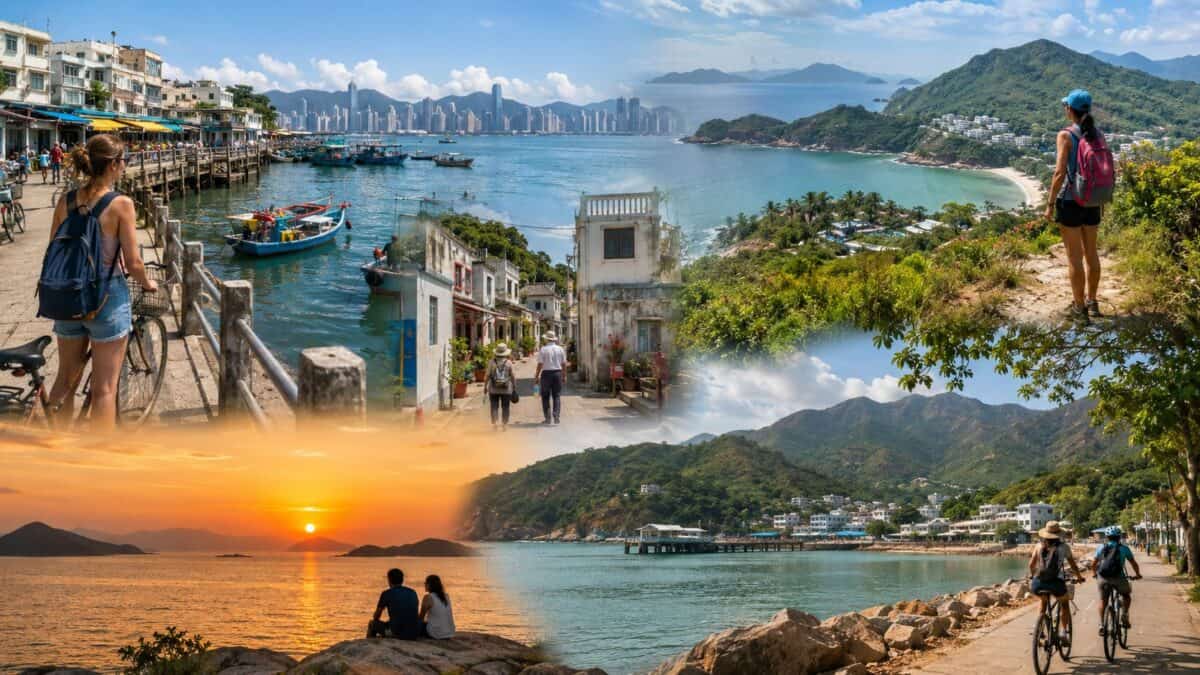
Image generated with Ai
The Hong Kong outlying islands provide an alternative way to experience Hong Kong beyond the skyline, the shopping, and the urban core. Cheung Chau, Lamma Island, Peng Chau, and Mui Wo offer easy airport or central access to fishing heritage, beaches, hiking, village landscapes, and waterfront dining. The Islands District encompasses over 20 islands and is still the largest district by area. Government records estimate the population at approximately 195,300 with the majority living in the urbanized area of Tung Chung. The remaining population lives in the communities of Cheung Chau, Peng Chau, Lamma, Mui Wo and South Lantau.
Hong Kong’s travel identity often begins with Victoria Harbour, but its geography tells a wider story. More than 200 outlying islands surround the territory, according to the Hong Kong Tourism Board. Ferries and kaitos connect many of these communities with the urban centre and with one another.
That accessibility creates an unusual tourism proposition. Travellers can leave Central and reach a fishing village, forested hillside or sandy beach without undertaking a conventional long-distance excursion. The journey itself becomes part of the destination, particularly when the ferry leaves the harbour skyline behind.
The Government’s Islands District guide describes Lantau, Lamma, Cheung Chau and Peng Chau as major islands within a much broader island network. It also highlights the area’s combination of traditional culture, natural scenery and outdoor recreation.
Advertisement
Advertisement
For travellers, this means Hong Kong can support several different holiday rhythms. A visitor can spend one morning amid skyscrapers and the afternoon walking through a village where fishing traditions still shape local life.
Cheung Chau offers perhaps the strongest introduction to island travel for first-time visitors. The dumbbell-shaped island has a population of around 20,000 and sits southeast of Lantau Island. Its compact geography makes walking, cycling and seaside exploration particularly practical.
Its cultural importance extends well beyond tourism. The Cheung Chau Jiao Festival was inscribed on the national list of Intangible Cultural Heritage in 2011. The festival includes the celebrated Bun Scrambling Competition and the Piu Sik Parade, drawing visitors from Hong Kong and overseas.
The island also preserves important built heritage. Yuk Hui Temple, better known as Pak Tai Temple, dates from 1783 and received Grade 1 historic-building status in 2010. That combination of religious heritage, fishing history and contemporary visitor culture gives Cheung Chau a more layered identity than a simple beach excursion.
Advertisement
Advertisement
Outdoor travellers can follow the Cheung Chau Family Trail towards the Mini Great Wall. The coastal section extends for about two kilometres and features granite railings, sea views and distinctive rock formations. It remains accessible to families and less experienced hikers.
Food adds another dimension. Waterfront seafood, local snacks and small eateries provide a strong culinary reason to linger rather than simply photograph the coastline. The result is an island experience built around heritage, food, walking and seaside leisure.Cheung Chau Feature Traveller Value Population Around 20,000 Central ferry Central Pier No. 5 Ordinary ferry About 55–60 minutes Fast ferry About 35–40 minutes Signature heritage Pak Tai Temple Outdoor highlight Mini Great Wall Strongest appeal Culture, food, walking and beaches
Ferry times can change, so travellers should verify current arrangements before departure. The Government’s transport information currently lists Central–Cheung Chau among Hong Kong’s franchised outlying-island services.
Lamma Island presents a different proposition. Located south of Hong Kong Island, it covers about 14 square kilometres and has a population of around 6,500. The Government identifies it as Hong Kong’s third-largest island.
Lamma’s character comes from its combination of greenery, fishing settlements, beaches and dining communities. Yung Shue Wan and Sok Kwu Wan form the island’s two principal centres, but the spaces between them provide the real travel experience.
The Family Trail links the two areas and allows visitors to experience coastal scenery without committing to an arduous mountain expedition. Along the route, travellers encounter jagged rock formations, greenery and views towards the Lamma Winds turbine.
Yung Shue Wan provides a lively contrast. Its restaurants include seafood establishments and European-style dining, while small shops contribute to the area’s multicultural atmosphere. Sok Kwu Wan, meanwhile, retains a stronger association with fishing and seafood.
This makes Lamma especially relevant to slow-travel travellers who want nature without sacrificing food or social atmosphere. It can feel removed from the metropolis while remaining geographically close to it.
Peng Chau is smaller in tourism profile but arguably richer in slow-travel character. Government information describes the island as a place where tranquillity, traditional community life and preserved historic structures coexist.
The island retains links with fishing and traditional livelihoods. Historic temples, including Lung Mo Temple, contribute to its cultural landscape. Its former industrial traces also distinguish it from islands marketed primarily around beaches or restaurants.
That industrial memory deserves particular attention. Former factories and workshops reflect a period when small-scale manufacturing formed part of island life. For travellers interested in heritage tourism beyond monuments, Peng Chau provides a more nuanced experience.
The island also works well for photography and unhurried walking. Tai Lei Island is connected to Peng Chau by a short bridge and offers a small beach, fishing views and an attractive sunset setting.
Transport also supports island-hopping. Current Government information places the Central–Peng Chau ferry journey at roughly 25–30 minutes. Travellers can also continue towards Mui Wo, Chi Ma Wan or Cheung Chau on inter-island services.
Mui Wo requires a geographical distinction. It is not an independent island separate from Lantau. Instead, it functions as an important gateway into rural and southern Lantau, making it highly relevant to travellers seeking an alternative to Hong Kong’s metropolitan centre.
Silver Mine Bay Beach anchors the area with its sandy shoreline and waterfront facilities. Nearby attractions include Silver Mine Cave, Silver Mine Waterfall, historic watchtowers and several temples.
For active travellers, Mui Wo has an even stronger proposition. The Mui Wo Mountain Bike Practice Ground occupies about 4.5 hectares inside Lantau South Country Park. It contains roughly nine kilometres of mountain-bike trails and technical features for different levels of ability.
The wider landscape expands the possibilities. Lantau South Country Park covers approximately 56 square kilometres and is Hong Kong’s largest country park. The park encompasses mountains, coastline, wetlands and areas around Mui Wo, supporting hiking, birdwatching and ecological recreation.
Mui Wo therefore works particularly well for outdoor travellers who want to connect beaches, cycling, hiking and rural landscapes within one itinerary.Destination Approximate population Defining travel character Best suited to Cheung Chau 20,000 Heritage, food and coast First-time island explorers Lamma Island 6,500 Greenery, hiking and seafood Nature and slow travel Peng Chau Smaller community Heritage and tranquillity Photographers and curious travellers Mui Wo Lantau gateway Beach, cycling and countryside Outdoor enthusiasts
Population figures are Government descriptions and should not be treated as visitor counts. They nevertheless demonstrate the very different community scales behind Hong Kong’s island tourism offer.
The real strength of these destinations lies in their differences. Travellers do not need to choose an island based simply on distance from Central. Instead, they can select one according to the experience they want.
Cheung Chau is the strongest all-rounder. Its heritage sites, compact walking environment, beaches and food culture make it particularly accessible to first-time visitors.
Lamma suits travellers who want a more pronounced nature experience. Its trail network, fishing villages and restaurant culture make it easy to combine exercise with an unhurried meal.
Peng Chau works best for travellers who value atmosphere over a packed sightseeing schedule. Its historic buildings, community character and former industrial landscape reward visitors who slow down.
Mui Wo provides the strongest outdoor gateway. Its location on Lantau makes it particularly useful for travellers combining cycling, beaches, country parks and wider southern-Lantau exploration.
The transport network itself creates an important tourism advantage. Current Transport Department information lists regular services linking Central with Cheung Chau, Mui Wo, Peng Chau, Yung Shue Wan and Sok Kwu Wan. It also lists inter-island services connecting Peng Chau, Mui Wo, Chi Ma Wan and Cheung Chau.
Current fares illustrate how accessible these journeys can be, although prices and schedules remain subject to change.Current service Approximate journey Adult single fare* Central–Mui Wo 35–40 min fast ferry HK$33.50 weekdays Central–Peng Chau 25–30 min HK$31.90 weekdays Central–Sok Kwu Wan 30–40 min HK$30.90 weekdays Peng Chau–Mui Wo 18–20 min HK$16.30 Mui Wo–Cheung Chau 31–35 min HK$16.30
*Selected current fares effective from April 2026; fares vary by day, passenger category and service.
The figures show why island exploration can be integrated into a conventional Hong Kong holiday. However, travellers should check the latest official timetable before setting out, especially when planning an inter-island connection.
The Transport Department’s ferry information is therefore the most reliable reference for current schedules and fares. Weather can also influence maritime operations, making same-day verification particularly important.
A stronger travel strategy is to treat the islands as a network rather than isolated day trips. A traveller with one free day could choose Cheung Chau for an uncomplicated introduction. A second day could combine Lamma’s trail with a seafood meal.
A longer stay could add Peng Chau for heritage and photography. Mui Wo could then provide a gateway to cycling or the wider landscapes of southern Lantau.
The inter-island network makes this approach more realistic. Current services connect Peng Chau with Mui Wo, Chi Ma Wan and Cheung Chau, while other licensed services connect Discovery Bay and Mui Wo through Peng Chau.
That creates an itinerary with greater geographical variety. Instead of repeatedly returning to the same urban centre, travellers can move progressively through different coastal communities.
| Traveller priority | Recommended base | Why it works |
| First island experience | Cheung Chau | Easy access and broad attractions |
| Food and seafood | Cheung Chau or Lamma | Strong waterfront dining culture |
| Hiking | Lamma or Mui Wo | Trails and countryside |
| Heritage | Cheung Chau or Peng Chau | Temples and historic communities |
| Photography | Peng Chau | Quiet streets and coastal scenery |
| Cycling | Cheung Chau or Mui Wo | Island and rural routes |
| Beaches | Cheung Chau, Lamma or Mui Wo | Multiple coastal settings |
| Slow travel | Peng Chau or Lamma | Less urban pace |
| Outdoor adventure | Mui Wo | Cycling and Lantau landscapes |
This approach also changes the way travellers understand Hong Kong. The territory becomes less a collection of urban attractions and more a maritime landscape of interconnected communities.
The growing appeal of outlying islands also creates a responsibility for visitors. These are not theme parks built around tourism. They remain residential communities where people work, worship, fish, operate businesses and raise families.
Travellers should therefore keep noise low in village areas and avoid blocking narrow lanes. Photography should respect residents, religious spaces and private property. Visitors should also carry litter away from beaches and follow designated hiking routes.
Supporting local restaurants, small shops and community businesses can distribute tourism spending more directly. That approach helps preserve the very character that attracts visitors away from central Hong Kong.
The outlying-island proposition fits several wider travel trends. Travellers increasingly seek low-intensity experiences, nature access, local food and cultural immersion rather than concentrating every holiday hour around landmark attractions.
Hong Kong already possesses the infrastructure needed to support this shift. Its ferry network provides relatively direct access, while the Islands District combines coastal scenery with established communities and extensive protected landscapes. The Government’s own island tourism platform now presents the area as a way to understand another side of Hong Kong.
That matters for destination diversification. Instead of dispersing visitors only across major attractions, island tourism can encourage longer stays and broader movement through less central communities.
For travellers, the reward is equally significant. A ferry ride can transform Hong Kong from a vertical city into a horizontal journey across water, villages, hills and beaches.
Hong Kong’s outlying islands allow for space and a more relaxed and community-centered relationship with the landscape and are hard to find in the crowded central districts. Cheung Chau offers food, heritage and coastal walks while Lamma offers food and hiking. Peng Chau offers heritage with a more secluded scene and Mui Wo connects visitors to the broader, more rural Lantau.
Together, these destinations allow for a more flexible way to sightsee outside of the traditional city offerings. Hong Kong does not lose its identity in this scenario, as travelers can transition from skyline to village in a single day. Visitors with a penchant for Lantau are sure to love these offerings as they may realize that the quiet side of Hong Kong is indeed not so far from the central parts of the city at all – you only need to ride the ferry.
Advertisement
Advertisement
Advertisement













Sunday, September 6, 2026
Sunday, September 6, 2026

Sunday, September 6, 2026
Sunday, September 6, 2026
Saturday, September 5, 2026
Saturday, September 5, 2026
Sunday, September 6, 2026

Sunday, September 6, 2026



