

UAE Steps Up With Saudi Arabia, Singapore and Others as Biometrics Meet Contactless Payment Technology in Travel

Published
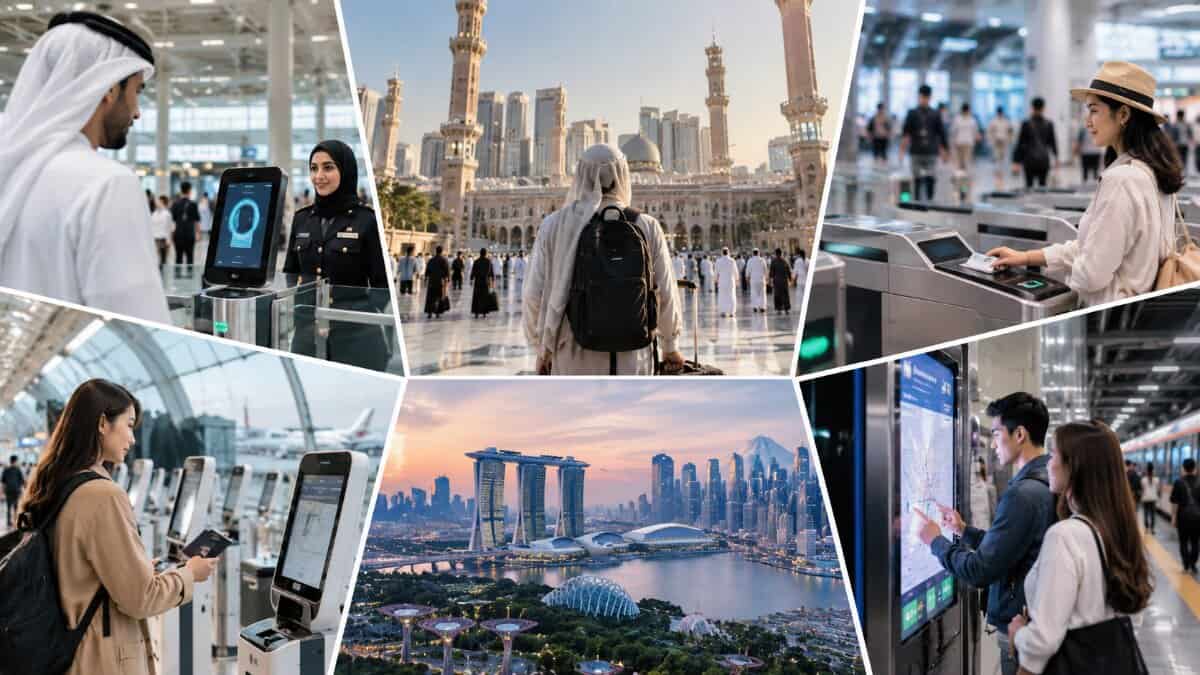
Authorities in the UAE, Saudi Arabia, Singapore, Japan and South Korea are expanding smart immigration, transport payment systems and digital visitor services in 2026 to make international journeys easier. Recent changes include Dubai’s mobile biometric border processing, Saudi Arabia’s integrated pilgrimage services, Singapore’s passport-less clearance for eligible journeys, Japan’s shared immigration and customs kiosks, and Seoul’s acceptance of overseas bank cards at ticket machines. These are separate national initiatives, not a joint agreement. Their value for travellers depends on eligibility, network coverage and the practical steps required after landing.
Seamless Tourism Becomes an Airport-to-City Travel Technology Challenge
The shared ambition goes beyond faster passport checks. Visitors must also buy their first train ticket, find reliable local information and complete hotel check-in. A digital border alone cannot solve those later problems.
Government and public-operator records reveal five different approaches: moving identity checks closer to the passenger, connecting pilgrimage services, expanding automated clearance, combining arrival declarations and removing barriers to public transport payments. The strongest test is whether tourists can use each service without extra registrations, unfamiliar payment cards or unexpected manual checks.
Five Tourism Hubs, One Visitor-Journey Comparison
| Destination | Immigration and arrival | Transport or payment | Visitor-facing service | Important limitation |
|---|---|---|---|---|
| UAE | Dubai mobile biometric processing; existing smart border systems | nol ticketing, with account-based upgrade underway | Government travel and mobility channels | New bank-card fare functionality is part of a phased upgrade, not a completed network-wide launch |
| Saudi Arabia | Automated passport gates at major airports | Riyadh Metro, buses, Darb planning and supported bank-card payments | Nusuk for Hajj and Umrah | Pilgrimage tools do not replace travel permissions or serve every leisure itinerary |
| Singapore | Automated arrival lanes; biometric passport-less departure for foreign visitors | SimplyGo accepts eligible foreign contactless cards | MyICA and hotel check-in technology | Foreign visitors still present passports on arrival; some foreign-card fares carry a fee |
| Japan | Visit Japan Web and shared immigration-customs kiosks | Bank-card tap payments across specified Kanto railway services | Official digital arrival and tourism information | Coverage depends on airport terminal and participating rail line |
| South Korea | Electronic arrival declarations and expanded smart-entry eligibility | Foreign bank cards at designated Seoul ticket machines | VISITKOREA journey planning | Ticket-machine acceptance is not universal direct bank-card tapping at all fare gates |
UAE: Dubai Moves Biometric Border Processing Beyond Fixed Counters
Dubai’s Government Media Office announced the Click & Travel service on 7 September 2026. Immigration officers use connected mobile devices to complete eligible entry or departure checks at the passenger’s location, particularly during busy periods and operational emergencies.
Advertisement
Advertisement
The authority reported 31,373 transactions during pilot operations from May to 31 August. Identity verification and transaction completion can take approximately 12 to 15 seconds, although that figure does not measure the entire airport journey. Departure access covers citizens, residents and visitors. During the first arrival phase, access is limited to UAE citizens and residents.
Dubai is also changing what happens after immigration. The Roads and Transport Authority reported in July that its account-based nol upgrade was 72% complete. Completion is scheduled for the first quarter of 2027. Planned functions include QR ticketing, digital wallets and bank-card payments, so tourists should not assume every future payment option is already available.
Advertisement
Advertisement
Saudi Arabia: Integrated Pilgrimage Apps Meet Airport and Metro Systems
Saudi Arabia’s digital visitor strategy combines airport capacity with services designed around a defined journey. The Saudi Press Agency, reporting on government airport infrastructure, confirmed the deployment of 152 automated passport gates across airports serving Riyadh, Jeddah, Dammam and Madinah in March 2025.
In May 2026, the Ministry of Hajj and Umrah’s Nusuk programme added 30 services, taking the application beyond 130. Official figures placed its global user base above 51 million. Services cover pilgrimage guidance, maps, transport schedules and crowd information, including movement between the holy sites.
Advertisement
Advertisement
For independent urban travel, the Royal Commission for Riyadh City lists the Darb app for trip planning and ticket purchases, alongside supported bank-card and mobile payments. Riyadh Metro’s airport corridor adds a practical connection between arrival and the capital.
The distinction matters. Nusuk focuses on religious journeys; it does not remove the need for a valid visa, Hajj authorisation where required, or separate travel arrangements beyond the programme.
Singapore: Faster Borders Connect With Hotel Check-In and Cashless Travel
Singapore offers evidence of implementation at considerable scale. The Immigration & Checkpoints Authority reported in May 2026 that nearly 127 million immigration clearances took place without presentation of a passport during 2025, a 270.2% increase over 2024.
Foreign arrivals at Changi may use automated lanes without prior enrolment, but must still present their passports. Eligible foreign visitors can use biometric passport-less clearance when leaving Singapore. Separate QR-code procedures apply at land checkpoints, with exceptions for first-time visitors.
Advertisement
Advertisement
The next practical layer is transport. SimplyGo permits supported foreign-issued contactless bank cards on public buses and trains without prior account registration. However, overseas-issued Mastercard and Visa cards incur an S$0.60 daily administrative fee.
Hotels are part of the same story. In September, the Singapore Tourism Board updated its E-Visitor Authentication-Ready programme. Its interface can automate checks of international guests’ permitted stay status for participating hotel technology suppliers. This is an integration route, not proof that every hotel offers automatic check-in.
Japan: Joint Arrival Kiosks Meet More Flexible Railway Payments
Japan is tackling two separate sources of friction: repeated arrival information and ticketing across different railway operators. The Digital Agency’s Visit Japan Web lets travellers prepare immigration and customs declarations online and display a code when entering the country. It is a web service, not a substitute for a passport or visa.
Japan’s Immigration Services Agency extended shared immigration and customs kiosks to Narita Airport Terminals 1 and 2 from 24 September 2026. They join facilities already introduced at other designated terminals, including Haneda, Kansai and Fukuoka. Travellers should check their actual terminal and follow the applicable border procedure.
The transport development is equally significant. Tokyo Metro confirmed that from 25 March, 11 Kanto railway operators supported interoperable contactless bank-card travel on 54 lines at 729 stations. This helps visitors change between participating services using compatible cards.
It does not mean every Japanese railway or station, including the nationwide high-speed network, accepts this payment method. Existing transport IC cards remain relevant.
Advertisement
Advertisement
South Korea: Digital Entry Expands as Seoul Tackles Foreign-Card Friction
South Korea is linking arrival improvements with easier access to urban travel. The Ministry of Justice expanded automated entry eligibility from 18 to 42 countries and regions on 16 March 2026. Use remains subject to official nationality and traveller eligibility rules.
The country also provides a free electronic arrival card for travellers required to submit one. It can be completed within three days before arrival. Those holding qualifying authorisations, including valid K-ETA approvals, may be exempt.
On 17 March, the Seoul Metropolitan Government enabled internationally issued payment cards at 440 ticket machines across 273 stations on subway Lines 1–8. Visitors can buy single-journey tickets and eligible short-term Climate Cards without first obtaining local cash. An average service fee of about 3.7% applies to international-card purchases or recharges.
The Korea Tourism Organization’s VISITKOREA app adds multilingual destination information and trip planning. Together these services ease different stages of travel, but do not form one universal payment or immigration system.
Tourism Demand Gives Digital Infrastructure Commercial Importance
| Destination | Latest relevant official measure available by 12 October 2026 | What the figure represents |
|---|---|---|
| Dubai, UAE | 6.97 million, January–August 2026 | International overnight visitors, Dubai Department of Economy and Tourism |
| Saudi Arabia | 140.9 million, full-year 2025 | Domestic and international airport passenger movements, General Authority for Statistics |
| Singapore | 16.9 million, full-year 2025 | International visitor arrivals, Singapore Tourism Board |
| Japan | 3,098,900, August 2026, down 9.6% year on year | Inbound visitor arrivals in one month, Japan National Tourism Organization |
| South Korea | 15.05 million, January–August 2026, up 21.6% year on year | International visitor arrivals, Ministry of Culture, Sports and Tourism |
These are different measures and reporting periods, not a ranking of national tourism performance. The figures come from Dubai’s tourism department, Saudi Arabia’s statistics authority, Singapore’s tourism board, Japan’s tourism organisation and South Korea’s culture ministry.
Their significance is operational rather than causal. Busy border systems and popular city transport networks need dependable capacity, but these statistics cannot prove that digital technology generated additional visitors. For conferences, short business trips and city breaks, predictable transfer and check-in processes can influence itinerary design, staffing and the time available for activities.
Advertisement
Advertisement
Original Cross-Market Analysis: Where Seamless Travel Still Breaks Down
The comparison reveals four tests that any destination must pass before its visitor journey becomes genuinely easier. The first is permission: online declarations and biometric gates do not remove visa conditions or guarantee admission. The second is eligibility: a service may work for residents, departing foreigners or named passport holders but not for every arriving tourist.
The third test is payment reach. Singapore already allows eligible visitors to tap a foreign bank card directly on public transport, subject to fees. Seoul has removed a different obstacle by allowing international cards at specified ticket machines. Tokyo is building interoperability among participating operators, while Dubai’s full nol upgrade is still under way. These are materially different levels of convenience.
The fourth is continuity. A visitor may clear immigration quickly yet still need a separate booking platform, physical card or manual hotel check. Singapore’s hotel authentication interface and Saudi Arabia’s pilgrimage-focused services illustrate how governments are addressing specific later stages.
The commercial opportunity lies in reducing those handovers, not in claiming a completely friction-free trip. Travel businesses should assess complete itineraries before promising savings or improved customer satisfaction.
Operational Priorities for Travel Agents and Tour Operators
The immediate task is to distinguish usable travel services from announcements and planned upgrades. Operators selling multi-stop trips should:
- Check each passenger’s passport, visa, digital arrival form and automated-gate eligibility separately.
- Confirm the airport terminal, route and payment method before promising biometric or contactless access.
- Show Singapore’s foreign-card daily fee and Seoul’s applicable ticket-machine service fee in trip budgets.
- Keep alternative payment options, physical documents and staffed assistance available for failed digital checks.
- Send travellers to official registration sites; South Korea’s justice ministry has warned about fake paid arrival-card websites.
- Review hotel check-in arrangements, accessible services and technical contingencies before finalising group or MICE transfers.
What Comes Next for International Travel Technology?
The next phase will depend on interoperability, reliable fallbacks and transparent costs. Dubai plans to finish its nol upgrade in early 2027, while Singapore has outlined further automated vehicle clearance at land borders from 2027. Neither should be sold as a fully available service today.
Advertisement
Advertisement
Across these five markets, technology is changing how visitors arrive, move and obtain assistance. The long-term advantage will belong to destinations that connect those stages while keeping entry requirements, payment charges and service limits clear.
Frequently Asked Questions
Are these five countries launching one joint travel system?
No. They are developing separate digital immigration, transport and visitor-service programmes with a common goal of easier travel.
Can foreign tourists enter every destination without a passport?
No. Automated gates and biometric systems have eligibility limits, and travellers must still carry valid passports.
Can overseas bank cards pay for every train journey?
No. Singapore, Seoul and participating Tokyo-area operators have different payment rules, coverage and fees.
Does Visit Japan Web replace a Japanese visa?
No. It helps prepare arrival information but does not replace any required visa or immigration decision.
What should travel agents check first?
Verify entry permissions, automated-gate eligibility, local transport payment options and backup procedures for each itinerary.
Advertisement
