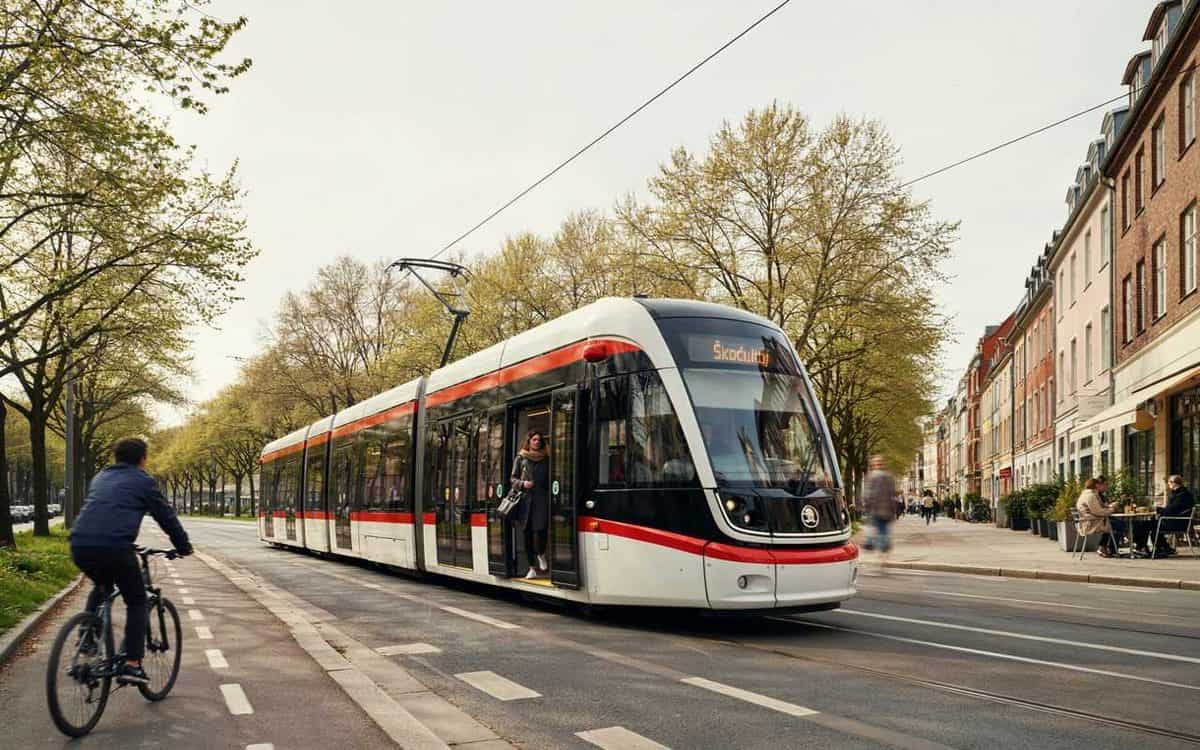
Image generated with Ai
Brandenburg an der Havel, Germany, has commissioned four more of the planned eight, modern Škoda ForCity Plus 48T low-floor trams scheduled to be delivered in 2026, continuing to expand its public transport network. Several municipalities in the EU are upgrading their transport services by replacing outdated transport services with modern, accessible and sustainable transport services. The first city to implement this modernization of their transport services will gain the confidence of passengers across all age groups, from children to the elderly, and those traveling with family members.
Brandenburg an der Havel is not only buying an additional tram with this order, it will also provide a modern regional transport policy for small municipalities in Germany to buy mobility solutions that are not only convenient, but also accessible and climate neutral. Many others will not recognize this opportunity to modernize public transport at low cost throughout an historical city.
Brandenburg an der Havel will have four more Škoda ForCity Plus trams from this order. Each of these trams has a capacity of 151 passengers, which greatly improves Brandenburg an der Havel’s current transport capacity.
The additional order strengthens a long-term cooperation between VBBr and Škoda Group. The vehicles belong to the ForCity Plus FCB platform, a joint development approach involving three Brandenburg region transport operators: Brandenburg an der Havel, Cottbus, and Frankfurt (Oder).
Advertisement
Advertisement
Instead of each city purchasing separate vehicles independently, the operators created a shared procurement strategy. This approach allows technical cooperation, reduced development costs, and better economic efficiency.
The project is significant because many European cities face the same challenge. They operate historic tram networks designed decades ago while passenger expectations have changed dramatically. Modern travellers want easier boarding, digital information, comfort, and environmentally responsible transport.
Brandenburg’s solution demonstrates how existing infrastructure can be upgraded through smarter rolling stock rather than expensive network reconstruction.
The new Škoda vehicles are designed specifically for metre-gauge tram networks. They measure approximately 28.96 metres in length and have been adapted to operate efficiently on established urban routes.
Advertisement
Advertisement
Many transport discussions focus on speed, capacity, or infrastructure expansion. However, the Brandenburg project highlights another important trend: passenger experience is becoming the central measure of public transport success.
The ForCity Plus 48T trams introduce several features designed around everyday passenger needs:
For older passengers and people with reduced mobility, accessibility is not an additional feature. It determines whether public transport is truly available to everyone.
This is where Brandenburg’s investment creates a wider impact. The city is not simply buying vehicles. It is improving independence for thousands of passengers who rely on public transport every day.
The first four vehicles were already introduced as part of Brandenburg’s fleet renewal programme, with the city confirming the importance of replacing older vehicles and securing the future of tram operations.
The scale of the project becomes clearer when looking at the technical figures.Category Škoda ForCity Plus 48T Tram Location Brandenburg an der Havel, Germany Operator Verkehrsbetriebe Brandenburg an der Havel GmbH (VBBr) Additional order 4 new trams Total Brandenburg order 8 trams Vehicle platform Škoda ForCity Plus FCB Length 28.96 metres Passenger capacity Around 151 passengers Track gauge 1,000 mm Maximum speed Up to 80 km/h Accessibility Low-floor design with multifunction areas Project partners Brandenburg an der Havel, Cottbus, Frankfurt (Oder)
The figure of eight vehicles may appear modest compared with large metropolitan rail projects, but its importance is much greater. Smaller cities often struggle to finance transport upgrades independently. Brandenburg’s shared procurement model shows how regional cooperation can unlock modernisation.
Public transport investment is increasingly becoming a tourism issue.
Visitors rarely experience a destination only through airports or hotels. Their impression is shaped by how easily they move around once they arrive. Reliable trams connect railway stations, city centres, cultural attractions, shopping districts, and residential areas.
Brandenburg an der Havel is a historic city with waterways, cultural landmarks, and connections within the wider Brandenburg region. A modern tram system can strengthen its attractiveness by making movement easier for residents and visitors.
The connection between transport quality and destination competitiveness is becoming stronger across Europe. Cities with comfortable, accessible public transport often gain advantages because visitors can explore without depending on private cars.
The new trams therefore support not only local mobility but also the wider visitor economy.
The most unique element of Brandenburg’s tram upgrade is not the vehicle itself. It is the cooperation model behind it.
The partnership between Brandenburg an der Havel, Cottbus, and Frankfurt (Oder) created one of Germany’s most interesting examples of regional tram procurement.
The three cities share similar challenges:
Instead of solving these problems separately, they combined their purchasing power.
Škoda Group’s ForCity Plus FCB project demonstrates how standardised technology can still be customised for different city environments.
This approach could influence future transport decisions in other European cities where budgets are limited but expectations continue rising.
Historic tram cities often face a difficult engineering challenge. Their networks were built for older vehicles, meaning new trams must adapt to existing curves, tracks, and operating conditions.
The ForCity Plus platform attempts to solve this through its bogie design. Škoda states that pivoting bogies at the vehicle ends help reduce wheel and track wear, particularly when operating through tight curves.
This matters because maintenance costs are one of the biggest challenges facing urban rail operators.
A vehicle that performs efficiently on existing infrastructure can extend the life of established networks while reducing long-term operating pressure.
The technology approach allows cities like Brandenburg an der Havel to modernise without completely redesigning their tram systems.
Across Europe, public transport authorities are facing a similar transformation.
Cities are balancing several demands at the same time:
The Brandenburg project reflects a wider move away from transport systems focused only on moving people from point A to point B.
Modern mobility is becoming about experience, sustainability, and inclusion.
For travellers, this means easier city exploration. For residents, it means stronger connections to jobs, education, healthcare, and cultural activities.
The future of urban transport will not only belong to the biggest cities. Smaller cities that invest strategically may become some of Europe’s most attractive and liveable destinations.
The Brandenburg an der Havel tram upgrade arrives at a time when European cities are rethinking how visitors and residents move. Transport is no longer viewed only as a public service. It is becoming a key part of destination competitiveness, urban identity, and sustainable tourism development.
A city with efficient public transport creates a smoother experience for visitors. Travellers arriving by train or regional connections can explore attractions, historic districts, shopping areas, and cultural sites without depending on private vehicles.
For Brandenburg an der Havel, the arrival of eight Škoda ForCity Plus 48T trams strengthens the city’s ability to offer cleaner and easier mobility. The project connects transport improvement with broader urban development goals.
The hidden opportunity is that smaller European cities can compete with larger destinations by improving the quality of everyday movement.
While major capitals often dominate tourism discussions, cities with reliable tram networks can create a different advantage: easier exploration, lower congestion, and a more authentic local experience.
One of the strongest elements of the Škoda ForCity Plus 48T programme is accessibility.
Modern travellers include a much wider range of passengers than previous generations. Elderly visitors, families with children, passengers carrying luggage, cyclists, and people with mobility challenges all require transport systems designed around inclusion.
The new Brandenburg vehicles respond to these changing expectations through:
The importance of accessibility extends beyond local residents. It directly influences how welcoming a destination feels for international visitors.
Tourism analysts increasingly recognise that transport accessibility affects destination choice. Visitors are more likely to choose locations where moving between attractions is simple, affordable, and comfortable.
Brandenburg’s tram investment therefore supports a wider transformation: creating a city environment where mobility becomes part of the visitor experience rather than a barrier.
One challenge facing many European cities is the need to modernise without destroying historic infrastructure.
Many tram networks were created decades ago. Their routes include narrow streets, sharp curves, and established urban layouts that cannot easily be redesigned.
This is where the Škoda ForCity Plus platform provides a strategic advantage.
The vehicles use a design combining low-floor technology with pivoting bogies at the vehicle ends. This approach aims to reduce stress on wheels and tracks, especially when operating through tight curves.
For cities with older networks, this technology provides a practical solution.
Instead of rebuilding entire transport systems, operators can introduce new vehicles that work alongside existing infrastructure.
The Brandenburg model shows that future mobility does not always require massive construction projects. Sometimes, the biggest improvements come from smarter vehicles operating on smarter strategies.
The strongest lesson from this project is cooperation.
The three German cities involved in the ForCity Plus FCB programme — Brandenburg an der Havel, Cottbus, and Frankfurt (Oder) — created a shared approach to tram procurement.
This strategy delivers several advantages:Advantage Impact Shared vehicle platform Reduces development complexity Joint procurement Improves purchasing efficiency Common technology approach Simplifies maintenance Regional cooperation Strengthens transport planning Adapted vehicle versions Meets local operating needs
The three cities are not receiving identical vehicles. Instead, the platform is adjusted for each network while maintaining technical similarities.
Brandenburg receives the 48T version, Cottbus receives the 47T version, and Frankfurt (Oder) receives the 46T version.
This balance between standardisation and local adaptation could become increasingly important across Europe as transport budgets face pressure.
Large cities often receive attention for transport innovation. However, Brandenburg’s project reveals another emerging trend.
Smaller cities are becoming laboratories for practical mobility solutions.
They face unique challenges:
Instead of copying major metropolitan systems, these cities are developing solutions suited to their own realities.
Brandenburg an der Havel demonstrates that innovation does not always mean underground rail networks, autonomous vehicles, or futuristic concepts.
Sometimes innovation means creating a dependable tram system that works better every day.
The 8-tram fleet expansion represents a quiet but important transformation in European urban mobility.
Transport investment creates economic value beyond the railway sector.
The benefits spread across multiple areas:
Reliable transport encourages people to access shops, restaurants, workplaces, and cultural locations.
Visitors gain easier access to attractions and city districts.
Modern transport systems support jobs in operations, maintenance, engineering, and infrastructure services.
Electric trams help reduce dependence on private vehicles and support cleaner urban environments.
A modern tram network can become part of a city’s economic strategy.
The value of the Brandenburg project should therefore not be measured only by the number of vehicles delivered. The wider impact comes from creating a stronger urban ecosystem.
From a travel analytics perspective, mobility infrastructure is becoming one of the strongest factors influencing destination performance.
Visitors increasingly evaluate destinations through convenience.
They consider:
Cities investing in these areas are likely to gain stronger competitiveness.
Brandenburg an der Havel’s tram renewal reflects a wider European trend where transport is becoming part of the tourism product itself.
The journey between attractions is no longer an invisible stage of travel. It is part of the experience.
For destinations seeking sustainable visitor growth, modern public transport can become a powerful marketing advantage.
The tramline in Brandenburg pales in comparison to the large billions-of-euro metro line expansions in the large cities, but in comparison to many of the large-scale programs, the tramline in Brandenburg can be considered a major program.
This is not about securing funding for four more trams.
This is about a new way of looking at how German cities can think of potential public transport systems and how core cities can think in terms of public transport and how evidence-based design can address passenger demands and needs.
Most people will miss that success in transport systems will not be measured by the size of systems, but on the systems that meet passenger needs most effectively.
Brandenburg an der Havel shows an excellent example of sustainable urban transport through design for improved transport accessibility, priority transport networks and transport connectivity.
The Škoda ForCity Plus 48T tram construction will further improve Brandenburg’s transport system.
The focus of this project is urban public transport and urban transport amenity partnerships.
Most successful European Cities will base their focus on public urban transport in order to attract residents, businesses and visitors. The transport system of differentiated cities will be successful.
The Brandenburg transport system clearly shows that the future of Urban Public Transport will not by how quickly you can get somewhere, but how easily you can get there.
The traveler of the future will measure the success of the transport system by how easy it was to get there and not by the distance traveled.
Advertisement
Tags: Brandenburg Germany, public transport innovation, Railway Technology, smart cities, sustainable travel
Advertisement
Advertisement












Wednesday, September 2, 2026

Wednesday, September 2, 2026

Wednesday, September 2, 2026

Wednesday, September 2, 2026

Wednesday, September 2, 2026

Tuesday, September 1, 2026

Wednesday, September 2, 2026

Wednesday, September 2, 2026