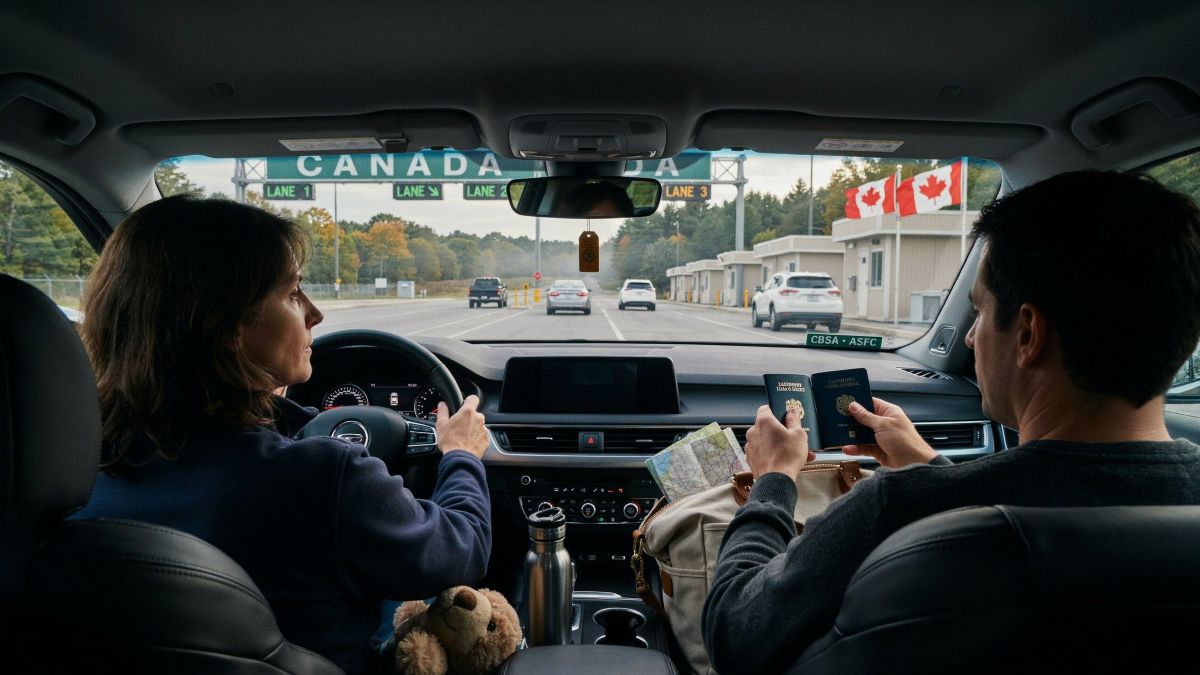
Image generated with Ai
For US and Canada cross border travel, choose a checkpoint by comparing its queue, your driving route and your direction of entry. Official readings reveal why this matters, and here’s why – neighbouring crossings can have different waits, while the return journey can present a different picture. For travellers with hotel bookings, attraction tickets or onward connections, the aim is to protect the whole itinerary.
The CBSA snapshot below records Canada-bound traveller waits at 04:40 UTC on 6 September 2026. That equals 00:40 EDT in Ontario and 21:40 PDT on 5 September in British Columbia.
Advertisement
| Major checkpoint | Route into Canada | Recorded traveller wait |
|---|---|---|
| Peace Bridge | Buffalo–Fort Erie | 6 minutes |
| Queenston–Lewiston Bridge | Lewiston–Niagara-on-the-Lake | No Delay |
| Rainbow Bridge | Niagara Falls–Niagara Falls | No Delay |
| Pacific Highway | Blaine–Surrey | 20 minutes |
| Douglas | Blaine–Surrey | 5 minutes |
These are timestamped observations. CBSA excludes delays on roads approaching the port of entry. Refresh the official border-wait dashboard before travelling.
At the recorded British Columbia reading, Douglas had a 15-minute queue advantage over Pacific Highway. That offers a useful decision rule: if a diversion adds more than 15 minutes of driving, it would erase the apparent saving, assuming the queues stayed unchanged.
Advertisement
This is a calculation from the snapshot, not a forecast of road conditions. Check the complete route before turning towards another checkpoint.
Build your comparison around three questions:
A small queue saving has limited value if the diversion creates a tighter schedule elsewhere.
A smooth entry into Canada says little about the journey back.
At 01:15 Eastern time on 6 September, the Niagara Falls Bridge Commission displayed these car waits:Niagara checkpoint Entering the United States Entering Canada Lewiston–Queenston 20 minutes No Delay Rainbow Bridge 11 minutes No Delay Peace Bridge 11 minutes No Delay
These readings come from the official bridge commission traffic display. They were recorded later than the CBSA snapshot above.
For a day trip, check both directions when planning, then refresh the relevant direction before returning. US Customs and Border Protection also provides an official US-entry border-wait service.
Niagara’s bridges have different access arrangements. A low displayed wait becomes useful only after you confirm the crossing suits your party.
The Niagara Falls Bridge Commission’s route guide identifies these distinctions:
For dedicated NEXUS lanes, every occupant, including children, must be a member and carry their card. The driver must check everyone’s eligibility under CBSA’s NEXUS instructions.
Check membership across the whole party before choosing a restricted lane.
CBSA’s 2026–27 service standards provide context for the figures travellers see:Period General highway standard NEXUS standard September–June, Monday–Thursday 10 minutes 5 minutes September–June, Friday–Sunday and holidays 20 minutes 10 minutes July–August, daily 20 minutes 10 minutes
The agency aims to meet these standards 95% of the time under normal conditions. They concern reaching the primary inspection booth. Further checks can extend the time before a traveller completes entry. See the official CBSA service standards.
For a fixed departure or timed attraction, leave flexibility beyond the displayed queue. An agency performance target cannot guarantee an individual arrival time.
Statistics Canada’s preliminary July 2026 figures, released on 11 August, show substantial travel in both directions. US residents made 2,663,946 trips to Canada by air and automobile, up 6.5% annually. Canadian residents recorded 2,277,054 returns from the United States using those modes, up 10.2%. These monthly figures provide background to the September snapshots. See the official July release.Travel measure July 2026 trips Change from July 2025 US residents entering Canada by automobile 1,914,937 +7.2% US residents entering Canada by air 749,009 +4.8% Canadian residents returning from the US by automobile 1,898,572 +12.8% Canadian residents returning from the US by air 378,482 −1.4%
Sources: Statistics Canada’s US-resident figures and Canadian-resident figures.
The longer comparison changes the interpretation. Canadian automobile returns remained 28.9% below July 2024. US-resident automobile arrivals were approximately 0.8% below July 2024, calculated from the published totals.
These preliminary figures count trips, cover a subset of entries and do not identify distinct holidaymakers. Monthly demand helps tourism businesses understand their market; it cannot predict the queue a guest will encounter. Statistics Canada schedules its August preliminary release for 11 September 2026. Its release notes explain the coverage limits and publication schedule.
Travellers using other corridors have separate developments to consider. The Gordie Howe International Bridge opened on 27 July 2026, adding a six-lane Windsor–Detroit connection approximately 2.5 kilometres long, with an 853-metre main span. See the Canadian government’s bridge announcement.
During 27–31 July, it handled 18,900 Canadian-resident automobile returns, 18,100 US-resident automobile arrivals and 4,100 commercial trucks entering Canada, according to Statistics Canada. Those opening-period counts establish use, without demonstrating a September congestion effect.
In Quebec, CBSA warns that inspection-line redevelopment at Saint-Bernard-de-Lacolle may raise waits until winter 2027. Check the official operational notice when planning that route.
CBSA’s June 2026 travel guidance recommends early-morning crossings and notes that holiday-weekend Mondays tend to be busiest. Turn that guidance into practical preparation:
Plan each leg separately. The most useful checkpoint is one your party can use, on a route that preserves time for the trip itself.
In conclusion, US and Canada cross border travel sees differing wait times across five major checkpoints, with official snapshots showing that location, direction and timing matter. Travellers should compare current queues with driving time, confirm checkpoint access and assess the return journey separately. Shorter displayed waits cannot guarantee faster arrivals, because approach-road traffic and additional inspections can extend the journey. Checking official updates, preparing documents and allowing flexibility around bookings helps travellers choose suitable routes and protect their holiday plans as border conditions change.
Advertisement
Advertisement
Advertisement













Sunday, September 6, 2026

Sunday, September 6, 2026

Sunday, September 6, 2026

Saturday, September 5, 2026

Saturday, September 5, 2026

Sunday, September 6, 2026

Sunday, September 6, 2026