
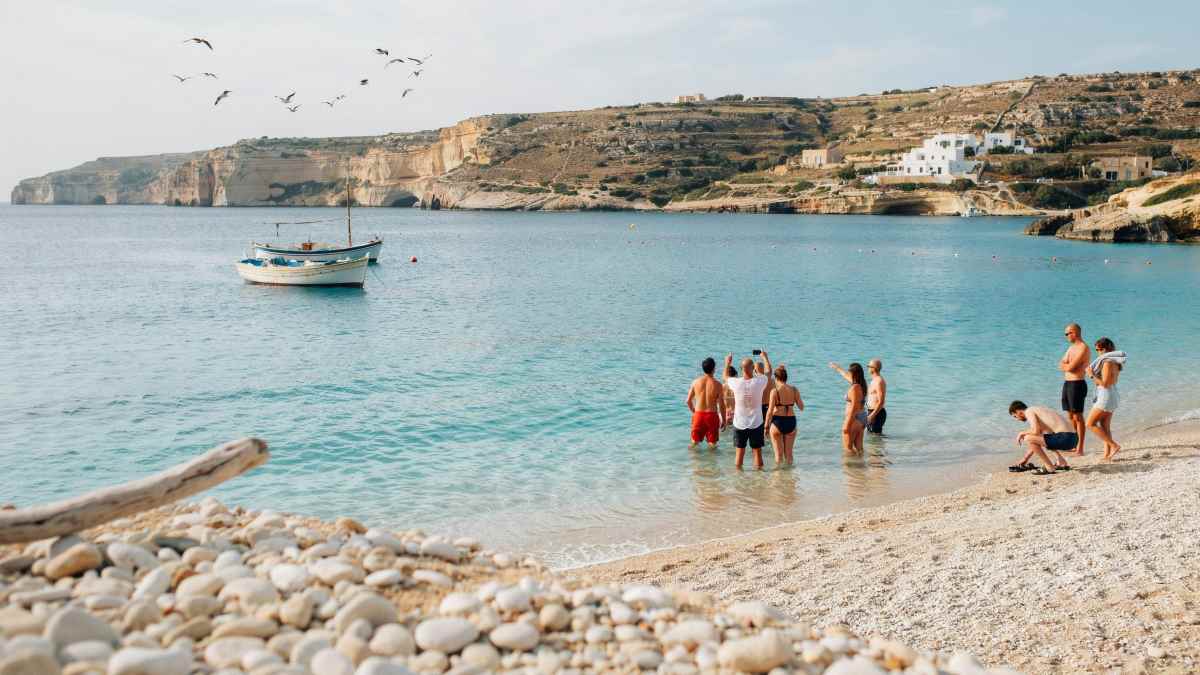
Image generated with Ai
The expansion of tourism in Malta has brought about a major problem that is affecting not only the main island but also Gozo and Comino because of the high number of day tourists visiting both islands. In the first five months, there was a total of 845,000 inbound tourists who visited both islands, accounting for over 50 per cent of the total number of inbound tourists. This reflects the popularity of the two islands among tourists. Nevertheless, the majority of these tourists are coming for short or same-day trips, putting a lot of strain on transport links and facilities but not providing any accommodation income equivalent to overnight tourism.
Gozo and Comino offer some of Malta’s most recognisable natural and coastal attractions. Their proximity to the main island makes them easy additions to a Malta holiday itinerary.
For many visitors, crossing to Gozo or Comino does not require changing accommodation. Travellers can make the journey in the morning and return later the same day.
This pattern produces high visitor numbers within a relatively concentrated period. Ferry services can become crowded while roads, public spaces, beaches and other facilities experience intense short-term demand.
Advertisement
Advertisement
The challenge is particularly pronounced when large numbers arrive within similar time windows.
Ferry links are at the centre of the pressure.
Large numbers of day visitors travelling between Malta and Gozo can create queues and congestion at terminals. Comino can experience similar pressures as visitors seek access to its highly popular coastal areas.
Transport infrastructure must handle not only tourists but also residents and workers who depend on regular connections.
Advertisement
Advertisement
When tourism demand dominates ferry capacity during busy periods, the effects can extend beyond visitors. Residents may face longer waiting times and more crowded services while local businesses must manage sudden waves of customers.
Improving visitor flows therefore requires consideration of both tourism needs and everyday island mobility.
One of the most important economic issues is the difference between visitor volume and visitor spending.
A day visitor can contribute to ferry operators, restaurants, cafés, beach services and attractions. However, they do not normally generate hotel or guesthouse revenue on the island.
This limits the economic benefit available to Gozitan accommodation providers.
An island receiving hundreds of thousands of visitors can therefore experience the infrastructure costs associated with mass tourism without receiving equivalent overnight spending.
This creates a difficult balance for Gozo. More visitors can support local businesses, but excessive day-trip dependence can increase pressure while limiting the value retained by accommodation operators.
Encouraging more travellers to stay overnight could provide one potential solution.
Gozo has a distinct tourism offer that includes countryside, villages, heritage sites, food experiences and coastal landscapes. These attractions can support longer visits rather than a single-day excursion.
Longer stays would spread visitor activity across more hours and potentially across a wider range of locations. Accommodation providers, restaurants and local experience operators could benefit from additional spending.
A shift towards overnight tourism could also reduce the intensity of short-term visitor peaks because travellers would have more flexibility to explore the island over several days.
Comino presents an even more concentrated visitor-management problem because of its small size and highly popular natural attractions.
The island’s limited physical capacity means large visitor numbers can quickly create congestion. Beaches, paths, landing areas and surrounding waters all face pressure when demand rises sharply.
Because many visitors come specifically for short excursions, managing arrival patterns becomes particularly important.
Rather than focusing only on increasing capacity, authorities and tourism stakeholders may need to consider how many people can comfortably use particular locations at the same time.
The growing pressure has accelerated calls for dedicated visitor-management fees for Gozo and Comino.
A targeted fee could potentially provide a direct source of funding for infrastructure, waste management, transport improvements, environmental protection and visitor facilities.
The principle is that tourism activity should contribute towards the costs created by tourism.
For such a system to work effectively, transparency would be important. Visitors and tourism businesses would need to understand where the money goes and how it improves the experience.
A well-designed charge could also help authorities manage demand rather than simply generate revenue.
The situation on Gozo and Comino highlights a wider challenge for Malta’s tourism sector.
Strong inbound demand is economically valuable, but visitor numbers concentrated in small or environmentally sensitive areas can create disproportionate pressure.
Malta can potentially address this by encouraging travellers to explore different parts of Gozo, promoting longer stays, improving transport planning and developing experiences outside the most heavily visited sites.
Seasonal and time-based visitor management could also help reduce pressure during the busiest hours.
The objective should not necessarily be to discourage tourism but to make visitor flows more manageable and economically beneficial for local communities.
Over 845,000 inbound visitors have entered Gozo and Comino during the first five months, indicating the massive demand for the smaller islands of Malta. Nevertheless, the prominence of day tripping highlights one crucial limitation in the tourism model. The infrastructure is being strained due to the traffic of ferries, while Gozitan tourist accommodations earn very little money due to lack of overnight visitors. The topic of establishing special fees for dedicated island tourism has thus become quite relevant. The next step in the development of the tourism industry for Malta should involve not only an increase in the number of tourists but also their management and distribution. The small islands of Gozo and Comino may serve as an important test site for Malta in terms of combining tourist demand and sustainable tourism on islands.
Advertisement
Tags: comino, Comino tourism, Comino visitors, Gozo, Gozo day visitors
Advertisement
Advertisement













Thursday, September 3, 2026
Thursday, September 3, 2026

Thursday, September 3, 2026
Thursday, September 3, 2026

Thursday, September 3, 2026

Wednesday, September 2, 2026

Thursday, September 3, 2026
Thursday, September 3, 2026


