
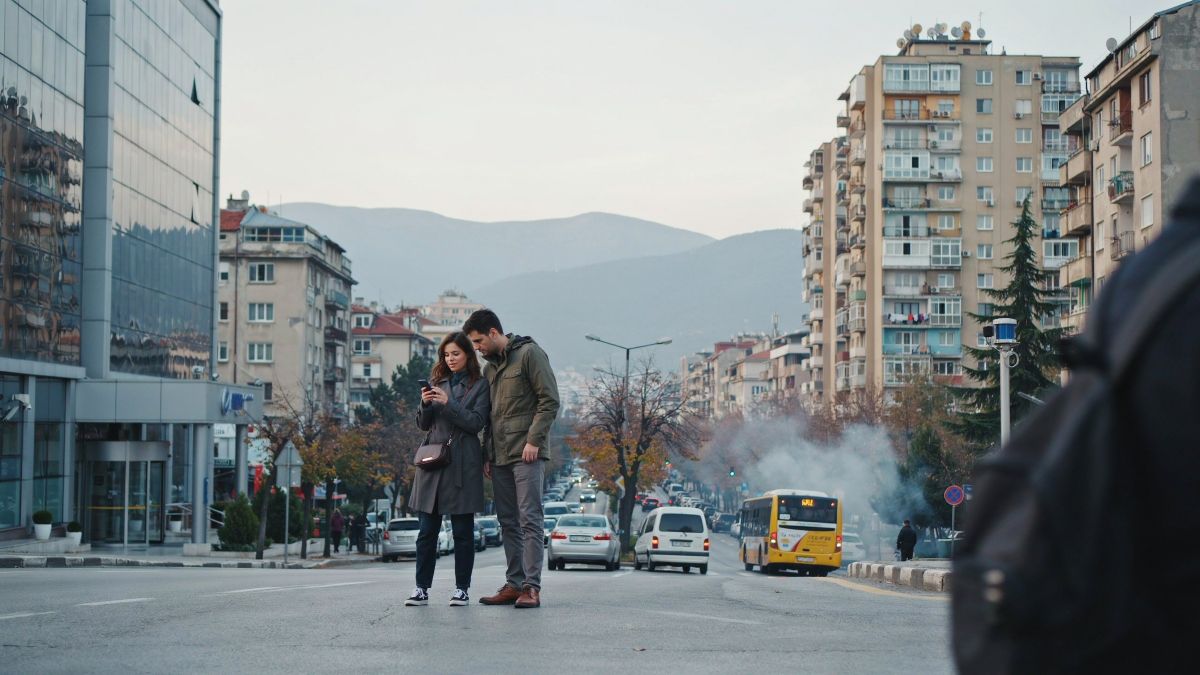
Image generated with Ai
Travel considerations related to North Macedonia come through as air quality becomes increasingly important in travel decisions across Europe. The most recent official sources indicate that PM₂.₅ levels remain elevated in some areas of south-eastern Europe. This means that travel planners may have to consider air quality in addition to the usual considerations such as flight, weather and hotel choices. North Macedonia becomes one such example due to the ongoing air quality issues recorded there. It does not mean that people have to refrain from visiting North Macedonia, but that they could look at local conditions, hotel locations and air quality data prior to travelling.
Europe’s pollution story can easily become misleading when complex environmental data is reduced to a simple league table. There is currently no authoritative official ranking declaring particular European countries to be the “most polluted countries in the world in 2026”. The World Health Organization released Version 8.0 of its Ambient Air Quality Database on 30 June 2026. It covers 8,023 settlements in 127 countries and territories and contains measurements from 2010 to 2024. However, WHO specifically warns against using this database to rank cities or make direct country comparisons because monitoring coverage, methods and data completeness differ.
Advertisement
For a defensible European comparison, the European Environment Agency provides a stronger picture. Its Air Quality Status in Europe 2026 assessment covers 39 countries and evaluates validated measurements from 2024 alongside preliminary information from 2025. The latest harmonised population-weighted PM₂.₅ country estimates available for comparison relate to 2023.
This distinction matters. The figures do not represent completed 2026 annual pollution measurements because the year is not over. Instead, they represent the latest official evidence available in 2026. That evidence still shows major differences across Europe.
Advertisement
Advertisement
The latest comparable population-weighted exposure figures reveal a clear concentration of higher PM₂.₅ levels in south-eastern Europe. These figures provide useful background information, but they should not be treated as predictions of conditions at a particular hotel or attraction.Country or territory Population weighted PM₂.₅ 2023 Approximate multiple of WHO 5 µg/m³ guideline Key finding North Macedonia 19.2 µg/m³ 3.8 times Highest exposure in the comparable EEA figures Bosnia and Herzegovina 18.6 µg/m³ 3.7 times High exposure with persistent monitoring concerns Serbia 17.5 µg/m³ 3.5 times High exposure and multiple 2024 exceedance stations Albania 17.2 µg/m³ 3.4 times High exposure but newer monitoring gaps require caution Kosovo 16.6 µg/m³ 3.3 times Part of the wider high exposure Balkan cluster Greece 16.5 µg/m³ 3.3 times Among the higher exposure levels within the EU Cyprus 14.7 µg/m³ 2.9 times Elevated exposure in the European comparison Bulgaria 14.3 µg/m³ 2.9 times Significant pollution related health burden Italy 14.1 µg/m³ 2.8 times Elevated exposure with recent station exceedances Romania 13.1 µg/m³ 2.6 times Elevated exposure in the latest comparable figures
North Macedonia recorded 19.2 micrograms per cubic metre, followed by Bosnia and Herzegovina at 18.6, Serbia at 17.5 and Albania at 17.2. Kosovo recorded 16.6, while Greece reached 16.5. Cyprus, Bulgaria, Italy and Romania also recorded levels well above the WHO annual guideline of 5 micrograms per cubic metre.
These are population-weighted exposure estimates. They should not be presented as a global pollution league table. Their value for travel planning lies in showing the broader geographical pattern.
North Macedonia stands out most clearly in the official evidence available in 2026. Its population-weighted PM₂.₅ exposure of 19.2 micrograms per cubic metre was almost four times the WHO annual guideline. Bosnia and Herzegovina followed closely at 18.6, while Serbia and Albania also recorded comparatively high exposure.
Advertisement
Advertisement
More recent monitoring reinforces the concern. In 2024, 23 monitoring stations across Europe recorded annual PM₂.₅ concentrations above the current EU annual limit of 25 micrograms per cubic metre. Six were in North Macedonia and another six were in Bosnia and Herzegovina. Serbia and Türkiye each had five, while Romania had one. Around 91% of these stations were located in urban areas.
This urban concentration is important for tourism because many European holidays centre on cities. Visitors often spend hours walking through central districts, using roads, waiting for transport and exploring outdoor attractions.
Preliminary information for 2025 again placed North Macedonia at the centre of the problem. Of 17 reporting stations exceeding the current EU annual PM₂.₅ limit, nine were in North Macedonia. Italy recorded three, Bosnia and Herzegovina had two, while Croatia, Denmark and Poland each recorded one.
The information also requires careful interpretation. Serbia and Türkiye had not supplied preliminary 2025 PM₂.₅ data for this particular EEA assessment. Their absence from the exceedance list cannot therefore be interpreted as evidence that their pollution problems disappeared.
The same caution applies to Albania and Kosovo when interpreting newer monitoring information. Data gaps can make recent comparisons more difficult. Travellers and publishers therefore need to distinguish between confirmed improvement and missing observations.
Several sources contribute to Europe’s PM₂.₅ problem. The EEA links high concentrations in Türkiye and parts of the Western Balkans mainly to solid-fuel use and relatively old vehicle fleets. More broadly, domestic heating using solid fuels, industry and transport can release fine particles, while agricultural ammonia contributes to the formation of secondary particles in the atmosphere.
This helps explain why pollution can change sharply between regions and seasons. A city that relies heavily on certain forms of heating can experience different pressures from a coastal resort or less densely populated area.
Road traffic adds another local factor. Busy urban streets can create a different environment from pedestrian districts, parks or quieter neighbourhoods. This means travellers need information at more than one geographical level.
National pollution data provides context, but it cannot tell a traveller exactly what conditions will be like at a particular destination. A coastal holiday, mountain resort and inland capital within the same country may experience very different air-quality conditions.
The EEA’s city air-quality system helps provide a more detailed view. Its European city tool covers 761 cities and examines long-term pollution-related mortality risk using PM₂.₅, nitrogen dioxide and ozone together rather than relying on a single pollutant.
This creates an important travel lesson. A country-level figure should be the beginning of research rather than the end.
Visitors can first understand the national background. They can then look more closely at the city they actually intend to visit.
Hotel location already affects price, transport time and access to attractions. Air quality adds another possible consideration.
A hotel beside a major traffic corridor can sit in a very different local environment from accommodation several streets away in a quieter area. Likewise, a property near a large transport hub may face different conditions from accommodation close to a pedestrian zone or park.
This does not mean travellers should assume every busy road has dangerous air or every quiet neighbourhood has clean air. Local monitoring is necessary.
However, the broader principle is useful. Travellers can consider neighbourhood conditions alongside room rates, reviews and proximity to attractions.
For city breaks built around long periods outdoors, this becomes particularly relevant.
The research supports a simple approach to planning. First, travellers can look at the wider country-level exposure picture. This gives broad environmental context. Second, they can examine longer-term conditions in the actual city they intend to visit. Third, they can check current air quality immediately before and during the journey.
The European Air Quality Index is designed for this short-term purpose. According to the EEA, it provides up-to-date information for European countries, regions and cities. It also provides recent conditions and a 24-hour forecast alongside health-based recommendations for reducing short-term exposure.
The distinction between long-term and short-term information is crucial. A city with a challenging annual pollution profile can still experience a relatively clean day. A destination with better long-term conditions can experience a temporary pollution episode.
Air quality therefore works much like weather. Travellers need both the broader pattern and today’s conditions.
The difference between parts of Europe becomes particularly clear when the Balkan figures are compared with monitoring results farther north.
In 2024, every PM₂.₅ monitoring station in Denmark, Estonia, Finland, Ireland, Luxembourg and Sweden recorded concentrations below the tighter EU annual limit of 10 micrograms per cubic metre that is scheduled to apply from 2030.
The same was true for stations in Andorra, Iceland, Montenegro and Switzerland.
This does not mean that every location in these countries always has clean air. Nor does it mean travellers should automatically choose northern Europe instead of southern or south-eastern destinations.
It does show how uneven Europe’s progress has become.
For travellers comparing several destinations, environmental conditions can therefore provide another piece of useful information.
The relationship between tourism and air pollution works in both directions. Visitors can experience poor air quality, but tourism transport can also contribute to local emissions.
The EEA identifies road traffic as one source of PM₂.₅ alongside domestic solid-fuel combustion and industry. In popular tourism cities, taxis, coaches, rental cars and airport transfers enter an already complicated transport and emissions system.
This creates a difficult challenge for destinations. Tourism depends on easy movement. Airports, roads, ports and public transport connect visitors with hotels and attractions. Yet some forms of transport can add environmental pressure.
The future of successful urban tourism may therefore depend increasingly on moving more visitors while producing fewer emissions.
Ports and airports deserve particular attention because they sit at the centre of many tourism economies.
The EEA warns that pollutant emissions from shipping and aviation are increasing, creating particular concerns around airports and ports. Maritime transport is projected to become the principal source of transport-related air pollution in coastal cities by 2030. Revised EU air-quality rules recognise both ports and airports as potential pollution hotspots requiring stronger monitoring.
This creates an important challenge for Mediterranean and coastal tourism centres. Cruise ships bring large numbers of visitors. Airports connect resorts with international markets. Road transfers then move passengers between terminals, hotels and attractions.
Destinations must balance this connectivity with growing pressure to improve environmental conditions.
European cities are already responding to transport pollution.
Low-emission zones, zero-emission areas, pedestrian districts, congestion charging, parking restrictions and limited-traffic zones are becoming part of urban transport policy. The European Commission says these Urban Vehicle Access Regulations can reduce congestion and traffic-related emissions while also improving safety.
For travellers, however, cleaner streets can create new rules to understand. Drivers using foreign-registered vehicles may face difficulties under different city access schemes. A rental car that can enter one European city centre may face restrictions in another.
Visitors planning road trips therefore need to check official municipal access rules before arrival.
Air-quality policy is therefore changing not only the environment of European destinations but also how tourists move through them.
The wider picture also contains encouraging evidence.
Europe is not moving uniformly towards dirtier air. EU-wide premature deaths attributable to PM₂.₅ exposure above the WHO guideline fell by 57% between 2005 and 2023.
The EEA links longer-term improvement to action at European, national and local levels. Important PM₂.₅ emissions reductions have come from electricity and heat production, residential fuel use and road transport.
That is an important part of the tourism story because it shows that the current pollution map is not permanent.
Policy can change conditions.
Cleaner heating can help. Cleaner transport can help. Better monitoring can reveal problems. Urban traffic measures can reduce local pressure.
The challenge is that different parts of Europe are moving at different speeds.
The strongest high-exposure cluster lies around the Western Balkans and south-eastern Europe, but the issue does not stop at the EU border.
Within the European Union, Greece, Bulgaria, Italy and Romania deserve particular attention because comparatively high PM₂.₅ exposure or pollution-related health burdens remain. Italy also recorded three monitoring stations above the current EU annual PM₂.₅ limit in preliminary 2025 information.
For tourism, this again highlights the danger of overgeneralisation. Greece contains large cities, islands, mountain regions and coastal resorts. Italy ranges from major industrial and urban areas to rural landscapes and Mediterranean coastlines.
A single national number cannot describe all of these places.
Destination-level and real-time information therefore remains essential.
Air quality becomes an issue that is raised due to the changing trends for travel planning in Europe. North Macedonia has been proven as a good case in point. Nevertheless, one should not be afraid of going to this region. It is important to have better information prior to picking up a destination. Higher concentrations of PM2.5 are observed in such Balkan countries as North Macedonia. On the contrary, lower concentration of pollutants is recorded in northern Europe. Consequently, air quality may become part of the criteria of travel planning together with weather, transportation and prices of hotels.
Advertisement
Tags: air quality travel, Balkan pollution, EEA air quality, Europe air pollution, Europe tourism pollution
Advertisement
Advertisement













Friday, September 4, 2026

Friday, September 4, 2026

Friday, September 4, 2026

Friday, September 4, 2026

Thursday, September 3, 2026

Wednesday, September 2, 2026

Friday, September 4, 2026

Friday, September 4, 2026


