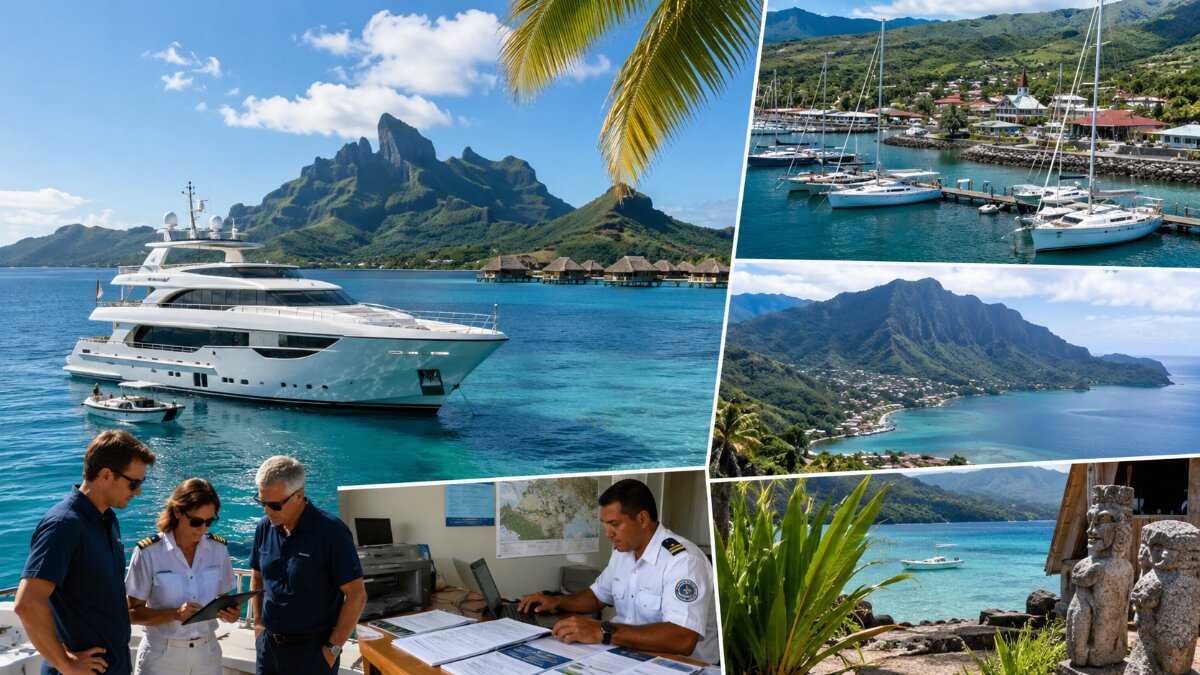
Image generated with Ai
From 1 September 2026, eligible pleasure vessels entering French Polynesia can use revised temporary-admission rules. Vessels under 24 metres may remain for up to 12 consecutive months without paying import duties and taxes while vessels over 24 metres may qualify for up to 36 months. Crew and passengers must separately meet French Polynesia’s immigration requirements which depend on nationality and length of stay. To renew a vessel’s temporary admission, owners must prove that it remained outside French Polynesia for at least six months and entered foreign territory during that period.
The central change is more complex than a simple reduction in the permitted stay of visiting sailing vessels. According to the French Polynesian Customs Directorate, vessels entering before 1 September 2026 remain linked to the previous declaration procedure, while vessels arriving from that date use the new post-September workflow. The previous temporary-admission regime allowed a maximum of 24 consecutive months. The new public guidance divides arriving private pleasure vessels into two length categories.
A vessel of less than 24 metres can now remain under temporary admission for up to 12 consecutive months. A vessel of more than 24 metres can remain for up to 36 consecutive months. Temporary admission allows an eligible privately used foreign vessel to remain without being definitively imported and without paying the import duties and taxes that would otherwise become applicable. A force-majeure extension of three additional months may be available.Compliance issue Previous regime From 1 September 2026 Practical travel impact Vessel below 24 metres Up to 24 months Up to 12 consecutive months Available customs stay is effectively halved. Vessel above 24 metres Up to 24 months Up to 36 consecutive months Large-vessel customs window increases by 12 months. Force majeure Possible extension Up to 3 additional months Not an automatic general extension. Renewal Six-month absence requirement existed under the preceding framework Proof of at least six months outside French Polynesia before renewed temporary admission Smaller vessels may need to restructure South Pacific cruising cycles more frequently. Crew immigration Separate from vessel customs status Remains separate A boat legally remaining for 12 or 36 months does not itself give every person aboard permission to remain that long.
Much of the operational significance lies on the other side of the 24-metre divide. Compared with the preceding 24-month regime, smaller qualifying vessels lose 12 months of temporary admission, while larger vessels gain 12 months. The resulting difference between the two categories is three to one: 12 months against 36 months.
Advertisement
That creates a materially different planning environment for long-range private vessels, expedition yachts and larger pleasure craft. Papeete is particularly relevant because the official Port Autonome de Papeete says its city-centre marina accommodates vessels between 12 and 100 metres and provides 87 berths alongside additional large-pontoon capacity. The port describes Papeete as a principal logistical, provisioning and coordination base before vessels continue through the islands.
The policy should not, however, automatically be described as an official government strategy to favour superyachts. The Customs material establishes the different durations, but the public documents reviewed do not explicitly state that attracting wealthier yacht owners is the purpose of the distinction. The measurable fact is the outcome: larger vessels now have a substantially longer customs-admission runway.
There is historical evidence explaining why the larger-yacht segment matters commercially. A French Polynesian maritime authority report based on a Tahiti Tourisme impact study found that an average of roughly 50 superyachts annually visited Tahiti and its islands between 2015 and 2018. Their estimated annual economic contribution was about XPF2.8 billion, then equivalent to around 5 per cent of total tourism receipts. The study estimated approximately 1,100 visitors and crew annually, with local value added per person around ten times that associated with a conventional visitor.
Those figures are historical and should not be presented as a 2026 market estimate. They nevertheless demonstrate why changes affecting large private vessels can have an economic significance that is disproportionate to their passenger numbers.
Advertisement
Advertisement
French Polynesia also enters the new regime from a position of strong overall tourism demand. The Institut de la statistique de la Polynésie française recorded 281,227 tourists in 2025, up 6.6 per cent and the highest annual total measured by the statistical institute.
This is the most important traveller distinction in the new regime.
A 36-month temporary-admission period applies to the vessel. It should never be interpreted as an automatic 36-month immigration entitlement for the captain, owner, crew or passengers.
According to the High Commission of the French Republic in French Polynesia, short-stay immigration treatment for non-EU nationals depends on nationality and status. Eligible visa-exempt travellers can generally remain for no more than 90 days in a 180-day period under the applicable short-stay framework. Travellers who are not exempt must possess the appropriate short-stay visa. Non-EU nationals planning a stay exceeding 90 days normally require a long-stay visa specifically valid for French Polynesia, obtained before arrival.
EU nationals operate under a different framework. They may stay beyond three months subject to conditions including adequate financial resources and health insurance and must register with their municipality of residence within three months when remaining longer term.
For yacht managers and travel advisers, this means two files must be managed independently: the customs status of the boat and the immigration status of every person aboard.
A superyacht might therefore be legally entitled to remain under temporary admission for three years while individual crew members rotate, obtain different immigration authorisations or leave the territory according to their personal status.
French Polynesian Customs states that temporary admission cannot simply be restarted by briefly sailing across the territorial boundary. Renewal requires proof that the vessel left French Polynesia for a minimum of six months and entered foreign territory.
For a sub-24-metre vessel, that means the basic planning cycle can now become considerably tighter: a maximum 12-month temporary stay followed, where renewal is intended, by at least six months outside the territory before another qualifying admission.
For vessels above 24 metres, the corresponding potential cycle is much longer because the first temporary-admission period can reach 36 months before the six-month external period becomes relevant.
This changes the economics of long-duration Pacific cruising. Smaller yacht owners may need to schedule New Zealand, Fiji, Tonga, Cook Islands or other foreign calls around customs compliance rather than simply weather and cruising preference. The precise foreign destination remains the operator’s choice subject to that country’s entry requirements; French Polynesian Customs requires evidence of departure from French Polynesia and entry into foreign territory.
Papeete remains the central customs and maritime-services hub, but yachts arriving from overseas are not universally required to make Tahiti their first physical landfall.
According to the Polynesian Directorate of Maritime Affairs, foreign pleasure vessels must enter through authorised first-touch locations where customs, immigration and biosafety formalities can be completed. The official list includes Papeete on Tahiti and Taiohae on Nuku Hiva, alongside Afareaitu, Uturoa, Fare, Vaitape, Hakahau, Atuona, Mataura, Moerai, Raima, Tiputa and Rikitea.
For arrivals at Tahiti or Moorea, customs formalities are handled through Papeete Port, while border-control formalities are handled through the territorial border police at Faa’a. When an authorised first landing occurs on another island, such as Nuku Hiva through Taiohae, the territorial gendarmerie handles the relevant customs and immigration process locally.
That procedure predates the September customs change. It is therefore not a new Taiohae concession. Its importance has increased, however, because crews operating under a shorter 12-month vessel allowance have a stronger reason to minimise unnecessary repositioning and structure their first Pacific arrival efficiently.Gateway factor Papeete, Tahiti Taiohae, Nuku Hiva Official first-touch location Yes Yes Customs handling Papeete Port Territorial gendarmerie for authorised non-Tahiti first landfall Immigration handling Territorial border police at Faa’a for Tahiti or Moorea arrival Handled with local entry formalities through the gendarmerie Large-vessel infrastructure Papeete Marina officially accommodates 12-100 metre vessels Primarily valuable as a Marquesas first-landfall gateway rather than as a substitute for Papeete’s large-yacht service infrastructure Strategic value Customs, provisioning, administration and yacht services Direct Marquesas entry can reduce the need to route first to Tahiti
Another important accuracy point concerns digitisation.
French Polynesia already operated an online pleasure-vessel declaration before 1 September. The old government portal still describes the previous 24-month temporary-admission regime. What changed is the creation of a separate post-1 September declaration pathway reflecting the revised length-based rules. French Polynesian Customs now explicitly publishes one online link for vessels that entered before 1 September and another for vessels entering from that date onwards.
The new government digital procedure has an estimated completion time of 29 minutes. It allows the vessel file to be updated during the stay, including changes involving passengers, crew embarkation or disembarkation and inter-island movements. Departure information must also be entered when the vessel leaves French Polynesia.
The Polynesian Directorate of Maritime Affairs separately asks pleasure vessels to register through the ESCALES tele-service. It also requires a maritime health declaration to be submitted at least 48 hours before arrival. Biosafety controls prohibit the landing of specified food, plants, plant material, wooden objects, animals and animal products before the appropriate authorisation is granted.
French Polynesia has been trying to manage growing pressure on anchorages and maritime facilities for several years.
The Directorate of Maritime Affairs previously reported that marinas and designated anchoring areas were experiencing saturation, creating unregulated anchoring and conflicts between visiting vessels, residents and maritime users. The ESCALES system was developed partly to improve allocation, traceability, reservation management and the protection of sensitive marine environments.
The current stopover management office already supervises cruise vessels and larger pleasure vessels above 20 metres, with its responsibilities intended to extend across the wider pleasure-craft sector. Its objectives include limiting overcrowding in popular anchoring zones, creating more organised moorings and reducing seabed damage.
That context makes the new length-based customs system particularly important. It potentially shortens the continuous presence of smaller foreign vessels while simultaneously giving the largest private craft a longer customs horizon. Whether that changes anchorage occupancy, marina demand, repair spending or superyacht visitation will require post-implementation data.
The public-facing government wording currently describes one category as vessels less than 24 metres and the other as vessels more than 24 metres. It does not expressly resolve, on the public pages reviewed, the treatment of a vessel recorded at exactly 24.00 metres.
Travel agents, yacht managers and captains handling a vessel at the exact threshold should therefore avoid interpreting the public summary themselves. Written confirmation should be obtained from French Polynesian Customs before an itinerary or long-term berth arrangement is sold on the assumption of either the 12-month or 36-month allowance.
That small drafting detail could become commercially significant where measurement certificates, registration documents and berth contracts depend on the applicable customs category.
The lasting importance of the September reform will depend less on the online form than on how the new duration structure changes traveller behaviour. Smaller private vessels now face a significantly shorter customs horizon, potentially accelerating onward movement through the South Pacific. Larger yachts gain enough time to treat French Polynesia as a multi-season operating base rather than only a conventional Pacific stop.
Papeete is positioned to benefit from that longer large-vessel window because it combines customs administration with marina infrastructure capable of accepting vessels up to 100 metres. Taiohae retains a different strategic role by allowing Marquesas arrivals to complete authorised first-landfall procedures without making Tahiti their initial Polynesian destination.
The greatest compliance risk is therefore not misunderstanding whether French Polynesia allows visiting yachts. It clearly does. The risk is assuming that one permission governs the entire journey. From September 2026, vessel length, temporary admission, six-month renewal rules, crew immigration status, first landfall, biosafety and maritime registration all have to be managed as separate but interconnected parts of the same voyage.
Advertisement
Tags: customs rules, french polynesia, marine travel, papeete, Taiohae
Advertisement
Advertisement












Wednesday, September 2, 2026

Wednesday, September 2, 2026

Wednesday, September 2, 2026

Wednesday, September 2, 2026

Tuesday, September 1, 2026

Wednesday, September 2, 2026

Wednesday, September 2, 2026