

Samos Walks Alongside Skiathos and More Destinations as Greece Tourism Builds Momentum Despite Shorter Stays and Early Declines

Published
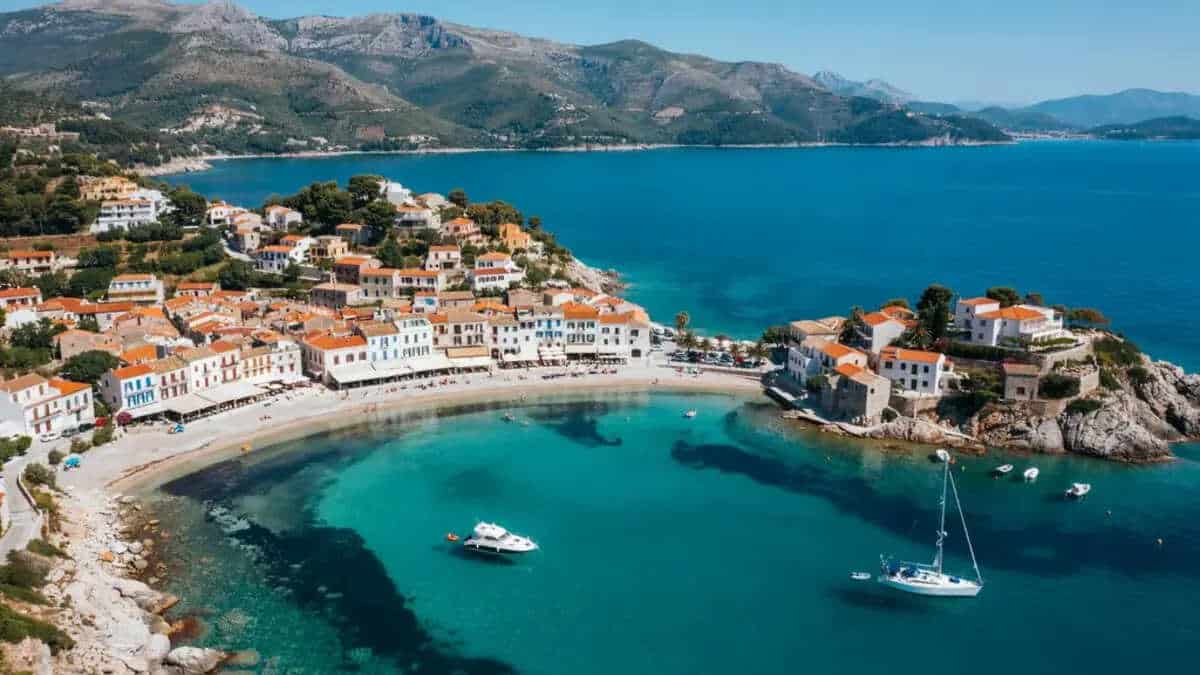
The 2026 Greek tourism season is gathering momentum across Samos, Skiathos, Kefalonia, and major hubs like Crete and Rhodes, bouncing back from a hesitant start to the year. A pickup in summer air arrivals, combined with high hotel occupancy and a surge in last-minute bookings, helped several destinations overcome an early-season slump, despite lower average lengths of stay and more restrained spending by tourists.
The season has therefore been shaped by two contrasting trends. More travellers have been recorded across several important destinations, but holidays have frequently become shorter. At the same time, tourism businesses have faced higher operating costs, meaning that rising arrival numbers cannot automatically be translated into equal growth in profitability.
Advertisement
Advertisement
Greece Tourism Recovers After a Nervous Start to the Season
The opening months of the tourism season were marked by uncertainty. Geopolitical tension in the Middle East influenced booking behaviour and made some travellers more cautious about committing to holidays months in advance.
To stimulate demand, discounts and promotional offers were introduced across popular Greek destinations during March and April. More flexible cancellation conditions were also made available across parts of the accommodation market, reducing the financial risk for travellers who were uncertain about their plans.
Advertisement
Advertisement
The situation changed as summer approached. Booking activity accelerated and a significant volume of demand was generated closer to departure dates. This last-minute booking pattern became one of the defining features of the season.
By the peak summer period, much of the weakness seen earlier in the year had been recovered.
Advertisement
Advertisement
Samos and Skiathos Lead Strong Growth Among Smaller Destinations
International air traffic strengthened substantially during the heart of summer.
More than 5 million international air arrivals were recorded across Greece’s main airports during July, representing growth of around 3.2% compared with the corresponding period of 2025. In August, arrivals approached 4.9 million, with growth of approximately 2.7%.
However, the expansion was not evenly distributed.
Some smaller island destinations recorded considerably faster growth than the countrywide average. Samos emerged as one of the strongest performers, with international arrivals increasing by 17.2% in August.
Skiathos also maintained strong momentum, recording approximately 15% growth, while Kefalonia followed closely with an increase of around 15.3%.
The figures indicate that tourism demand was being distributed beyond Greece’s biggest and traditionally dominant resort destinations. Smaller islands were increasingly benefiting from international connectivity and changing traveller preferences.
Advertisement
Advertisement
Mykonos Grows While Santorini and Athens Face Softer Demand
Performance varied significantly among Greece’s internationally recognised destinations.
Mykonos maintained positive growth across both July and August. During August alone, international air arrivals increased by approximately 8.5%, demonstrating that the island continued to attract significant overseas demand.
A different picture was seen in Santorini, where international air traffic remained broadly unchanged. This marked a noticeable contrast with the rapid growth recorded in Samos, Skiathos and Kefalonia.
Athens also moved against the wider upward trend. International arrivals were reported to have declined by approximately 4.2% in August.
These differences show that Greece’s tourism recovery cannot be viewed as a single national pattern. Demand has increasingly varied by destination, accessibility, accommodation availability, pricing and visitor behaviour.
Crete Builds on Strong Air Arrivals but Travellers Stay for Less Time
The major tourism centres of Crete, Rhodes and Corfu continued to produce positive results during the peak season.
Advertisement
Advertisement
In Crete, Chania delivered particularly strong growth. International arrivals during the January-August period reached approximately 1.28 million, representing an increase of around 9.9%.
At Heraklion, international arrivals exceeded 3 million, with growth estimated at around 5%.
However, one of the most important developments was the shortening of holidays. The average duration of stays in parts of Crete was reported to have fallen to below eight days.
This matters because arrival growth alone does not determine tourism revenue. A visitor taking a seven-day holiday may generate less accommodation and local spending than someone staying for ten or fourteen days.
Short-term rental accommodation has also become a larger part of the market, creating additional competition for traditional hotels and changing how visitor nights are distributed.
Despite these pressures, Crete was estimated to have attracted roughly 400,000 additional arrivals during the year, keeping the wider tourism picture positive.
Advertisement
Advertisement
Rhodes and Corfu Maintain High Occupancy Through the Summer Peak
Rhodes moved through the peak season with strong accommodation demand. Overall occupancy across the season was reported to have exceeded 80%, while both arrivals and hotel receipts were estimated to have increased by approximately 3%.
International air arrivals rose by around 5.3% in July and 3.8% in August.
Across January to August, approximately 2.33 million international arrivals were recorded, representing annual growth of roughly 3.7%.
Corfu delivered an equally important performance. Hotel occupancy surpassed 90% during July and August, supported heavily by last-minute demand.
International arrivals at Corfu airport reached approximately 1.67 million during January-August, an increase of around 7.5%.
Airport figures, however, do not represent hotel demand perfectly. Some travellers arriving through Corfu use short-term rentals, while others use the island as a gateway before travelling onwards, including to neighbouring Albania.
Advertisement
Advertisement
Even with this movement, the overall revenue picture for Corfu’s accommodation sector remained positive.
International Markets Shape Greece’s Tourism Performance
Several overseas markets played distinctive roles in the 2026 season:
- United Kingdom: British travellers provided one of the strongest sources of demand, particularly for Rhodes, where the UK market increased by approximately 14%. British connectivity was also expected to support Corfu beyond the traditional summer season.
- Poland: Polish tourism demand continued to expand, with Rhodes recording growth of roughly 7% from the market. Poland also contributed positively to Corfu’s international visitor mix.
- Germany: German demand remained broadly stable in Rhodes compared with the previous year, while the market continued to play an important role in the wider Greek tourism sector.
- Israel: Israeli demand recorded particularly strong growth in Corfu, helping support the island’s international visitor base despite wider geopolitical uncertainty in the Middle East.
- Albania: Corfu continued to serve partly as a regional gateway, with some passengers arriving on the island before travelling onwards to Albania. This means airport traffic can be higher than the number of visitors actually staying on Corfu.
Shorter Stays Become a Critical Issue for Tourism Revenue
The biggest concern behind the positive arrival numbers has been the changing behaviour of travellers.
Visitors have increasingly been taking shorter holidays, while spending has been described as more controlled in several destinations.
This creates an important distinction between tourism volume and tourism value. More passengers can arrive without generating an equivalent increase in overnight stays, restaurant activity, retail spending or hotel revenue.
Higher operating expenses have added further pressure. Accommodation operators must therefore balance occupancy, pricing and costs carefully even when visitor traffic is rising.
Advertisement
Advertisement
For Greece, the financial success of the season will consequently depend not only on how many travellers arrived, but also on how long they stayed and how much they spent.
September and October Extend Greece’s Tourism Opportunity
A further positive development has emerged beyond the traditional July-August peak.
Strong demand continued through September, helped by milder weather, reduced crowding and travellers seeking holidays outside the busiest summer period.
Activity has also remained healthy into October, strengthening Greece’s efforts to extend its tourism calendar.
In Rhodes, parts of the hotel sector are expected to remain active until around mid-November, adding valuable weeks to the season.
Corfu is moving even further towards year-round connectivity. Air links with the United Kingdom are expected to continue beyond the normal tourism season and into January, creating a bridge between autumn travel and winter demand.
Advertisement
Advertisement
The development could become increasingly significant if travellers continue shifting towards spring and autumn holidays.
Ultimately, Greece’s 2026 tourism season is being defined by resilience rather than simple growth. Samos, Skiathos, Kefalonia and other destinations have gained impressive momentum, while Crete, Rhodes and Corfu have maintained substantial visitor volumes.
Greece sees tourism recover as strong summer arrivals and last-minute bookings compensate for slow start, growth continues, but shorter stays and weaker demand in some key destinations seen as challenges to further growth
While arrivals in strong summer months and increased last-minute bookings help to offset a slow start to the year, shorter stays, mixed performance across destinations and more cautious spending highlight challenges to Greece’s tourism recovery.
Advertisement
