
Egypt Invites Eclipse Watchers to Discover More Than Luxor’s Ancient Temples

Published
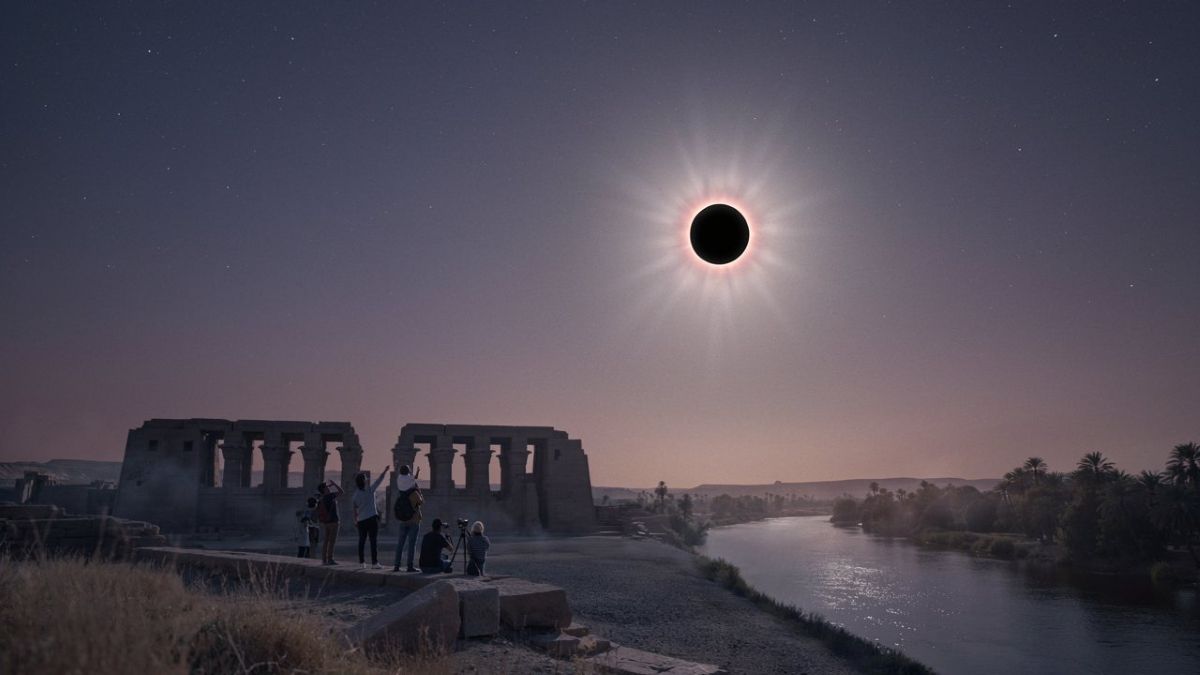
Image generated with Ai
While visiting Egypt for the eclipse in 2027, you will have the chance to see not only the temples of Luxor but much more, as the phenomenon offers a good opportunity to acquaint yourself with the heritage of the city and its guides. In addition, a scientific conference to be held during the event may encourage those interested in science to stay in Egypt after the event itself. At the same time, the country is ready to organize viewing sites in Luxor and Siwa, as well as reports abroad about the increased interest of people in the eclipse. However, interest does not mean that there will be a tourist upsurge in the country.
Why Egypt is preparing for an eclipse years in advance
The Moon will pass between Earth and the Sun on 2 August 2027. Along a narrow path, it will cover the Sun completely for a short time. The maximum totality will last about 6 minutes and 23 seconds. That is the greatest duration on the eclipse path. Visitors at other sites may experience a shorter period, depending on their exact location.
Advertisement
Advertisement
Egypt’s National Research Institute of Astronomy and Geophysics (NRIAG) identifies Luxor as a key place to watch the event. Its eclipse information says totality begins in Luxor city at about 1.02 pm local time. The institute describes the 2027 eclipse as one of the longest total eclipses visible from land until 2114. The event’s long duration and Egyptian setting make it a strong draw for astronomy fans and cultural travellers alike.
The eclipse will not be visible in the same way across every destination. Parts of North Africa, including Egypt, Morocco, Algeria, Tunisia and Libya, lie along the totality path. Much wider areas will see only a partial eclipse. This gives Egypt a chance to promote a distinct viewing experience, while reminding travellers that totality depends on the place they choose.
Advertisement
Advertisement
Egypt is already planning for visitors
Egypt’s Ministry of Tourism and Antiquities has formed a committee to prepare for the eclipse. The committee brings together officials and representatives connected with tourism, antiquities, hotels, aviation, customs and other government bodies. Its stated role includes organising events and helping manage tourist flows around the main viewing areas. The ministry says this coordination should help reduce congestion and make the experience more orderly.
At its first planning meeting, the committee discussed where visitors could watch the eclipse. It also highlighted the need to coordinate with Egypt’s meteorological authority and local governments. The ministry said selected sites should have basic facilities such as toilets and catering. These details matter because eclipse visitors need clear directions and suitable places to wait. They also show that the event is being treated as a visitor-management challenge, not only a publicity opportunity.
Advertisement
Advertisement
The same announcement named Luxor and Siwa among Egypt’s locations expected to experience a long period of eclipse totality. That allows the story to look beyond one city. Luxor can appeal to travellers who want ancient sites and Nile Valley experiences. Siwa offers a different desert setting. However, official plans do not yet prove that a combined Luxor-Siwa eclipse itinerary is available. Any mention of such a trip should be presented as a possibility for tour planners to explore.
The story continues after the sky grows dark
The strongest tourism angle may extend beyond the eclipse itself. NRIAG lists a three-day scientific conference in Luxor from 3 to 5 August 2027, immediately after the eclipse. Its website says the meeting will bring together astrophysicists, space engineers and Egyptologists to discuss observations. Registration details are still to be announced. The institute also invites universities, observatories and astronomy societies to coordinate scientific visits and observation activities.
Advertisement
Advertisement
This creates a clear reason for some delegates to remain in Luxor after eclipse day. They may attend the conference, visit observatories or explore the city’s heritage sites. Researchers, their colleagues and other interested travellers could form a specialist visitor group. Yet the size of that group is not known. No verified public estimate of conference attendance or eclipse-driven hotel demand has been announced. The conference is a planned programme, not proof of a tourism boom.
There is a practical distinction between the eclipse audience and the conference audience. Some visitors may travel mainly to see totality. Others may come for scientific work and stay for several days. Cultural visitors may build a wider holiday around the event. These groups could help hotels, guides, restaurants and transport providers. But the size of any benefit will depend on actual bookings and visitor spending. Tourism authorities and businesses will need to publish clearer figures as the date approaches.
The conference also gives Luxor a way to connect science with history. NRIAG says the programme will discuss ancient Egyptian astronomical heritage alongside modern observations. This creates a distinctive story for travellers interested in both the sky and the past. It can also support guided explanations, museum visits and educational programmes, if organisers develop them. The available announcement confirms the conference themes. It does not confirm a wider public festival or an event schedule at archaeological sites.
Recent interest gives the story a timely hook
Tourism interest has appeared in official market updates. On 27 September 2026, Egypt’s State Information Service reported that Japanese tour operators had expressed growing interest in watching the next year’s eclipse from Luxor. The same report said travel programmes combining Alexandria with Luxor and Aswan were already being offered. This connects eclipse travel with existing cultural itineraries, rather than treating the event as a trip with only one stop.
Advertisement
Advertisement
That combination could give visitors reasons to explore more of Egypt. A traveller might visit Alexandria, continue to Luxor for the eclipse, then travel to Aswan. But the report does not say that every programme is designed around the eclipse. Nor does it provide the number of Japanese bookings. Use it as evidence of interest and existing multi-city products, not as a measure of confirmed visitor growth.
A separate government report dated 1 August 2026 relayed comments from US tour operators. They reported growing demand for Egypt and particularly strong bookings for 2027 ahead of the Luxor eclipse. This offers another sign that some travellers are planning early. The report does not give a booking total or identify how many reservations relate specifically to the eclipse. The distinction matters: operator feedback is useful market evidence, but it is not a national arrivals forecast.
Together, these updates help establish a timely news story. The event has an official preparation process, a scientific programme and reported interest from overseas operators. The next important evidence will come from confirmed viewing-site capacity, transport plans and updated booking data. Those details will show whether interest turns into a broad visitor flow or remains concentrated among specialist travellers.
Heritage can help turn an event into a longer holiday
Luxor already gives visitors a reason to stay beyond eclipse day. Its temples, tombs and Nile setting can support a wider cultural itinerary. Egypt’s Ministry of Tourism and Antiquities opened two restored New Kingdom tombs in Luxor in May 2026: TT416, associated with Amenhotep “Rabouya”, and TT417, associated with his son Samut. The ministry reported improvements to visitor services, including new signs, shaded areas and a guidebook in Arabic and English.
These new openings offer a specific heritage development to include in an article about future travel. They show how Luxor’s tourism offer continues to develop ahead of 2027. They may interest visitors who want to explore sites beyond the most familiar stops. But the tombs have not been announced as eclipse-viewing locations. Keep the two ideas separate: visitors could explore them as part of a broader Luxor stay, subject to normal access arrangements.
The wider opportunity is to encourage visitors to spread their time across several experiences. Eclipse viewing could form the centrepiece of a trip. Heritage visits, guided walks, local food and river journeys could fill the days around it. That would create more chances for local businesses to benefit. It would also help the destination offer a complete trip rather than a single moment in the sky.
Advertisement
Advertisement
This approach suits Egypt’s existing tourism profile. The ministry reported that the country welcomed about 19 million tourists in 2025, an increase of 21 per cent on 2024. It also reported strong growth in visits to archaeological sites and museums. These figures show that Egypt already attracts large numbers of travellers. They do not show that the eclipse caused any part of that growth, which took place before the 2027 event.
Entry rules need careful wording
The headline’s reference to visa-free travel needs a precise treatment in an Egypt-focused article. Egypt’s e-visa portal describes an online visa application for eligible nationalities. An e-visa is a visa obtained electronically; it is not visa-free entry. Travellers should check the rules that apply to their passport and itinerary before booking.
Some travellers may qualify for a limited visa exemption in specified South Sinai resorts. For example, British passport holders arriving at Sharm El-Sheikh can receive a free entry stamp for stays of less than 15 days at certain resorts. The exemption applies to those resort stays. Travellers who plan to visit other parts of Egypt, including Luxor, need to follow the relevant visa requirements. It would be misleading to describe this narrow resort arrangement as visa-free access to the whole country.
For a traveller planning to see the eclipse in Luxor, the useful advice is simple: confirm the current entry rules for your nationality and route. Check whether you need to apply before departure or can use an available visa-on-arrival process. Rules and fees can change, so readers should use official government or Egyptian visa-portal information close to travel. No eclipse-specific visa waiver has been announced.
Morocco can be mentioned briefly as a separate African comparison. Its national tourism office says visa needs depend on nationality and directs travellers to the Accès Maroc portal. Morocco’s official e-visa conditions specify a single entry and a stay of up to 30 days for that visa category. These rules do not apply to Egypt, and the two countries should not be presented as sharing one visa policy.
Visitor comfort and safe viewing will shape the experience
The eclipse will draw people outdoors, so event planning must consider more than the view. NRIAG warns that Luxor is hot in August and advises visitors to drink water, cover their heads and seek shade. The ministry’s planning meeting also discussed basic facilities at viewing sites. Together, these points support practical questions about shade, seating, drinking water, toilets and access for visitors who need mobility support.
Advertisement
Advertisement
The precise arrangements still need to be confirmed. The information available does not set out final site capacities, public transport schedules, medical support plans or accessibility details. These gaps make useful follow-up reporting. Ask the relevant authorities where approved viewing zones will be, when visitors can enter and what facilities each location will provide. Do not state that a service exists until officials confirm it.
Eye safety also belongs in any traveller guide. People must use safe solar viewers during the partial phases of a solar eclipse. Ordinary sunglasses do not provide enough protection. Cameras, binoculars and telescopes need proper solar filters. During totality, people may look without eye protection only while the Sun is completely covered. They must put their viewers back on as soon as totality ends.
These practical points can make the article more useful to readers. A clear plan helps visitors arrive prepared and understand the difference between totality and the partial phases before and after it. It also directs attention towards the quality of the whole experience, not simply the number of minutes the sky grows dark.
What Egypt must prove before the tourism story is complete
The eclipse creates a powerful opportunity, but its long-term value cannot be measured by the spectacle alone. Egypt will need to show whether visitors stay longer, travel beyond the main viewing point and spend with local businesses. Future updates could include hotel occupancy, visitor numbers, conference registrations, transport capacity and the locations chosen for public viewing.
The September 2026 planning announcement shows that officials have begun coordinating. The scientific conference creates a programme immediately after eclipse day. Recent operator reports point to interest from Japan and the United States. These are meaningful signs, but they describe preparation and demand signals, not a guaranteed windfall.
For travellers, the key task will be to plan the full journey. They should confirm the exact viewing location, check entry rules for their passport, review travel arrangements and prepare for the outdoor conditions. For tourism businesses, the challenge will be to make the eclipse fit into a wider holiday that feels easy to navigate and rewarding after the brief period of totality.
Advertisement
