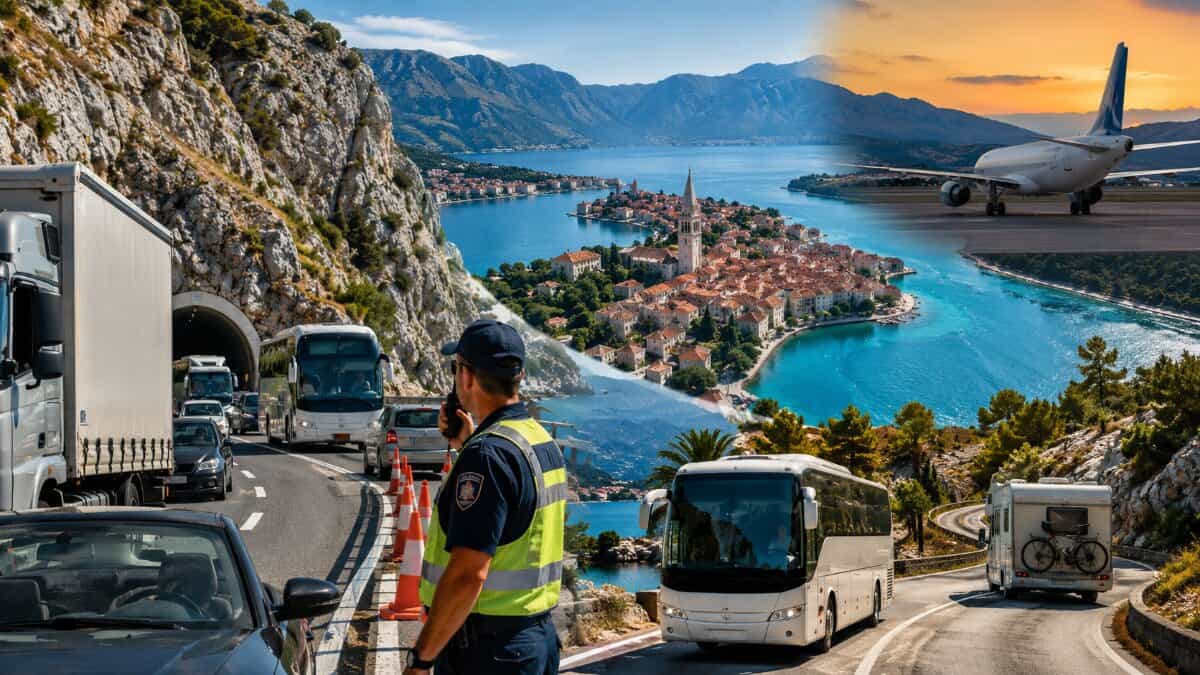
Image generated with Ai
Montenegro is effectively creating protected evening capacity for tourist traffic across its principal coastal corridor this summer. Freight vehicles exceeding 7.5 tonnes are restricted on the M-1 through Kotor, Tivat, Budva, Bar and Ulcinj until 15 September, while police can meter trucks back onto the road after midnight to prevent fresh queues. The policy matters because Montenegro’s seaside resorts generated 91.6% of collective-accommodation overnight stays in June, placing unusually concentrated seasonal demand on a narrow transport network.
Montenegro’s seasonal heavy-vehicle restrictions are usually read as a road-traffic regulation. For the travel industry, however, the more consequential interpretation is that the country is temporarily reallocating scarce coastal road capacity towards the periods when visitors, airport transfers, hotel movements, excursions, private cars and local passenger services place the greatest pressure on the network.
According to the Police Directorate of the Government of Montenegro, freight vehicles with a maximum permitted mass exceeding 7.5 tonnes cannot use the M-1, selected M-2 sections and M-10 during defined evening periods between 15 June and 15 September 2026. The authority explicitly connects the measure with the expected increase in traffic during the summer tourist season and the requirement to maintain safe and uninterrupted movement.
On weekdays, the restriction operates between 19:00 and midnight. On Saturdays and Sundays, when discretionary and tourist road movements can become particularly concentrated, the window begins earlier at 17:00 and continues until midnight.
Advertisement
Advertisement
The M-1 restriction is strategically important because it covers the coastal spine from the Debeli Brijeg border crossing through Herceg Novi, Kotor, Tivat, Budva, Bar and Ulcinj to Sukobin, near the frontier with Albania. It therefore intersects resort traffic, international road movements, Tivat Airport transfers and several of Montenegro’s most heavily visited coastal municipalities.
| Measure | 2026 operating rule | Geographic relevance | Travel-industry implication |
|---|---|---|---|
| Heavy freight above 7.5 tonnes | Restricted Monday-Friday, 19:00-24:00 | M-1, selected M-2 sections and M-10 | Removes large freight vehicles during critical evening visitor movements |
| Weekend freight control | Saturday-Sunday, 17:00-24:00 | Same principal routes | Longer seven-hour capacity window during leisure-heavy weekends |
| M-1 coastal corridor | Debeli Brijeg-Herceg Novi-Kotor-Tivat-Budva-Bar-Ulcinj-Sukobin | Main coastal tourism axis | Direct relevance for transfers, touring programmes and self-drive itineraries |
| Kotor regional restriction | Heavy freight restricted 07:00-24:00 until 15 October | R-1 Kotor-Trojica-Krstac | Kotor remains under tighter controls after the main September window |
| Coach and camper restriction | Daily restriction until 15 October on designated R-1 and R-25.1 sections | Kotor-Njeguši-Lovćen area | Coach excursions and camper itineraries require route-level checking |
| Freight re-entry | Police can gradually release trucks after restrictions expire | Restricted network | Midnight does not necessarily mean an immediate unrestricted freight surge |
| Exempt movements | Includes specified priority, maintenance, assistance and specialist vehicles | Defined by official order | Operators should not interpret the measure as an absolute ban on every heavy vehicle |
The most important operational provision for B2B travel planners appears near the end of Montenegro’s order.
Police are instructed not merely to enforce the prohibited hours but also to take additional measures designed to prevent columns of freight vehicles forming once restrictions expire. Heavy vehicles can therefore be returned to traffic gradually and under time-controlled conditions, with drivers required to maintain appropriate spacing.
That detail changes the meaning of the policy.
This is not simply a binary system in which trucks disappear at 19:00 and all return simultaneously at midnight. It creates an element of active traffic metering, extending capacity management beyond the formal restriction itself.
For destination operators, this matters because a sudden midnight release of waiting freight could simply transfer congestion into a later time band. Controlled reintegration is designed to reduce that rebound effect.
Hotels arranging late airport transfers, destination management companies operating evening movements, private-transfer providers and tour operators positioning vehicles overnight should therefore avoid treating midnight as an exact point at which traffic conditions automatically normalise.
The latest municipality-level accommodation information available from Montenegro’s official Statistical Office strengthens the capacity-management interpretation.
According to MONSTAT, Montenegro recorded 206,990 tourist arrivals and 793,956 overnight stays in collective accommodation in June 2026. Foreign visitors generated 90.8% of those nights. Most significantly for the coastal road system, seaside resorts accounted for 91.6% of all collective-accommodation overnight stays and 81.9% of arrivals.
The geography is therefore extremely concentrated.
Budva alone recorded 81,821 arrivals and 354,146 overnight stays in June. Kotor registered 16,894 arrivals and 47,394 nights. Together, the two municipalities accounted for approximately 47.7% of all collective-accommodation arrivals and 50.6% of overnight stays recorded nationally during the month, based on MONSTAT data.
| Market area | Arrivals | Share of national arrivals | Overnight stays | Share of national nights |
| Montenegro total | 206,990 | 100% | 793,956 | 100% |
| All seaside resorts | 169,527 | 81.9% | 727,230 | 91.6% |
| Budva | 81,821 | 39.5% | 354,146 | 44.6% |
| Kotor | 16,894 | 8.2% | 47,394 | 6.0% |
| Budva and Kotor combined | 98,715 | Approx. 47.7% | 401,540 | Approx. 50.6% |
| Tivat | 10,631 | 5.1% | 31,670 | 4.0% |
| Herceg Novi | 24,155 | 11.7% | 124,508 | 15.7% |
| Bar | 22,728 | 11.0% | 104,525 | 13.2% |
| Ulcinj | 13,298 | 6.4% | 64,987 | 8.2% |
Source calculations use MONSTAT preliminary June 2026 collective-accommodation data. Private accommodation is not included in this monthly dataset.
The implication is substantial. The same strip of coastline carrying tourist accommodation demand also carries local residents, commercial deliveries, international road traffic and transfers feeding Tivat Airport.
Fresh transport statistics published on 12 August 2026 reinforce the argument that Montenegro is managing a system experiencing simultaneous growth across several passenger channels.
According to MONSTAT’s second-quarter transport statistics, road passenger transport increased 2.6% year on year, local road passenger transport rose 11.9%, and passengers handled at airports increased 20.5% compared with the second quarter of 2025.
These indicators are particularly relevant because they describe different components of the visitor journey.
International air passengers must still complete the surface-transport leg between an airport and accommodation. Local passenger transport shares road space with private vehicles. Coaches and transfer vehicles compete for capacity at the same time as resort arrivals, residents and freight.
Montenegro’s challenge is therefore not solely attracting travellers. It is increasingly about moving existing demand through geographically constrained destinations without allowing transport friction to degrade the visitor experience.
Kotor deserves special attention because its controls extend beyond the main 15 September expiry applying to the M-1 freight regime.
Heavy freight is restricted on the R-1 between Kotor, Trojica and Krstac from 07:00 until midnight through 15 October 2026. The June order also restricts M2 and M3 buses, including relevant light and heavy coaches and minibus categories, as well as campers on specified regional sections through 15 October.
That creates a meaningful distinction between the national coastal restriction and local itinerary planning around Kotor.
Tour companies should not assume that the end of the principal summer truck measure on 15 September restores all regional access arrangements. Kotor-area controls continue into the shoulder season.
This is particularly relevant for autumn programmes combining the Bay of Kotor with Njeguši, Cetinje or Lovćen, where route direction, vehicle category and the precise road section can determine whether a planned movement is permissible.
Temporary capacity controls are only one side of Montenegro’s response. The longer-term solution is structural.
The Government of Montenegro announced in May 2026 that a designer and contractor had been selected for the first phase of the Budva bypass, a fast-road section linking the main Podgorica-Budva and Budva-Tivat routes. The contract value for project documentation and construction is approximately €196.26 million, with a completion period of 48 months from commencement.
Earlier project documentation describes the Markovići-Lastva Grbaljska section as approximately eight kilometres long, involving four bridges totalling around 1.4 kilometres and two twin-tube tunnels with a combined length of about 4.3 kilometres. More than 70% of that proposed section would consequently consist of major engineering structures.
The stated objective includes diverting transit traffic away from Budva’s urban area, easing congestion and improving road safety.
| Capacity challenge | Immediate 2026 response | Structural response | Strategic implication |
| Peak evening freight | Seasonal time restrictions | Future high-capacity road infrastructure | Protects existing capacity while new assets develop |
| Weekend tourist pressure | Earlier 17:00 freight restriction | Budva bypass | Addresses short-term peaks and longer-term transit conflict |
| Post-ban freight queues | Controlled truck re-entry | Improved coastal network | Moves policy beyond basic prohibition into flow management |
| Kotor route constraints | Extended R-1 controls | Wider transport planning required | Shoulder-season tours also face operational considerations |
| Growing passenger demand | Police deployment and seasonal controls | New and upgraded transport assets | Tourism growth increasingly depends on mobility performance |
The defining feature of Montenegro’s 2026 approach is that road capacity is being managed through time allocation while physical capacity remains constrained.
A destination cannot build tunnels, bypasses or new carriageways quickly enough to resolve a single summer season. What it can change immediately is which vehicle categories occupy existing roads during the hours of greatest tourism pressure.
That makes the weekday and weekend distinction important. The 2025 regime generally restricted qualifying freight from 17:00 to 22:00 daily on the major routes. In 2026, the principal window has become more differentiated: 19:00 to midnight on weekdays and 17:00 to midnight at weekends.
The policy therefore allocates capacity according to time rather than permanently excluding freight.
For travel businesses, this provides a useful indicator of where destination growth is creating operational pressure. Montenegro is still expanding tourism connectivity, but its most successful coastal municipalities sit inside a transport geography where airport growth, hotel demand, road passengers, freight, day trips and local movement converge.
That is the information-gain story behind what initially appears to be a straightforward truck regulation.
The freight policy also sits inside a broader 2026 tourist-season management programme.
According to the Government of Montenegro’s summer inspection plan, the principal tourist season runs from 1 July to 15 September, with continuous joint inspection coverage organised across five shifts. Inspectors are stationed in Ulcinj, Bar, Budva, Kotor, Herceg Novi, Žabljak and Kolašin, while the Kotor team also covers Tivat.
The Police Directorate has separately intensified traffic enforcement on roads experiencing increased tourist pressure, including routes around Kotor and Budva. Recent summer operations have targeted heavily used sections such as Lipci-Kotor, Budva-Tivat, Budva-Cetinje and Budva-Petrovac.
Together, these policies show that the government is treating peak tourism as an operational capacity challenge across transport, safety and destination management rather than purely as a visitor-volume target.
Montenegro’s summer road policy points towards a wider shift in mature destination management which includes tourism success is increasingly judged not simply by arrivals but by whether infrastructure can absorb them without damaging mobility and safety or visitor satisfaction.
Kotor and Budva expose that challenge particularly clearly. Together they generated more than half of Montenegro’s collective-accommodation overnight stays in June 2026, while the surrounding coastal network simultaneously carries airport passengers, international road traffic, residents, coaches, freight and excursion movements.
The current truck windows provide a temporary capacity tool. Controlled freight re-entry adds a more sophisticated operational layer. Kotor’s extended restrictions show that pressure does not disappear with the traditional peak-season calendar. The Budva bypass represents the longer investment cycle required to separate tourism and transit movements more permanently.
For the international travel trade, the development is therefore bigger than a seasonal driving rule. Montenegro is moving towards active destination-capacity management, using time-based traffic controls today while investing in infrastructure designed to support a larger and more connected tourism economy tomorrow.
Advertisement
Advertisement
Advertisement











Wednesday, September 2, 2026

Wednesday, September 2, 2026

Wednesday, September 2, 2026

Wednesday, September 2, 2026

Wednesday, September 2, 2026
Tuesday, September 1, 2026

Wednesday, September 2, 2026

Wednesday, September 2, 2026