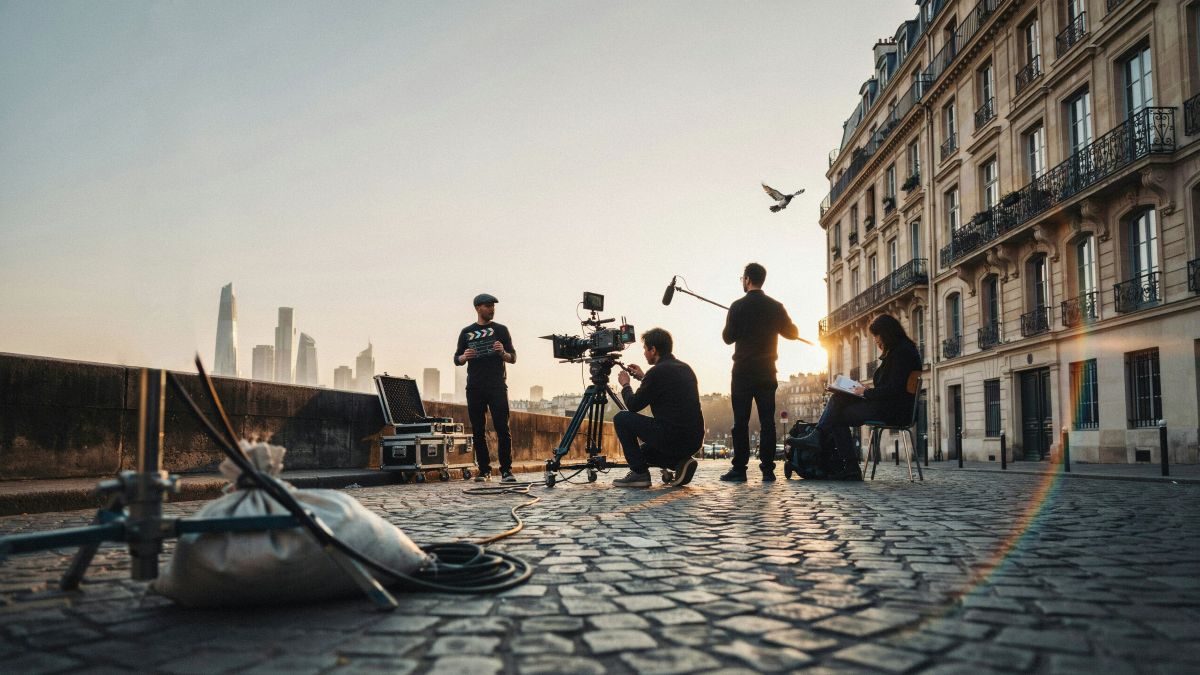
Image generated with Ai
France creates a strong new film link between Europe and the Gulf countries as production teams look for new ways to collaborate. This is more than just selecting a shooting location. France provides funding expertise, competent crews, visual effects capabilities, and festival connections. At the same time, the Gulf market provides new investment, rapidly developing production facilities, unique filming locations and a larger audience.
In the face of increased competition, France is using its production connections and reliable film networks to remain at the forefront of international film industry.
Advertisement
Saudi Arabia has become one of the world’s most ambitious film markets. Its Film Commission says qualifying productions can receive incentives of up to 60%. This is a very high figure in the global production race. Saudi Arabia is also building studios, training workers, promoting local stories and meeting international producers at major film events.
The country used the 2026 Berlinale in Berlin to show its film locations, production services and growing industry. Saudi Arabia is not only trying to bring foreign crews to its cities and deserts. It is trying to build a complete film economy. That includes production, skills, investment and international partnerships.
Advertisement
Advertisement
Abu Dhabi has a different but equally powerful model. Its film commission increased its rebate from 30% to a starting rate of 35% for qualifying applications from January 2025. It also expanded the types of projects that can qualify. The emirate raised the maximum qualifying spend for feature films from US$5 million to US$10 million.
Abu Dhabi has linked filmmaking with destination marketing. It has used major productions and Middle East premieres, including Mission Impossible Dead Reckoning Part One and Dune Part Two, to show its landscapes and modern city image to global audiences. Officials said the Abu Dhabi Film Commission had supported 180 major productions in recent years.
Qatar is building a wider media ecosystem. Media City Qatar offers business support, licensing, investment help and a screen-incentive application. Its public portal does not show one standard rebate percentage. Instead, it presents Qatar as a place where media companies can open, grow and create long-term projects.
Europe’s answer is not only about offering more money. European countries still have skilled crews, famous studios, strong copyright systems, experienced post-production teams and world-leading festivals. They are now working to make these strengths easier for international producers to use.
Advertisement
Advertisement
France offers a 30% Tax Rebate for International Productions. The rate can rise to 40% when a project has more than €2 million in qualifying French visual-effects spending. The rebate can reach €30 million per project. Foreign producers must use a French production-services company and meet spending and cultural rules.
Britain has also changed its support system. The Audio-Visual Expenditure Credit offers a 34% headline rate for film and high-end television. Eligible independent films can receive a 53% gross credit under the Independent Film Tax Credit. Qualifying UK visual-effects spending can receive a 39% rate from April 2025. England has also introduced 40% business-rates relief for eligible film studios.
Germany raised DFFF II support to 30% of recognised German production costs for qualifying projects starting from February 2025. Greece offers a 40% cash rebate, with a maximum of €8 million for each project. Spain has national deductions of 30% on the first €1 million of eligible spend and 25% after that, while some regions offer higher levels under local rules.
These figures matter. Yet they do not mean every offer gives the same final value. A cash rebate, tax credit and grant work in different ways. Producers must check the rules, local spending needs, limits, tax treatment, crew costs and studio availability before deciding where to film.
France has one of the clearest direct links with Saudi Arabia. The Saudi Film Commission has listed the French National Centre for Cinema, known as CNC, among its international co-operation partners. This is institutional co-operation. It should not be described as a new formal bilateral co-production treaty unless official records prove that point.
France’s importance is clear at film markets and festivals. At the 2026 Berlinale, the CNC highlighted projects that connected France with Saudi Arabia and Qatar. These included Kurtuluş Salvation, involving Turkey, France, the Netherlands, Greece, Sweden and Saudi Arabia. Another project, Only Rebels Win, linked France, Lebanon and Qatar.
These projects show a major change. Gulf countries are not standing outside the European film system. Their producers and stories are already moving through European funding, festival and distribution networks. France can offer much more than a rebate. It can offer VFX talent, cultural funding, international co-production knowledge and access to Cannes and other key markets.
Britain’s strategy mixes film policy with trade policy. The UK government’s Creative Industries Sector Vision includes plans for creative-industry trade missions, including Saudi Arabia. It also refers to Gulf export activity, links with investors and buyers, and work on audiovisual services and the movement of creative professionals.
This means London is not simply trying to beat Riyadh or Doha. Britain wants to stay valuable to Gulf investors and producers. It can offer studio expertise, visual effects, finance, rights management, writers, technical workers and access to global distribution networks. The UK has also placed creative industries inside its broader economic relationship with Saudi Arabia. The government reported more than £360 million in investment linked to the wider partnership, though this is not a film-only figure.
Germany is using Berlin in a similar way. Berlinale and the European Film Market remain major places where films are bought, sold, funded and discovered. Saudi Arabia attended the 2026 Berlinale to promote its film sector. The programme also included Saudi-linked films, including a Germany–Saudi Arabia production.
Berlin gives Gulf producers access to European buyers, distributors, festival programmers and creators. Germany’s strengthened DFFF II makes the country more attractive as a filming base. Together, the incentive and Berlin’s market power give Germany a strong role in the new Europe–Gulf screen network.
Spain has created one of Europe’s clearest screen-tourism strategies. It does not want the benefits of filming to end when a cast and crew leave. It wants visitors to explore the places they see on screen.
Spain Film Commission runs Spain Screen Grand Tour, FITUR Screen and Screen Tourism Experiences. These programmes help turn filming locations into travel products and visitor experiences. This is important for cities, islands, villages, hotels, guides and local businesses. A successful series or film can keep bringing attention to a place for years.
Spain also combines its incentives with proof of economic impact. A government-supported study said every euro invested through the international filming fiscal-incentive programme generated an additional €9 between 2019 and 2023. This is an important claim because it shows why governments value screen production beyond the first spending by a crew.
The Spanish film My Brother Ali was shot in Spain, Qatar and Saudi Arabia, among other locations. This does not prove a Spanish government co-production deal with Qatar or Saudi Arabia. But it does show that European and Gulf locations can now appear within the same production story.
Italy is using cinema as a form of cultural and economic diplomacy. The country’s international tax-credit system drew strong demand in 2025. Italy’s Ministry of Culture said 36 films requested about €198 million in international tax credits, up from 13 films in 2024. Rome was the most-used Italian filming location among productions starting in 2025.
Italy’s approach is not only about rebates. The government-backed Vespucci World Tour and Villaggio Italia programme included cinema and Venice International Film Festival activity as part of a wider presentation of Italian culture, tourism and business. Its route later included Doha, Abu Dhabi and Jeddah.
This does not mean Italy held the same Venice-linked film programme at every Gulf stop. The official information does not prove that. What it does show is that Italy placed cinema inside a national-brand project that entered all three Gulf markets. Italy is using Rome’s production strength and Venice’s global prestige to build awareness among Gulf audiences, businesses and investors.
Greece is proving that smaller countries can also make a strong offer. Its Cash Rebate Greece programme gives a 40% rebate to qualifying national and international audiovisual projects. Law 5105/2024 reshaped the country’s public screen system.
Greece has added help at the early stage too. Its LOCATE within GREECE programme supports location scouting and pre-production scouting for foreign film and television projects considering Greece. This can make the process easier before cameras begin to roll.
Greece is not shown in the reviewed official sources as having a new formal screen deal with Saudi Arabia, Qatar or the UAE. Its Gulf connection is mainly competitive. Greece is improving its tools because productions can move quickly between countries. It wants producers to see Greek islands, cities, history and landscapes as a smart choice alongside larger European and Gulf hubs.
European screen power is transforming the world of filmmaking as France, Britain, Germany, Spain, Italy, and Greece compete against the Gulf film boom through better incentives, skills, and international cooperation. Instead of simply using iconic locations Europe is increasing its screen offerings. Gulf centers are constructing studios, developing talent, and drawing in international productions. However, the European film festival circuit, film crews, post-production facilities, and film finance continue to hold value. The emerging Europe–Gulf corridor offers investment opportunities, employment, screen tourism, and new narratives for both regions. In the world of producer decision making, whole ecosystems must be considered not just rebate percentages.
Advertisement
Tags: Abu Dhabi film rebate, Europe film industry, European film incentives, France film production, Gulf film boom
Advertisement
Advertisement













Monday, September 7, 2026

Monday, September 7, 2026

Monday, September 7, 2026

Monday, September 7, 2026
Monday, September 7, 2026

Monday, September 7, 2026