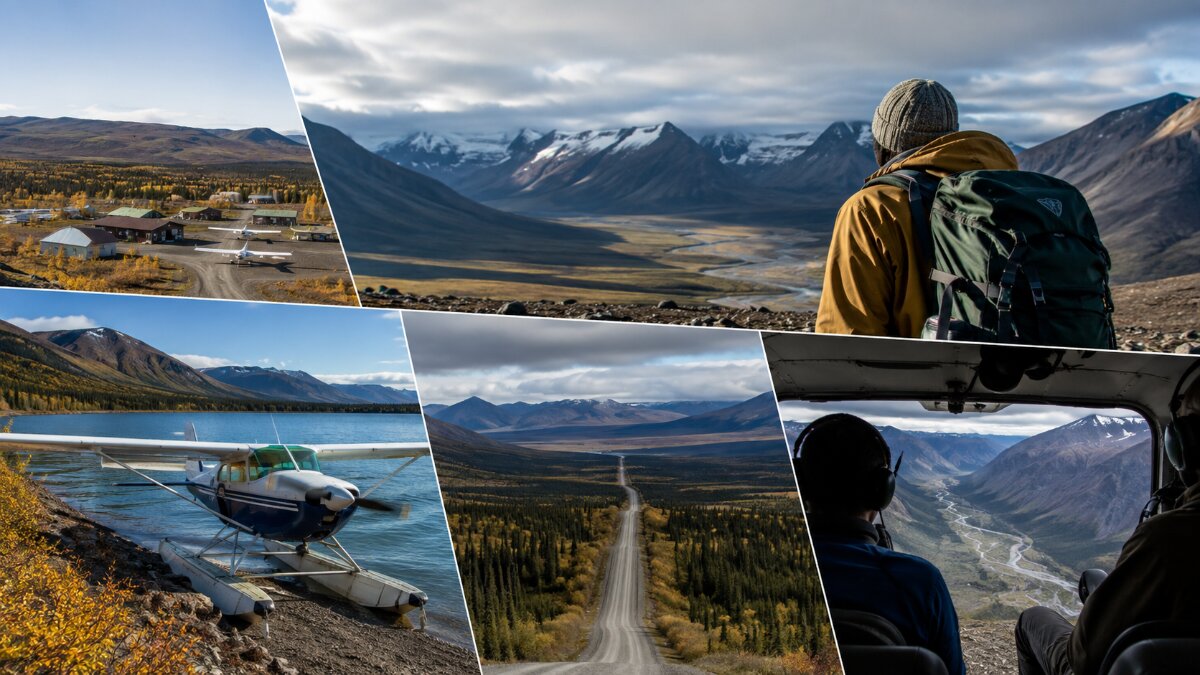
Image generated with Ai
Gates of the Arctic National Park and Preserve remains open year-round, but its late-season travel support network is about to contract rapidly. The Arctic Interagency Visitor Center at Coldfoot begins its winter closure on 17 September 2026. Standing National Park Service weather guidance says local air-taxi operators pull floatplanes from service on 23 September as freeze-up develops. Bettles remains staffed through September, while Fairbanks continues year-round visitor assistance. Commercial operators also face specific 2026 backcountry-orientation obligations for clients entering park or preserve lands.
The central fact for travellers, tour operators and Alaska adventure specialists is that Gates of the Arctic National Park and Preserve does not close in September. According to the National Park Service, the park is open 24 hours a day throughout the year. There are no roads or marked trails leading into the park, making aircraft, wilderness hiking and carefully organised transport fundamental to most visits.
What changes in September is the availability of staffed visitor infrastructure surrounding the wilderness.
The Arctic Interagency Visitor Center at Coldfoot, located at Milepost 175 of the Dalton Highway, operates from noon until 8pm during its open season. Its official winter closure runs from 17 September to 22 May. This means 16 September is effectively the final scheduled operating day before the 2026 winter closure begins.
Advertisement
This creates a more significant travel-industry story than a simple seasonal visitor-centre closure because other elements of the Arctic access system also change within days.
Standing NPS weather guidance states that freezing temperatures become increasingly common from mid-August and that rivers generally freeze between mid-September and early October. The same official guidance states that local air-taxi operators pull their floatplanes out of service on 23 September.
That places only six days between the start of Coldfoot’s winter closure and the date identified by NPS for the seasonal withdrawal of local floatplanes.
However, the distinction is important. The NPS information does not describe 23 September as a federal restriction, mandatory aviation deadline or closure of all air access. It is longstanding seasonal guidance describing local operating practice. Individual operators, aircraft types, weather conditions and landing requirements can differ.
The NPS access guidance says most visitors enter the park using small air-taxi aircraft equipped with floats or tundra tyres. Consequently, withdrawal of floatplanes does not mean every aircraft stops serving the wilderness after that date. Travel companies should reconfirm aircraft availability and landing capability directly with authorised operators rather than advertise 23 September as a universal aviation shutdown.
| Date | Verified operational change | Travel significance |
|---|---|---|
| 7 September | Fairbanks begins winter visitor-centre hours | Year-round planning continues Monday to Saturday |
| 15 September | Anaktuvuk Pass Ranger Station winter closure begins | Staffed NPS support inside park boundaries ends |
| 17 September | Coldfoot Arctic Interagency Visitor Center closes for winter | Major Dalton Highway information point becomes unavailable |
| 23 September | NPS seasonal guidance identifies local floatplane withdrawal | Water-based aircraft availability becomes more restricted |
| 30 September | Final day before Bettles winter closure period | Bettles remains an important late-season staffed gateway |
| 1 October | Bettles Ranger Station winter closure begins | Fairbanks becomes the principal year-round NPS planning base |
Fairbanks is directly connected to Gates of the Arctic access rather than simply being the nearest major tourism city.
According to National Park Service directions, access to Gates of the Arctic begins in Fairbanks. Small airlines operate between Fairbanks and gateway communities including Bettles and Anaktuvuk Pass, with flag-stop service to Coldfoot. NPS guidance places Coldfoot roughly 280 road miles north of Fairbanks via the Dalton Highway.
The Fairbanks Alaska Public Lands Information Center is open year-round. Its official winter timetable begins on 7 September and runs through 31 May, with opening hours of 8am to 5pm, Monday through Saturday.
That continuity matters after Coldfoot and other seasonal facilities close.
Travellers can obtain trip-planning assistance and backcountry orientation information in Fairbanks before moving north. NPS safety guidance also recommends that wilderness visitors carry two forms of communication and notes that satellite communication equipment can be rented in Fairbanks. Air travellers should carry additional food and build weather days into itineraries because poor conditions can prevent air taxis from flying.
For the travel trade, Fairbanks therefore becomes more than a connection point. It functions as the principal year-round logistical staging centre for increasingly complex late-season departures.
Bettles plays a different role.
The National Park Service identifies Bettles Field, around 20 miles south of the southern boundary of Gates of the Arctic, as a common point for air-taxi entry and as a take-out location for river journeys. Scheduled commercial air service links Bettles with Fairbanks, while several air-taxi operators use the community for access into different parts of the park.
The Bettles Ranger Station and Visitor Center is scheduled to operate from 2pm until 6pm, Monday through Saturday, before its winter closure begins on 1 October and continues through 31 May.
That provides roughly two additional weeks of scheduled staffed support after Coldfoot enters winter closure.
For tour operators routing travellers through Bettles, those days can be particularly valuable for final trip information, backcountry orientation and park-condition discussions before travellers move into the wilderness.
The service transition has a stronger B2B implication because commercial operators are subject to formal 2026 National Park Service stipulations.
According to the 2026 Gates of the Arctic Commercial Use Authorization stipulations, commercial operators must ensure that every client using park or preserve lands receives a Backcountry Visitor Resource orientation. Operators may deliver the orientation themselves using park materials supplied by the superintendent.
In-person orientations are available during normal operating hours at Fairbanks, Bettles, Coldfoot and Anaktuvuk Pass when those facilities are staffed.
Operators seeking a customised interpretive programme are instructed to contact the relevant visitor centre or ranger station at least two weeks before arrival.
The commercial stipulations contain additional requirements that reinforce how carefully wilderness products must be managed.2026 commercial requirement Verified NPS rule Client orientation Every client using park or preserve lands must receive the required resource orientation Operator cultural briefing CUA holders must undergo cultural-resource orientation before entering the field Aviation reporting Certain transport operators must report drop-off and pick-up GPS coordinates GPS accuracy Coordinates must be accurate to within one-quarter mile Commercial river groups Maximum party size of 10, including guides and boatmen Commercial backpacking/base camps Maximum party size of 10, including guides, subject to limited custom-trip approval Landing locations Use of landing areas remains at the pilot’s discretion
The late-September centre closures therefore do not remove the orientation obligation. Instead, commercial companies must make sure the requirement is fulfilled earlier or through an authorised operator-led process.
For road-based travellers, another distinction is essential: closing the Arctic Interagency Visitor Center does not close the Dalton Highway.
The Bureau of Land Management describes the Dalton as a 414-mile highway extending from Livengood, about 84 miles north of Fairbanks, to Deadhorse. It remains a remote, mostly gravel industrial route with steep sections, heavy truck traffic and limited services.
BLM warns that snow and ice can occur north of Coldfoot during any month. Mobile coverage is extremely limited, while medical facilities and grocery stores are absent along the corridor. Travellers are directed to Alaska’s official 511 system for current road conditions and alerts.
Alaska DOT&PF operates seven year-round maintenance camps along the Dalton Highway. Individual camps generally cover around 60 to 70 miles of road, demonstrating the scale of infrastructure required to keep this remote corridor operational.
For agents selling self-drive or guided Arctic road products, the practical message is straightforward: the road remains an access corridor, but the availability of visitor assistance changes substantially after mid-September.
The late-season transition is commercially relevant because September has become more important to Gates of the Arctic visitation.
Final National Park Service statistics show that Gates of the Arctic recorded 14,923 recreation visits in 2025, compared with 11,907 in 2024, an increase of 25.33 per cent.
September alone accounted for 1,937 recreation visits in 2025, compared with 1,502 in September 2024, equivalent to an increase of about 29 per cent. September visitation has more than doubled from the 923 recreation visits recorded in the same month in 2021.Year September recreation visits Full-year recreation visits 2021 923 7,362 2022 1,165 9,457 2023 1,337 11,045 2024 1,502 11,907 2025 1,937 14,923
NPS currently displays preliminary 2026 monthly data, but several months remain incomplete in the current-year series. The agency explicitly cautions that current-year figures are preliminary and subject to quality review. For that reason, 2025 is the latest completed annual dataset suitable for reliable year-on-year analysis as of 2 September 2026.
The park’s low absolute visitation can obscure its wider economic value.
The latest completed NPS Visitor Spending Effects study currently available for park-level comparison covers 2024. It attributes $23.177 million in visitor spending to Gates of the Arctic and estimates that this activity supported 217 jobs, $11.270 million in labour income, $20.368 million in value added and $33.207 million in economic output.NPS economic measure 2024 official estimate Recreation visits 11,907 Visitor spending $23.177 million Jobs supported 217 Labour income $11.270 million Value added $20.368 million Economic output $33.207 million
These are modelled economic-contribution estimates rather than direct business revenue figures. They nevertheless demonstrate why reliable transport, gateway accommodation, guiding, aviation and visitor preparation matter economically even at one of America’s least visited large national park units.
The most important original travel-trade insight from the official data is that the autumn transition removes redundancy from the visitor-support chain.
A traveller in early September can potentially use several staffed locations. Anaktuvuk Pass then closes from 15 September. Coldfoot follows from 17 September. NPS seasonal guidance places the floatplane transition on 23 September. Bettles enters winter closure from 1 October.
Fairbanks remains.
For independent visitors, this means more preparation must occur before departure. For specialist operators, it means orientation, food storage, communications, aircraft availability, weather contingencies and pickup arrangements become progressively less forgiving.
That matters particularly at Gates of the Arctic because NPS warns that there is no mobile phone service or normal visitor infrastructure in the wilderness and that visitors may not encounter another person before their scheduled pickup. Bear-resistant food containers are also required for overnight visits.
The September transition at Gates of the Arctic shows why simple open-or-closed destination calendars do not fit remote wilderness tourism. The national park stays open all year. The quality of access changes when visitor centres close when waterways begin to freeze when floatplane availability shifts and when aviation becomes more sensitive to weather. For the adventure travel market this creates both risk and opportunity. September visitors have risen a lot while NPS economic models show that a small number of visitors spend a lot of money.
Operators who can manage aviation meet orientation requirements keep communications up and plan for emergencies can keep serving the shoulder season.. Their products must reflect the real conditions of Arctic operations not just the fact that the park is open all year. As of 2 September 2026 the main travel story is not that Gates of the Arctic is closing. It is that the support network around a wilderness starts shrinking in stages, from mid‑September. This makes preparation, professional logistics and accurate traveller information more important.
Advertisement
Advertisement
Advertisement












Wednesday, September 2, 2026

Wednesday, September 2, 2026

Wednesday, September 2, 2026

Wednesday, September 2, 2026

Wednesday, September 2, 2026

Tuesday, September 1, 2026

Wednesday, September 2, 2026

Wednesday, September 2, 2026