
UAE Travel Plans Face Delays After Dubai Sheikh Mohammed bin Zayed Road Collision Near Ras Al Khor

Published
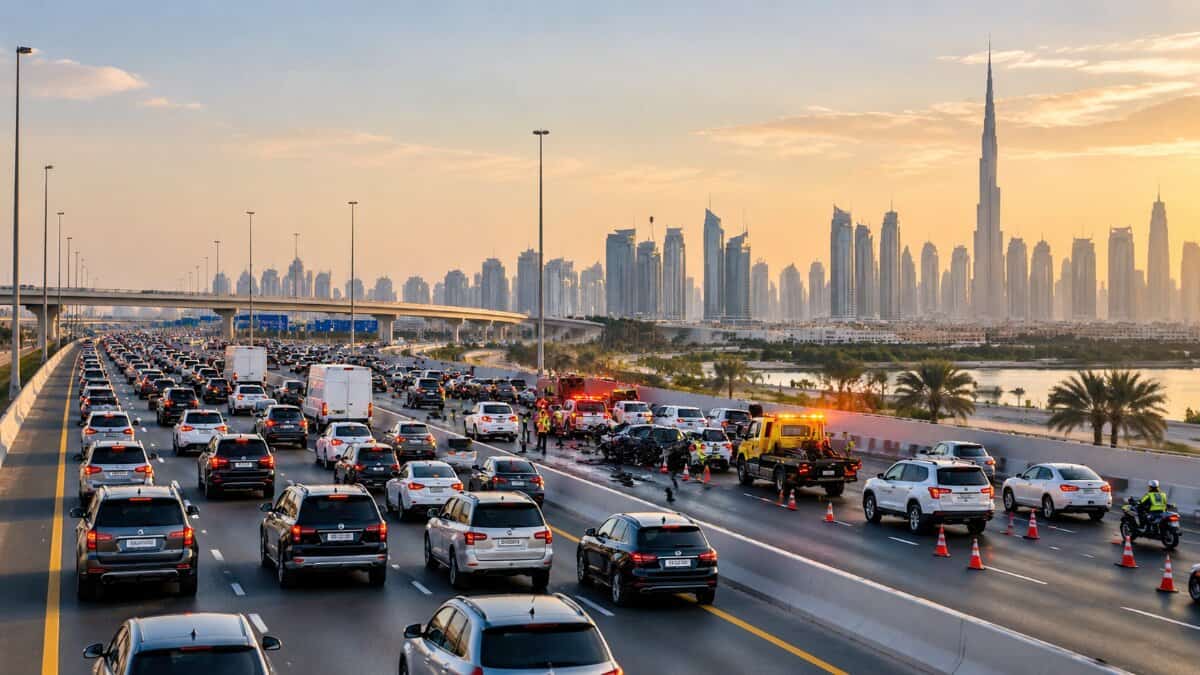
Image generated with Ai
A traffic disruption on Sheikh Mohammed bin Zayed Road (E311) in Dubai, UAE, following an accident before the Ras Al Khor exit towards Abu Dhabi, has highlighted the importance of real-time road planning for tourists, airport passengers and travel operators. Dubai Police advised motorists to exercise caution and expect delays on the affected route. The incident brings renewed attention to how key road corridors connecting Dubai and Abu Dhabi influence airport transfers, hotel mobility, business travel and UAE holiday planning.
Dubai Road Delays Impact Airport Transfers and Tourist Mobility
A traffic incident on one of the UAE’s busiest highways has created a wider travel planning concern beyond daily commuting. The disruption on Sheikh Mohammed bin Zayed Road (E311) demonstrates how road conditions can directly influence the movement of international visitors travelling between Dubai, Abu Dhabi and major transport hubs.
Advertisement
Advertisement
Dubai Police reported that an accident occurred before the Ras Al Khor exit on Sheikh Mohammed bin Zayed Road towards Abu Dhabi, affecting traffic flow and creating congestion. Motorists were advised to remain cautious and allow additional travel time.
For the tourism industry, the importance of this alert lies in the strategic role of E311. The highway is not only a commuter route but also a major connection used by visitors travelling between hotels, attractions, airports, business districts and neighbouring emirates.
Advertisement
Advertisement
The latest disruption underlines a growing requirement for travel companies to include road-condition monitoring as part of UAE travel planning, particularly for visitors with fixed schedules such as flights, cruise departures, conferences and organised tours.
Why Sheikh Mohammed bin Zayed Road Is Critical for UAE Tourism Connectivity
Sheikh Mohammed bin Zayed Road is among Dubai’s most important transport corridors, linking multiple residential, commercial and industrial zones while supporting movement between Dubai and Abu Dhabi.
Advertisement
Advertisement
The road’s importance for tourism comes from its connection with several major travel patterns:
| Travel Segment | Possible Impact from Road Disruptions |
|---|---|
| International tourists | Longer transfer times between hotels and airports |
| Airport passengers | Need for earlier departure planning |
| Tour operators | Adjustments to sightseeing schedules |
| Business travellers | Potential delays for meetings and events |
| Rental car users | Increased journey uncertainty |
| Cruise passengers | Risk of delayed port transfers |
The UAE’s tourism model depends heavily on efficient mobility. Dubai attracts millions of international visitors each year, while Abu Dhabi continues expanding its role as a leisure, business and cultural destination.
Advertisement
Advertisement
Because many travellers combine both emirates in one itinerary, disruption on a major connecting highway can affect multi-city holiday planning.
Airport Transfer Risks Increase When Dubai Road Networks Face Delays
The travel impact of a Dubai road disruption is most visible in airport connectivity.
Dubai International Airport (DXB) serves as a major global aviation hub, while Abu Dhabi International Airport (AUH) has become increasingly important for international routes and tourism growth.
Many visitors use road transfers because Dubai and Abu Dhabi itineraries often include:
Advertisement
Advertisement
- airport-to-hotel journeys
- Dubai city tours
- Abu Dhabi cultural attractions
- business events
- luxury resort stays
- cruise connections
A delay on Sheikh Mohammed bin Zayed Road can create uncertainty for travellers moving between these locations.
Key Airport Transfer Considerations for Travellers
| Traveller Type | Recommended Planning Approach |
|---|---|
| International arrivals | Keep additional transfer time after landing |
| Departing passengers | Leave hotels earlier during congestion periods |
| Families | Allow flexibility for private transfers |
| Tour groups | Maintain alternative route planning |
| Business visitors | Avoid tightly scheduled road movements |
For travel advisers and destination management companies, the incident highlights the importance of using live traffic monitoring before arranging transfers.
Dubai and Abu Dhabi Travel Planning Requires More Dynamic Mobility Management
The traditional approach of fixed transfer schedules is becoming less effective in highly connected destinations such as the UAE.
Dubai’s tourism ecosystem includes airports, hotels, attractions, shopping districts, business centres and cruise facilities spread across a large metropolitan area.
A disruption on one major route can create wider effects because travellers often follow tightly planned itineraries.
Examples include:
Advertisement
Advertisement
- a delayed airport pickup affecting hotel check-in
- a delayed city transfer affecting attraction bookings
- a delayed Abu Dhabi journey affecting event attendance
- longer road journeys affecting cruise embarkation timing
This creates a need for travel operators to introduce more flexible planning systems.
UAE Infrastructure Expansion Supports Long-Term Visitor Mobility
The UAE has invested heavily in transport infrastructure to support tourism growth and population expansion.
Dubai’s Roads and Transport Authority (RTA) manages one of the region’s most advanced urban transport networks, including roads, public transport systems and mobility solutions.
According to the RTA, Dubai’s transport strategy focuses on improving connectivity, reducing travel friction and supporting economic sectors including tourism.
Official transport planning has increasingly focused on:
| Infrastructure Area | Tourism Importance |
|---|---|
| Road capacity improvements | Supports visitor movement |
| Smart mobility systems | Improves travel information access |
| Public transport expansion | Provides alternatives to road travel |
| Digital traffic management | Helps reduce disruption impact |
For international visitors, this means UAE travel planning increasingly depends not only on attractions and accommodation but also on understanding mobility conditions.
Advertisement
Advertisement
Travel Agents and Tour Operators Need Stronger Dubai Mobility Risk Planning
The latest Sheikh Mohammed bin Zayed Road disruption provides an operational lesson for travel businesses selling UAE packages.
Tour operators managing Dubai holidays should consider:
- real-time road monitoring before transfers
- flexible pickup windows
- alternative route planning
- communication systems for delayed passengers
- additional buffer time for airport movements
Operational Checklist for UAE Travel Businesses
- Monitor Dubai Police and RTA transport updates.
- Avoid arranging airport transfers with minimal time margins.
- Inform customers about possible peak-hour delays.
- Coordinate with transport providers before major movements.
- Maintain alternative arrangements for important transfers.
These measures can reduce customer disruption and improve visitor experience.
Growing Importance of Smart Travel Planning in Dubai’s Tourism Market
The incident reflects a broader trend in global tourism: mobility information is becoming part of the travel product.
Visitors increasingly expect destinations to provide seamless movement between airports, hotels, attractions and business locations.
For Dubai, where tourism, aviation and hospitality are closely connected, transport reliability remains a major part of destination competitiveness.
Advertisement
Advertisement
Road alerts such as the Sheikh Mohammed bin Zayed Road disruption demonstrate why travellers and operators need access to accurate information before starting journeys.
Key Takeaways for Travel Agents and Tour Operators
- Dubai road conditions can directly influence airport transfer schedules.
- Sheikh Mohammed bin Zayed Road is a vital corridor connecting Dubai and Abu Dhabi travel movements.
- Tour operators should include additional time buffers for UAE road transfers.
- Airport passengers should check traffic conditions before departure.
- Private transfer companies should maintain alternative routing plans.
- Business and MICE planners should consider road conditions when scheduling movements.
- Travel advisers should provide mobility guidance alongside hotel and flight recommendations.
Long-Term Travel Impact
The Dubai traffic alert highlights how modern tourism depends on more than airports, hotels and attractions. Efficient mobility has become a central part of visitor experience.
As Dubai and Abu Dhabi continue strengthening their positions as global tourism and business destinations, road intelligence, smart transport systems and flexible travel planning will become increasingly important.
For international travellers, the lesson is clear: UAE holidays require not only itinerary planning but also mobility awareness. For the travel industry, transport disruption management is becoming an essential component of delivering reliable visitor experiences.
Advertisement
