

China-Vietnam Transport Links Gain Momentum as Rail and Flight Expansion Fuels Cross-Border Tourism

Published
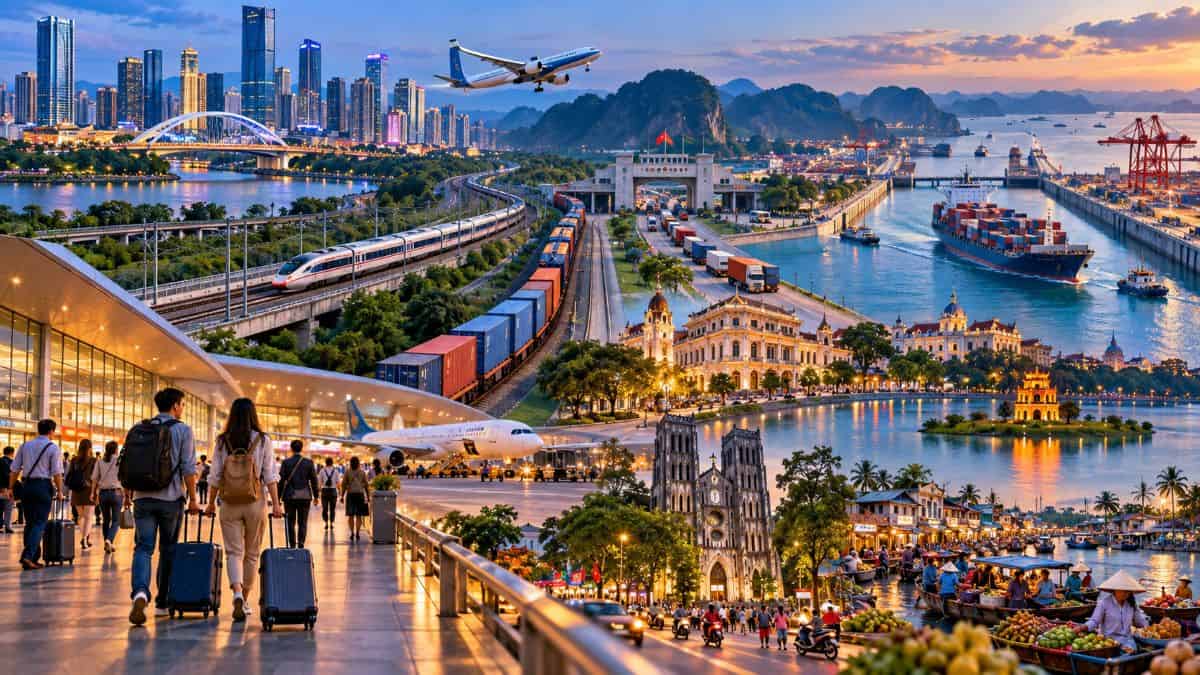
China and Vietnam are rapidly strengthening transport connectivity across rail, aviation and maritime networks. The shift could reshape cross-border tourism, business travel and regional logistics as both economies seek greater resilience amid US trade pressure. Vietnam recorded nearly 21.2 million international arrivals in 2025, with China supplying 5.3 million visitors. Meanwhile, passenger capacity between the two countries is reaching a record level in 2026. Three planned standard-gauge railway corridors could further integrate southern China with northern Vietnam. The newly opened 134.2-kilometre Pinglu Canal has also launched a direct Nanning–Can Tho cargo route. Together, these projects are turning a border relationship into a broader regional mobility corridor.
Why China and Vietnam Are Rewiring Regional Mobility
The latest infrastructure push goes beyond conventional trade. China and Vietnam transport links are increasingly connecting manufacturing centres, ports, airports and tourism destinations across a single regional network.
Advertisement
Advertisement
The development comes as both countries face greater uncertainty in international trade. US tariff measures have increased the importance of diversified supply chains and alternative commercial corridors.
For Vietnam, the opportunity is particularly significant. The country sits between China’s manufacturing base and major Southeast Asian markets. Its northern provinces also provide a natural bridge between southern China and Vietnam’s ports.
Advertisement
Advertisement
Vietnam welcomed nearly 21.2 million international visitors in 2025. That represented a 20.4 per cent annual increase and exceeded the country’s pre-pandemic 2019 performance. China was the largest source market, contributing about 5.3 million arrivals.
The tourism relationship therefore gives transport investment a second dimension. Better connectivity can move factory components and finished goods, but it can also move tourists, business travellers and conference delegates.
Advertisement
Advertisement
Jack Nguyen, Vietnam CEO of business services platform Ascentium, described the shift on October 5, 2026 as a move towards a more integrated manufacturing, logistics, tourism and supply-chain corridor.
“As US tariffs and non-tariff barriers create more uncertainty, Vietnam and China have strong incentives to deepen their transport, supply chain and trade links and diversify their markets,” Nguyen said.
That logic is already visible in aviation, rail planning and maritime infrastructure.
Rail Projects Could Transform Border Travel
Rail represents the most consequential long-term change. Vietnam and China are advancing three standard-gauge railway corridors designed to improve international freight and passenger connectivity.
The three projects cover the Lao Cai–Hanoi–Hai Phong, Dong Dang–Hanoi and Mong Cai–Ha Long–Hai Phong corridors. Vietnam and China formalised cooperation on planning the latter two routes in March 2026.
The Lao Cai–Hanoi–Hai Phong project has moved further towards implementation. Vietnam’s government has targeted completion by 2030, while construction activity and preparatory work are already progressing.
Advertisement
Advertisement
The project is designed to connect the Chinese border at Lao Cai with Hanoi and the major maritime gateway of Hai Phong. Its main route will extend for roughly 390.9 kilometres, with branch lines adding further connectivity.
Vietnam’s National Assembly approved an investment framework exceeding VND203.2 trillion. That equates to roughly US$8.4 billion under the government-cited conversion.
The project’s significance for travellers will emerge gradually. It does not mean tourists can immediately board a new high-capacity international train between China’s southern cities and Hai Phong.
Instead, the immediate value lies in infrastructure integration. Standard-gauge compatibility can eventually reduce the technical barriers that have limited cross-border railway operations.
Vietnam’s Ministry of Construction says the two additional railway corridors are being studied through 2040 and 2050 planning horizons. The Dong Dang–Hanoi corridor alone could handle millions of tonnes of freight and additional passenger services.
| Railway Corridor | Main Vietnamese Cities | Strategic Role | Current Direction |
|---|---|---|---|
| Lao Cai–Hanoi–Hai Phong | Lao Cai, Hanoi, Hai Phong | Border trade, manufacturing and port access | Major project targeted for completion by 2030 |
| Dong Dang–Hanoi | Lang Son, Hanoi | China border, passenger and freight connectivity | Standard-gauge planning underway |
| Mong Cai–Ha Long–Hai Phong | Mong Cai, Ha Long, Hai Phong | Tourism, coastal trade and border mobility | Technical planning cooperation underway |
For travellers, the most important future benefit could be greater choice. Air services will remain dominant for long-distance journeys, while rail could become more attractive for shorter cross-border itineraries.
Advertisement
Advertisement
Aviation Is Already Bringing Markets Closer
Unlike the railway projects, aviation connectivity is producing immediate benefits.
OAG data cited in the latest industry assessment shows 8.6 million passenger seats available between China and Vietnam in 2026. That compares with 7.7 million seats in 2025.
The increase reflects stronger airline participation and growing tourism demand. Vietnamese and Chinese carriers are adding capacity between major cities and increasingly connecting secondary destinations.
Vietjet announced five new China routes in 2026. The network includes Hanoi–Hangzhou, Hanoi–Enshi, Hanoi–Huangshan, Ho Chi Minh City–Guilin and Ho Chi Minh City–Huangshan.
Vietravel Airlines also launched a direct Ho Chi Minh City–Shenzhen service in August. That route strengthens access to one of southern China’s major technology and manufacturing centres.
Vietnam Airlines continues to market direct services between Vietnam and major Chinese gateways. Its current network includes links involving Beijing, Shanghai, Guangzhou and several Vietnamese destinations.
Advertisement
Advertisement
| Indicator | 2025 | 2026 | Travel Significance |
|---|---|---|---|
| China-Vietnam air capacity | 7.7 million seats | 8.6 million seats | Greater flight choice |
| Chinese visitors to Vietnam | About 5.3 million | Strong demand continues | Major tourism source market |
| Vietnam international arrivals | Nearly 21.2 million | 2026 target 25 million | Expanding inbound market |
| New Vietjet China routes | — | 5 announced | Wider secondary-city access |
The aviation expansion matters beyond leisure travel. More direct flights make short business trips more viable and support meetings, exhibitions, conferences and investment activity.
For tourism operators, the development also opens opportunities beyond Hanoi and Ho Chi Minh City. Chinese travellers can increasingly reach destinations such as Guilin-linked markets, Hangzhou, Huangshan and Shenzhen without relying solely on traditional gateway combinations.
Pinglu Canal Opens A New Maritime Shortcut
The newest development has come by water.
China opened the 134.2-kilometre Pinglu Canal in September 2026. The canal connects Nanning in Guangxi with the Beibu Gulf and creates a new river-to-sea route towards international markets.
The project cost about 72.7 billion yuan, or approximately US$10.75 billion. It is designed to accommodate vessels of up to 5,000 tonnes and shorten the inland journey to the sea by roughly 560 kilometres.
Its relevance to Vietnam is immediate.
Advertisement
Advertisement
A new Nanning–Can Tho cargo route began operating after the canal opened. The first vessel reached Can Tho in September, creating a direct maritime connection between southwest China and Vietnam’s Mekong Delta.
The route could be particularly useful for agricultural and seafood exports from southern Vietnam. It can also facilitate machinery, industrial components and other manufactured goods moving south from China.
This is where the transport story becomes genuinely multimodal. Cargo can move through rail networks into Nanning, continue by water through the Pinglu Canal and then enter Vietnam by sea.
That model could eventually make the corridor more competitive for companies seeking alternatives to longer conventional maritime routes.
For tourism, the canal has a more indirect role. Its immediate function is commercial rather than passenger transport. Yet the infrastructure could stimulate port investment, logistics development and new business activity around Nanning, Qinzhou and Can Tho.
Trade Pressure Is Changing Transport Priorities
The infrastructure push cannot be separated from the changing global trade environment.
Advertisement
Advertisement
The United States has imposed significant tariff measures since 2025. Washington’s framework with Vietnam maintained a 20 per cent reciprocal tariff on originating Vietnamese goods, while goods determined to have been transshipped to evade duties can face an additional 40 per cent rate under US rules.
That creates an incentive for manufacturers to scrutinise supply chains more closely. It also increases the importance of genuine production, documentation and origin compliance.
Vietnam has emerged as a major manufacturing centre for electronics, machinery, textiles and other export industries. China remains a critical supplier of components, equipment and raw materials.
Consequently, improved transport does not simply increase bilateral trade. It can reduce friction within production networks.
For the travel industry, the same network effect can increase demand for corporate travel. More factories, logistics facilities and investment projects typically create more movement among executives, engineers, consultants and service providers.
Tourism Could Become More Regional
The tourism implications deserve equal attention.
Advertisement
Advertisement
Vietnam’s government recorded 5.3 million Chinese visitors in 2025. China accounted for roughly one quarter of Vietnam’s total international arrivals.
Vietnam has also set a target of approximately 25 million international visitors for 2026. The government has identified stronger connectivity, tourism promotion and visa facilitation as important growth drivers.
The opportunity is therefore not simply about increasing Chinese arrivals.
Improved connectivity could encourage multi-destination Asian itineraries. Travellers may combine southern China with northern Vietnam, or extend business trips into leisure journeys.
Northern Vietnam stands to benefit particularly. Lao Cai, Sa Pa, Hanoi, Ha Long Bay and Hai Phong sit along corridors that could gain from stronger cross-border transport.
Meanwhile, Guangxi has a natural tourism relationship with Vietnam because of its proximity and cultural links. Nanning and coastal Guangxi could become more important gateways for travellers exploring southern China and northern Vietnam together.
Advertisement
Advertisement
What Travellers Should Expect Now
Travellers should distinguish between infrastructure under development and services already operating.
The planned railways will take several years to complete. Existing border rail services and road crossings remain subject to current infrastructure, immigration procedures and operating arrangements.
Air travel is currently the most practical option for travellers seeking frequent city-to-city connectivity. The growing number of direct routes also makes secondary Chinese destinations more accessible from Vietnam.
The new Pinglu Canal is primarily a cargo development rather than a conventional tourist transport route. However, the canal has also generated sightseeing activity in Guangxi, creating a new attraction around China’s expanding waterway infrastructure.
Travellers should check airline schedules, entry requirements and border regulations before booking. Transport capacity can expand faster than immigration arrangements or local tourism infrastructure.
For Chinese visitors to Vietnam, official visa rules should also be checked before departure. Vietnam’s e-visa system covers citizens of numerous countries, including China under specified passport conditions.
Advertisement
Advertisement
For Vietnamese citizens travelling to China, policy has also evolved. Since August 20, 2026, Vietnam citizens have been eligible for China’s 240-hour transit visa exemption under specified conditions, as well as a 30-day visa-free entry policy for Hainan.
The Corridor Could Redefine Regional Travel
The deeper significance of these projects lies in their combined effect.
Aviation delivers speed. Rail can deliver predictable cross-border movement. Maritime infrastructure provides scale for cargo. Together, they create a more diversified transport ecosystem between two of Asia’s most important manufacturing economies.
For tourism, that ecosystem can support more direct routes and broader destination combinations. For business travel, it can reduce the friction surrounding cross-border meetings and industrial investment.
For logistics, the implications are even greater. The Nanning–Can Tho route demonstrates how China’s inland transport system can connect directly with Vietnam’s production and agricultural economy.
The strategy also fits a wider regional trend. Across Southeast Asia, governments are investing in railways, airports, ports and integrated logistics corridors to reduce dependence on individual transport routes.
Advertisement
Advertisement
China and Vietnam are therefore not simply improving a border crossing. They are building the infrastructure for a more interconnected China–ASEAN travel and trade system.
The result will not appear overnight. Railway construction, border procedures and passenger services will take years to mature. Yet the direction is already clear: transport connectivity is becoming a central pillar of the China-Vietnam relationship.
For travellers, that should eventually mean more routes, more destinations and greater itinerary flexibility. For tourism businesses, it could mean access to a much larger cross-border market. And for the wider region, these projects signal that Southeast Asia’s next tourism corridors may be built around integrated transport rather than individual destinations.
FAQs
1. What are China-Vietnam transport links improving?
Railways, flights, freight services and maritime connections are expanding between the two countries.
2. How will the new railways benefit travellers?
New standard-gauge routes could improve cross-border passenger travel and make northern Vietnam more accessible.
3. How many China-Vietnam flight seats are available in 2026?
Around 8.6 million passenger seats are available between China and Vietnam this year.
Advertisement
Advertisement
4. How important are Chinese tourists to Vietnam?
China was Vietnam’s largest tourism source market in 2025, contributing about 5.3 million visitors.
5. What is the Pinglu Canal?
The 134.2-kilometre Pinglu Canal connects Nanning with the Beibu Gulf, creating a faster maritime route.
6. Will these developments boost tourism?
Yes. Better air, rail and maritime connectivity could encourage more cross-border and multi-destination travel.
Advertisement
