
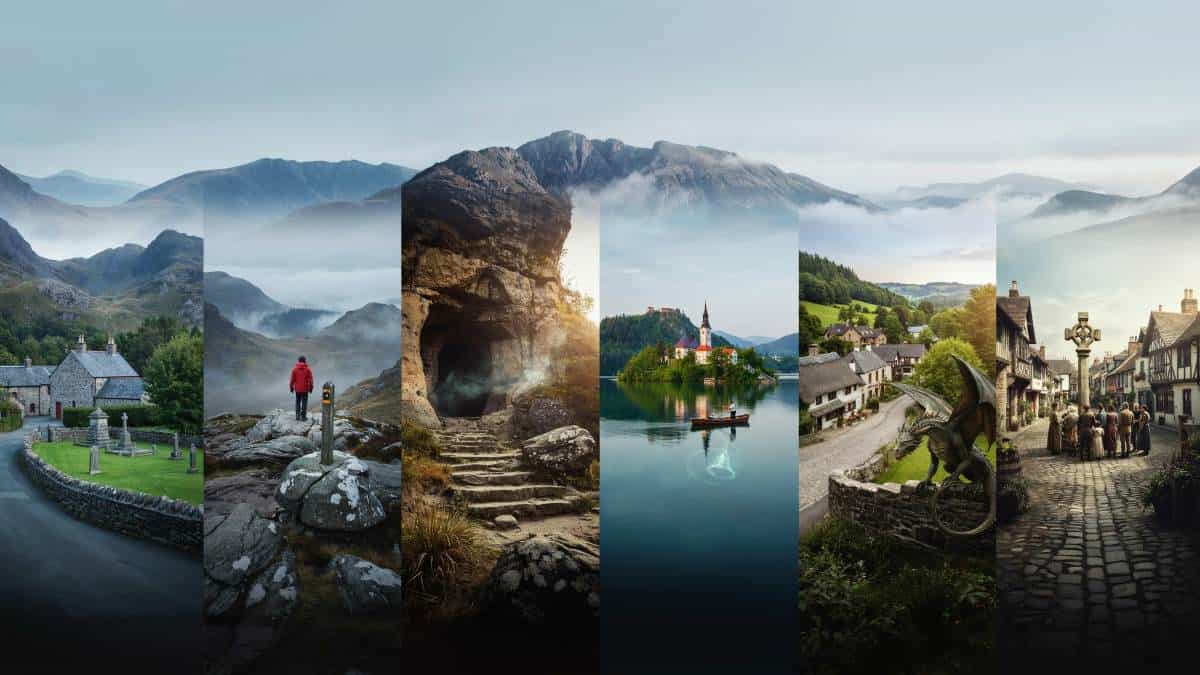
Image generated with Ai
Spain and Wales are showing off the unknown side of Europe, which many travelers don’t know. In addition to popular cities and tourist attractions, mysterious stories are waiting to be discovered in small villages, harsh mountains, and caves. Caves of witches, dragons, and forgotten history add another dimension to adventurous travelers’ journeys around Europe. The Spanish Zugarramurdi is the place where caves have something to do with the old tales about witchcraft and the actual Inquisition process. Eryri in Wales is rich in legends about dragons, giants, magical lakes and mythological kingdoms. Beddgelert keeps the tragic story of Gelert, the loyal dog that belonged to Llywelyn the Great. The very name of this village translates as “Grave of Gelert”. However, there is much more about these locations than amazing stories. They show the power of forgotten history, folklore, and landscape, which can make modern trips interesting and impressive. There are dragons in the legends of Wales and caves of witches in the folklore of Spain, which are connected with the historical events. Travel And Tour World encourages curious travelers to read the full story.
Europe hides more than grand capitals, famous castles and crowded tourist streets. Across its quieter corners, lesser-known destinations with quirky legends in Europe preserve stories of dragons, witches, drowned kingdoms, tragic dogs and even a bell lost beneath a lake. These places may look peaceful today. Their legends are anything but peaceful. From Beddgelert in Wales to Zugarramurdi in Spain, local stories still shape how people understand the land. Some tales come from old folklore. Others grew around real historical events. A few remain impossible to prove. That is exactly what makes these lesser-known destinations with quirky legends in Europe so fascinating. Travel beyond the usual European hotspots. Look closer at these hidden villages and landscapes. You may find that the strangest stories are waiting far away from the biggest tourist crowds.
Advertisement
| 2026 Tourism Indicator | Latest 2026 Figure | What It Means for the Article |
|---|---|---|
| International tourists visiting Europe, Q1 2026 | 130+ million | Shows the enormous scale of Europe’s tourism market |
| Europe international arrivals, Q1 2026 | +4% YoY | European travel demand remained strong at the start of 2026 |
| Europe international arrivals, Q2 2026 YTD | +5.0% YoY | Growth continued despite geopolitical and economic uncertainty |
| European overnight stays, Q2 2026 YTD | +4.8% YoY | Travellers continued to spend nights across European destinations |
| European destinations reporting growth | Almost 80% | Tourism growth was widespread rather than limited to a few countries |
| Destinations achieving double-digit arrival growth | Around 20% | Several markets recorded particularly strong expansion |
| Northern Europe arrivals | +10.0% | Northern Europe was the strongest-performing European subregion |
| Northern Europe overnight stays | +8.4% | Overnight demand also grew strongly |
| Central & Eastern Europe arrivals | +5.2% | Travellers continued seeking new experiences and better value |
| Central & Eastern Europe overnight stays | +6.9% | Stay demand increased faster than arrivals |
| Leisure travel spending in key European source markets | 13.0% of consumer spending | Travel remained a major consumer priority |
| Global leisure-spending benchmark | 8.5% | European consumers allocate substantially more to leisure travel |
Beddgelert sits inside the spectacular Eryri landscape in Wales. The village carries one of Europe’s most famous sad legends. According to local folklore, Prince Llywelyn the Great returned from hunting and found his baby’s cradle overturned. His loyal dog, Gelert, stood nearby with blood on his body. Llywelyn believed the dog had killed his child. He killed Gelert in anger. Then came the terrible truth. The baby was alive. A dead wolf lay nearby. Gelert had fought the animal and saved the child. The village name means “Gelert’s Grave”. This story makes Beddgelert one of the most memorable lesser-known destinations with quirky legends in Europe, even though the tale is folklore rather than proven history.
There is an even stranger layer to the Beddgelert story. Official Welsh heritage records connect the famous grave memorial with the early nineteenth century. The memorial appeared in 1802. That date matters. The story became part of the village’s identity and helped attract visitors. So, while the emotional tale of Gelert remains deeply rooted in local tradition, its famous tourist presentation has a more recent history. That makes Beddgelert especially useful for travellers who want quirky travel destinations with a twist. You are not simply visiting a pretty Welsh village. You are stepping into a story shaped by folklore, tourism and changing ideas about heritage. The question is simple: did the dog really die there? The evidence does not give travellers a simple yes.
Advertisement
Advertisement
Deep in Navarra lies Zugarramurdi, a small destination with an extraordinary reputation. Its caves became connected with stories of witches, magical gatherings and mysterious night-time meetings. Yet this is not simply a spooky tale invented for modern tourists. Navarra’s government records the area’s connection with historic witchcraft investigations and the notorious 1610 Logroño trial. People in the region faced accusations of witchcraft. The stories became tied to the caves and local traditions surrounding alleged gatherings. That combination makes Zugarramurdi one of the most compelling lesser-known destinations with quirky legends in Europe. Visitors can see the landscape behind the stories and understand how fear, folklore, and real persecution became tangled together.
The most powerful part of Zugarramurdi is the line between legend and history. Stories of witches can sound like fantasy. The historical investigations were very real. The Government of Navarra includes Zugarramurdi within its official route connected with the region’s witchcraft heritage. The destination therefore offers something different from a normal folklore attraction. You can explore the landscape while remembering that people once faced serious accusations because of beliefs about witchcraft. That makes European legends here more than entertainment. They reveal how communities once understood fear and supernatural forces. For travellers searching for hidden European destinations, Zugarramurdi offers a rare combination. It has caves, mountain scenery, folklore and documented history. Few destinations can produce such a strange mixture without needing to invent a dramatic backstory.
Lake Bled is better known than some destinations on this list. Yet its strangest story deserves far more attention. According to Slovenian government material, a grieving widow wanted a bell made in memory of her murdered husband. During its journey to Bled Island, a terrible storm struck. The boat sank. The bell disappeared beneath the water. But the story did not disappear. Legend says that the lost bell can still be heard from the depths on peaceful nights. Imagine standing beside a calm Slovenian lake and wondering whether a bell could really sound from underwater. That haunting image gives Lake Bled a special place among lesser-known destinations with quirky legends in Europe, especially for travellers who enjoy mysterious places rather than standard sightseeing.
The landscape around Bled looks almost too peaceful for such a dark tale. The lake surrounds an island, while the surrounding hills create a dramatic setting. The legend of the sunken bell adds another layer to that scenery. This is what makes folklore powerful. A normal landscape can suddenly feel different once you know its story. The Slovenian government has preserved the tale in official cultural and promotional material. That does not prove that the bell rings beneath the lake. It shows that the story has become part of Bled’s cultural identity. For people searching for quirky travel destinations, that distinction matters. The attraction is not proving a supernatural event. The attraction is understanding how the legend became part of the place.
Advertisement
Advertisement
Mordiford in Herefordshire offers perhaps the strangest story on this list. The quiet English village is associated with a legend about a little girl who befriended a dragon. Yes. A dragon. The story has survived as part of local heritage. The village’s official parish information records the dragon legend and its place in the community’s history. Mordiford does not have the global fame of London, York or Edinburgh. That makes its story even more intriguing. Travellers looking for lesser-known destinations with quirky legends in Europe may find exactly what they want here. The tale is unusual, easy to remember and completely different from the darker witch stories elsewhere. It also proves that European folklore does not always need castles and kings. Sometimes, all it needs is a child and a dragon.
Many European dragon legends involve brave knights, battles, and heroic kings. Mordiford offers something much stranger. A child and a dragon. The contrast gives the story its charm. It transforms an ordinary village into a place with a remarkable piece of folklore. The official local record treats the dragon story as a legend. It does not present the creature as proven historical fact. That distinction should remain clear. Still, legends can influence how people see places. They give villages stories that visitors remember long after they leave. For anyone collecting European legends, Mordiford deserves attention because it breaks the usual pattern. There is no need for a famous medieval capital. The dragon has already done the publicity work.
Some lesser-known destinations with quirky legends in Europe hide their stories in remote landscapes. Bwlch y Saethau is one of them. The name means “Pass of the Arrows”. According to Eryri National Park’s official account, local legend connects the area with King Arthur. The story says Arthur was struck by an arrow during battle. He was then taken towards the shore of Llyn Llydaw. Three mysterious maidens carried him away. Their destination was Afallon, or Avalon. That gives one remote Welsh mountain pass a connection with one of Europe’s most enduring legendary figures. There is no need for a giant monument. The landscape itself carries the story. For fans of Arthurian folklore, this is a far more unusual destination than the standard medieval attractions.
The Arthurian connection makes Bwlch y Saethau particularly compelling. The legend does not simply place Arthur in the landscape. It gives the mountain pass a role in his final journey. Three maidens appear. Arthur is wounded. Then he disappears towards Avalon. That mystery has survived through generations. The official Eryri National Park material presents this as mythology and folklore, not established history. That careful distinction actually makes the destination more interesting. Visitors can walk through a real landscape while learning about an old story attached to it. This is the appeal of hidden European destinations. They can turn a simple walk into a journey through folklore. The mountains remain real. The story remains legendary. Together, they create an unforgettable travel experience.
Now for one of the most wonderfully bizarre stories. Penkridge in Staffordshire has a local legend claiming that King Edgar made the settlement the capital of England for three days while fighting the Danes. Three days. That tiny detail makes the story impossible to forget. South Staffordshire District Council records the claim while making clear that its historical accuracy is uncertain. That is exactly how responsible travel writing should handle folklore. Penkridge therefore joins the list of lesser-known destinations with quirky legends in Europe not because historians have confirmed its three-day capital status, but because the story has become part of its local identity. It is a brilliant reminder that European history is not always presented in neat textbook chapters. Sometimes, the strangest footnotes survive in small communities.
Imagine being told that your town was once the capital of England. Then imagine being told it lasted only three days. That is the quirky appeal of Penkridge’s legend. The official council material does not claim the event as proven fact. Instead, it records the story as local legend. That distinction protects the article from turning folklore into fake history. For travellers, however, the mystery remains entertaining. Why did the story survive? Did it grow from an old historical memory? Did later generations reshape it? We cannot answer those questions with certainty. But that uncertainty is precisely what gives quirky travel destinations their power. They invite questions rather than handing visitors a finished answer.
Eryri National Park deserves its own place because its folklore extends far beyond one famous story. Official park material connects the landscape with legends involving giants, fairies, dragons, witches and mythical creatures. The mountains and lakes carry stories that have developed over generations. This makes Eryri an unusually rich destination for anyone fascinated by European legends. The landscape itself is dramatic. Then the stories add another dimension. A lake is no longer simply a lake. A mountain is no longer simply a mountain. Each can become part of a tale involving supernatural beings, ancient heroes, or lost worlds. That is why Eryri stands out among lesser-known destinations with quirky legends in Europe. Its folklore is not attached to one isolated attraction. It spreads across the landscape.
One of the most fascinating Welsh legends concerns Cantre’r Gwaelod, the legendary drowned kingdom. The story describes a lost land associated with the waters of Cardigan Bay. Its legend has become part of the wider mythology surrounding the Welsh landscape.
Stories of drowned lands have appeared in many cultures. Yet in Wales, the tale has remained strongly connected with the country’s identity and storytelling traditions. For travellers, the attraction is obvious. Look across the water and imagine a lost kingdom beneath it. There is no confirmed underwater empire waiting for tourists. The legend belongs to folklore. Still, the idea gives the landscape an extraordinary sense of mystery. It also strengthens Eryri’s reputation among hidden European destinations where natural scenery and old stories constantly overlap.
Travel does not always have to mean chasing the biggest attraction. Sometimes the better story waits in a small village. Beddgelert gives visitors a tragic tale about loyalty. Zugarramurdi exposes the frightening collision between witch folklore and real historical persecution. Bled offers a mysterious bell beneath the water. Then comes Mordiford, where a little girl and a dragon dominate local legend. Penkridge offers a three-day capital story. Bwlch y Saethau connects a remote mountain pass with King Arthur and Avalon. These are precisely the kinds of lesser-known destinations with quirky legends in Europe that can make travel feel personal. You are not simply ticking off landmarks. You are discovering stories.
| Rank | Country | 2026 Arrival Growth | Article Connection |
|---|---|---|---|
| 1 | Greece | +38.3% | Strong Mediterranean demand and growing interest in alternative experiences |
| 2 | Italy | +21.1% | Major European tourism leader with strong 2026 growth |
| 3 | Malta | +16.0% | Strong island tourism and Mediterranean appeal |
| 4 | Portugal | Growing | Part of the strong Southern European performance |
| 5 | Spain | Growing | One of Europe’s major tourism markets and a key comparison for Spain’s lesser-known destinations |
| 6 | United Kingdom / Wales | No comparable 2026 figure in the cited ETC release | Relevant because Beddgelert, Mordiford and Eryri are featured in the article |
| 7 | Slovenia | No comparable 2026 figure in the cited ETC release | Relevant because of Lake Bled and its sunken-bell legend |
There is one rule travellers should remember. A legend is not automatically a historical fact. The official sources behind these destinations often make that distinction clear. That is important because folklore becomes less interesting, not more interesting, when it is falsely presented as proven history. The real value comes from understanding both sides. A story may be centuries old. Its modern tourist presentation may be much newer. A supernatural tale may sit beside a documented historical event. That tension makes European legends fascinating. It also makes these destinations ideal for curious travellers who want more than photographs. The best quirky travel destinations leave you with a question. Was the story true? Or did generations of storytellers simply make the landscape more magical?
These destinations reveal a different Europe. Forget crowded city squares for a moment. Think instead about a quiet Welsh village, a Spanish cave, a Slovenian lake or an English country settlement. Each place carries a story. Each story changes the way the landscape feels. That is the real appeal of lesser-known destinations with quirky legends in Europe. You can visit Beddgelert and remember Gelert. You can stand near Bled and wonder about the sunken bell. You can explore Zugarramurdi while thinking about the people caught in historic witchcraft accusations. The experience becomes richer because the destination has something to say. And sometimes, the strangest stories are the ones that stay with you longest.
The next great European travel story may not begin in Paris, Rome, or Barcelona. It may begin in Mordiford. It may begin beside a quiet lake in Bled. It may begin in the caves of Zugarramurdi. It may begin on a remote Welsh mountain pass where Arthur supposedly started his final journey towards Avalon. That is why lesser-known destinations with quirky legends in Europe deserve a place on modern travel lists. They offer mystery without requiring fantasy to be presented as fact. They offer history alongside folklore. Most importantly, they give travellers a reason to look closer. So, when planning your next European escape, do not only ask, “What is famous here?”
The examples of Spain and Wales demonstrate that Europe’s most vivid travel experiences do not necessarily originate in the continent’s best-known capital cities. It is in places such as witch caves, dragons, tragic legends, and history forgotten where Europe can reveal its strongest identity. In the Spanish village of Zugarramurdi, local folklore concerning witches merged directly with the actual inquisition procedure of 1610. In Wales, the country also boasts fascinating folklore. The region of Eryri preserves stories of Gelert, ancient giants, witches and the lost kingdom of Cantre’r Gwaelod. Such stories bring an added layer that cannot be found in mere tourist attractions. These tales are what allow tourists to stop, think and wonder. Therefore, one should not limit his/her European experience to the most obvious places. One should explore the villages, caves, and mountains where strange and wonderful stories can be found. According to Travel And Tour World, eager travelers should read the whole story to uncover more fascinating folklore of Europe.
Advertisement
Tags: Avalon legend Wales, Beddgelert legend, Beddgelert Wales, Bwlch y Saethau, dark tourism Europe
Advertisement
Advertisement













Thursday, September 3, 2026

Thursday, September 3, 2026

Thursday, September 3, 2026

Thursday, September 3, 2026

Thursday, September 3, 2026

Wednesday, September 2, 2026

Thursday, September 3, 2026

Thursday, September 3, 2026


