
Norway Reshapes Svalbard Travel Between Longyearbyen and Russia-Operated Barentsburg as Thawing Routes, Marine Restrictions and New Insurance Rules Challenge Travellers

Published
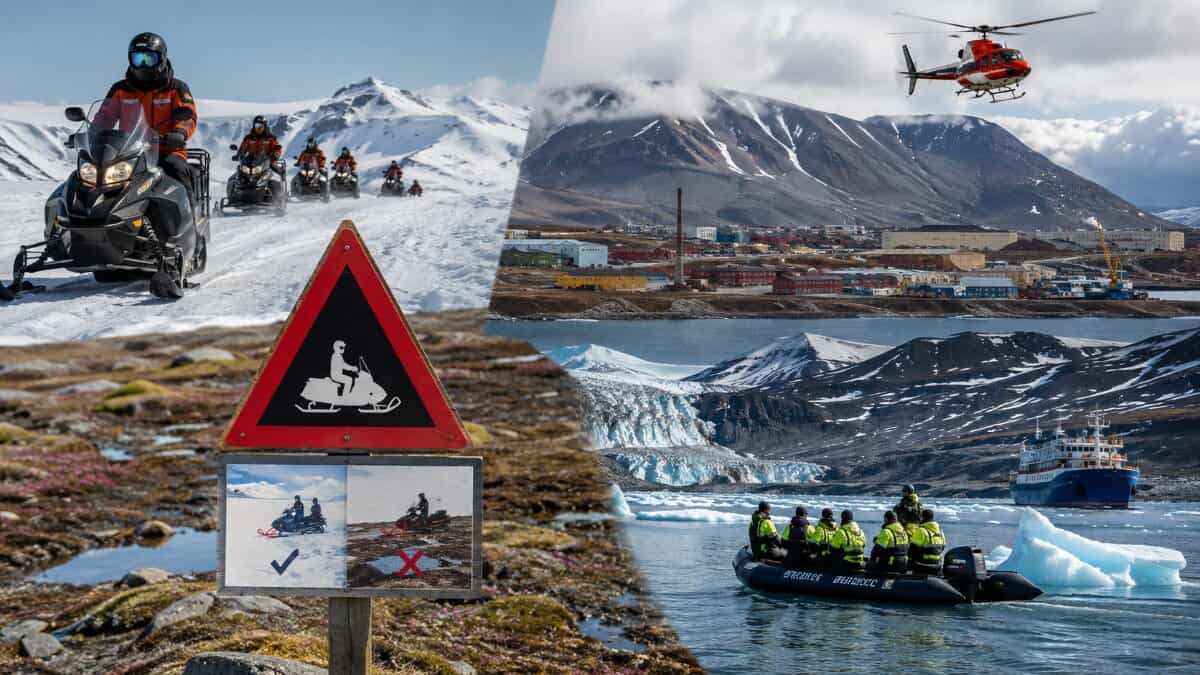
Image generated with Ai
Svalbard’s bare-ground snowmobile prohibition is exposing a wider risk for Arctic travel packages. When snow disappears, operators cannot simply move vehicles across tundra or substitute a boat without considering separate permits, landing restrictions, passenger limits, insurance obligations and route safety. The issue directly affects journeys originating in Longyearbyen and reaching Russian-operated Barentsburg, Pyramiden, Isfjord Radio and other roadless locations. Norway’s new field-safety framework makes poorly documented last-minute changes increasingly difficult for operators and potentially disruptive for travellers.
Svalbard’s bare-ground warning reveals a larger travel-industry problem
According to the Governor of Svalbard, reports were received in April 2026 of snowmobiles travelling across bare ground in Adventdalen, immediately outside Longyearbyen. Mild weather and rain had exposed increasingly large areas, despite temperatures later returning below freezing.
The legal threshold is important. Terrain must be both frozen and covered by snow before belt-driven vehicles can operate away from established roads. Frozen gravel, exposed vegetation or partly thawed tundra does not become legally usable merely because air temperatures fall again.
The Governor also indicated that inspections could be conducted in the affected area. The latest official travel and motor-traffic guidance available on 4 August 2026 continues to apply the underlying prohibition, rather than presenting the April warning as a temporary restriction. For travellers, the immediate consequence is a possible shortened excursion, changed destination or cancellation. For the travel trade, however, the deeper concern lies in the absence of a straightforward replacement mode.
Advertisement
Advertisement
Longyearbyen and Barentsburg expose Svalbard’s transport-substitution trap
Svalbard has no inter-settlement road network. Official destination information records only around 40 kilometres of roads and confirms that travellers cannot drive between Longyearbyen, Barentsburg, Pyramiden, Ny-Ålesund or Isfjord Radio. Movement between these locations normally depends on snowmobiles during winter and boats during summer.
Advertisement
Advertisement
That creates a vulnerable transition period. Once a snow-covered corridor breaks, an operator cannot take a snowmobile around the exposed section across tundra. A boat may not yet be a practical or commercially equivalent replacement because of sea conditions, ice, landing access, vessel availability, passenger capacity and the different duration of the journey.
Barentsburg sharpens this issue. The Norwegian Polar Institute classifies Barentsburg as Norwegian territory under Norwegian authority, while identifying it as a mining town operated by the Russian state-owned company Trust Arktikugol. Norway’s motor-traffic, environmental and field-safety requirements therefore govern organised journeys reaching the settlement, regardless of its Russian commercial and cultural character. Longyearbyen and Barentsburg are settlements rather than conventional cities. They nevertheless function as two of Svalbard’s most important centres for tourism operations, accommodation, guiding and expedition logistics.
Why switching from snowmobile to boat is not a simple solution
Norway tightened Svalbard’s environmental regulations from 1 January 2025. Tourist landings in specified protected areas are now limited to 43 mapped sites. Ships operating in protected areas may carry no more than 200 passengers, while additional rules cover vessel speed near bird cliffs, walrus haul-out sites and shorelines. Icebreaking through fast ice is also prohibited.
Consequently, replacing a snowmobile excursion with a marine programme may alter much more than the vehicle. It can change the departure point, operating area, landing site, passenger-to-guide ratio, required equipment, wildlife controls, rescue exposure and total operating time.
| Operational layer | Official requirement | Consequence for a changed itinerary |
|---|---|---|
| Exposed terrain | Off-road motor travel over ground that is not snow-covered or is thawed is prohibited | Snowmobiles cannot bypass broken snow corridors across tundra |
| Snow-covered terrain | Visitor access is restricted to mapped areas and qualifying organised arrangements | A route cannot be moved freely to any location where snow remains |
| Marine substitution | Boat operations must follow wildlife distances, speed controls and icebreaking restrictions | A vessel cannot always reproduce the original route or timing |
| Protected-area landings | Tourist disembarkation is limited to mapped authorised sites | The intended attraction may become inaccessible from the water |
| Vessel size | Ships in national parks are limited to 200 passengers | Large-group substitution may require splitting or complete redesign |
| Aircraft alternative | Aircraft use for tourism purposes is generally prohibited and exemptions are restrictive | Helicopter or aeroplane transfers are not routine fallback products |
| Inter-settlement roads | No road connects Longyearbyen with Barentsburg, Pyramiden or Ny-Ålesund | Coaches and four-wheel-drive vehicles cannot replace either mode |
The combined framework means that route substitution must be treated as a new operational assessment, not a simple transport swap.
Advertisement
Advertisement
Norway’s 2026 field-safety rules raise the commercial stakes
A new Field Operation Safety Regulation entered into force on 1 January 2026. According to the Governor’s application and registration guidance, tourism and field operators require permission for activities throughout Svalbard. Applications must normally be submitted at least eight weeks before operations begin. Operators must maintain appropriate safety arrangements, insure their activities throughout the archipelago and report to the Governor within four weeks after the end of the season. The framework also introduces internal-control requirements covering tourism and field activities.
Required search, rescue and medical-transport coverage depends on the insurance zone.
| Insurance zone | Required coverage per operation | Trade relevance |
|---|---|---|
| Zone A | NOK 120,000 | Lower-cost operating areas still require documented protection |
| Zone B | NOK 350,000 | More remote substitutions increase potential exposure |
| Zone C | NOK 650,000 | Deep-field or highly remote itineraries demand substantial coverage |
A permit under the field-safety framework does not remove the need to satisfy environmental legislation or separate motor-traffic restrictions. Therefore, a material rerouting decision should be checked against the permitted activity, operating plan, insurance certificate and environmental rules before being presented to guests as an equivalent replacement.
Approved Svalbard guides will become compulsory for relevant tourism and field activities outside inhabited areas from 1 July 2027. The Governor has created separate summer and winter guide levels, with winter approval also qualifying the holder for summer work. This distinction reinforces the operational difference between snow-based and marine or land-based products.
Climate conditions could make route failure more frequent
The April 2026 warning was triggered by mild weather and rain rather than a legislative change. However, official climate assessments indicate that the underlying problem is likely to become more persistent. Norway’s national climate reporting identifies earlier spring thaw and reduced fjord ice as factors that shorten the snowmobile-tourism season and restrict the areas available for such activities. The Government’s Svalbard white paper also records shorter fjord-ice seasons on the western coast and recognises that climate change has altered the possibilities for motorised travel.
Advertisement
Advertisement
The official Climate in Svalbard 2100 assessment found an observed annual warming of approximately 4°C between 1971 and 2017, with winter warming of about 7.3°C. The associated analysis concluded that Svalbard had effectively lost around two months of winter compared with conditions during the 1970s. These long-term findings do not predict the exact closing date of any individual route, but they demonstrate why fixed calendar-based snowmobile programmes carry increasing commercial risk.
Environmental sensitivity also grows as the ground thaws. Norway’s Svalbard white paper records that only around 10 per cent of the archipelago’s land is vegetated, polar vegetation has limited regenerative capacity and old off-road tracks can remain visible for decades. Increased precipitation and permafrost thaw make exposed terrain still more susceptible to damage.
Which destinations face the greatest itinerary exposure?
| Destination | Direct connection to the issue | Principal seasonal vulnerability |
|---|---|---|
| Longyearbyen | Main tourism gateway and departure base; bare ground was reported in the town’s surroundings | Local approach routes can fail before distant areas lose all snow |
| Adventdalen | Location specifically identified in the April 2026 warning | Exposed valley sections can interrupt access towards interior routes |
| Barentsburg | Russian-operated settlement reached from Longyearbyen without a road connection | Winter snowmobile and summer boat products cannot always substitute immediately |
| Pyramiden | Remote former Soviet settlement with organised seasonal access | Limited modal alternatives and long operating distances |
| Isfjord Radio | Remote accommodation and expedition destination outside the road network | Route viability depends on season, terrain and marine conditions |
| Ny-Ålesund | Research settlement with tightly managed visitor access | Summer visits rely principally on guided marine operations |
| Tromsø | Mainland aviation gateway for many Svalbard journeys | Expedition changes may affect connecting nights and onward flights |
| Oslo | Major national and international gateway feeding Longyearbyen | Longer disruption chains can reach mainland air and hotel bookings |
Statistics Norway recorded 2,512 residents in Longyearbyen and Ny-Ålesund at the beginning of 2026, while Barentsburg and Pyramiden together had 392 residents. The figures illustrate the limited permanent service base supporting a geographically extensive and internationally marketed Arctic tourism economy.
The overlooked commercial risk lies in package promises
The most important B2B implication is that operators should stop treating late-season snow as a predictable inventory component. A product sold around a named destination, such as Barentsburg or Pyramiden, carries greater fulfilment risk than a flexible experience sold around available Arctic conditions.
A destination-specific promise may trigger a more complex substitution discussion when the route closes. A shorter local excursion, boat journey or additional night in Longyearbyen may not match the original duration, inclusions, physical demands or traveller expectations. This is particularly relevant for wholesalers packaging flights through Tromsø or Oslo, fixed hotel nights, specialist clothing, snowmobile hire and remote accommodation into one price. A route failure can leave some components usable while making the central experience impossible.
Advertisement
Advertisement
The more resilient commercial model is a season-adaptive package with pre-contracted alternatives. Such a programme defines a snow route, a marine option and a local land-based experience before sale. It also explains that substitutions depend on legal access, not solely on operator preference. This analysis does not establish that every rerouting requires a fresh permit. It does establish that operators must verify whether the alternative remains within their approved activity, insurance scope, internal-control system and applicable environmental permissions.
Critical actions for travel agents and Svalbard operators
- Stop advertising late-spring snowmobile itineraries as unconditionally guaranteed by date.
- Request recent route-condition confirmation from the operating supplier before final payment.
- Establish a clearly defined snow, marine and local alternative for each affected departure.
- Confirm that substitutions fall within the operator’s permission, insurance and internal-control documentation.
- Avoid promising helicopters, off-road vehicles or unapproved landings as emergency alternatives.
- State whether a destination change, shortened duration or different transport mode qualifies for rebooking, credit or refund.
- Protect connecting flights through Tromsø and Oslo with realistic buffers where the Arctic activity is the principal reason for travel.
- Record the physical and equipment differences between snowmobile, boat, hiking and dog-sled alternatives.
- Check vessel capacity and authorised landing access before moving groups from land to sea.
- Monitor official Governor notices and the Svalbard interactive regulatory map rather than relying exclusively on historical operating dates.
Svalbard’s future travel market will depend on flexibility rather than fixed seasons
The bare-ground prohibition is not a new ban, but its significance has changed. Earlier thaw, weaker route continuity, stricter environmental controls and the 2026 field-safety regime are converging around the same commercial weakness: rigid itineraries designed around yesterday’s seasonal calendar.
Longyearbyen will significantly remain the principal logistics hub. Further Barentsburg, Pyramiden, Ny-Ålesund and Isfjord Radio will also remain powerful visitor draws. Yet the products connecting them will need more sophisticated contingency design, clearer contracts and closer coordination between snowmobile operators, vessel providers, guides, accommodation businesses and international distributors.
Svalbard’s competitive advantage lies in scarce, remote and highly regulated experiences. Protecting that advantage will require the trade to sell access responsibly, explain uncertainty before departure and build alternatives that are legally and operationally credible. The companies that adapt first will be better placed to protect travellers, Arctic terrain and the long-term value of Norway’s most distinctive expedition destination.
Advertisement
