
Slovenia, Belgium and Denmark Converge With 40 Nations as 2026 UEC European Road Championships Drive Cycling Tourism

Published
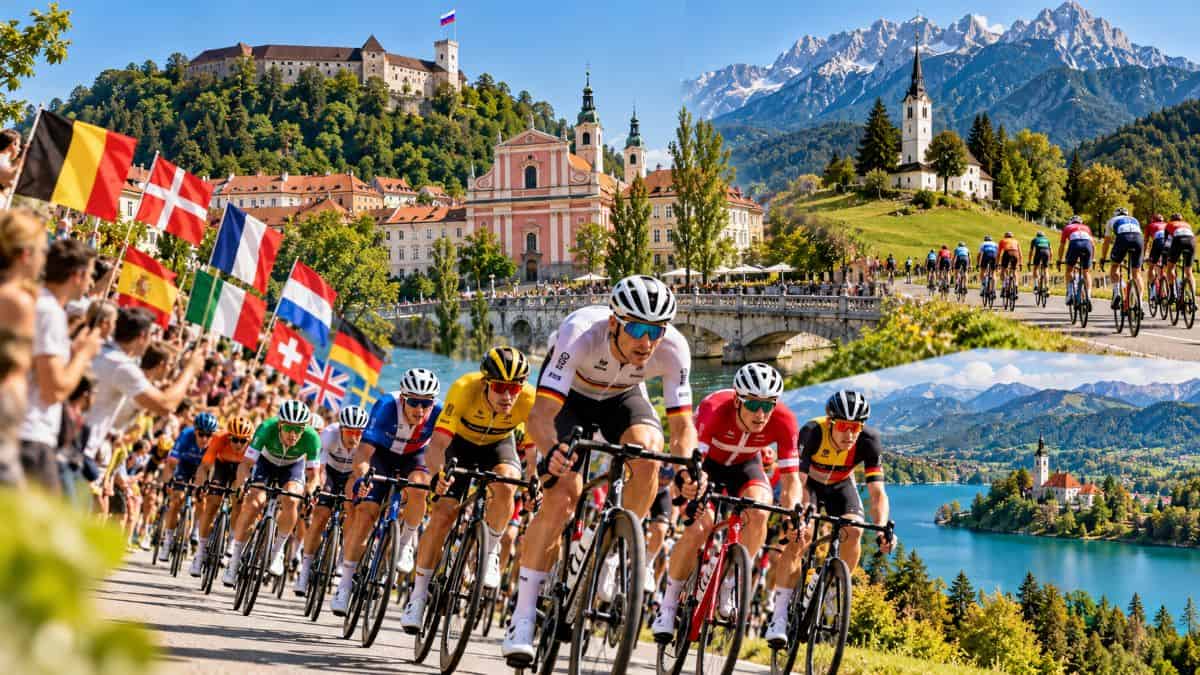
Image generated with Ai
Slovenia has become the centre of European road cycling as the 2026 UEC European Road Championships run from 2 to 7 October. More than 900 athletes from 43 countries are registered for five days of racing across junior, U23 and elite categories. The championship connects Ljubljana, Šenčur and 12 Slovenian municipalities, turning roads, towns and Alpine landscapes into an international sporting stage. Yet the tourism significance reaches beyond the race itself. Slovenia is using television exposure, destination advertising, GCN content and its new Pause and Feel Slovenia activation to convert cycling attention into travel inspiration. With 2025 delivering almost 7 million tourist arrivals and 17.84 million overnight stays, the event arrives as Slovenian tourism enters another strong growth phase.
Europe’s Cycling Elite Converges on Slovenia
The scale of the championship marks a significant moment for Slovenia’s sporting and tourism profile. The official championship organisation describes the event as the largest cycling event in the history of independent Slovenia, with more than 800 riders from over 45 countries expected across 14 races. The UEC separately confirms 900 registered athletes from 43 countries, reflecting the evolving entry picture as competition approaches.
The international field also gives the event a powerful travel-media dimension. Slovenia shares the start lists with cycling powers including Belgium, Denmark, France, Italy, the Netherlands, Spain, Switzerland, Germany, Great Britain, Poland and Sweden. High-profile riders include Remco Evenepoel, Mads Pedersen, Mathieu van der Poel, Tom Pidcock and Demi Vollering.
| Market | Prominent cycling connection | Tourism relevance |
|---|---|---|
| Slovenia | Primož Roglič, Tadej Pogačar and Matej Mohorič | Home-market cycling identity |
| Belgium | Remco Evenepoel | Major European cycling audience |
| Denmark | Mads Pedersen | Strong road-cycling following |
| France | Elite European cycling presence | Large regional travel market |
| Italy | Strong professional cycling culture | Major Slovenian tourism market |
| Netherlands | Demi Vollering and leading riders | Important cycling-oriented audience |
| Spain | Juan Ayuso and other elite riders | Growing Slovenian visitor market |
| Switzerland | Marc Hirschi and Swiss cycling interest | High-value Alpine travel audience |
| Germany | Lennard Kämna and major cycling market | Slovenia’s largest foreign tourism market |
| Great Britain | Ethan Hayter and British cycling audience | Established European travel market |
| Poland | Michał Kwiatkowski | Fast-growing Slovenian tourism market |
| Sweden | Jakob Söderqvist | Northern European cycling audience |
This international composition matters because the championship does not depend solely on Slovenian spectators. Instead, it creates a concentrated European communications platform around a destination already associated with cycling.
Advertisement
Advertisement
Twelve Municipalities Become One Cycling Stage
The championship route creates a geographical story that extends well beyond Ljubljana. The official course connects 12 municipalities, including Ljubljana, Medvode, Škofja Loka, Kranj, Vodice, Mengeš, Domžale, Kamnik, Komenda, Cerklje na Gorenjskem, Preddvor and Šenčur.
That distribution gives visitors several potential bases for exploring the event. It also spreads the tourism narrative across urban, historic and Alpine settings rather than concentrating attention on the capital.
Advertisement
Advertisement
The decisive racing takes place around Šenčur. The championship finishing circuit covers 22.1 kilometres and includes 367 metres of elevation gain. Its defining challenge is the 2.1-kilometre climb to Možjanca, averaging 10.2% and reaching a maximum gradient of 15.8%.
The men’s elite road race stretches to 196.3 kilometres. Riders will tackle five finishing circuits, creating a demanding finale that should give spectators repeated opportunities to experience the race atmosphere.
Advertisement
Advertisement
| Championship feature | Official figure |
|---|---|
| Competition period | 2–7 October 2026 |
| Registered athletes | 900 |
| Countries represented | 43 |
| Official championship races | 14 |
| Host municipalities | 12 |
| Men’s elite road race | 196.3 km |
| Final circuit | 22.1 km |
| Elevation per final circuit | 367 m |
| Možjanca climb | 2.1 km |
| Average Možjanca gradient | 10.2% |
| Maximum gradient | 15.8% |
| Spectator admission | Free |
For travellers, the free spectator access is particularly important. The championship organisation confirms that visitors do not need tickets to watch the races along the course.
Slovenia Links Sporting Fame With Tourism
The tourism strategy surrounding the championship goes beyond conventional event advertising. Slovenia is using the visibility of elite racing to reinforce a broader destination identity built around active travel, landscapes, gastronomy and sustainability.
That approach also builds on the international profile of Tadej Pogačar and Primož Roglič, who serve as Slovenian tourism ambassadors. Their sporting achievements have helped associate Slovenia with high-level cycling far beyond the country’s relatively small domestic market.
The Slovenian Tourist Board has therefore positioned the championship as both a sporting event and a destination-marketing opportunity. Its campaign connects the excitement of professional racing with slower cycling experiences across the country.
Advertisement
Advertisement
The contrast is deliberate. Elite racing measures seconds, gradients and finishing margins. Tourism instead encourages visitors to stop, explore and absorb the landscape.
That philosophy underpins Pause and Feel Slovenia, the tourism board’s activation launched around the championship. The campaign highlights cycling routes alongside food, culture, mountains, wellbeing and sustainable experiences.
Television Turns Race Routes Into Travel Inspiration
Television provides perhaps the most valuable tourism asset created by the event. A cycling race naturally places landscapes directly inside the broadcast narrative, allowing destinations to appear repeatedly while viewers follow the competition.
The Slovenian Tourist Board has incorporated green “I feel Slovenia” flags along the route. These create a recognisable visual identity while providing destinations with additional exposure during race coverage.
Tourism advertising will also appear on Eurosport, while points of interest along the course are being integrated into the broadcast experience. The strategy effectively turns sporting coverage into a moving destination guide.
The tourism board has also continued its relationship with Eurosport, which began in 2017. For 2026, its wider cycling partnership includes advertising around the Giro d’Italia, Tour de France, Vuelta a España, Tour of Slovenia and the European Championships. The board says 230 video advertisements will run across Eurosport channels.
Advertisement
Advertisement
This creates a broader communications cycle rather than a single-event campaign. Slovenia can therefore remain associated with cycling throughout much of the European racing calendar.
GCN Extends Slovenia’s Cycling Story
The destination campaign is also moving beyond conventional sports broadcasting. Two cyclists from Global Cycling Network recently travelled across Slovenia for a short documentary highlighting cycling experiences in the country.
GCN reaches more than 40.1 million cycling fans, according to the Slovenian Tourist Board. Its content therefore offers access to an audience already interested in cycling rather than a general television audience discovering the sport incidentally.
The journey covered landscapes including the Karst, Ljubljana, the Soča Valley, the Julian Alps, Bohinj and Bled. That geographical range reinforces an important tourism message: visitors can build an itinerary around cycling rather than simply attend a race.
For destination marketers, this distinction is significant. Sporting spectators may represent short-stay demand, while cycling enthusiasts can become longer-stay travellers who combine riding with food, nature and cultural experiences.
Tourism Enters the Championships From a Strong Base
The event arrives during an exceptionally strong period for Slovenian tourism. Official 2025 statistics recorded 6.99 million tourist arrivals and 17.84 million overnight stays, both roughly 6% above 2024. Foreign visitors generated 5.47 million arrivals and 13.36 million overnight stays.
Advertisement
Advertisement
Germany remained Slovenia’s largest foreign market in overnight stays. Italy ranked second, followed by Austria, Croatia, Czechia and the Netherlands among the leading markets. Several cycling-relevant markets also posted notable annual growth.
| Tourism indicator | 2025 result | Change from 2024 |
|---|---|---|
| Total tourist arrivals | 6,993,930 | +6.2% |
| Total overnight stays | 17,843,311 | +5.9% |
| Foreign arrivals | 5,471,217 | +8.3% |
| Foreign overnight stays | 13,358,792 | +8.1% |
| German overnight stays | 2,037,276 | +3.7% |
| Italian overnight stays | 1,186,432 | +8.1% |
| Austrian overnight stays | 1,073,764 | +5.7% |
| Croatian overnight stays | 777,068 | +10.9% |
| Czech overnight stays | 771,662 | +12.8% |
| Netherlands | Among six leading foreign markets | +12% |
The figures also reveal an important seasonal opportunity. Slovenia recorded particularly strong growth in spring and autumn, rather than relying exclusively on July and August. Foreign overnight stays increased 30% year-on-year in April, according to the national statistical office.
That pattern makes an October cycling championship especially relevant. It places an internationally visible event inside a period when Slovenia has already demonstrated capacity for stronger shoulder-season tourism.
What Travellers Need to Know
Visitors heading to the championship should plan around temporary traffic arrangements. The organisers have published rolling closures across parts of the Ljubljana-to-Gorenjska route, while several roads around Šenčur face longer full closures.
On 2 October, rolling closures affect the route between Ljubljana, Medvode, Škofja Loka, Kranj, Smlednik, Vodice, Mengeš, Radomlje, Kamnik, Komenda and Cerklje na Gorenjskem. Individual closures are expected to last up to 30 minutes.
The final circuit around Šenčur, Olševek, Preddvor, Možjanca and Cerklje na Gorenjskem also faces full closures during racing. Visitors should therefore check the official traffic information before setting out, particularly when travelling by car.
Advertisement
Advertisement
For spectators, the absence of admission fees makes roadside viewing straightforward. However, the most attractive viewing points may become busy, particularly around the final circuit and Možjanca climb.
Travellers can also use the championship as an anchor for a wider Slovenian itinerary. Ljubljana provides an urban starting point, while the route towards Gorenjska opens access to historic towns, Alpine scenery and established outdoor destinations.
Cycling Could Outlast the Championship
The strongest tourism opportunity may emerge after the medals are awarded. Slovenia’s campaign explicitly encourages visitors to switch from watching professional riders to experiencing the country’s cycling routes themselves.
That creates a more durable tourism proposition than a conventional sporting-event campaign. The championship lasts six days, but cycling holidays can extend across seasons and regions.
Slovenia’s tourism authorities are already framing the destination around road cycling, mountain cycling and recreational routes. The GCN collaboration further demonstrates an effort to communicate experiences rather than merely promote a single event.
The strategy also complements Slovenia’s existing international cycling calendar. The 2026 Tour of Slovenia connected 45 Slovenian destinations and one Italian destination, while Eurosport continued to provide international exposure.
Advertisement
Advertisement
The European championship therefore sits within a larger cycling ecosystem. It is not an isolated event but another layer in Slovenia’s sustained attempt to associate travel with two wheels.
A European Event With a Slovenian Afterlife
The championship’s international value ultimately lies in what remains after the peloton disappears. Slovenia has transformed elite cycling into a destination-marketing platform, linking international athletes, television audiences and cycling communities with places beyond the finish line.
The participation of dozens of European nations broadens the event’s reach, while the 12-municipality route gives the tourism story unusual geographical depth. Meanwhile, strong 2025 visitor numbers provide evidence of an established tourism market rather than an emerging destination relying on one sporting event.
For travellers, the message is equally clear. Come for the racing, but consider staying for the landscapes, food, historic towns and cycling routes. As the stopwatch stops, Slovenia’s tourism story is designed to continue.
Advertisement
