
Philippines Connects With Singapore, Thailand and More as “Consumer Behaviour Is Moving Into AI” Reshapes Hotel Bookings

Published
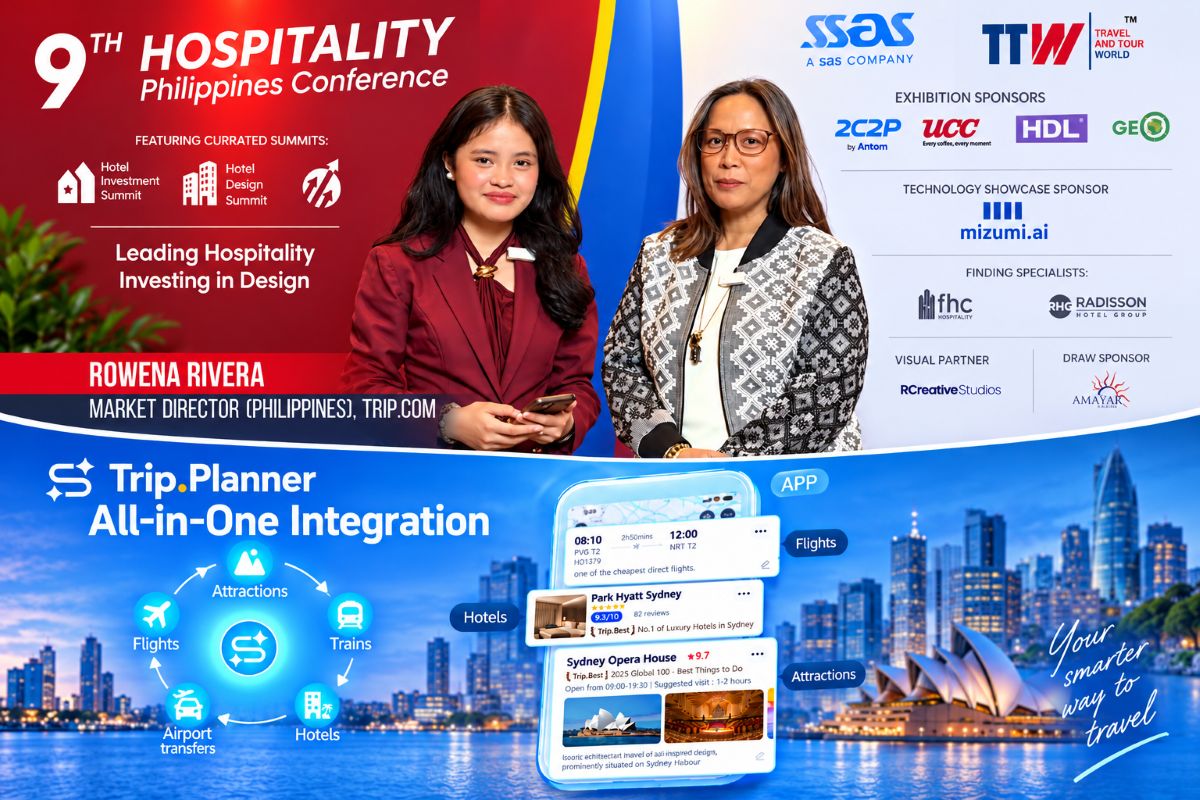
Image Credit: TTW and Trip.com
Philippines Connects With Singapore, Thailand and More as “Consumer Behaviour Is Moving Into AI” Reshapes Hotel Bookings because hotels across major Asian tourism markets are adapting to a new discovery and booking environment driven by artificial intelligence, accurate digital content, personalisation and traveller data. In the Philippines, Trip.com is urging hotel partners to keep information, images, room details, availability and pricing current so AI-led platforms can surface relevant properties. Singapore, Thailand and More are following similar paths through destination apps, AI tools and data-driven visitor services. As Consumer Behaviour Is Moving Into AI, Hotel Bookings increasingly depend on whether accommodation providers are visible, accurate, competitive and easy for digital systems to interpret.
Artificial intelligence, accurate digital content and changing traveller behaviour are becoming central to how Philippine hotels compete for international bookings, according to Rowena Rivera, Market Director for the Philippines at Trip.com.
Speaking exclusively to Travel And Tour World at the 9th Hospitality Philippines Conference at Marriott Manila, Rivera outlined how Trip.com is viewing the market from an online travel agency perspective, with particular attention to destination demand, AI-assisted travel planning, hotel visibility and the changing habits of domestic and international travellers.
Advertisement
Advertisement
For Rivera, one of the strongest messages from the conference was that tourism growth depends on cooperation across the wider ecosystem rather than action from a single segment.
“What I learned is that this is not like a singular business. It has to be a collective work between and among the different sectors in the industry.”
Advertisement
Advertisement
Her comment reflects one of the central themes of the interview: digital distribution, hotels, destinations, airlines, government and travel platforms increasingly operate as interconnected parts of the same visitor journey.
Which Philippine destinations are attracting international interest?
When asked which traditional or emerging Philippine leisure destinations were showing strong international inbound interest on Trip.com, Rivera highlighted several established gateways.
Advertisement
Advertisement
She pointed first to Cebu, noting the importance of Mactan as an international entry point and as a gateway to other destinations across the Visayas and Mindanao.
“We still see the popular island destinations because they are also gateways that have international flights flying into them.”
She also named Boracay as a consistently popular leisure destination and identified Bohol as another important market because of its proximity to Cebu and access through an international airport.
Metro Manila remains central for a different reason. Rivera described it as serving both leisure and business travellers while also functioning as the country’s largest international arrival point.
Advertisement
Advertisement
Her comments suggest that international air access continues to play a significant role in destination visibility. Destinations connected directly to international gateways may have an advantage because they are easier for overseas travellers to discover, book and include in multi-stop itineraries.
How is Trip.com using AI in the travel booking journey?
Artificial intelligence was one of the most prominent topics in the interview.
Rivera explained that Trip.com launched its consumer-facing AI tool, TripGenie, around three years ago. The feature is available through the Trip.com app and is designed to help travellers with a wide range of trip-planning questions.
“You can ask it anything related to the travel.”
She gave several examples. A traveller could ask what to do in Shanghai, seek help understanding a menu in Paris or use the system when trying to navigate an unfamiliar destination.
More significantly, Rivera described how the technology is moving beyond simple questions towards increasingly detailed trip planning.
Advertisement
Advertisement
A user could provide the number of people travelling, the intended month, the duration of the trip, a budget and preferred experiences. The AI could then build recommendations incorporating flights, hotels and activities available through the Trip.com platform.
“Just feed it all there and it will come up with a recommendation for you, including flights, including hotels, activities.”
The implication for the hospitality industry is clear: travellers are increasingly moving from traditional manual search behaviour towards conversational planning environments where an AI system may influence which destinations, hotels and activities appear in the final itinerary.
Why does accurate hotel content matter more in the AI era?
Rivera’s strongest point for hotel operators concerned the quality and accuracy of their digital information.
She said her goal as Trip.com’s Philippines market director is to help hotel partners grow because the platform benefits when its partners grow.
However, she stressed that hotels now need to consider how consumer discovery is changing.
Advertisement
Advertisement
“Because the behavior of the consumers is now moving into AI, we need to make sure their information, their content is accurate, is out there.”
This is particularly important because AI tools can only work effectively with information that is available, current and relevant.
Rivera warned that a weak digital footprint or outdated imagery can make a property less attractive during the discovery process.
“If a consumer will ask, like, ‘I want to go to the Philippines,’ and you don’t have that digital footprint or your content, your photos are old, maybe it will not be very attractive.”
Her message goes beyond basic visibility. Hotels increasingly need to ensure that room types, facilities, photographs and customer-relevant details are clearly represented.
For example, family travellers may want connecting rooms or larger family accommodation. Couples may look for different amenities, while travellers from Japan, Russia or China may prioritise different aspects of a property.
Advertisement
Advertisement
The more complete the content, Rivera suggested, the better positioned a hotel is to appeal to the traveller most likely to book it.
How can hotels improve their performance on online travel platforms?
Rivera identified three connected areas: content, availability and pricing.
First, hotels should provide complete and accurate information. Second, inventory needs to be available at the right time. Third, pricing needs to remain competitive.
“We work on that availability, on the content, and of course the pricing has to be competitive and attractive as well.”
This reflects the increasingly data-driven nature of hotel distribution.
Simply appearing on an online travel agency is not necessarily enough. Properties need to present the information that matches specific traveller requirements while also maintaining attractive commercial conditions.
Advertisement
Advertisement
Rivera added that once these pieces are in place, Trip.com can give hotels wider exposure.
“When they have that, then we’re able to show them to the world and hopefully attract as many customers.”
For Philippine accommodation providers, this is particularly relevant as the country seeks to attract travellers from a broader mix of international markets.
What must Philippine hospitality brands prepare for by 2027?
Looking towards 2027 and beyond, Rivera emphasised uncertainty and adaptability.
She argued that consumer behaviour is changing while the mix of nationalities travelling to the Philippines is also evolving.
“One thing we have to be aware of is that consumer behavior is changing.”
Advertisement
Advertisement
That shift means hotels cannot assume that the same source markets, booking habits or seasonal demand patterns will remain constant.
Rivera said Trip.com’s platform data can help partners identify how traveller behaviour is changing and prepare accordingly.
“We have to be ready for that uncertainty, and we can use the data that we have on the Trip.com platform to understand how this consumer behavior is shifting and how can I prepare better for this.”
She also pointed out that different nationalities tend to travel during different periods of the year. Understanding those patterns can help hotels prepare inventory, content, pricing and marketing campaigns around expected demand.
“Certain nationalities travel on certain months of the year. So we prepare accordingly and we have to be really adaptive to these changes.”
This may become one of the most important competitive capabilities for Philippine hospitality brands: the ability to respond quickly when traveller origin, booking channels and digital behaviour shift.
Advertisement
Advertisement
Why is the OTA perspective becoming more important?
Rivera’s interview also highlights how online travel agencies are evolving beyond their traditional role as booking channels.
Trip.com is increasingly positioning itself across discovery, planning, recommendation and transaction.
AI tools can help travellers decide where to go. Platform content can influence which properties become visible. Data can reveal changing source markets. Pricing and availability determine whether that interest converts into a booking.
From that perspective, OTAs now sit much earlier in the traveller decision-making process.
Rivera summarised Trip.com’s role at the conference as bringing the OTA perspective into broader discussions about digitalisation and changing consumer behaviour.
Her comments also reinforce the need for Philippine tourism businesses to see technology not simply as an operational tool, but as part of how destinations and hotels are discovered internationally.
Advertisement
Advertisement
What is the central message for Philippine tourism?
The central message from the interview is that the next phase of Philippine hospitality growth will depend heavily on adaptability.
Cebu, Boracay, Bohol and Metro Manila continue to benefit from strong destination recognition and international connectivity. However, the way travellers discover and book those destinations is changing.
AI is becoming a more influential part of travel planning. Hotel information needs to be accurate and detailed. Pricing and availability still matter. Source markets are changing, and seasonal behaviour differs between nationalities.
Rivera’s clearest warning to hospitality businesses is therefore also an opportunity.
As she explained:
“The behavior of the consumers is now moving into AI.”
Advertisement
Advertisement
For Philippine hotels and tourism businesses, the challenge is to make sure that when travellers ask AI where to stay, what to book and how to build a trip, the right information is already there, current and compelling.
| Country / market | What is changing | Role of AI / digital tools | Importance for hotels and international bookings | Traveller-behaviour angle | Contrast with the Philippines |
|---|---|---|---|---|---|
| Philippines | Hotels are being pushed to improve digital visibility, content accuracy, availability and pricing | Trip.com is using AI through TripGenie for recommendations, itinerary planning, hotels, flights and activities | Strong digital content may improve the chance that properties appear attractive when travellers search through AI-led platforms | Source markets, seasonal travel patterns and booking behaviour are shifting | The Philippines is strongly OTA-led, with Trip.com emphasising content accuracy and adaptability |
| Singapore | Tourism authorities are preparing businesses for an AI-driven visitor economy | Singapore Tourism Board has developed an AI playbook, signed an AI-focused MoU with OpenAI and trialled AI-powered multilingual visitor guides | Hotels are being encouraged to use technology to improve productivity, guest engagement and competitiveness; Singapore is also expanding digital hotel check-in | STB explicitly says technology should help businesses understand traveller behaviours and needs | Singapore has a more coordinated government-led AI strategy than the Philippines, extending beyond OTA visibility into operations and destination management |
| Thailand | The visitor journey is being digitised from inspiration through spending | Tourism Authority of Thailand launched an upgraded Amazing Thailand app with an AI chatbot, personalised recommendations and itinerary functions | The platform helps international visitors discover accommodation, food, attractions and experiences, potentially influencing where spending and bookings flow | AI recommendations are designed to respond to traveller needs throughout the trip | Thailand is using AI at a national destination level, whereas the Philippines example is centred more strongly on OTA and hotel-platform optimisation |
| Malaysia | Tourism marketing is becoming increasingly digital, platform-led and content-driven | Tourism Malaysia is working with Mastercard, Agoda and Xiaohongshu on personalised content, digital campaigns and end-to-end visitor tools | Hotel and destination visibility increasingly depends on high-quality content across digital platforms used by overseas travellers | Malaysia is targeting travellers by market, especially China, and using platform ecosystems to shape discovery and travel decisions | Malaysia places especially strong emphasis on international digital marketing partnerships and social-content ecosystems alongside booking platforms |
| South Korea | Tourism authorities are explicitly studying how AI agents and online platforms influence travel planning | Korea Tourism Data Lab has analysed AI adoption by major OTAs, O2O platforms and big-tech ecosystems; KTO also identifies the rise of the “AI trip butler” | Hotels and tourism businesses need to be discoverable within recommendation systems increasingly used before booking | Korea’s 2026 tourism-trend research identifies AI as moving beyond efficiency towards more personalised, emotionally responsive assistance | Korea is further advanced in formally analysing AI-agent behaviour and its implications for inbound tourism marketing |
| Japan | Tourism is undergoing broad digital transformation covering booking, recommendations, payments and visitor data | Japan Tourism Agency promotes seamless digital booking, personalised recommendations and use of traveller data before, during and after trips | Accommodation providers are encouraged to adopt PMS and digital systems that improve productivity and service value | Visitor movement, accommodation, booking and purchasing data are being used to shape destination marketing and management | Japan’s approach is more infrastructure- and data-management driven than the Philippines’ OTA-content focus |
| UAE – Dubai | Hospitality is becoming more automated and digitally seamless | Dubai has rolled out a citywide contactless hotel check-in solution using one-time digital identity and biometric verification | Faster check-in and digital guest handling improve convenience for international hotel guests and strengthen destination competitiveness | Dubai is responding to demand for frictionless, technology-led hospitality | Dubai focuses more heavily on the operational guest journey, while the Philippines discussion focuses more on AI discovery, content accuracy and conversion |
What does the comparison show?
The table shows that the Philippines is not an isolated case. Across Singapore, Thailand, Malaysia, South Korea, Japan and Dubai, tourism authorities and hospitality businesses are increasingly competing for international travellers before those travellers ever reach a hotel website.
The biggest similarity is the shift from simple online booking towards AI-assisted discovery and personalised recommendation. In the Philippines, Trip.com argues that hotels need accurate photos, room information, availability and pricing because AI systems increasingly influence which properties travellers see. Singapore is going further by building an AI framework for the tourism sector, while Thailand is placing AI directly inside its national visitor app. Malaysia is using digital content ecosystems and platforms such as Agoda and Xiaohongshu to shape overseas demand. South Korea is actively studying how AI agents change inbound travel marketing, while Japan is combining personalised recommendations with booking, payment and visitor-data systems.
The biggest contrast is where the transformation is centred. The Philippines example is strongly OTA- and hotel-content-led. Singapore and Japan are more government- and infrastructure-led. Thailand focuses on destination-wide AI assistance, Malaysia on digital marketing ecosystems, South Korea on AI-driven traveller behaviour analysis, and Dubai on frictionless hotel operations. Collectively, they point towards the same competitive reality: hotels that are accurate, visible, personalised and machine-readable are becoming better positioned to capture international bookings.
Conclusion
Philippines Connects With Singapore, Thailand and More as “Consumer Behaviour Is Moving Into AI” Reshapes Hotel Bookings because international travel planning is shifting from simple search towards AI-assisted recommendations, personalised discovery and data-led decisions. The reason is clear: travellers increasingly expect faster, more relevant answers about where to stay, what to do and how to build a trip. In the Philippines, accurate hotel content is becoming critical, while Singapore, Thailand and More are investing in AI-enabled tourism experiences. As Consumer Behaviour Is Moving Into AI, Hotel Bookings will increasingly favour properties that maintain complete information, strong digital visibility, competitive pricing and content suited to changing international traveller needs.
Image Credit: TTW and Trip.com
Advertisement
