
Iraq and Syria Accelerate a United States-Supported Mediterranean Energy Corridor as Iran Attacks Disrupt Kuwait Aviation and Strike Jordan, Reshaping Engineering Travel, Secure Meetings and Corporate Mobility Across the Middle East

Published
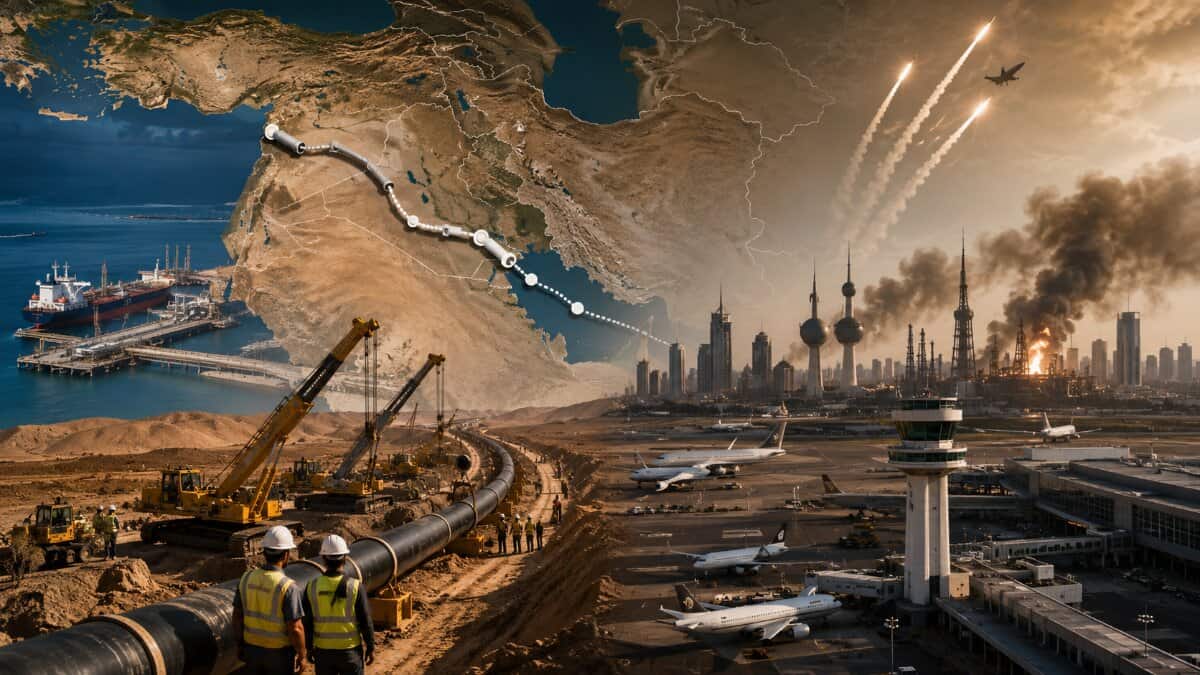
The Iraq–Syria pipeline agreements signed in Washington have created an immediate business-travel story before any crude begins moving. Technical studies, commercial structuring, security planning and infrastructure surveys are expected to generate specialist travel connecting Washington, Baghdad, Basra, western Iraq, Damascus and Syria’s Mediterranean coast. However, the same regional crisis has temporarily interrupted Kuwait airport operations and exposed Jordan to Iranian missile and drone attacks. The emerging opportunity is therefore controlled engineering mobility, secure meetings and infrastructure-related MICE demand rather than a near-term leisure tourism reopening.
New Iraq–Syria Pipeline Angle Extends Far Beyond Oil Exports
The most important travel-industry angle is not the eventual movement of Iraqi crude towards the Mediterranean. It is the substantial movement of people, expertise, equipment and commercial delegations required before the corridor can become operational.
Syria and Iraq signed two memoranda of understanding in the United States covering the rehabilitation of an oil pipeline and cooperation with an international consortium. The Syrian Petroleum Company and Basra Oil Company signed the government-level agreement, while a second memorandum brought together Chevron, UCC Holding and TI Capital. The consortium is expected to prepare technical and financial studies and establish an implementation framework covering the pipeline and associated facilities.
A U.S. Department of State media note dated 17 July formally recorded American support for cooperation between Iraq and Syria on reconstructing the crude oil pipeline. The presence of the U.S. energy secretary during the signing further positioned Washington as an important diplomatic, investment and project-development centre for the initiative.
Advertisement
Advertisement
For the travel trade, this means the first measurable demand is likely to appear in premium business cabins, secure accommodation, long-stay corporate housing, meeting facilities, ground transport, travel-risk services and specialist visa support. The first passengers will not be holidaymakers. They will be engineers, surveyors, legal advisers, financiers, procurement teams, insurers, energy consultants and security professionals.
Verified Pipeline Structure and Its Travel Implications
Official Iraqi and Syrian descriptions indicate that the project may form part of a larger pipeline network rather than a single isolated rehabilitation programme. However, public documents use different route names, making technical clarification essential.
Advertisement
Advertisement
| Verified element | Official status through 18 July 2026 | B2B travel significance |
|---|---|---|
| Bilateral agreement | Two memoranda were signed involving Syria, Iraq and an international consortium | Opens a multistage programme requiring diplomatic, technical and commercial travel |
| Syrian description | Rehabilitation and revival of the Kirkuk–Baniyas crude oil pipeline | Creates potential project activity across northern or central Iraq and Syria’s Mediterranean corridor |
| Iraqi description | Institutional announcements refer to a Haditha–Banias pipeline | Points towards western Iraq as another potential engineering and logistics centre |
| Wider Iraqi network | Official Iraqi reporting lists Basra–Haditha, Kirkuk–Ceyhan and Haditha–Banias among planned routes | Suggests multiple work fronts rather than one linear pipeline assignment |
| Consortium | Chevron, UCC Holding and TI Capital | Increases expected demand for international project teams and executive travel |
| Current phase | Technical studies, financial evaluation and implementation planning | Confirms that construction and oil transport have not yet begun |
| U.S. role | Washington hosted the agreements and the State Department formally supported the cooperation | Strengthens Washington’s potential role as a recurring meeting and investment hub |
| Operational status | No verified opening date or active crude flow has been announced | Travel sellers must not promote the corridor as completed or commercially operational |
The route terminology is a significant reporting and operational detail. Syria’s official announcement identifies the historic Kirkuk–Baniyas link, while Iraqi institutional reports describe the Haditha–Banias connection and a broader trunk pipeline from Basra to Haditha.
This may indicate a combined system in which crude from southern Iraq reaches Haditha before continuing westwards, alongside possible rehabilitation of older infrastructure. It may also reflect different phases of a wider export-diversification programme. Until detailed engineering documents are published, travel managers should avoid assuming that every contract, delegation or worksite belongs to the same physical route.
Basra–Haditha Development Could Create a Larger Project-Travel Market
The Syrian agreement becomes more commercially significant when considered alongside Iraq’s broader pipeline strategy.
Iraq’s Ministry of Oil has stated through the Iraqi News Agency that the Basra–Haditha project is intended to transport up to 2.5 million barrels per day towards three export terminals and could provide approximately 15,000 employment opportunities. Another official Iraqi update described a branch extending from Haditha towards Banias.
These figures do not represent the capacity or workforce of the Syria-bound branch alone. They apply to the wider Iraqi pipeline programme. Nevertheless, they demonstrate the potential scale of the infrastructure ecosystem surrounding the Washington agreements.
For travel management companies, that ecosystem could produce recurring traffic between Basra, Baghdad, Anbar Governorate, Washington and international engineering centres. Demand may include contractor rotations, inspection visits, procurement meetings, training programmes, technical workshops and government-to-government consultations.
Advertisement
Advertisement
Hotels in established Iraqi commercial centres could benefit before remote pipeline locations do. Secure properties with meeting rooms, controlled transport access, flexible catering, extended-stay inventory and strong corporate security procedures would be better positioned than conventional leisure accommodation.
Original Analysis Shows Project Travel Will Precede Energy Diversification
Large infrastructure corridors begin generating travel before construction contracts reach full execution. Route surveys, feasibility assessments, environmental reviews, legal structuring, financing negotiations and security audits all require physical movement.
The consortium’s study mandate therefore represents a potential travel-demand trigger in its own right. Washington may host investment and financing meetings. Baghdad and Basra may handle governmental, commercial and operational coordination. Haditha could emerge as a specialist field-support location if the western branch advances. Damascus and the Mediterranean coast may eventually receive engineering teams, although current security conditions sharply restrict foreign mobility.
This creates a hub-and-spoke travel pattern rather than a conventional city-pair market. International personnel may attend meetings in Washington or Baghdad, connect through established regional gateways and use tightly managed ground arrangements for site visits.
MICE demand is also more likely to develop through small, high-value gatherings than major public conventions. Expected formats include engineering workshops, investor meetings, procurement briefings, technical training and bilateral infrastructure forums.
The opportunity must not be confused with a Syrian tourism recovery signal. The United States continues to classify Syria at Level 4, advising against all travel because of armed conflict, terrorism, kidnapping and damaged infrastructure. Jordan remains at Level 3, with specific border areas adjoining Iraq and Syria placed at Level 4.
Advertisement
Advertisement
Consequently, much of the corridor-related meeting demand may initially be displaced towards Washington, Baghdad and secure third-country venues rather than the physical pipeline route.
Iran Conflict Turns Kuwait and Jordan into Immediate Travel-Risk Indicators
The strategic value of an overland Mediterranean energy route is being examined while the regional aviation system remains vulnerable to sudden military escalation.
Kuwait Airways reported the rescheduling of most commercial flights after a temporary suspension of aircraft departures and arrivals on 18 July. Kuwait’s official news service also recorded continuing air-defence responses to Iranian missile and drone activity.
In Jordan, U.S. Central Command confirmed that two American service members were killed on 17 July while U.S. and partner forces responded to Iranian ballistic missile and drone attacks. Another service member remained missing, while four personnel were evacuated to Jordanian hospitals and subsequently discharged.
The Jordan travel advisory records an ongoing threat from Iranian missiles and drones, alongside significant disruption to commercial flights following the beginning of United States–Iran hostilities. It also restricts travel near the Syrian and Iraqi borders, precisely the wider geography associated with the proposed energy corridor.
| Country | Role in the developing story | Immediate travel-industry implication |
| Iraq | Oil producer, infrastructure owner and origin of the proposed westbound network | Potential growth in engineering travel, contractor rotations, government meetings and secure accommodation |
| Syria | Mediterranean transit territory and location of the Banias outlet | Long-term corridor potential, but severe restrictions currently limit safe international mobility |
| United States | Diplomatic venue, formal supporter and home market of participating energy interests | Likely centre for financing, legal, investment and executive meetings |
| Iran | Principal source of the current missile, drone and maritime-security escalation | Drives airspace uncertainty, schedule changes, insurance pressure and contingency costs |
| Kuwait | Gulf aviation market affected by temporary airport suspension and flight rescheduling | Demonstrates the need for flexible tickets, rapid reaccommodation and alternate gateway planning |
| Jordan | Regional aviation and business hub exposed to missile and drone attacks | Remains useful for regional connectivity but requires heightened duty-of-care controls |
ICAO Data Shows How Quickly Middle East Connectivity Can Collapse
The latest available institutional aviation data illustrates why travel planning around the pipeline cannot be separated from regional airspace management.
Advertisement
Advertisement
ICAO recorded approximately 5,100 daily flights across its Middle East region before major disruption between late February and May 2026. Traffic then fell to 1,677 daily flights, a decline of almost 67 per cent. By the end of May, operations had recovered to approximately 3,700 flights per day but remained well below the pre-disruption level.
| Official aviation indicator | Pre-crisis or baseline level | Lowest or disrupted level | Latest reported recovery | Operational meaning |
| ICAO Middle East daily flights | About 5,100 | 1,677 | About 3,700 by late May | Regional capacity can contract rapidly even before individual markets close completely |
| Muscat flight information region | 2,057 daily flights in January | 1,125 in March | 1,655 in May | Alternative southern routes remain exposed to major traffic redistribution |
| Muscat first peak diversion event | Normal scheduled operation | 28 diverted aircraft received | All accommodated on stands | Diversion airports require immediate handling, parking and passenger-support capacity |
| Muscat second peak diversion event | Normal scheduled operation | 21 diverted aircraft received | Nine temporarily held on a taxiway | Airport congestion can affect passengers even where the destination airport remains open |
| APELO traffic interface point | January baseline | Traffic shifted towards the route | 56 per cent above baseline by May | Conflict avoidance can concentrate aircraft into fewer usable corridors |
ICAO also documented airborne holding, fuel-related priority declarations, rerouting, unavailable flight levels and increased controller workload. These factors can produce longer journey times, missed connections, additional fuel burn and unplanned overnight stays without a formal closure at the passenger’s booked airport.
Pipeline Diversification Will Not Immediately Lower Airfares
The revived pipeline should not be presented as an instant solution to aviation-fuel prices or airline operating costs.
The project remains at the study and implementation-planning stage. It would transport crude oil, not directly supply finished aviation fuel to airport hydrant systems. Refineries, storage facilities, product pipelines, maritime terminals and distribution contracts would still determine whether any eventual crude-export resilience benefits airlines.
Its long-term value lies in reducing Iraq’s dependence on one vulnerable export direction. The World Bank estimates that oil represented 53 per cent of Iraqi real GDP, 88 per cent of government revenue and 91 per cent of merchandise exports in 2025. It also records that the Strait of Hormuz blockade significantly reduced Iraqi export capacity and slowed production.
Greater export flexibility could eventually reduce part of the geopolitical risk embedded in oil markets. However, airfares will continue to respond to airline fuel hedging, refinery availability, insurance costs, route length, airspace restrictions and aircraft utilisation.
Advertisement
Advertisement
Iraq Infrastructure Spending Strengthens the Corporate Travel Case
The pipeline programme is developing alongside a wider Iraqi transport-investment cycle.
The World Bank’s active Iraqi portfolio comprised ten projects with a total commitment of 2.24 billion U.S. dollars as of October 2025. Transport and energy represented the largest shares, including a 930 million U.S. dollar railway extension and modernisation programme. A further 900 million U.S. dollar road project was announced to improve connectivity, reliability and employment.
This convergence of pipeline, railway and road investment may create a broader infrastructure-travel cluster. Travel suppliers should therefore monitor Iraq as an integrated project market rather than evaluating each energy or transport contract separately.
Operational Takeaways for Travel Agents and Tour Operators
- Classify the opportunity correctly: Treat the pipeline as an emerging engineering, investment and government-travel market rather than a leisure product.
- Verify the worksite: Confirm whether a traveller’s assignment concerns Basra–Haditha, Haditha–Banias, Kirkuk–Baniyas or another linked project before arranging flights and ground transport.
- Avoid non-refundable itineraries: Use changeable fares, protected connections and contracts that permit rapid rerouting during airport or airspace suspensions.
- Build multiple gateway options: Prepare alternatives through more than one regional hub and avoid relying on a single Gulf transfer point.
- Separate meetings from site visits: Hold financial, legal and procurement meetings in lower-risk commercial centres where physical access to the pipeline is unnecessary.
- Apply enhanced duty of care: Require live traveller tracking, scheduled check-ins, secure ground transport, medical support and tested evacuation procedures.
- Review insurance exclusions: Armed conflict, missile attacks, government evacuation and airspace closure may be excluded or tightly limited under standard policies.
- Monitor official notices: Track civil aviation authorities, airport operators, government travel advisories and airline operational updates rather than relying only on reservation-system schedules.
- Protect MICE contracts: Include force-majeure, venue relocation, delegate substitution and virtual-delivery provisions in regional event agreements.
- Do not promise immediate fuel savings: The project is not operational and cannot yet produce a verified reduction in airline fares or aviation-fuel costs.
Long-Term Outlook
The Iraq–Syria pipeline initiative could eventually influence far more than the direction of crude exports. It may help establish a westward infrastructure axis linking southern and western Iraq with the Mediterranean while generating specialised business travel, long-stay accommodation demand, secure meetings and cross-border technical services.
Its travel impact will unfold in stages. Studies and negotiations will support executive and advisory travel first. Procurement and construction could later create larger contractor rotations. Sustained airline or hotel growth would depend on security, financing, border access, sanctions compliance, airspace stability and the publication of a definitive pipeline alignment.
The most important strategic lesson is that Middle East travel resilience is increasingly connected to energy resilience. Airlines, travel management companies and MICE planners can no longer evaluate airports, airspace, fuel supply, critical infrastructure and political risk as separate subjects. The Washington agreements have introduced a potentially valuable project corridor, but the attacks affecting Kuwait and Jordan demonstrate that its commercial promise will be realised only through disciplined risk management and carefully controlled mobility.
Advertisement
Advertisement
FAQs
1. What is the Iraq–Syria Mediterranean energy corridor?
The proposed corridor is intended to revive and expand pipeline infrastructure capable of carrying Iraqi crude westwards through Syria towards the Mediterranean coast. As of 19 July 2026, the initiative remains at the technical, financial and implementation-planning stage rather than commercial operation.
2. Why is the pipeline important for Iraq?
The project could give Iraq an additional export route that does not depend entirely on Gulf shipping lanes and the Strait of Hormuz. Greater route diversification may reduce exposure to maritime disruption, regional conflict, port closures and shipping-security risks.
3. What role does Syria play in the project?
Syria would provide the westward transit territory and Mediterranean outlet for Iraqi crude. The proposed development involves rehabilitating dormant pipeline infrastructure and evaluating associated facilities, although extensive reconstruction, financing and security preparation would be required.
4. How is the United States connected to the agreement?
The agreements were signed in Washington with formal American support. The United States is expected to remain important to investment discussions, technical cooperation, financing arrangements and the participation of international energy and infrastructure companies.
5. How could the project affect business travel?
The project may generate demand for engineers, construction specialists, financiers, legal advisers, security consultants, procurement teams and government delegations. This could support premium aviation, secure accommodation, long-stay corporate housing, ground transport and specialist travel-management services.
6. Why are Kuwait and Jordan included in the wider story?
Kuwait and Jordan illustrate the regional travel risks accelerating interest in alternative infrastructure. Aviation disruption in Kuwait and missile and drone activity affecting Jordan demonstrate how quickly airspace, airports, business itineraries and corporate mobility can be affected by conflict.
Advertisement
Advertisement
7. Will the pipeline immediately reduce airfares or aviation-fuel prices?
No. The proposed system would transport crude oil and is not yet operational. Airline costs would still depend on refining capacity, aviation-fuel distribution, insurance, airspace restrictions, fuel hedging, route length and wider oil-market conditions.
8. Is the corridor currently safe for tourism or general business travel?
The project should not be interpreted as a leisure-tourism reopening. Several areas connected to the proposed route remain affected by armed conflict, infrastructure damage and strict government travel warnings. Early travel demand is more likely to involve controlled specialist missions and secure meetings.
9. What opportunities could emerge for MICE operators?
Potential opportunities include technical workshops, investor meetings, procurement briefings, infrastructure conferences, training programmes and bilateral government sessions. Initial events may be held in Washington, Baghdad or secure third-country hubs rather than close to pipeline construction areas.
10. What should travel agents and corporate travel managers monitor?
They should track official airport notices, civil aviation updates, government travel advisories, airline schedules, border restrictions, insurance exclusions and verified pipeline milestones. Flexible tickets, alternative gateways, traveller tracking, secure transport and evacuation planning should remain central to every itinerary.
Advertisement
