

United Kingdom Keeps Pace With France and Others as Canterbury–Rome Adventure Spurs Travel Cost Comparisons

Updated
Published
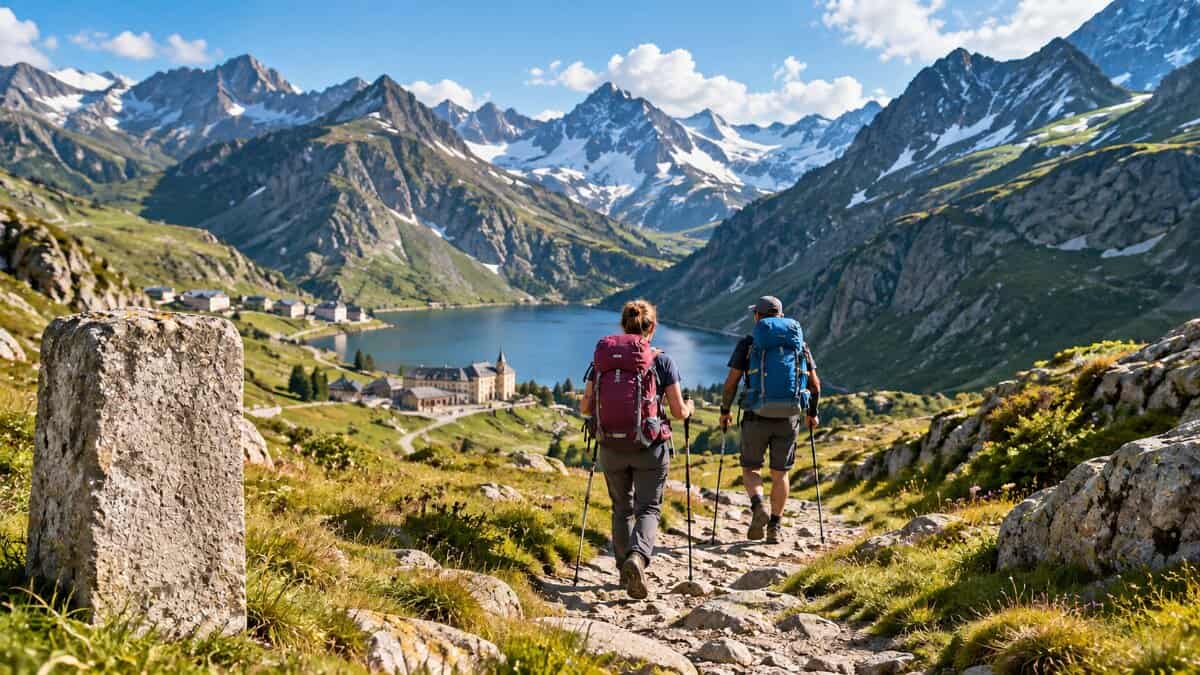
The Via Francigena is entering a critical autumn planning period. A March 2026 walking guide connects London with Canterbury over 140 kilometres, while a European tourism initiative reported fresh engagement with British operators on 1 October. Meanwhile, Switzerland expects the Great St Bernard Pass road to remain usable only until approximately mid-October, subject to snowfall. For travellers crossing the United Kingdom, France, Switzerland and Italy, the immediate challenge is choosing affordable walking stages, securing accommodation, arranging luggage transfers and avoiding increasingly hazardous Alpine conditions.
The four countries already share the historic Via Francigena. No new four-country government partnership has been announced. The significant 2026 development lies in how an expanding walking network, new tourism-business activity and an approaching mountain-season deadline are changing the practical choices available to independent hikers and organised adventure travel operators.
Advertisement
Advertisement
Via Francigena 2026: Fresh UK Tourism Links Create New Adventure Travel Opportunities
The latest development comes from the European Union-funded DETOUR initiative. In an update published on 1 October 2026, the project documented engagement with British tourism operators and local institutions along the Francigena Britannica, the walking extension between London and Canterbury.
According to the DETOUR project’s official update, the engagement formed part of wider work connecting long-distance walking routes with accommodation businesses, local food producers, tourism experiences and small enterprises.
Advertisement
Advertisement
The development matters because the Via Francigena is increasingly relevant to travellers seeking shorter, independently bookable adventures rather than exclusively undertaking a lengthy pilgrimage to Rome.
For tour operators, it creates a more commercially accessible proposition. Walkers can begin with a week in England, undertake selected French countryside stages, book Swiss hiking holidays or complete the final approach to Rome in Italy.
Advertisement
Advertisement
However, the recent activity does not constitute a new government agreement between the four countries. The common link remains the historic pilgrimage corridor, which the Council of Europe recognised as a Cultural Route in 1994.
United Kingdom, France, Switzerland and Italy Share One Historic Adventure Tourism Corridor
The Via Francigena follows a route associated with Archbishop Sigeric of Canterbury, whose journey to Rome in AD 990 provided the historical foundation for reconstructing the pilgrimage itinerary.
Its modern tourism value extends beyond religious travel. The route combines walking, heritage attractions, rural accommodation, independent travel and locally delivered visitor experiences.
Its geographical continuity offers travel businesses the opportunity to design journeys connecting several European markets while allowing customers to choose how much of the route they wish to complete.
| Country | Relevant route section | Verified route information | Adventure travel significance |
|---|---|---|---|
| United Kingdom | London, Canterbury and onward towards Dover | The Francigena Britannica covers 140 km from London to Canterbury across seven suggested walking stages | Introduces a new itinerary starting in the capital and connecting with the established pilgrimage |
| France | Calais through northern and eastern France towards Switzerland | The GR145 Via Francigena covers 988 km across 47 stages | Supports countryside hiking, cultural discovery and extended independent travel |
| Switzerland | Lake Geneva, Valais and Great St Bernard Pass | The Bourg-St-Pierre–Grand St Bernard walking stage is 11.6 km, with 976 metres of ascent | Provides Alpine adventure, but with substantial weather and seasonal exposure |
| Italy | Aosta Valley, Tuscany, Lazio and Rome | The northern Lazio section covers 196.6 km over nine stages, ending at St Peter’s Square | Combines rural walking, historic towns and the established pilgrimage destination |
Sources: Confraternity of Pilgrims to Rome, French Hiking Federation, Pays du Saint-Bernard tourism office and Italy’s official tourism portal. Distances refer to different sections and should not be added together as a complete route measurement.
London’s Canterbury Walking Extension Strengthens the United Kingdom’s Adventure Travel Offering
The Francigena Britannica is especially important for British walking tourism because it places London within the wider pilgrimage itinerary.
Advertisement
Advertisement
According to the Confraternity of Pilgrims to Rome, the 140-kilometre route begins at Southwark Cathedral and ends at Canterbury Cathedral.
The association published an updated walking guide in March 2026, supported by downloadable route information. The itinerary links sections of established walking paths, including the Thames Path, Darent Valley Walk, Pilgrims Way and North Downs Way.
The extension received formal recognition from the European Association of the Vie Francigene on 18 October 2024. The 2026 guide represents a practical improvement in access to information rather than the first establishment of the route.
London to Canterbury: Official Seven-Day Walking Itinerary
| Walking day | Starting point | Destination | Distance |
|---|---|---|---|
| 1 | Southwark Cathedral | Abbey Wood | 17 km |
| 2 | Abbey Wood | Dartford | 18 km |
| 3 | Dartford | Kemsing | 23 km |
| 4 | Kemsing | Aylesford Priory | 22 km |
| 5 | Aylesford Priory | Hollingbourne | 18 km |
| 6 | Hollingbourne | Boughton Lees | 22 km |
| 7 | Boughton Lees | Canterbury Cathedral | 20 km |
| Total | London | Canterbury | 140 km |
Distances reproduce the recommended stages in the Confraternity’s 2026 route guide.
The extension offers accessible transport connections and several alternatives for overnight accommodation.
The Confraternity’s guide explains that travellers can use London as an accommodation base for the opening stages, taking trains back from locations such as Abbey Wood and Dartford.
Advertisement
Advertisement
It also identifies Ashford as a possible accommodation alternative for walkers completing stages around Hollingbourne and Wye.
This flexibility matters commercially. It allows operators to sell point-to-point walking products without requiring every customer to remain overnight at each designated stage endpoint.
According to Canterbury City Council’s 2026–2043 city-centre strategy, improving the visibility of the Via Francigena and strengthening the safety and quality of pilgrimage routes form part of the city’s longer-term ambitions.
That creates a relevant connection between heritage tourism, active travel, visitor accommodation and destination development.
France’s 988-Kilometre Walking Corridor Offers Flexible Cross-Country Holidays
France provides the longest continuous national section among the examples assessed in this report.
According to the Fédération Française de la Randonnée Pédestre, the French Via Francigena is officially recognised as GR145, extending 988 kilometres from Calais to the Swiss border over 47 stages.
Advertisement
Advertisement
The route passes through landscapes associated with Hauts-de-France, Champagne and Burgundy-Franche-Comté. Its cultural attractions include Arras, Laon, Reims, Besançon and Langres.
These destinations give the French section a different commercial character from the British extension.
Instead of a single week-long introduction, France offers possibilities for extended walking itineraries and shorter countryside breaks.
Independent hikers can choose particular sections based on transport access, accommodation availability and personal fitness.
For specialist adventure travel businesses, the opportunity lies in dividing the established trail into manageable products rather than expecting every customer to complete its full length.
However, the distance also introduces logistical complexity. Accommodation facilities, baggage transport arrangements and public transport connections cannot be assumed to operate uniformly across all 47 stages.
Advertisement
Advertisement
Operators therefore need to establish arrangements at individual destinations rather than relying on the existence of the GR145 designation alone.
Switzerland’s Great St Bernard Pass Faces a Critical October Operating Window
Switzerland provides the most immediate operational concern for travellers considering an Alpine crossing during October 2026.
According to the Government of the Canton of Valais, the Great St Bernard Pass road reopened completely between Switzerland and Italy on 22 June 2026.
The reopening followed repairs to infrastructure on the Italian side that had suffered avalanche damage. The Swiss approach had already reopened on 29 May.
The government identified an expected operating period extending approximately to mid-October 2026, depending on snowfall.
That projection is directly relevant on 8 October because the anticipated seasonal closure period is approaching. It does not establish that the road has already closed, nor does it guarantee that it remains open on any particular subsequent day.
Advertisement
Advertisement
Great St Bernard Pass: Verified Operational Figures
| Operational indicator | Official information |
|---|---|
| Elevation of the road pass | 2,476 metres |
| Swiss road reopening | 29 May 2026 |
| Full cross-border road reopening | 22 June 2026 |
| Snow accumulation reported for 2026 | 11 metres |
| Approximate ten-year average snow accumulation | 13 metres |
| Annual road traffic | Approximately 85,000 vehicles |
| Expected seasonal road accessibility | Until approximately mid-October, weather permitting |
| Bourg-St-Pierre to pass walking stage | 11.6 km |
| Ascent on the walking stage | 976 metres |
| Indicative walking duration | 4 hours 15 minutes |
Sources: Government of Valais and the official Pays du Saint-Bernard tourism office. The road reopening information must not be interpreted as a current hiking safety clearance.
The distinction between road accessibility and walking safety is crucial.
A road might remain open while nearby walking paths become dangerous because of fresh snow, poor visibility, ice or deteriorating weather.
The Confraternity of Pilgrims to Rome also makes clear that pedestrians cannot walk through the Great St Bernard road tunnel. Anyone using the tunnel as an alternative crossing must arrange appropriate vehicle transport.
Consequently, adventure travel companies should not continue marketing October Alpine walking departures without confirming current ground conditions and establishing an alternative itinerary.
The most commercially sensible response may be to offer lower-altitude sections in Switzerland or postpone the high-pass walking element until a suitable subsequent season.
Advertisement
Advertisement
Independent Via Francigena Walking Costs Versus Organised Packages in 2026
Accommodation prices create another significant distinction between independent hiking and organised adventure travel.
According to the Confraternity of Pilgrims to Rome’s budgeting guidance, basic accommodation costs differ considerably between European route sections.
Italy provides relatively inexpensive pilgrim lodging in many locations. Switzerland generally requires greater expenditure, particularly when travellers choose private accommodation instead of shared hostel facilities.
These are indicative budgeting figures, not live room rates or confirmed availability for 8 October 2026.
Via Francigena Accommodation and Package Price Comparison
| Country or product | Published indicative price | Accommodation or service | Important qualification |
|---|---|---|---|
| Italy | €10–€15 per night | Basic pilgrim hostel | Shared facilities; availability varies |
| France | €20–€40 per person | Gîtes and B&B accommodation | Breakfast may be included |
| Switzerland | CHF 20–40 per night | Hostel accommodation | Indicative low-budget option |
| Switzerland | CHF 50–100 per person | B&B or similar accommodation | Private accommodation costs more |
| United Kingdom | No verified uniform nightly tariff | Hotels, hostels and other local accommodation | Prices require stage-specific quotations |
| Switzerland organised walking holiday | From CHF 949 | Yverdon-les-Bains to Aigle package advertised through Switzerland Tourism | Includes luggage transfer and travel support; not a Great St Bernard crossing |
Sources: Confraternity of Pilgrims to Rome and Switzerland Tourism’s official walking holiday listing. The Swiss package lists validity beginning 8 October 2026, but actual booking availability has not been confirmed.
A five-night Swiss hostel stay could therefore have an indicative accommodation-only cost of CHF 100–200 at the Confraternity’s published budget rates.
Advertisement
Advertisement
Five nights of B&B accommodation would suggest CHF 250–500 per person before food, transport or other expenses.
Those amounts cannot be treated as direct alternatives to the CHF 949 organised holiday without accounting for differences in duration, hotel category, meals, route section, luggage transfers and included services.
Nevertheless, the comparison highlights why travellers should examine the total holiday cost rather than focusing exclusively on the advertised package price.
For an independent walker, the apparent savings may diminish once individual transfers, additional transport, accommodation changes and emergency arrangements are included.
For travel agencies, the challenge is demonstrating exactly what customers receive in exchange for a package premium.
Luggage Transfers and Rural Accommodation Could Determine the Success of Multi-Country Hiking Products
The availability of baggage transport represents an important dividing line between conventional walking holidays and specialist pilgrimage travel.
Advertisement
Advertisement
Switzerland Tourism’s advertised Yverdon-les-Bains to Aigle package includes luggage transfer, travel documentation, navigation support and a SwitzerlandMobility subscription.
That confirms the existence of organised baggage-supported holidays on a selected Swiss section. It does not establish continuous luggage-transfer coverage throughout the United Kingdom, France, Switzerland and Italy.
Such a distinction is particularly important for customers expecting hotel-to-hotel walking without carrying their principal luggage.
A complete international itinerary would require separate arrangements across multiple operating environments, particularly around the English Channel and Alpine sections.
Travel companies should establish whether baggage transfers cover every overnight stop, which accommodation providers accept deliveries and what happens if weather conditions interrupt the planned route.
The same applies to independent accommodation.
Advertisement
Advertisement
Although pilgrim hostels can reduce costs, their presence along an established trail does not guarantee capacity during particular travel dates. Some accommodation providers may require advance contact or impose restrictions on arrival times.
A well-designed October programme therefore depends as much on confirmed logistics as on the quality of the walking route.
Italy’s New Tourism Investment Signals Wider Commercial Opportunities Along the Route
Italy offers a separate but connected 2026 development through the DETOUR programme.
According to the initiative’s official September announcement, eight Italian partnerships selected for support began their implementation phase following a meeting in Florence on 9 September 2026.
Each partnership can receive up to €25,000, with a combined allocation of €200,000. The projects are scheduled to continue until May 2027.
The selected initiatives cover accessibility, digital technology, food tourism, hospitality, community participation and new visitor experiences.
Advertisement
Advertisement
They involve Italian regions including Lombardy, Emilia-Romagna, Liguria, Tuscany and Lazio.
The €200,000 allocation relates to these eight Italian projects. It is not funding announced for the United Kingdom, France and Switzerland, and the DETOUR programme should not be mistaken for a new four-country Via Francigena agreement.
Its wider relevance is the movement towards developing visitor services around existing long-distance trails rather than concentrating solely on route promotion.
Italian Government Statistics Reveal Strong International Interest in Walking Tourism
According to Italy’s Ministry of Tourism, data collected for 2025 by the European Association of the Vie Francigene indicate increased use of the pilgrimage infrastructure.
The figures were published in February 2026 and provide a relevant evidence base for assessing current tourism opportunities.
| Tourism indicator | Reported figure |
|---|---|
| Pilgrim credentials distributed in 2025 | Nearly 20,000 |
| Credential distribution points | 132 |
| Testimonium certificates issued in Rome | More than 12,000 |
| International share of reported pilgrims | 53% |
| September share of walking departures | 19% |
| April share of walking departures | 13% |
| October share of walking departures | 12% |
| Growth in credentials distributed against 2024 | 35.95% |
| Growth in Testimonium certificates against 2024 | 117.96% |
Source: Italian Ministry of Tourism, February 2026, reporting 2025 route-association statistics. Credentials and certificates are administrative indicators, not a verified count of all unique hikers.
Advertisement
Advertisement
The October departure figure is particularly significant for adventure travel businesses assessing demand beyond the conventional summer holiday period.
However, growing shoulder-season interest must be distinguished from the operational feasibility of every section.
A walker beginning an itinerary in October in Tuscany or Lazio faces different weather conditions and logistical challenges from someone attempting to cross the Great St Bernard Pass.
For the industry, the relevant opportunity is therefore the development of region-specific seasonal products, supported by realistic difficulty ratings and appropriate contingency plans.
New Commercial Analysis: The Four-Country Route Needs a More Precise Adventure Travel Business Model
The evidence points towards a central commercial challenge: the Via Francigena operates as a connected cultural route, but travellers purchase accommodation, transport, baggage support and walking experiences through fragmented local markets.
This difference becomes particularly visible during October.
Advertisement
Advertisement
The United Kingdom’s newly documented London–Canterbury itinerary creates additional possibilities for short walking holidays. France offers extensive countryside stages. Switzerland supplies an Alpine adventure product with a limited high-altitude season. Italy provides well-established pilgrimage accommodation alongside newly supported tourism innovation.
These strengths are complementary, but they cannot automatically be combined into a seamless holiday.
For example, a low-cost hostel itinerary may become impractical when a specific stage has no suitable available bed. A baggage-supported holiday may become substantially more expensive if transfers must be arranged separately. An Alpine crossing may require cancellation or rerouting when weather changes.
The strategic opportunity is to create clearly differentiated products: self-guided budget holidays, supported premium walks, short countryside breaks and seasonal pilgrimage programmes.
Operators that publish transparent inclusions, independently verified accommodation arrangements and explicit weather contingency policies can provide more reliable products than those relying primarily on the historic appeal of the trail.
This is the principal business implication of the 2026 developments. The route’s future competitiveness depends on practical service integration rather than its geographic scale alone.
Advertisement
Advertisement
Dover–Calais Ferry Logistics and European Border Rules Add Important Planning Requirements
The route’s connection between Britain and continental Europe introduces additional travel considerations.
According to the Confraternity of Pilgrims to Rome, travellers crossing from Dover to Calais on foot must select a ferry service that specifically accepts foot passengers and make an advance booking.
The organisation identifies P&O Ferries as a foot-passenger option and advises travellers to confirm the latest sailing arrangements directly.
Its guidance also highlights early check-in requirements and the additional time needed for passenger transfers within ferry terminals.
Travellers should not assume that every Dover–Calais sailing accepts pedestrians or that a vehicle booking can be substituted for a foot-passenger reservation.
Border formalities require equally careful treatment.
Advertisement
Advertisement
According to the UK Foreign, Commonwealth & Development Office, the EU Entry/Exit System began implementation on 12 October 2025 and forms part of the border procedures affecting British travellers visiting Schengen countries.
For eligible non-EU visitors, biometric registration requirements must be considered when planning the initial entry into the Schengen area.
France, Switzerland and Italy belong to the Schengen travel area. The United Kingdom has separate immigration requirements.
For British short-stay visitors travelling visa-free, the normal Schengen limit is 90 days within any rolling 180-day period. Travellers of other nationalities must check their individual visa and entry eligibility.
A pilgrimage passport or route credential is not a substitute for an immigration document.
Critical Operational Priorities for Adventure Travel Agents and Tour Operators
Travel businesses developing Via Francigena programmes for late 2026 and subsequent seasons should prioritise the following measures:
Advertisement
Advertisement
- Confirm Alpine conditions: Check current official road status, weather forecasts, walking-path accessibility and emergency arrangements before accepting Great St Bernard crossings.
- Secure accommodation first: Confirm actual inventory on every planned stage, particularly where low-cost pilgrim lodging is limited.
- Calculate comparable holiday costs: Separate lodging, meals, luggage services, ferry fares, public transport, insurance and other expenses when comparing independent and organised travel.
- Audit luggage arrangements: Obtain confirmation of baggage collection, delivery times, weight limits and excluded stages from individual providers.
- Protect Channel connections: Verify foot-passenger ferry eligibility, check-in requirements and suitable onward transport from Calais.
- Verify entry documentation: Review passport validity, applicable Schengen permissions and border procedures for each customer’s nationality.
- Publish alternative itineraries: Offer safer lower-altitude or regional walking sections when high-mountain conditions deteriorate.
- Avoid unsupported route-wide promises: Do not advertise continuous waymarking, accommodation guarantees or unified transfer services without verifying each component.
Via Francigena’s Long-Term Outlook Depends on Reliable Walking Infrastructure
The developments identified in 2026 suggest that the Via Francigena has opportunities to develop beyond its traditional positioning as a long-distance pilgrimage.
A documented London–Canterbury approach, established French walking infrastructure, Swiss commercial hiking products and investment in Italian visitor services provide different components of an international adventure travel market.
Nevertheless, increased route visibility does not automatically translate into commercially viable travel programmes.
Seasonal accessibility, consistent service standards, accommodation capacity and reliable transport connections will determine how successfully businesses can convert interest into completed journeys.
For travellers, the immediate message in October 2026 is clear: the Via Francigena offers multiple ways to explore Europe on foot, but the safest and most economical option depends on the exact section, season and level of support selected.
For the travel industry, the longer-term opportunity lies in making this historic four-country journey easier to book, easier to understand and more dependable without compromising its cultural identity or its distinctive walking experience.
Advertisement
Advertisement
FAQs
1. Which countries are connected by the Via Francigena?
The historic Canterbury–Rome pilgrimage itinerary connects the United Kingdom, France, Switzerland and Italy. Its shared identity is long-distance walking, cultural heritage and pilgrimage tourism. The recognised route also has an extension south of Rome towards Santa Maria di Leuca.
2. What is the latest United Kingdom development on the Via Francigena?
The Francigena Britannica connects London and Canterbury through a 140-kilometre walking itinerary. An updated guide was published in March 2026, and the DETOUR programme reported engagement with British tourism operators and local institutions on 1 October 2026. Formal recognition of the extension dates to October 2024.
3. How much does it cost to walk the Via Francigena independently?
Costs depend on the country, accommodation category and services chosen. Indicative pilgrim lodging in Italy can cost €10–€15 nightly, while basic Swiss hostel accommodation is estimated at CHF 20–40. These figures exclude numerous other expenses and do not represent guaranteed October 2026 rates.
4. Is the Great St Bernard Pass safe for walking in October 2026?
Its safety cannot be determined from the calendar alone. The Canton of Valais anticipated road accessibility until approximately mid-October 2026, subject to snowfall. Walking conditions require separate assessment, and the road tunnel cannot be crossed on foot. Travellers should confirm current conditions before attempting the crossing.
5. Can travellers book the entire United Kingdom-to-Italy journey with luggage transfers?
Selected organised Via Francigena walking holidays offer luggage transfers, including products advertised through Switzerland Tourism. However, no verified single service covers every stage of the full four-country itinerary. Travellers and operators must confirm individual services, accommodation arrangements and cross-border connections before departure.
Advertisement
