
Europe’s Tourism Summit Puts Digital Borders and Visitor Management in Focus

Published
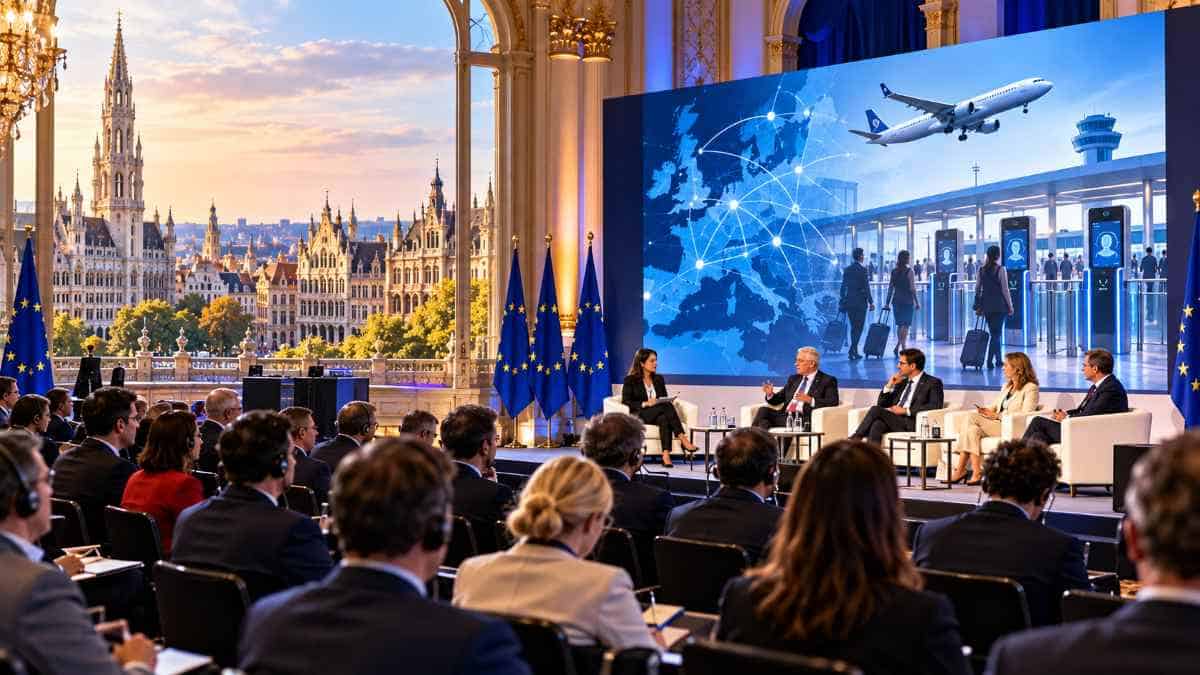
A new era of discussions was set out on 29 September 2026 in Brussels with the Euronews Travel & Tourism Summit, where policymakers discussed the changing nature of tourism within the context of the challenges facing the European travel sector. This conference took place in Albert Hall, and it came after the busiest European summer when it comes to air traffic. According to data from EUROCONTROL, the daily average number of flights reached 35,959 over the months of July and August, and 37,659 flights were registered on 24 July, which marked a new record for the network.
Europe’s Record Summer Raises the Pressure
Advertisement
Advertisement
The scale of summer aviation matters because tourism growth is no longer taking place in a low-volume environment. Europe’s airports and airspace systems are handling sustained demand while destinations face congestion, heatwaves and pressure on local communities.
European Travel Commission CEO Eduardo Santander described climate change as the biggest threat facing tourism and called for a more coordinated response. The discussion linked tourism resilience with transport planning, better connections and investment.
Advertisement
Advertisement
The message from Brussels was not simply to reduce visitor numbers. Speakers examined how tourism flows can be managed, with attention to where travellers go and whether local infrastructure can support them.
EES Has Already Changed Europe’s External Borders
Advertisement
Advertisement
The European Union’s Entry/Exit System is no longer a future rollout. It became fully operational on 10 April 2026 across the external borders of the 29 countries using the system.
The EES records travel-document details, facial images and fingerprints of eligible non-EU nationals travelling for short stays. It replaces manual passport stamping with digital entry and exit records and supports automated checks for overstays and identity fraud.
For airports, the transition represents a major operational change. Border authorities, airlines and passengers have adapted to biometric registration and new data flows.
From Border Technology to Passenger Flow
The summit’s connectivity debate placed border processing within a larger question: how can Europe make travel easier without overwhelming popular gateways and destinations?
Digital border systems can reduce some manual procedures, but they cannot solve congestion by themselves. Airport capacity, air traffic management, rail connections, public transport and visitor distribution all influence the experience.
Advertisement
Advertisement
That is why secondary destinations are becoming increasingly important.
MEP Daniel Attard said Europe needs better connections to places that could benefit from tourism but currently lack the infrastructure to receive more visitors. Investment in rail, airports and other connections could help redirect some demand away from saturated locations.
Overtourism Shifts Towards Visitor Management
Managing visitor flows was one of the summit’s clearest themes. Rather than treating overtourism only as a problem of absolute visitor numbers, speakers examined how destinations can improve distribution.
This includes encouraging travellers towards less-visited neighbourhoods, cities and regions, extending stays and developing stronger links between major gateways and secondary destinations.
Central European tourism leaders also argued for stronger cross-border cooperation, suggesting that neighbouring countries could be marketed as interconnected destinations. Short distances between cities make multi-country itineraries particularly suitable for this model.
Advertisement
Advertisement
Predictive Tourism Needs Better Data
Digital visitor management depends on data.
Airports process large volumes of passenger information, while destinations use booking patterns, mobility data and accommodation statistics to understand demand. The next step is using those datasets to anticipate pressure before a destination reaches its limits.
However, the Brussels summit did not establish a single EU-wide quota system for inbound visitors. Nor did it announce a continent-wide mandatory predictive visitor-distribution platform.
Instead, discussions pointed towards more coordinated management, better infrastructure and smarter use of available data.
Aviation and Tourism Must Work Together
Advertisement
Advertisement
The record summer showed why tourism policy cannot be separated from aviation.
EUROCONTROL reported that 72.6% of European flights arrived on time during summer 2026, while air traffic flow-management delays fell compared with 2025 despite higher traffic. Yet some markets continued to experience severe pressure where airport and air-traffic-control capacity struggled to keep pace with demand.
For destinations, the challenge is broader than attracting visitors. They also need reliable connections, accommodation and infrastructure capable of handling peak demand.
Europe Looks Beyond the Numbers
The summit in Brussels gave a view of the start of a more complicated era for tourism in Europe. While the demand for international tourism is still high, there is an increasing need to find out how that demand can be managed, not only increased. Digital borders, biometric technology, data, and improved connectivity are among the instruments of this strategy. The introduction of the EES system can serve as the clearest evidence of this digital transition already underway. Visitor flow management is another important aspect, with tourist destinations working on distributing tourism flows in order to relieve pressure on certain areas. What is likely to come from it is the creation of a better-connected European tourism system that will direct tourists to different locations. The key task here is to ensure expansion and connectivity without overburdening the destination points.
Advertisement
