
American Airlines Joins United, Delta, ANA, Lufthansa, Air India as SFO Delays Quadruple to Twenty Minutes, Japan, China, South Korea, India Hit Hard by FAA’s Parallel Landing Ban at San Francisco International Airport

Published
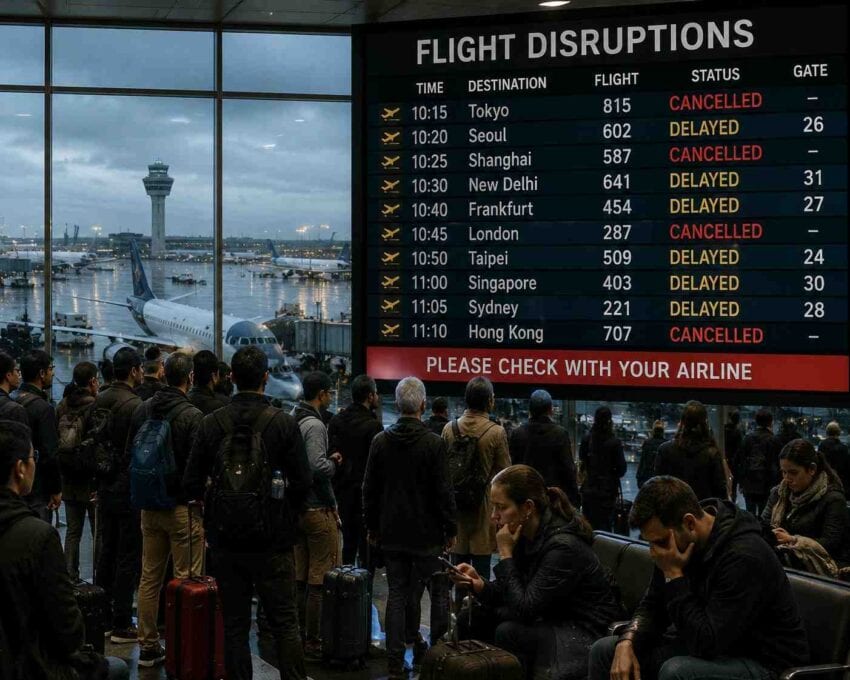
Image generated with Ai
Flight disruptions 2026 are intensifying at San Francisco International Airport (SFO) after the FAA parallel landing ban reduced runway efficiency during peak operating hours. Combined with ongoing runway modernization work, the change has triggered a sharp rise in delays across major international routes. Airlines including American Airlines, United Airlines, Delta Air Lines, ANA, Lufthansa, and Air India are now experiencing widespread schedule disruption. Key travel markets such as Japan, China, South Korea, and India are among the most affected, with average delays reaching around 20 minutes, nearly four times previous levels.
WHAT IS CAUSING THE FLIGHT DISRUPTIONS 2026 AT SFO?
The main driver of disruption is the FAA restriction on parallel landings at SFO, introduced to improve safety margins between closely spaced runways.
Advertisement
Advertisement
SFO’s runways are separated by approximately 750 feet, one of the narrowest configurations in the United States, limiting simultaneous landing operations under stricter radar-based sequencing.
Key operational causes
- FAA parallel landing restriction
- One-third reduction in landing capacity
- Ongoing runway modernization project
- Radar-based sequencing replacing visual approaches
- Peak-hour congestion between 1 PM and 9 PM
This creates a structural bottleneck rather than a seasonal disruption.
Advertisement
Advertisement
AIRLINES MOST IMPACTED BY SAN FRANCISCO AIRPORT DELAYS
The impact is concentrated among major long-haul international carriers operating transpacific and transatlantic networks.
Major airlines impacted
- American Airlines
- United Airlines
- Delta Air Lines
- ANA (All Nippon Airways)
- Lufthansa
- Air India
These carriers depend heavily on SFO as a transpacific gateway hub connecting Asia, Europe, and North America.
Advertisement
Advertisement
Operational impact on airlines
- Increased aircraft turnaround delays
- Higher missed connection rates
- Increased fuel burn due to holding patterns
- Reduced schedule reliability on long-haul routes
- Restructuring of arrival and departure banks
SFO DELAYS 2026: KEY NUMBERS AND DATA INSIGHTS
The operational slowdown is now measurable across multiple performance indicators.
Delay statistics
- Average delays increased from ~5 minutes to ~20 minutes
- Peak-hour flights show 50%+ delay probability
- Departure delays rising faster than arrivals in multiple datasets
- Overall flight disruption levels increased by ~1.8× year-on-year
Operational pattern
- International flights most affected
- Domestic flights moderately impacted
- Morning departures show lower delay rates
- Evening peak hours show highest congestion
COUNTRIES MOST AFFECTED BY FLIGHT DISRUPTIONS 2026
SFO serves as a major Pacific gateway, and disruptions are heavily concentrated in long-haul international corridors.
Advertisement
Advertisement
Japan
High-frequency Tokyo–SFO routes face extended arrival sequencing delays, affecting business travel and US domestic connections.
China
Shanghai and coastal routes experience longer holding patterns and cargo scheduling disruptions during peak traffic windows.
South Korea
Seoul Incheon–SFO flights face variability in arrival timing, impacting semiconductor and tech-sector travel schedules.
India
US tech diaspora travel is affected, with increased risk of missed connections on one-stop itineraries via West Coast hubs.
Advertisement
Advertisement
Germany and United Kingdom
Frankfurt and London routes face secondary delays due to congestion in US domestic transfer networks.
IMPACT ON TOURISM AND HOSPITALITY INDUSTRY

Image generated with Ai
The consequences of flight disruptions 2026 extend beyond aviation into tourism economics.
Tourism impact
- Reduced reliability of short-stay travel itineraries
- Increased preference for alternative gateways such as Los Angeles and Seattle
- Longer buffer requirements affecting itinerary planning
- Lower efficiency in packaged tourism schedules
Hospitality impact
- Delayed hotel check-ins due to late arrivals
- Reduced effective stay duration for business travelers
- Increased operational strain during peak travel hours
- Scheduling inefficiencies for tours and transfers
AIRLINE ROUTE OPERATIONS IMPACT TABLE
| Airline | Key Routes Affected | Primary Impact |
|---|---|---|
| American Airlines | SFO–London, SFO–Dallas | Hub connection delays |
| United Airlines | SFO–Tokyo, SFO–Sydney | Transpacific disruption |
| Delta Air Lines | SFO–Seoul, SFO–Atlanta | Domestic connection misses |
| ANA | Tokyo–SFO | Arrival sequencing delays |
| Lufthansa | Frankfurt–SFO | Extended holding patterns |
| Air India | Delhi–SFO | Increased US connection risk |
WHAT TRAVELERS SHOULD DO
With ongoing flight disruptions 2026 at SFO, travelers are advised to adjust planning strategies.
Recommended actions
- Check flight status regularly before departure
- Arrive earlier for international departures
- Maintain 2–3 hour connection buffers
- Use alternative Bay Area airports when possible
- Choose flexible booking options with rebooking support
- Monitor airline alerts for real-time changes
Booking strategy
- Prefer morning departures for lower delay risk
- Avoid tight same-day domestic connections
- Choose refundable or flexible fare classes
BROADER INDUSTRY IMPLICATIONS
The FAA’s parallel landing restriction highlights structural limits in high-density airport systems.
Key implications
- Reduced peak-hour efficiency at major hubs
- Greater reliance on secondary airports
- Higher operational costs for airlines
- Potential redistribution of transpacific traffic flows
SFO remains a critical international gateway, but its capacity ceiling is now more constrained under safety-driven sequencing rules.
FREQUENTLY ASKED QUESTIONS
Why are flight disruptions 2026 increasing at San Francisco Airport?
Due to FAA parallel landing restrictions combined with runway construction, reducing landing capacity and increasing delays.
Advertisement
Advertisement
Which airlines are most affected by SFO delays?
American Airlines, United Airlines, Delta Air Lines, ANA, Lufthansa, and Air India due to heavy reliance on SFO international routes.
Which countries are most impacted by SFO disruptions?
Japan, China, South Korea, India, Germany, and the United Kingdom are most affected due to high-volume long-haul traffic.
AUTHOR’S OBSERVATION
The disruption at SFO reflects a broader aviation shift where safety-focused regulatory decisions significantly reshape operational efficiency. While safety margins improve, congestion at major hubs intensifies, forcing airlines and travelers into more flexible, less predictable travel patterns.
Advertisement
