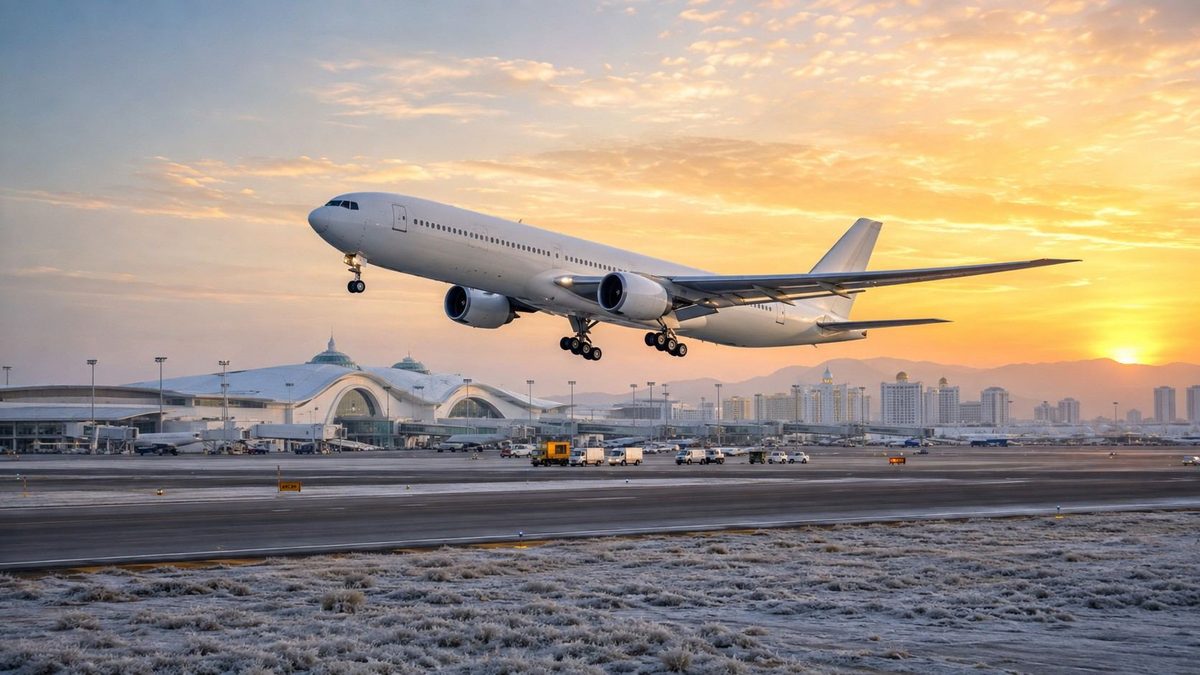
Image generated with Ai
Turkmenistan Airlines will expand winter flights from Ashgabat to Seoul, Milan Ho Chi Minh City and Kazan starting on October 25 2026. This move strengthens air links between Ashgabat and key cities in Asia, Europe and Russia. The updated timetable includes flights on all four routes with changes to departure times across the airline’s international network. The winter flight schedule update matters because it gives travellers options for both business and leisure travel. It also helps raise Ashgabat’s profile as a gateway. However the expansion is not an increase in service. Instead it focuses on boosting frequency on selected routes. For example flights, to Delhi will be reduced. Several other destinations will keep their weekly flight schedules during the winter season.
The winter programme introduces targeted capacity increases across four established international routes. Seoul, Milan, Ho Chi Minh City and Kazan will each receive more flights from Ashgabat when the new timetable takes effect on 25 October 2026.
The official schedule does not present these services as new destinations. Turkmenistan Airlines already serves all four cities, but the increased frequencies will give passengers additional departure choices during the 2026–27 winter season.
Kazan receives the largest increase. Flights between Ashgabat and the Russian city will rise from four to six weekly departures, creating an almost daily service.
Advertisement
Advertisement
Ho Chi Minh City and Milan will each increase from two to three weekly flights. Seoul will move from one to two services per week, doubling the frequency available on the route.
The changes are confirmed in the official Turkmenistan Airlines international timetable. All published times are local and remain subject to operational changes.
The schedule comparison shows where capacity is increasing and where services are being reduced. It also prevents the winter programme from being incorrectly described as growth across every international route.Route from Ashgabat Existing weekly frequency Frequency from 25 October 2026 Confirmed change Seoul 1 2 Increase of 1 Ho Chi Minh City 2 3 Increase of 1 Milan 2 3 Increase of 1 Kazan 4 6 Increase of 2 Istanbul 12 scheduled departures 13 scheduled departures Increase of 1 Delhi 3 2 Reduction of 1 Beijing 2 2 No frequency change Bangkok 2 2 No frequency change Kuala Lumpur 2 2 No frequency change London 2 2 No frequency change Frankfurt 2 2 No frequency change
The increases should therefore be understood as a network adjustment based on individual markets. They are not evidence that every international service is expanding.
Passengers should also distinguish between frequency changes and timing changes. Some destinations keep the same number of weekly flights but receive different departure or arrival times under the winter programme.
The Ashgabat–Seoul route currently operates once each week. From 25 October, the outbound timetable lists services on Tuesdays and Thursdays.
The Tuesday flight is scheduled to leave Ashgabat at 16:50 and arrive in Seoul at 04:30 the following day. The Thursday departure is scheduled for 06:40, with arrival at 18:20.
Return services are listed from Seoul on Wednesdays and Thursdays. This gives travellers two weekly options instead of one, although the pattern includes an overnight journey on the Tuesday departure.
The increase matters for passengers travelling between Turkmenistan and South Korea for business, education, family visits and tourism. Greater frequency can make shorter journeys more practical and reduce the need to build an itinerary around a single weekly flight.
A twice-weekly operation also provides more flexibility when travellers face a change to their original plans. However, it still requires careful planning because the service is not daily.
Ashgabat–Ho Chi Minh City services will increase from two to three weekly departures. Flights are listed on Tuesdays, Thursdays and Fridays under the winter timetable.
The Tuesday service is scheduled to leave Ashgabat at 16:10. The Thursday flight departs at 08:00, while the additional Friday service is timed for 17:20.
The new Friday departure adds another option for travellers heading to Vietnam. It could be useful for passengers planning weekend departures or connecting travel after completing a working week.
Return services are listed from Ho Chi Minh City on Wednesdays, Thursdays and Saturdays. Passengers must check the exact arrival date because two outbound services reach Vietnam after midnight on the following day.
The added frequency improves direct access between Turkmenistan and southern Vietnam. It also strengthens links to Ho Chi Minh City, one of Vietnam’s main commercial and visitor gateways.
Flights from Ashgabat to Milan will rise from two to three each week. The winter schedule lists departures on Wednesdays, Fridays and Saturdays.
The Wednesday flight is due to leave Ashgabat at 13:35. The new Friday rotation departs at 02:35, while the Saturday service leaves at 12:05.
Return flights from Milan are scheduled on Wednesdays, Fridays and Saturdays. Travellers using the early Friday departure should pay close attention to the date shown on their ticket and plan their airport journey accordingly.
The extra service strengthens Turkmenistan’s direct connection with Italy. Milan serves leisure visitors, business travellers, students and passengers travelling onward within northern Italy.
Three weekly services provide greater itinerary flexibility than the previous twice-weekly pattern. They may also make the route more usable for shorter journeys that would otherwise require a lengthy stay or an indirect return.
Kazan receives the strongest confirmed increase in the winter programme. Flights will rise from four to six weekly departures from Ashgabat.
The timetable lists outbound services on Tuesday, Wednesday, Thursday, Friday, Saturday and Sunday. Monday is the only day without a scheduled Ashgabat–Kazan departure.
This near-daily pattern gives travellers substantially more choice than the current four-flight schedule. It can support family travel, education, business movement and wider connections between Turkmenistan and Russia.
Kazan is a major transport, cultural and commercial centre in the Russian Federation. The city also serves as the capital of Tatarstan and has established cultural links with communities across Central Asia.
The expanded timetable reduces the gaps between services. Travellers will have more alternatives if one date is unsuitable, although seats, fares and operational availability will still vary.
The winter programme also contains a reduction. Ashgabat–Delhi services are currently scheduled three times per week, but the timetable effective 25 October lists two weekly departures.
Flights will operate on Wednesdays and Thursdays. The existing Saturday service does not appear in the published winter schedule.
The Wednesday flight is scheduled to leave Ashgabat at 01:40 and reach Delhi at 05:35. Thursday’s service is listed to depart at 09:35 and arrive at 13:30.
Return flights from Delhi are scheduled on the same two days. This reduction means Indian travellers will have less weekly flexibility than under the preceding timetable.
Passengers who planned to travel on a Saturday should check whether their booking has been affected. They should use the airline’s official booking channels to confirm availability, rebooking conditions and current departure times.
The Delhi reduction is important because it shows why the programme should not be described as a universal expansion. Capacity is being increased in selected markets while being reduced elsewhere.
Istanbul remains the most frequently served international destination in the published Turkmenistan Airlines timetable. The winter programme includes several flight numbers operating across different days.
A comparison of the listed departures indicates an increase from 12 to 13 scheduled weekly flights. New or redistributed Wednesday and Friday rotations help create the expanded pattern.
The route’s high frequency gives passengers more choice than other international destinations in the network. Istanbul can also provide onward access to destinations across Europe, the Middle East and other regions through separate connections.
Travellers making onward journeys must check whether their tickets are issued as one itinerary or as separate bookings. Separate tickets can create additional risk if an arriving flight is delayed and the next airline does not protect the connection.
The published timetable confirms frequency and timing information. It does not guarantee a protected connection with another carrier.
Several services continue without a confirmed frequency increase. Beijing, Bangkok, Kuala Lumpur, London and Frankfurt retain their existing number of weekly departures, although some timings change.Destination Winter frequency Operating pattern from Ashgabat Beijing 2 weekly Friday and Sunday Bangkok 2 weekly Friday and Sunday Kuala Lumpur 2 weekly Tuesday and Thursday London 2 weekly Wednesday and Saturday Frankfurt 2 weekly Wednesday and Saturday
London services remain twice weekly, but the local arrival times change because of the seasonal clock difference in the United Kingdom. Frankfurt also retains two weekly flights with revised local timings.
Bangkok and Beijing continue with two departures each week. Kuala Lumpur retains its Tuesday and Thursday pattern, although the published departure times change.
These revisions can affect hotel bookings, airport transfers, domestic connections and check-in plans. Travellers should not assume that a familiar flight will retain the same departure time throughout the winter.
Ashgabat International Airport is the centre of Turkmenistan Airlines’ domestic and international network. The airport connects the capital with destinations across Asia, Europe and Russia while also supporting domestic travel to regional cities.
The winter increases broaden the range of dates available to passengers using Ashgabat as their starting point. They may also help travellers combine international flights with domestic services to Mary, Dashoguz, Turkmenabat, Turkmenbashy, Balkanabat and Kerki.
Domestic schedules require separate checking because connection times are not automatically guaranteed. Passengers should allow sufficient time for baggage collection, check-in, security and any change between domestic and international terminals or processing areas.
Ashgabat’s geographical position gives it potential as a bridge between Central Asia and surrounding regions. Yet the scale of that role depends on practical matters such as visa requirements, through-ticketing, baggage arrangements and coordinated schedules.
The winter timetable confirms flight operations. It does not announce a new transit policy or visa reform.
The expanded services arrive during a period in which Turkmenistan is promoting a broader range of tourism experiences. These include cultural heritage, archaeological sites, ecological attractions, resorts and modern urban destinations.
At the Turkmentravel 2026 International Tourism Exhibition and Conference, official information highlighted plans to expand tourism routes, improve infrastructure, strengthen service standards and develop cooperation with international travel companies.
The official government report on Turkmentravel 2026 stated that around 70 domestic and international companies participated. It also reported that approximately 300 tourism companies were operating within Turkmenistan at that time.
Those figures describe the industry’s business base. They should not be confused with visitor arrivals, tourism revenue or aviation passenger totals.
The government report did not publish a complete annual series for international tourist arrivals, tourism receipts, sector employment or tourism’s contribution to gross domestic product. Those figures should not be estimated without an official statistical release.
Turkmenistan’s visitor appeal includes ancient settlements, desert landscapes, traditional culture, modern architecture and the Caspian Sea coast. International air access through Ashgabat provides an entry point for many of these experiences.
The country has three UNESCO World Heritage properties: State Historical and Cultural Park Ancient Merv, Kunya-Urgench and the Parthian Fortresses of Nisa. These sites reflect different periods of Central Asian history and form part of Turkmenistan’s cultural tourism offering.
Merv lies near the modern city of Mary. Domestic flights between Ashgabat and Mary can help visitors continue towards the archaeological landscape after entering the country.
Kunya-Urgench is located in northern Turkmenistan and is generally approached through the Dashoguz region. Nisa stands closer to Ashgabat and can be included in a visit based in the capital.
Official heritage information identifies cultural preservation and tourism development as linked priorities. A government overview of Turkmenistan’s historical and cultural heritage describes the country’s archaeological and cultural assets without providing current visitor totals.
More weekly flights can create additional arrival and departure combinations for hotels and tour operators. A traveller may be able to select a shorter stay or avoid an unnecessary overnight stop caused by a limited flight pattern.
Tour operators can also design itineraries around a larger choice of international arrival dates. This is especially relevant for routes that previously operated only once or twice each week.
The Seoul increase may make short business or cultural trips more practical. Three weekly Ho Chi Minh City and Milan services create additional options for organised groups and independent passengers.
Kazan’s near-daily pattern offers the strongest scheduling flexibility. It could support regular movement throughout the winter rather than concentrating passengers around four departure days.
These are operational opportunities, not confirmed demand forecasts. The airline has not published projected passenger numbers, load factors or expected tourism spending associated with the increases.
Air connectivity can support visitor spending, hotel demand, employment and commercial activity. However, credible economic analysis must remain tied to published evidence.
No official revenue forecast accompanies the winter timetable. Turkmenistan Airlines has not stated how many additional seats will be offered, which aircraft will operate each rotation or how much passenger traffic is expected.
The timetable also does not provide forecasts for hotel occupancy, tourism receipts, job creation or foreign investment. Assigning precise economic benefits would therefore be unsupported.
The confirmed effect is narrower but still important. Travellers receive additional weekly options on four routes, Istanbul gains another scheduled departure, and Ashgabat’s international timetable becomes more flexible in selected markets.
Businesses serving passengers may gain more opportunities, but the outcome will depend on demand, fares, visa accessibility, tour availability and the operational reliability of the schedule.
The winter schedule does not change Turkmenistan’s entry rules. International visitors must confirm the visa or authorisation requirements that apply to their nationality and purpose of travel.
A flight listing does not guarantee entry. Passengers should secure every required document before departure and ensure that their passport remains valid for the required period.
Travellers connecting through Ashgabat should determine whether they need to pass immigration, collect baggage or change terminals. The answer can depend on how the ticket was issued and whether baggage is checked through to the final destination.
Passengers should obtain written confirmation from the airline or an authorised booking office if their transit situation is unclear. They should not rely solely on general social-media advice.
Entry conditions can change independently of the flight timetable. Travellers should check official consular information again shortly before departure.
The Turkmenistan winter flights schedule begins on 25 October 2026. Travellers with bookings close to that date should confirm whether their flight follows the preceding timetable or the new winter programme.
Important checks include:
Flights and departure times can change for operational, regulatory, weather or airspace reasons. The official timetable itself advises passengers that schedules may be adjusted.
The confirmed winter programme begins on 25 October 2026. It establishes higher frequencies to Seoul, Ho Chi Minh City, Milan and Kazan while maintaining several other international routes.
The government has separately identified expanded tourism routes, improved infrastructure, better service quality and stronger international cooperation as tourism priorities. These objectives provide wider policy context for the aviation changes.
No official announcement confirms further international destinations beyond those shown in the current timetable. There is also no published target for the number of passengers the expanded services will carry.
Future route growth should therefore be reported only after it appears in an official airline schedule, government announcement or regulatory filing. The current evidence supports targeted winter frequency increases, not claims of unlimited network expansion.
The official international timetable takes effect on 25 October 2026. Passengers travelling around the transition date should confirm which schedule applies to their booking.
Seoul increases from one to two weekly flights. Ho Chi Minh City and Milan rise from two to three, while Kazan grows from four to six. Istanbul also receives an additional scheduled weekly departure.
No. Delhi falls from three to two weekly services. Beijing, Bangkok, Kuala Lumpur, London and Frankfurt retain their existing frequencies, although some departure and arrival times change.
Turkmenistan winter timetable offers travel choices between Ashgabat and four key international markets starting on 25 October 2026. Seoul receives a weekly flight and Ho Chi Minh City as well as Milan each see their weekly flights increase to three. Kazan gets the boost rising from four to six weekly flights. The programme also changes departure times adds flights to Istanbul and cuts Delhi flights to two per week. Travellers should view this as a network change, not a full expansion, on all routes. Turkmenistan winter flight schedule can help tourism and business travel. Passengers must check current times and entry rules before leaving.
Advertisement
Tags: Airline News, Ashgabat, Kazan, Milan Ho Chi Minh City, Seoul
Advertisement
Advertisement












Wednesday, September 2, 2026

Tuesday, September 1, 2026

Wednesday, September 2, 2026

Wednesday, September 2, 2026

Tuesday, September 1, 2026

Tuesday, September 1, 2026

Wednesday, September 2, 2026

Wednesday, September 2, 2026



