

Argentina and Other Countries Push New Citizenship-by-Investment Programmes as Nauru and Saint Vincent Join Emerging Trend

Updated
Published
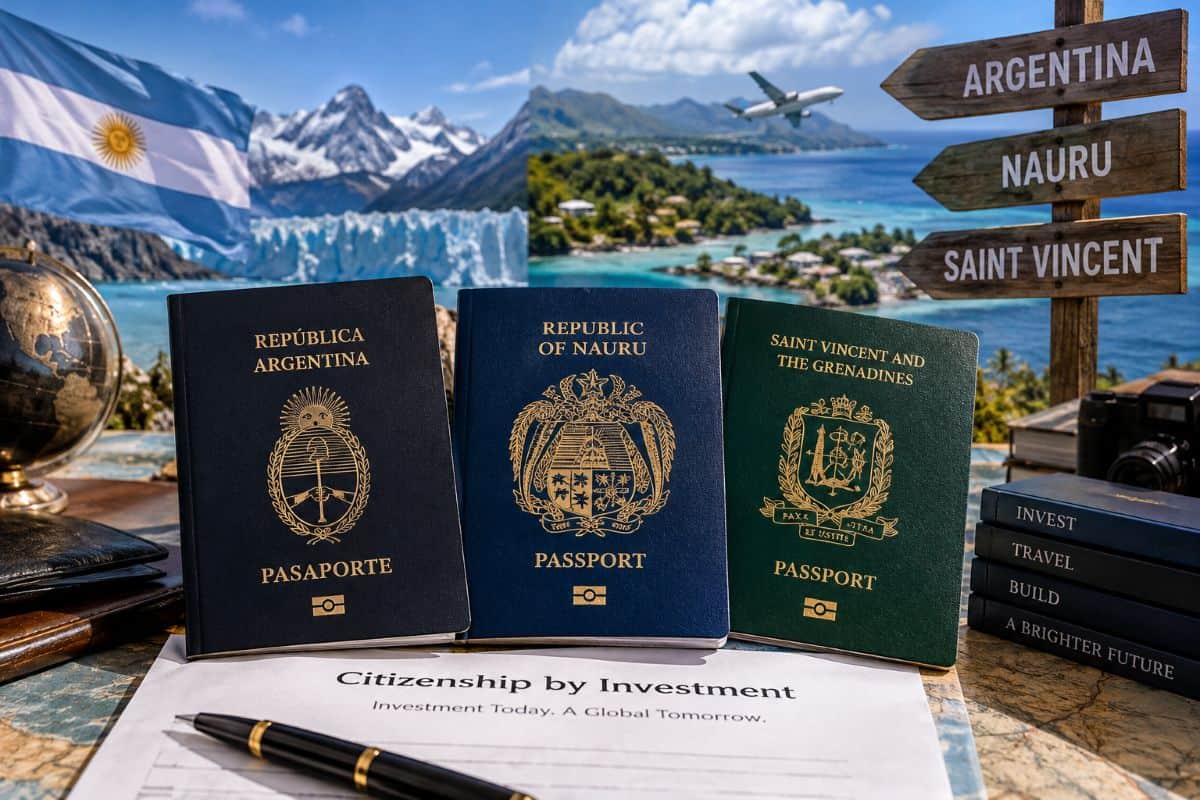
Argentina and Others Push New Citizenship-by-Investment Programmes as Nauru and Saint Vincent Join Emerging Trend because governments are increasingly using investor citizenship to attract capital, support development and strengthen economic resilience. Argentina has introduced a new framework centred on qualifying investment, while Nauru has already launched a citizenship programme linked to climate and infrastructure financing. Saint Vincent and the Grenadines is also preparing its own entry into the sector, with official plans focused on investment mobilisation, debt management and long-term resilience. Although these programmes differ in price, structure and residency rules, they point to a broader shift in how smaller and emerging economies are using citizenship policy as a tool to secure international investment.
Why Is Argentina Introducing Citizenship by Investment Now?
Argentina formally announced the launch of its Citizenship by Investment Programme on 2 October 2026, with applications expected to begin during the fourth quarter of 2026.
The Government said the initiative forms part of a broader strategy to increase international integration, strengthen the investment climate and attract foreign capital. The programme provides two main routes. A principal applicant can make a US$350,000 non-refundable contribution to the National Treasury or subscribe to a specially created US$800,000 public security.
Argentina has also built family provisions into the programme. A spouse or qualifying child aged 18 to 25 can apply through an additional US$100,000 contribution, while a child under 18 requires US$25,000. The Government states that a family consisting of the main applicant, spouse and two minor children could therefore apply for US$500,000 in total.
Advertisement
Advertisement
Argentina’s Official Citizenship-by-Investment Structure
| Applicant or route | Official amount |
|---|---|
| Main applicant — Treasury contribution | US$350,000 |
| Main applicant — government security | US$800,000 |
| Spouse | US$100,000 |
| Child aged 18–25 | US$100,000 |
| Child under 18 | US$25,000 |
| Example family of four | US$500,000 |
The table shows why the widely used “US$350,000 passport” description is incomplete. The amount refers to the lowest route for the principal applicant, while family composition can substantially increase the total cost.
How Does Argentina’s Investment Route Differ From Normal Naturalisation?
Argentina’s ordinary naturalisation route generally requires a foreign national aged over 18 to have lived legally and continuously in the country for two years before applying.
Advertisement
Advertisement
The investment route changes that framework significantly.
Argentina’s updated Citizenship Law allows foreigners who can demonstrate a “relevant investment” to seek citizenship regardless of the length of their residence. The Ministry of Economy has authority to determine which investments qualify.
That distinction makes the new scheme more than a conventional residency-by-investment programme. Applicants are not simply being offered a residence permit followed by a long citizenship waiting period.
However, investment does not mean automatic approval. Argentina says applications will undergo rigorous assessment designed to protect national security, financial-system integrity and the international standing of Argentine citizenship. The Government has also committed to due-diligence and financial-transparency standards aligned with OECD and FATF recommendations.
Why Is Nauru One of the Closest New Comparisons?
Nauru provides one of the clearest recent examples of a newly established citizenship-by-investment programme.
Its Economic and Climate Resilience Citizenship Program allows eligible foreign investors to obtain Nauruan citizenship by contributing to the national Treasury Fund. The Government says the standard contribution begins at US$105,000 for a single applicant.
Advertisement
Advertisement
A family of two to four requires a contribution of US$110,000, while a family of five or more starts at US$115,000. Additional application and due-diligence charges apply.
Nauru has given the programme a distinctive policy objective. Rather than presenting it solely as an immigration product, officials explicitly connect the revenue with climate resilience and sustainable development.
The Government says a major national challenge is the long-term ambition to move about 90% of the population living near the coast to higher ground, where significant infrastructure development is required.
Argentina and Nauru Compared
| Feature | Argentina | Nauru |
|---|---|---|
| Programme position | Announced, applications expected Q4 2026 | Operational |
| Lowest principal contribution | US$350,000 | US$105,000 |
| Alternative financial route | US$800,000 government security | Treasury contribution model |
| Main policy focus | Foreign capital and investment | Climate resilience and development |
| Family pricing | Separate contributions by dependent | Family contribution bands |
| Due diligence | Required | Required |
| Residence emphasis | Investment route bypasses normal two-year requirement | Programme structured as direct citizenship route |
The comparison demonstrates that the programmes share the objective of attracting international capital, but their economics and national priorities are very different.
What Makes Nauru’s Programme Different From a Conventional ‘Golden Passport’?
Nauru explicitly connects citizenship revenue with environmental vulnerability.
Its programme office says funding can support national resilience initiatives as the Pacific nation confronts severe geographic and climate constraints. Official information also states that applicants must have a clean personal background and prove the legitimate source of their funds.
Advertisement
Advertisement
The programme advertises an expected processing period of roughly three to four months, subject to screening and approval.
Due diligence is a central component. Nauru says the system is designed around Financial Action Task Force standards and includes extensive checks intended to prevent applicants associated with financial crime or security risks from obtaining citizenship.
For readers comparing programmes, this matters. The headline investment figure is only one element. Application fees, background checks, qualifying dependants, legal documentation and government approval all influence the actual cost and complexity of the process.
Why Is Saint Vincent and the Grenadines Entering This Market?
Saint Vincent and the Grenadines represents another significant development because its Government has officially announced plans to establish a Citizenship by Investment Programme.
In its 2026 Budget Address, the Government said it intended to launch the programme as part of a strategy to secure a more resilient and sustainable financial future.
The Budget explicitly links the initiative with the economic vulnerabilities faced by Small Island Developing States, including recurring climate-resilience costs and the fiscal risks associated with excessive reliance on traditional debt.
Advertisement
Advertisement
The Government says the programme will include:
- a mandated minimum investment floor;
- a residency requirement;
- continuous due diligence;
- multi-layered background checks;
- adherence to emerging international standards.
Importantly, the Government has not yet published a final official investment price on its citizenship website. The Prime Minister’s Office currently states “Citizenship by Investment Coming Soon” and says further requirements will be published later.
Where the Three Programmes Stand
| Country | Current official position | Minimum publicly confirmed amount | Main stated objective |
|---|---|---|---|
| Argentina | Applications expected Q4 2026 | US$350,000 | Attract foreign investment |
| Nauru | Operational | US$105,000 | Climate resilience and development |
| Saint Vincent and the Grenadines | Programme announced / details forthcoming | Not yet officially published | Capital mobilisation, resilience and lower debt dependence |
This table is particularly important for readers because it prevents three very different stages of programme development from being treated as identical.
Is This Really an Emerging Global Citizenship-by-Investment Trend?
The evidence supports describing it as an emerging development, but not as a worldwide rush.
Nauru already operates its programme. Argentina has formally announced its framework and expects applications in the fourth quarter of 2026. Saint Vincent and the Grenadines has committed to establishing a programme, although its final pricing and operational rules remain pending.
The common denominator is economic policy.
Advertisement
Advertisement
Argentina wants additional foreign capital. Nauru is linking citizenship revenue with climate resilience. Saint Vincent and the Grenadines is presenting investor citizenship as a sovereign capital-mobilisation tool that could reduce dependence on conventional debt.
That shared logic is more important than the phrase “golden passport”.
In all three cases, government policy frames citizenship as part of a wider economic strategy involving investment, national development and fiscal resilience rather than merely offering travel privileges to wealthy applicants.
Argentina’s Autumn Appeal Adds Lifestyle Context to Its Citizenship-by-Investment Programme
Argentina’s autumn season, which generally runs from March to May, gives prospective investors and long-stay visitors a useful glimpse of the country beyond its financial opportunities. Buenos Aires becomes milder, Patagonia moves into striking red and gold landscapes, while Mendoza combines cooler vineyard weather with harvest-season experiences. This lifestyle dimension is relevant to Argentina’s new Citizenship-by-Investment Programme because applicants are not simply assessing an investment route; they may also be evaluating the country as a place for longer-term personal, business or family connections. The programme’s investment pathway can therefore intersect naturally with travel discovery, as visitors experience Argentina’s cities, wine regions, mountains and cultural attractions before making wider decisions about residency, citizenship and economic engagement.
What Should Investors and Travellers Compare Before Applying?
Potential applicants should look beyond the advertised minimum contribution.
The first factor is the true family cost. Argentina, for example, charges separately for spouses and children, while Nauru uses different contribution bands according to family size.
Advertisement
Advertisement
The second factor is residence. Argentina’s investment pathway allows qualifying applicants to bypass the normal two-year residence requirement, while Saint Vincent and the Grenadines has stated that its future programme will include a residency requirement.
The third factor is due diligence. All three governments emphasise background checks, financial integrity and security screening.
Investors should also distinguish citizenship from tax residence, investment returns and immigration rights in other countries. Holding citizenship does not automatically produce identical tax or mobility outcomes everywhere.
Above all, applicants should rely on current government rules rather than promotional claims from unofficial intermediaries.
Anup Keshan, Founder and Editor-in-Chief of Travel And Tour World
“Argentina, Nauru and Saint Vincent and the Grenadines show how citizenship-by-investment is evolving beyond a simple mobility product and becoming increasingly connected with wider economic priorities. Argentina is focusing on international investment, Nauru is linking its programme directly with climate resilience, while Saint Vincent and the Grenadines is positioning its proposed framework around sustainable financing and lower dependence on debt. For global travellers and investors, this creates new opportunities, but transparency remains essential. Governments must maintain strong due diligence, clear eligibility rules and responsible use of investment proceeds if these programmes are to build credibility and deliver meaningful long-term value.”
Why Are More Governments Considering Investor Citizenship?
Argentina and Others Push New Citizenship-by-Investment Programmes as Nauru and Saint Vincent Join Emerging Trend because these governments are searching for alternative sources of capital to finance development, resilience and economic priorities.
Advertisement
Advertisement
The cause is clear: investment needs are rising, while traditional borrowing can create fiscal pressure. The answer is a tightly regulated citizenship pathway capable of attracting international capital. The reason differs by country. Argentina wants investment and greater international integration. Nauru needs climate-resilience funding. Saint Vincent and the Grenadines wants stronger sovereign financing and reduced debt dependence.
Add Argentina halloween, Shopping Destinations
Advertisement
