
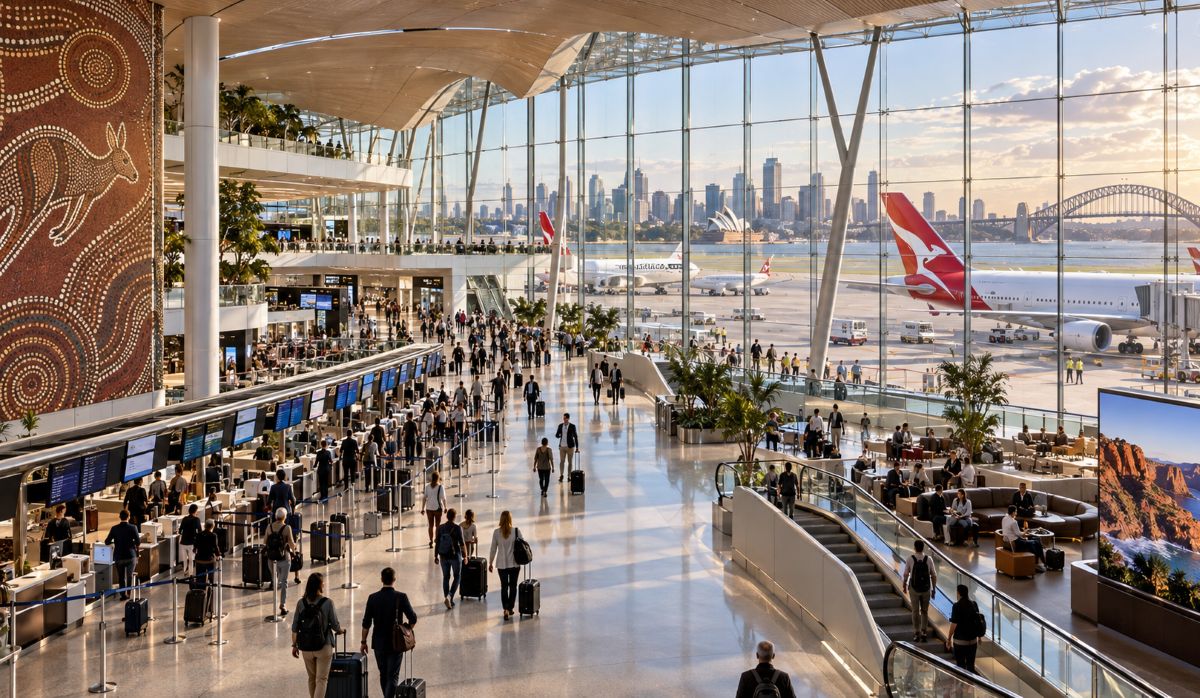
Image generated with Ai
Something I read the other day has put more of a rush on me to start booking flights than it has in the last ten years. Call it a Curse, but I don’t even book flights more than once a year. It has been even longer since I went to Australia, and believe me, I don’t ever want to go to back there again. I haven’t gone to visit in years. It is and has always been a place I don’t ever want to go to again. It is crazy to think how Australian airports can charge ridiculous amounts to see family that was taken from you by the Airport Mafia. Traveling to Australia is a subsidized government trip. You go to see a country that is owned by families of airport Mafia and thieves. You can imagine how much flights will cost coming out of Australia once their airports have been privatized. With these changes, almost all of the airline’s profits go to the airports. It means travel will never be a reasonable option for the passenger. Of course, you get to experience the profitability of the “corporate air mafia” on your hard earned dollars.
Why Are Major Airports in Sydney, Melbourne, Brisbane, and Perth Escalating Operating Charges Ahead of the Busy Spring Season?
Advertisement
Privatised airport operators across Australia are aggressively restructuring commercial contracts with airlines to bankroll an unprecedented nationwide capital investment pipeline. Gateways in Sydney, Melbourne, Brisbane, and Perth are collectively spending between £10 billion and £17 billion over the coming decade to build extra runways, integrate domestic and international terminals, and install fully automated digital baggage facilities. According to official oversight findings, major airport gateways increased their aeronautical capital expenditure by an incredible 43.6% in a single financial year, driving operational fees up to secure massive commercial revenue returns.
These heavy financial commitments allow primary hubs to generate remarkable profit margins while shifting amortisation costs directly onto commercial carriers like Qantas and Virgin Australia. Sydney Airport reported staggering aeronautical profits reaching £300 million, while Perth Airport experienced an extraordinary 73.7% jump in aeronautical revenue to total £68 million. As airport corporations prioritize long-term asset expansions, airlines are left with little choice but to transfer these mounting operational overheads directly to everyday holidaymakers through elevated ticket prices.
Advertisement
How Is Airservices Australia Driving Significant Air Traffic Management Price Hikes Across Skyways in Sydney and Melbourne?
Government-owned air navigation provider Airservices Australia has formally introduced substantial pricing escalations for core air traffic control and aviation rescue firefighting services. Under this newly approved multi-year statutory framework, the national air navigation body is enforcing a weighted average price increase of 12% annually in real terms. This aggressive tariff restructure is specifically designed to modernise Australia’s vast air traffic management system and support initial operational preparations for the upcoming Western Sydney International Airport.
The direct financial result of this statutory reset is an immediate charge increase passed straight to domestic and international travellers flying through busy hubs like Sydney and Melbourne. Standard one-way main-trunk flight tickets now incur an extra statutory burden of £0.80 per passenger, while regional flight routes face a mandatory £0.50 per passenger add-on. By locking in these continuous multi-year price escalations, state aviation regulators are ensuring that essential technology overhauls, such as the ambitious OneSKY flight system, remain fully funded by the traveling public.
What Is the Immediate Financial Impact of the Statutory £40 Federal Passenger Movement Charge on International Flights Leaving Brisbane and Perth?
Advertisement
Advertisement
The Australian Federal Government has officially enacted legislative increases to the statutory Passenger Movement Charge, dealing another financial blow to international travellers departing from hubs like Brisbane and Perth. Collected directly at airport border checkpoints, this statutory departure tax has officially jumped from £36 to £40 per departing passenger. Federal economic projections indicate that this targeted border tax hike will harvest an additional £390 million over the next five years to help offset national security and border processing expenditures.
Because international airlines simply collect this government tax at the point of sale, departing holidaymakers face compounding travel costs before their flights even take off. Overseas tourists visiting iconic natural destinations through major gateways in Brisbane or Perth are finding their overall travel budgets severely stretched. Industry experts warn that stacking heavy federal departure taxes on top of escalating privatised airport fees risks making Australia a significantly less competitive destination for cost-conscious global travellers.
How Will Surging Airport Operating Fees Impact Local Tourism and Regional Businesses Across Sydney, Melbourne, Brisbane, and Perth?
Escalating airport operational fees threaten to disrupt regional travel and diminish tourism competitiveness across iconic Australian hubs including Sydney, Melbourne, Brisbane, and Perth. As privatised airport operators pass their vast capital expansion costs down to commercial airlines, ticket prices inevitably rise, forcing families to rethink their spring vacation budgets. Consequently, international visitors and domestic holidaymakers are left with far less discretionary income to spend on local hospitality venues, boutique hotel accommodation, and regional tour operators.
Tourism leaders across regional coastal communities and major metropolitan cities express deep concern that relentless aviation fee hikes will deter budget-conscious travelers during peak holiday periods. When airfares swallow the majority of a family’s holiday budget, surrounding local businesses suffer immediate drops in foot traffic and overall visitor expenditure. Unless passenger traffic remains exceptionally strong, the compounding weight of airport charges, federal taxes, and navigation fees could severely stall the broader economic recovery of the Australian tourism sector.
What Regulatory Oversight Measures Are Being Proposed to Control Escalating Airport Costs in Major Metropolitan Hubs?
Aviation industry advocacy groups argue that airport operational charges have been escalating by roughly 14% annually, vastly outstripping general consumer price inflation across the country. In response to these growing concerns, national competition watchdogs emphasize that major metropolitan airports operate as powerful natural monopolies within their respective capital cities. To prevent unfair pricing practices, regulatory authorities are pushing for comprehensive reforms to protect airlines and consumers from unchecked operational fee hikes.
Following recommendations laid out in the government’s official Aviation White Paper, regulators are advocating for the implementation of binding commercial arbitration mechanisms to settle contract disputes between airlines and airport operators. Establishing enforceable financial transparency guidelines will ensure that multi-billion-pound capital expenditure projects remain strictly necessary and reasonably priced. By enforcing stronger regulatory controls, consumer advocates hope to restrain excessive profit margins and ensure air travel remains affordable for everyone.
Which Australian Airports Collect The Highest Aeronautical Revenue Per Passenger From Operating Carriers In Sydney, Melbourne, Brisbane, And Perth?
Sydney Airport commands the domestic market by generating $29.43 in aeronautical revenue per passenger, translating into an aeronautical operating profit of $584.3 million and a 20.8% return on assets. In comparison, Melbourne Airport yields $20.37 per passenger for an operating profit of $236.0 million at a 7.0% return on assets. Brisbane Airport secures $21.93 per passenger, producing $215.5 million in operating profit. Meanwhile, Perth Airport records $21.27 per passenger, achieving a 73.7% jump in operating profit to $130.6 million with a 12.0% return on assets.
The contrast reveals Sydney Airport collects roughly 45% more revenue per passenger than Melbourne, highlighting how specific contract terms directly inflate carrier operational costs. These varying pricing models across capital hubs alter ground fees, ultimately trickling down into base airfare prices for everyday travellers.
How Do Car Parking Profit Margins Exceeding 75% At Gateways In Brisbane, Sydney, Melbourne, And Perth Boost Airport Operating Cash Flows?
Landside non-aeronautical monopolies generate massive cash flow, led by Brisbane Airport’s car parking profit of $125.3 million at a 76.8% margin. Sydney Airport recorded $108.7 million at a 66.3% margin, Melbourne Airport posted $101.3 million at a 59.5% margin, and Perth Airport delivered $66.7 million at a 61.4% margin. Drive-up hourly parking rates reach $25.00 at Brisbane and $24.20 at Sydney. Additionally, access fees charged to rideshare operators, taxis, and public transport grew 18% to reach $69.6 million collectively.
These privatised facilities leverage near-monopolistic control over landside transportation access to secure high profit margins alongside aeronautical fees. By capturing substantial cash reserves through parking and transport levies, airports maintain cash flow buffers that support broader real estate and commercial site developments.
Where Is The $1.5 Billion Annual Infrastructure Capital Expenditure Distributed Across Key Gateways In Melbourne, Brisbane, Sydney, And Perth?
Annual capital investments across major gateways totalled $1.51 billion, led by Melbourne Airport spending $762.1 million—a 48.1% year-on-year increase—on third-runway site preparation, baggage handling upgrades, and international terminal expansions. Brisbane Airport expanded its capital spend by 62.3% to $326.2 million as part of a $5 billion domestic terminal overhaul. Sydney Airport committed $298.7 million, up 31.7%, toward terminal integration and automated security screening. Perth Airport directed $126.3 million toward runway expansions and terminal consolidation works.
These large annual investments expand the regulatory asset base across privatised airport structures. Consequently, operators raise landing and facility charges on airlines to cover long-term asset depreciation and financing costs.
Why Are Aeronautical Revenues Hitting Record Levels Of $2.6 Billion Despite Total Passenger Numbers Remaining Below Historic Levels In Australia?
Passenger throughput across Australia’s four primary gateways reached 120.4 million, with Sydney handling 41.8 million, Melbourne 36.2 million, Brisbane 24.4 million, and Perth 17.5 million. Despite international traffic growing by 32.1% and domestic volumes by 6.7%, overall flight movements remained under historic baselines. Nevertheless, combined aeronautical revenues surged to record levels between $2.6 billion and $2.9 billion.
This financial divergence illustrates how airports generate greater revenue per flight movement despite lower passenger volumes. By recalibrating contractual landing yield rates and service fees, airports protect total earnings even when passenger numbers have not fully recovered.
How Are Surging Operational Expenses Of $23.31 Per Head Impacting Regional Air Transport Networks Outside Sydney, Melbourne, Brisbane, And Perth?
Regional airports face an average operational expense of $23.31 per passenger against an average aviation revenue of $27.36 per head. Total annual capital reinvestment across regional infrastructure stands at $50.9 million, representing a modest 3.3% of asset replacement value. Maintenance costs for regional runways and pavement range from $2.58 million to $23.28 million per facility, depending on structural requirements.
Unlike major metropolitan gateways, local councils running regional airfields lack commercial retail ecosystems to offset operating costs. Rising expenses for mandatory security upgrades, lighting, and resurfacing are passed straight to regional flight routes, driving up travel costs for regional communities.
How Do 14% Annual Airport Fee Escalations Compress Operating Margins For Major Carriers Like Qantas And Virgin Australia Across Domestic Routes?
Aeronautical operational charges have grown at an annual rate of 14%, outstripping baseline CPI metrics of 3% to 4%. Furthermore, Airservices Australia’s pricing reset adds $1.50 per passenger on domestic trunk routes and $1.00 on regional flights. Paired with the statutory $80 Passenger Movement Charge, fixed regulatory fees make up an increasing share of standard fare costs.
This environment squeezes airline operating margins between fixed statutory fees and price-sensitive passenger demand. Carriers like Qantas and Virgin Australia must choose between absorbing these non-negotiable costs or passing them to passengers through higher ticket prices.
What Role Do Escalating Ground Handling Contracts And Mandatory Biometric Security Upgrades Play In Terminal Fee Increases Across Australia?
Ground service operators including Menzies, Swissport, dnata, and QGS face increasing terminal lease access fees across major facilities. Concurrently, mandated security upgrades—such as CT baggage scanners and biometric screening gates—account for over $200 million in spent capital across Sydney and Melbourne alone. Across air navigation and terminal operations, industry-wide operational expenses have increased by 8.1%.
Legislative requirements for security equipment force airports to procure advanced hardware systems. These capital expenditures are then amortized over time, leading to higher passenger facility charges passed on through airline ticketing systems.
Should Australia Replace Its Privatised Airport Monitoring Model With Binding Arbitration Recommended By The ACCC And Aviation White Paper?
Historical inquiries by the Productivity Commission in 2002, 2006, 2012, and 2019 advocated for “light-touch” regulatory monitoring. Conversely, the ACCC maintains that privatised capital city gateways operate as natural monopolies, historically sustaining profit margins between 45% and 80%. Proposed policy reforms recommend establishing independent binding arbitration mechanisms during Aeronautical Service Agreement renewals.
Supporters argue that binding arbitration would prevent airports from imposing non-negotiable landing charges on commercial carriers. This regulatory adjustment aims to balance infrastructure investment incentives with fair airfare pricing for consumers.
The Final Verdict
Though it may seem the opposite, the creation of giant, billion dollar airports is not travel at all. Travel is more about the emotional side and is exemplified by fathers meeting sons after years of separation, business owners making a last minute trip to finalize a business deal, and employees taking a well-deserved vacation to the beaches of Australia. The profits that the privatized operators of New South Wales, Victoria, Queensland, and Western Australia airports earn are not the only things that are displayed on the screen. Operational profits give everyday people the opportunity to miss important events in their lives. Sky piracy will mean that the joy of flying will be a privilege of just a few lucky people. Everyday people will continue to fund activities that bring no benefit to the corporation unless someone intervenes. The right to operate an airline should be an honor, and travel should not be restricted to just Australian air space.
Frequently Asked Questions
Why are Australian airports increasing operating charges ahead of spring?
Airports are raising fees to finance a £10 billion to £17 billion capital investment pipeline aimed at upgrading terminal facilities, building new runways, and automating security systems.
How much are Airservices Australia fees rising?
Airservices Australia is implementing a statutory price increase averaging 12% annually in real terms to fund modern air traffic management systems like OneSKY.
What is the new cost of the federal Passenger Movement Charge?
The federal departure tax levied on departing international passengers has officially risen from £36 to £40 per person.
Advertisement
Advertisement
Advertisement













Sunday, September 6, 2026

Sunday, September 6, 2026

Sunday, September 6, 2026
Sunday, September 6, 2026
Sunday, September 6, 2026

Saturday, September 5, 2026

Sunday, September 6, 2026

Sunday, September 6, 2026



